The Library
“The room, yes, was smaller than the O.B.’s study, the rows of shelves packed more closely together. Not the exact configuration, then, but unnervingly similar, and as he stepped towards the books, he found himself remembering their titles, or, at least, finding the touchstones when he looked for them – there was Churchill, there was Beevor, there, among newer volumes, were Macintyre, Andrew and Aldrich. Biographies and histories and analytical studies, with the occasional frivolity thrown in, in the shape of a smattering of paperbacks kept low down, where the casual gaze wouldn’t encounter them – not an embarrassment, but a private pleasure: Deighton, Ambler, Price, Littell. The le Carrés in hardback on a shelf above, next to Dickens.”
(from Clown Town, by Mick Herron, p 40)
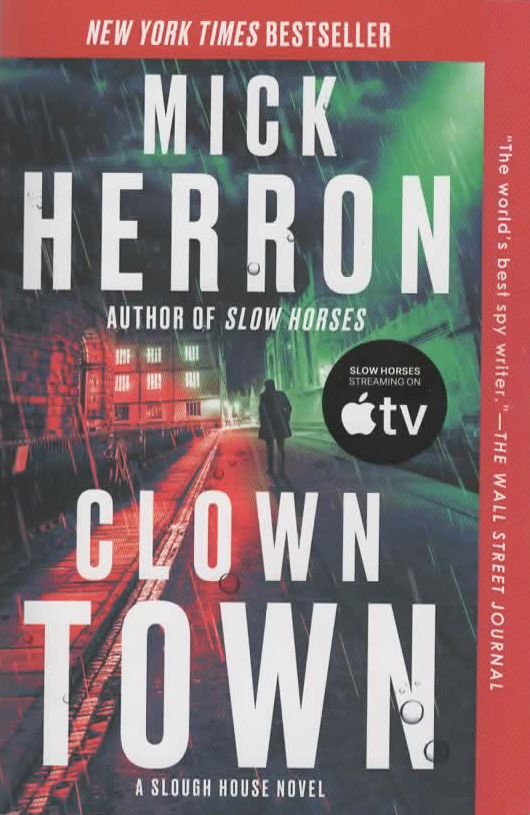
The key driver in the plot of Clown Town, the latest in the series of Slough House novels by Mick Herron, is the discovery that a book is missing from the library of David Cartwright, a now deceased former big honcho in MI5, who was affectionately known as ‘the Old B.’, and who is probably modelled on Herron’s literary hero, David Cornwell. (I bought the book a few weeks ago, when it came out in paperback.) River Cartwright, David’s grandson, who had been largely brought up by his grandparents, had fortunately taken a video of his grandfather’s library before it was packed up and shipped to an Oxford college, a very thinly disguised St. Antony’s, ‘the spooks’ college’. The archivist at the college has been checking inventory against River’s movie, and notices that a volume has disappeared. By using a motion-capture program, she can discern that its title is Secret Voices: A Hidden History of Deep Cover Lives, by one M. H. Leggaty. Yet no such book exists, and the author is untraceable.
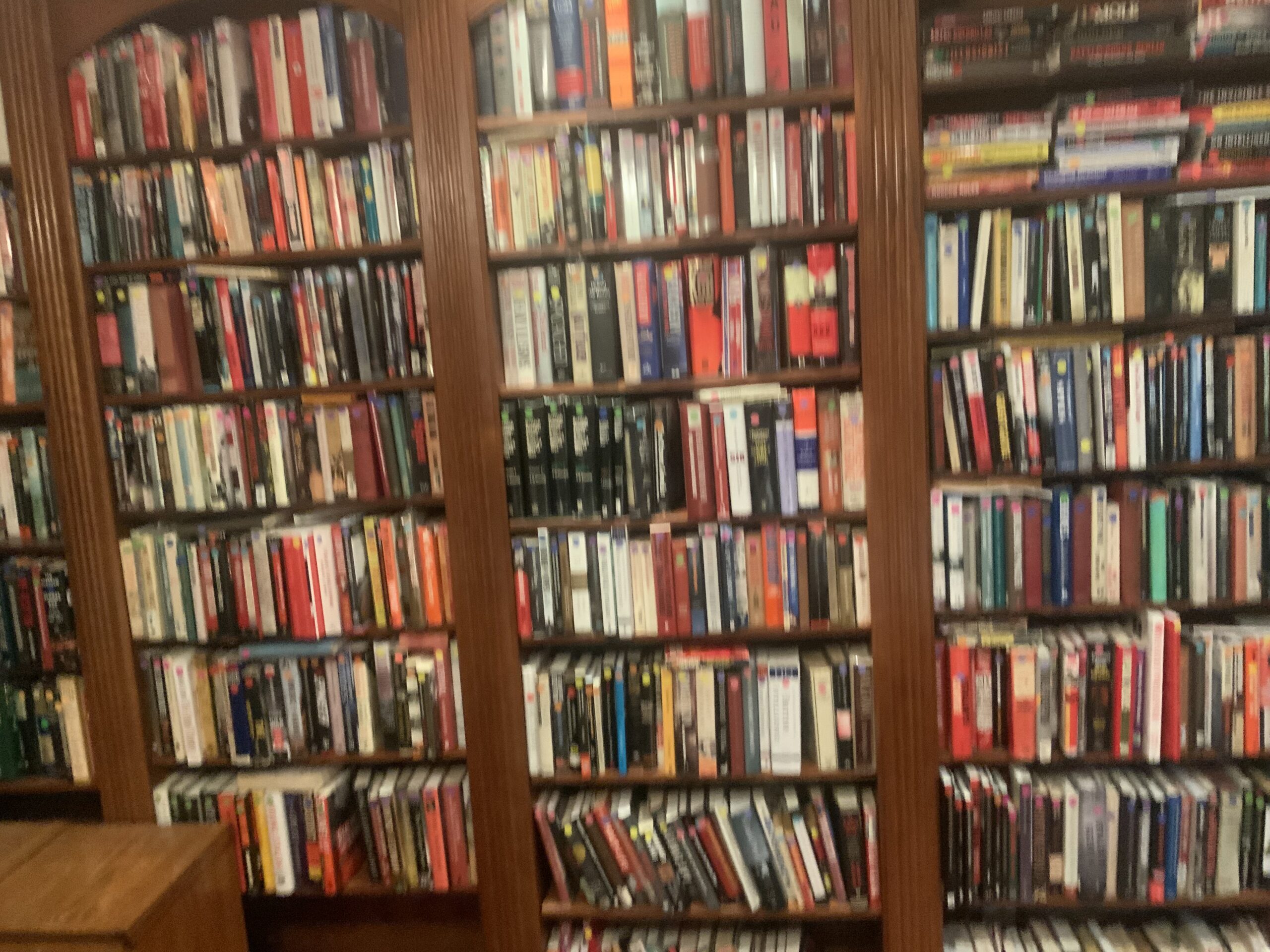
Readers of this column will have to turn to Herron’s book to learn what the ‘O.B.’ was doing placing a dummy volume among all his genuine articles. (I have to admit that I guessed what the mystery was all about from reading the short, macabre Preface to Clown Town, since I had read Secret Soldiers, by Peter Harclerode, while I was in California in August.) If you inspect any of the embedded photographs published here, however, and can decrypt the pixels of those whose titles are not well-focussed, I guarantee that you will not find any fake titles. A few rare ones – and many familiar items, too. My library resembles in many ways the collection that Cartwright assembled, although I have to say that the works of espionage fiction (I considered including My Silent War and Sonja’s Report in that category, especially after Alexandra Pringle’s declaration) are stored upstairs in our daughter’s bonus room, where dwell all my paperback fiction, classics, Pelicans, and various assorted works that are properly not to be regarded as the ‘core’ of my espionage/intelligence/history/literature Library.
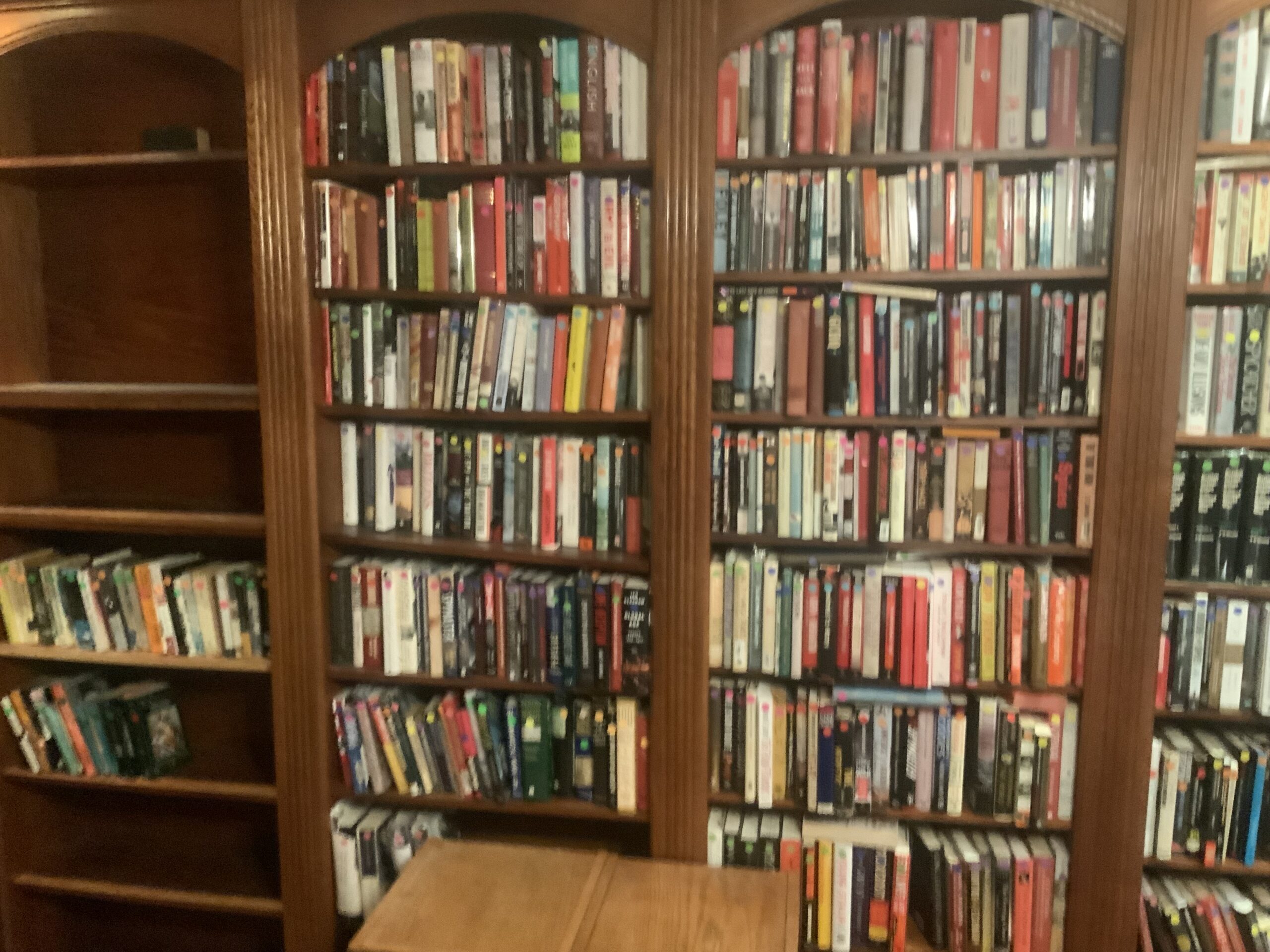
I have registered 7,308 books at the website LibraryThing. Nearly all my books on history, Oxford reference books and companions, multiple volumes of the DNB, and relevant biographical items, as well as a vast and probably unmatched array of poetry and humorous verse, have already been boxed up and stored at the Percy Family Collection within the Center for Southeast North Carolina Archives and History at the University of North Carolina in Wilmington. For the last few months I have been exploiting as much as possible the remaining 2,000 or so books that constitute the beating heart of my library, using them on my last two major projects, namely the identity of JOSEPHINE, and the strange case of the SOE Swedish Section (the report on which will appear here at the end of October). On September 24, the personnel from UNCW moved in to box up this remaining set. It was day of mixed emotions, obviously.
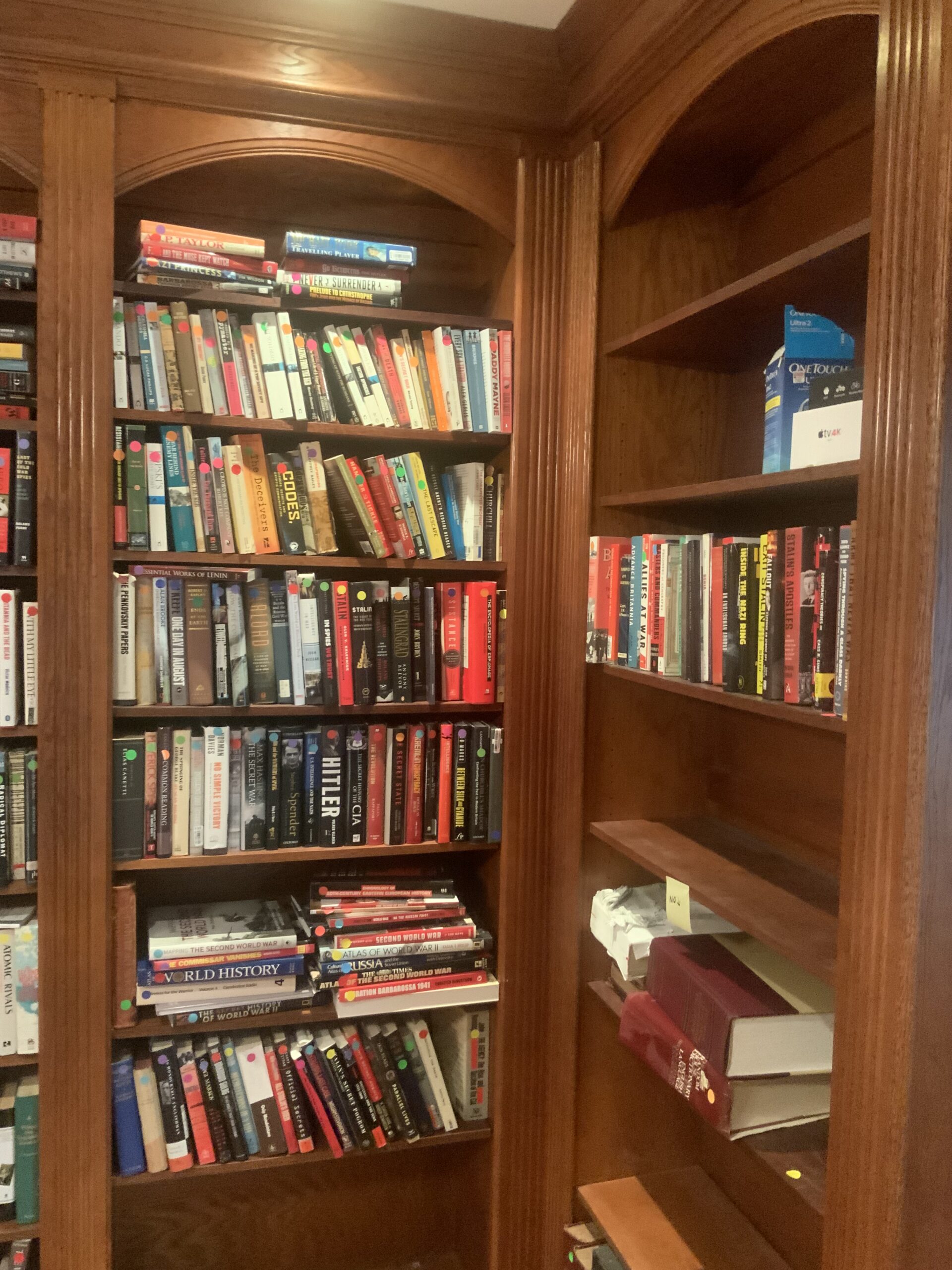
I have held back on several dozen items that could have gone: books that I shall want to treasure and re-read, like my P.G. Wodehouse anthologies, or important items that I have somehow not yet read. Most of the latter will find their way to the Collection in due course. I shall hold on to my Encylopaedia Britannica set, purchased in the late nineteen-sixties, and various other reference works useful for crossword-compilation. My collection of humorous volumes, books on bridge and chess, and on other games (which sits in another room), will remain. What it does mean, however, is that my conventional research, which relies heavily on rapid access to a vast range of historical and bibliographical sources, has effectively come to an end. I still have projects that I want to pursue that can be accomplished without such access (such as a detailed analysis of the PEACH and Maclean archives at Kew, either already downloaded or currently being photographed by my London-based researcher), but any access to a vital book will require my driving into Wilmington, thirty-five miles away, and being well-prepared to inspect what I want. Thus my vague ambitions for writing more about the Illegals, or trying to resolve the conundrums surrounding Alexander Foote, or digging more into the Dick Ellis story, will probably have to be abandoned.
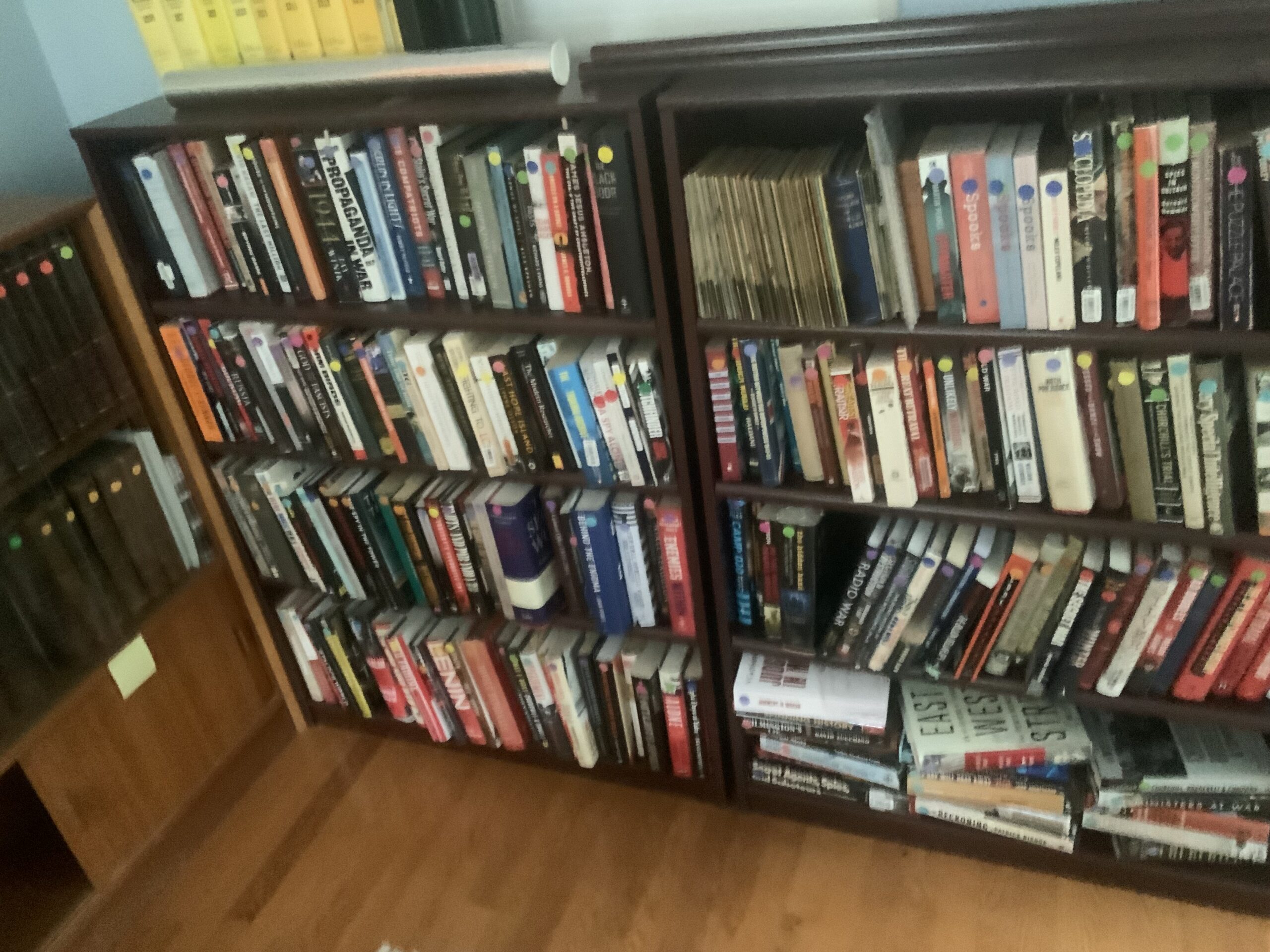
There is much work still to do. I have to register and describe a large number of paper archives: pamphlets, letters, newspaper and magazine clippings, bound volumes of nineteen-thirties magazines (predominantly The Listener, Atlantic Monthly,and Life), as well as several other loose and important issues of Life, scholarly articles and book reviews, a complete set of Purnell’s History of the Twentieth Century (from the late 1960s), and various miscellanea. I have a large electronic archive to sort out from a chaotic existence on my computer, including (for example) notes taken on hundreds of books, dossiers on key intelligence matters, correspondence, notes on documents from the National Archives, reviews and reports sent to me by enthusiastic supporters, and spreadsheets containing such analysis as the evolving organization of MI5 and a list of Personal Files owned by MI5 (but including dozens not acknowledged openly by the Service). The crown jewels of my archive – a four-hundred-and-fifty page Chronology of Events covering mostly 1930 to 1963 –has to be edited and properly indexed. Then I have to design and implement – alongside an archivist at UNCW (who was supposed to have arrived by now, but whose appointment has regrettably been put back to 2028) – a portal to the whole coldspur archive, and the library and artifacts that support it, so that future scholars may browse its contents on-line, and plan a visit to exploit them. For I firmly believe that the combined electronic and paper-based collection will be the premier source of intelligence and espionage information for the years 1930-1980 (primarily) in the nation, probably in the world.
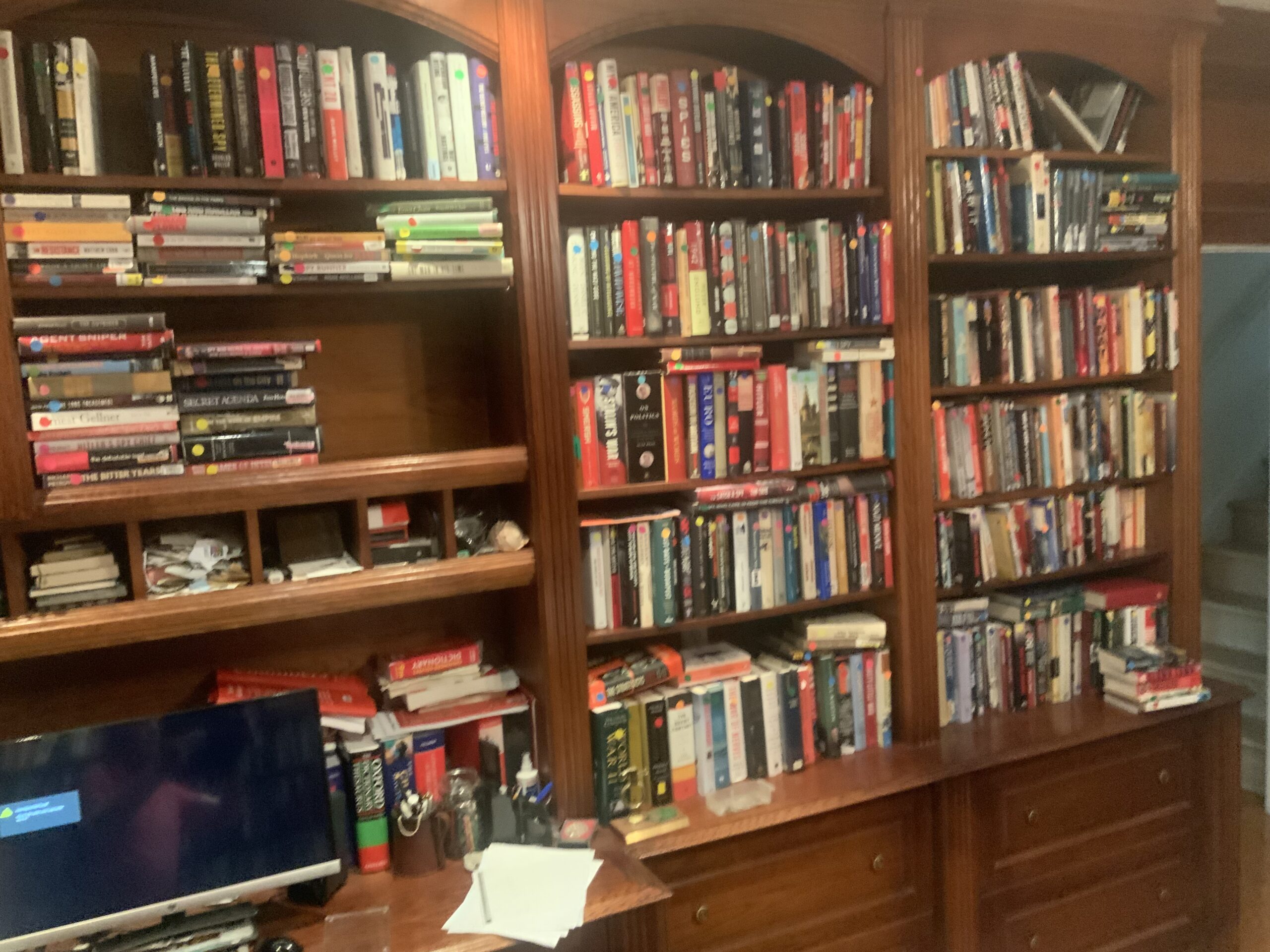
The day of the last exfiltration was an important and symbolic date. It was also the day of our fiftieth wedding anniversary.
* * * * * * * * * * * * *
‘The Secrets Behind the Atom Spies’
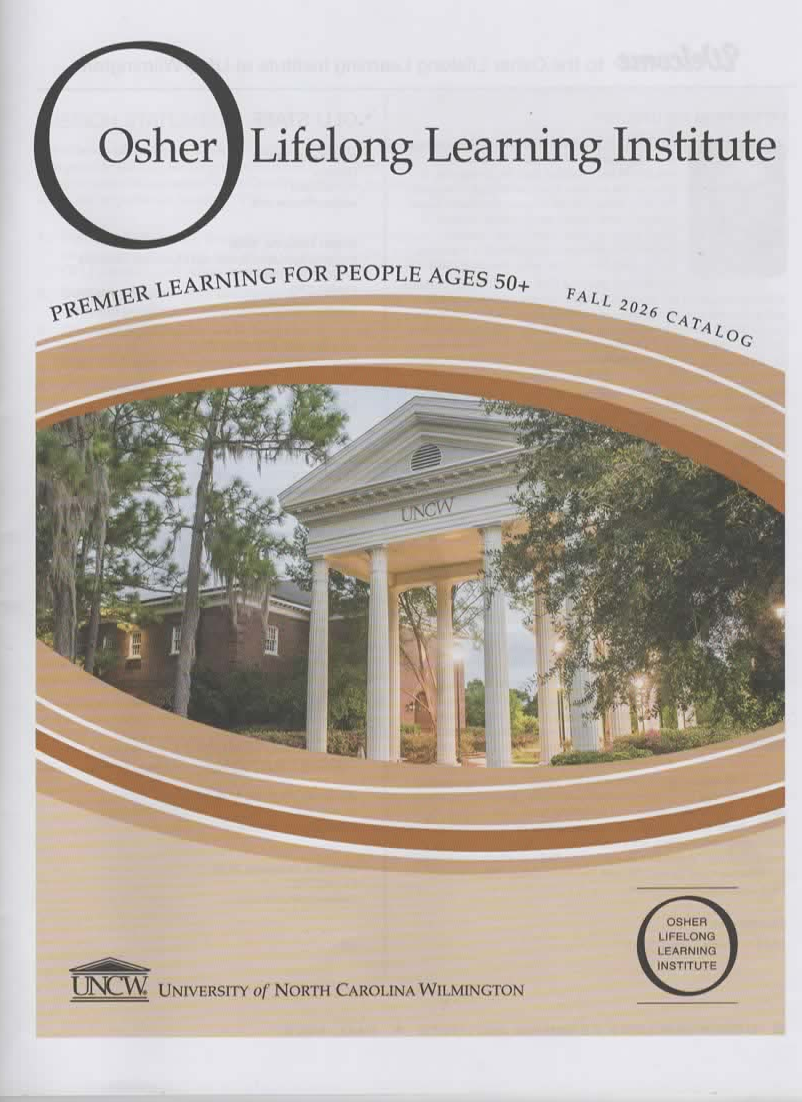
On September 1, I delivered a presentation at the Osher Lifelong Learning Institute (OLLI) at UNCW in Wilmington. The institute’s promotional materials describe it as follows: “OLLI at UNCW is a membership organization that seeks to foster lifelong learning opportunities, individual growth and social connection. Funded in part by the Bernard Osher Foundation, we are part of a national network of 125 lifelong learning institutes on college and university campuses in each of the 50 states and the District of Columbia.” I was delighted to have been invited to speak, and it did not take long for me to select a subject that had an Anglo-American theme, one that would allow me to showcase some of my recent original research.
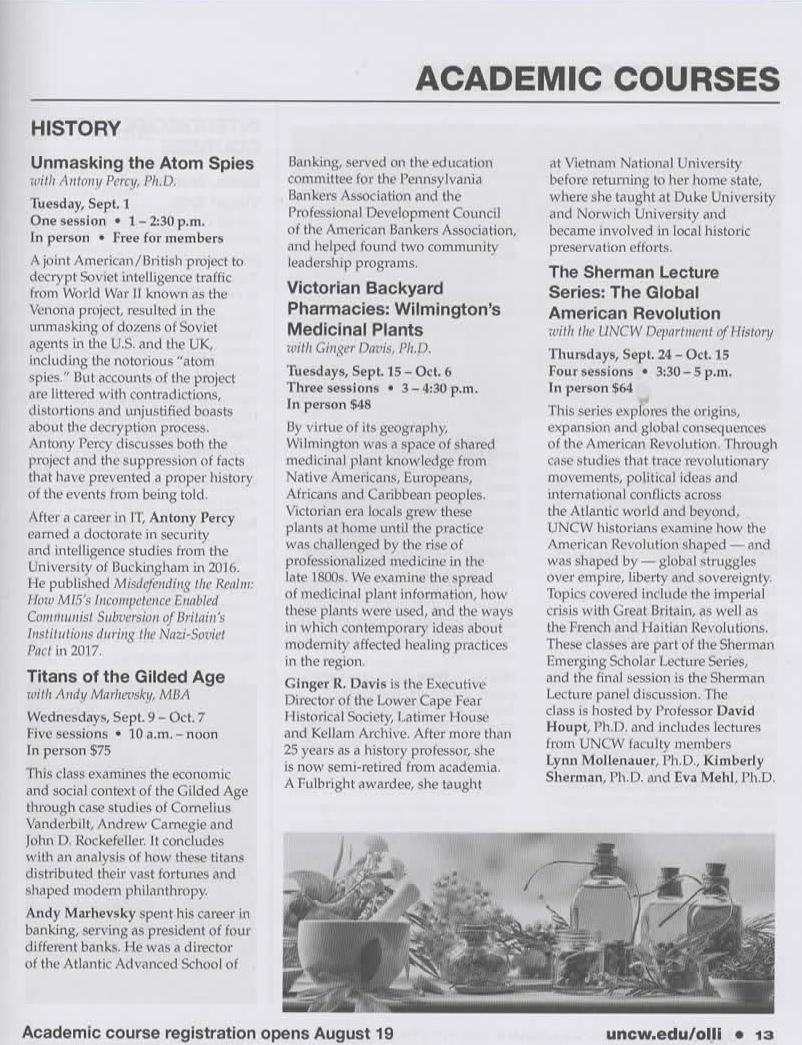
While the title became a little distorted during the process, the essence remained the same – a fuller account of how VENONA allowed some critical spies to be unmasked, and how the full story has often been misrepresented. My session attracted a full house, in an excellent setting, liberally provided with television screens. I spoke for about an hour (a bit longer than I believe is probably appropriate), but the audience seemed engrossed, and I entertained some excellent questions afterwards. Before the event, a few correspondents who had read about it asked whether a recording of the presentation would be made. I replied that I did not think that the audio-visual record of an intimate, interactive event would make for a suitable podcast, but I did commit to providing a transcription – not a literal one, but one giving the essential story – and publishing it on coldspur. Thus it appears below.
It was over seventy-five years ago when the spurt of revelations about illegal disclosure of atomic secrets to the Soviets came to public notice, soon after Stalin surprised the world by detonating a nuclear device. What secrets could still remain undescribed after all these years? After all, a number of spies were detected, and some prosecuted, with varying outcomes. Yet a few escaped attention, such as Theodore Hall, who refused to admit his guilt, and ended up living out his days working at Cambridge University in England. There were some over whom a cloud of suspicion hung, but who were never named. A final aspect of the secrecy, however, relates to the process by which the spies were identified. The official historians have distorted the truth for reasons of aggrandizing the achievements of the institutions that harboured them, and of concealing the depth of infiltration that may have occurred.
My talk today focusses on a cluster of four agents, two of them a married pair, namely Julius and Ethel Rosenberg, Klaus Fuchs, and Donald Maclean. Each had a very different background, very singular approaches to the task of espionage, and vastly different outcomes driven by the authorities that pursued them. The Rosenbergs came from families who had escaped tsarist oppression in Rusia, and who saw communism as an egalitarian creed that abolished such discrimination and persecution. Witnessing the Depression, they were drawn to Stalin’s cause, but, having been enmeshed in the Soviet spy web, were detected, and then executed in the land of their birth. Fuchs, a German, fled to Britain from Hitler’s anti-communist purges in 1933, and, despite his open communist leanings, was recruited to the Tube Alloys project that explored the development of atomic weaponry. Fuchs was even granted naturalization, and was in 1943 sent to the USA to assist in the Manhattan Project, the US operation to construct an atomic bomb. After returning to the UK after the war, his espionage was detected, he confessed, and he was sentenced to a long prison sentence in his adopted country. Maclean, an upper-class Briton, wheedled his way into the Foreign Office despite a questionable ideological track-record at Cambridge University. His espionage was also detected, but, shortly before interrogation, he escaped without punishment, fleeing to the state that had recruited and supported him, and that had demanded a dreadful loyalty out of him – the Soviet Union. The fact that the conclusions of their individual experiences were so totally out of proportion to the significance of their espionage reveals a great deal about differing political cultures, and the dynamics of international relationships at the time.
Yet a fascinating aspect of the whole enterprise was the timing. The atomic bomb was dropped on Hiroshima on August 26, 1945. The USSR successfully tested its version of the bomb on August 29, 1949 – to the great surprise of the Americans, who did not expect them to be ready for at least another five years. Klaus Fuchs was sentenced on March 1, 1950. Donald Maclean escaped on May 25, 1951. The Rosenbergs, having been arrested in 1950, were executed on June 19, 1953. How was it that the British and the Americans were so ignorant of the espionage being carried out in their midst, and how did the culprits manage to stay undetected until well after the events? The answer is that all four shared a common fate: they were betrayed by a flawed Soviet wartime communication system that should, by any analysis, have provided watertight intelligence concerning the Soviet Union’s project to replicate the USA/UK’s joint nuclear weapons project – what the Russians called ENORMOZ.
How far back should we look back for causes for this secrecy and betrayal? In August 1945, the Soviet Union was still an ally of the western democracies. Yet that compact had been an often shallow and tenuous relationship. August 1939 is a good starting-point for understanding the political tensions that endured throughout the temporary alliance against the Axis powers. In recent years, Germany had been steadily spreading its tentacles over European territory (Austria, the Sudetenland of Czechoslovakia) while the Soviet Union had for the whole decade been promoting the role of Communism as the only force capable of resisting Fascism. At the end of August 1939, however, it announced a non-aggression pact with Hitler’s Germany (the so-called Ribbentrop-Molotov agreement), accordingly shocking many of its adherents, some of whom abandoned the Leninist/Stalinist creed immediately. Two weeks later, Germany invaded Poland (and the Soviet Union took the opportunity to invade the Baltic States), prompting Great Britain and France to declare war on Nazi Germany. The Soviet Union was not an enemy of Great Britain, but for the next eighteen months or more, it was a hostile force, providing matériel to Germany to help it wage what became known as the Battle of Britain. Great Britain, which had for most of the preceding twenty years considered the Soviet Union as its primary adversarial threat, had good reason for resenting Stalin’s assistance to its declared enemy. Fortunately, Britain held out and, with the prospect of invasion extinguished, Hitler changed his attention to the conquest of the Soviet Union. Yet the resentment endured.
When the attack occurred (Operation BARBAROSSA) on June 22, 1941, Winston Churchill, Britain’s prime minister, made an unauthorized and over-emotional gesture to Stalin, promising him every support Britain could give to help the Soviets beat the Nazis. Many senior politicians were shocked by the excess of Churchill’s overtures, conscious of how Communism had been viewed as an existential threat for so long. They were critical of Stalin’s behaviour, especially his hypocrisy and his brutality in the Baltics. Moreover, Stalin immediately started exploiting Churchill’s naivety, requesting within days that Britain open a ‘Second Front’, when the country – alongside the dominions of the Empire – was already stretched across several worldwide fronts, trying to beat back the Germans. (The United States were of course not participants in the war yet.) Thus began a very difficult four-year period in which Stalin took advantage of Churchill’s continuing timidity regarding the Soviet Union, with Churchill always fearing that, if he did not appease the Generalissimo, Stalin might resuscitate his pact with Hitler, and the two of them might then turn against the western powers.
After the USA entered the hostilities in December 1941, Hitler having declared war on it after Pearl Harbor, Great Britain and the USA engaged upon a deeper level of intelligence sharing, recognizing the threat represented by Hitler’s plans to develop an atomic bomb. The results of the British MAUD Committee, and its Tube Alloys project, were conveyed to the emergent US programme, which led to the establishment of the Manhattan Project in July 1942. The USA took the lead role in January 1943. Security was a vital concern: the Americans and the British obviously had to keep the details of the project secret from the Germans and the Japanese, but President Roosevelt decided not to involve the Soviet Union, or confide in it. The military recognized that it would probably be a hostile force when the war was over. Unfortunately, government institutions on both sides of the Atlantic were riddled with Soviet sympathizers and spies, with the result that Moscow learned of the work as early as August 1941, primarily from the group in England known as the ‘Cambridge Five’ (Philby, Burgess, Maclean, Blunt and Cairncross). Information concerning the development of the bomb flowed freely to Stalin via his clandestine channels, and the fact that he was not informed of the project by Churchill and Roosevelt (nor of other highly secret endeavours such as the ULTRA decrypts) served only to increase his suspicions about the trustworthiness of his new allies.
The essence of this story concerns the methods by which Stalin’s agents passed their intelligence back to Moscow. In Britain, intermediary couriers were a straightforward way of getting information to the Soviet Embassy, which had a wireless link to Moscow. Wireless activity by agents (such as SONIA) was minimal. In the USA, the situation was different. Private wireless links were hazardous and unreliable from the USA to Moscow, as was diplomatic wireless traffic, and a system of couriers was used to send messages to the consulates and embassies of San Francisco and Washington. Thereafter, commercial cable links were used by the Soviet Embassy to send information to Moscow: according to regulations, the government was authorized to keep copies of all traffic transmitted in this way. The possible exposure of interception was recognized by the NKVD, which therefore had to deploy a proven watertight encipherment system to guarantee that the Americans never discovered what intelligence their spies were picking up, and who their sources were. The process of encryption involved two stages: the replacement of common words and phrases with items looked-up in a codebook (a type of dictionary), and a rigorous system of One-Time Pads (OTPs) – sheets of meaningless numbers that were used to modify texts mathematically. As their name implies, each pad was to be discarded once it had been used, thus providing an unbreakable level of encryption.
Under wartime stress, the system failed. In 1942, a duplicate set of OTPs was shipped out to all Soviet stations abroad. A sharp-eyed analyst at Arlington Hall, where the Signal Security Agency (SSA) had established its headquarters, noticed that certain messages appeared to be reflecting familiar text. The VENONA project, designed to decrypt Soviet diplomatic traffic, took off. Yet it was still an arduous process: fragments of messages might be created, but they lacked vital context. The use of the codebook meant that the terms used, and the identities of the sources, remained a mystery until further decryption, complemented by inspired guesswork, could bring some coherence to the overall story. That is why many of the key items of intelligence were not revealed until after the first bomb was detonated. Even so, the cryptologists were aided by such elements as stolen cribs, and codebooks retrieved from the battlefield in Finland in 1940. The historians have severely underplayed such activities, preferring to attribute the breakthroughs to the sweat and imagination of the cryptanalysis team of the SSA (and in 1945, the Army Security Agency).
Two persons played a significant part in this effort, the American language expert Meredith Gardner, employed at the SSA, and an expert British cryptologist, John Tiltman, who visited the USA in 1942 and 1944, and built up a strong relationship with Gardner. I call them ‘the Two Gentlemen of Venona’. It was Tiltman who had retrieved the Soviet code-book from Petsamo in Finland in 1940, and Gardner displayed fragments of it in his office. Yet the contribution made by this pair – as well as the assistance that they gained from FBI raids on the Soviet trade mission in Washington – have been largely diminished in the accounts by the historians. With the aid of such techniques and ‘cribs’ (raw texts alongside encrypted versions), Gardner was able to make progress in decrypting the flawed transcripts.
Attitudes towards the Soviet Union among Americans were diverse, and changed quickly. There were diehard communists, mostly Jews, and their offspring, who had emigrated from Russia and saw communism as the antidote to racial discrimination, like the Rosenbergs. Others joined the movement as Fascism advanced, impressed by Moscow’s ability to present Communism as the only force capable of resisting it. They and were not deterred by the Nazi-Soviet Pact, seeing it as a temporizing measure. And then there were Stalin’s agents, under great pressure to deliver secrets, knowing what the penalty of inertia might be. The public at large had no knowledge of the Manhattan Project, but saw the ‘Russians’ as gallant allies. Roosevelt’s naive hope of post-war partnership with the Soviet Union through the United Nations was echoed by the British Foreign Office’s desire for ‘co-operation’ with the country when hostilities ended. While Germany’s potential to deliver an atomic bomb was still a major threat, scientists were supportive of the bomb project. Albert Einstein encouraged Roosevelt to accelerate development in order to pre-empt the Nazis.
Yet the environment quickly changed when Hiroshima was bombed. Germany had now been defeated. When Einstein realized the results of the explosion, he implored Roosevelt to impose a moratorium, and called for international surveillance of all development of atomic weaponry. General Leslie Groves, the Manhattan Project chief, did not help matters by telling his scientists that the real enemy, and target, was now the Soviet Union. In Britain and the United States, the military was ahead of the politicians on the Communist threat. A further twist in the plot occurred in September 1945, when a cypher clerk with Soviet Military Intelligence in Ottawa, Canada, Igor Gouzenko, defected with intelligence that showed that dozens of Canadians and Britons were involved in espionage, especially of atomic secrets. That resulted in the swift confession and conviction of Allan Nunn May, who had debunked in haste back to his native UK. Despite the hesitancy on the part of the Canadian administration to confront the Soviets, these events effectively marked the beginning of the Cold War.
The VENONA project made slow but steady progress. The movements and activities of possible spies came into sharper focus. The first to succumb was Klaus Fuchs. As an open communist, Fuchs had escaped to Britain from Nazi Germany in 1933, where he made no secret of his beliefs. When war broke out, he was interned, but after release he was assigned to work with Rudolf Peierls, who had collaborated with Otto Frisch on the potential of Uranium-235, and was working on the Tube Alloys project. Fuchs became a British subject: his communist background was forgiven in the frantic search for competent scientists. He passed on secrets to the courier ‘Sonia’ – Ursula Beurton, as she was at the time. In 1943 he was sent – in breach of the requirements of protocol – to the United States, where he ended up working at the Los Alamos Laboratory. He continued his espionage there, using couriers. After the war, he returned to Britain, where he headed up the Theoretical Physics Division at the Atomic Energy Research Establishment at Harwell. In 1947, he resumed his practice of passing on confidential information to the Soviets.
When an item in the VENONA transcripts pointed to a visit made by an agent with the cryptonym ‘REST’ to see his sister in Boston, the FBI rapidly worked out that it must be Fuchs, and passed on the information to MI5. After a long period of surveillance, Fuchs was encouraged to confess to officer Jim Skardon, and shortly afterwards he was put on trial. On March 1, 1950, he was sentenced to fourteen years in prison. Fuchs later said that he expected the death penalty, but his crime was an offense against the Official Secrets Act, not treason, since the Soviet Union had never been a declared enemy. There were further ironical elements: Fuchs had begun to appreciate the benefits of living in England, and he had been enjoying an affair with the wife of a colleague. Moreover, archival material hints that Fuchs may have been passing confidential US secrets to the British since his return. The McMahon Act of 1946 had forbidden sharing of technical information on atomic matters with any other country, including the UK.
Meanwhile, the FBI was trying to identify Fuchs’s courier, known by the name ‘RAYMOND’. The British agreed that the agency could send a representative to London, to show Fuchs photographs, in the hope that he might be able to identify the person. After some reluctance, Fuchs identified Harry Gold as the courier. The FBI tracked down Gold, and caught him in a lie about his travel to Los Alamos. He confessed, revealed the name of David Greenglass, for whom he had also acted as courier and whose sister was Ethel Rosenberg. She and her husband were arrested in 1950, and charged with espionage. Both Gold and Greenglass gave testimony as prosecution witnesses against the Rosenbergs, never believing that they would be facing the death penalty. The Rosenbergs were stubborn, declined to co-operate, and were sent to the electric chair on June 19, 1953. For decades, protests were made on behalf of their innocence, and it took the VENONA releases of 1995 to prove that they had been guilty. Guilty indeed they were, but they did not deserve the death sentence.
Donald Maclean was identified through a similar mistake, although the process was quite separate from that of Fuchs and the Rosenbergs. The source ‘HOMER’ had been noticed as far back as September 1947, when a September 1944 message informing Stalin about an upcoming meeting between Churchill and Roosevelt in Quebec spelled out an obvious danger. Yet Maclean was not formally recognized as being HOMER until the end of March 1951 – three-and-a-half years later, a period longer than that between the entry of the USA into the war and VE-Day. Why did it take so long? A reluctance to face the truth, a bewilderingly bureaucratic process of going through the profiles of the thousands of employees at the Washington Embassy, but mostly a deliberate effort to decelerate the whole exercise because of the embarrassments it might cause. Indeed, Dick White, the Chief of B Division of MI5, attempted to convince his colleagues early in 1950 that the whole project should be abandoned.
What gave Maclean away? According to the records, another telegram from the summer of 1944 era referred to a visit that HOMER was making to New York to visit his pregnant wife. This message was reputedly not decrypted until March 1951, when a shortlist of five candidates could quickly be reduced to one. Yet that snail’s pace should have been accelerated. Another of the Cambridge Spies, Kim Philby (who of course guessed who HOMER was soon after he arrived in Washington at the end of 1949), not only warned his Soviet masters, but even went so far as to draw London’s attention to Maclean as a possible suspect, in order to deflect interest away from any connection he had with his fellow-agent. He even reminded MI5 of the fact that the defector Walter Krivitsky had in early 1940 urged his interrogators to investigate the ‘Imperial Council spy’ who had passed on proceedings of that body. At the time, MI5 had strangely decided not to pursue that very direct clue pointing to Maclean, or the ‘journalist in Spain’ hint that should have directed the service unswervingly at Philby.
The long and short of it was that Maclean was put under immediate (but not very disciplined) surveillance. He had inexplicably been appointed head of the American desk at the Foreign Office in November 1950, after being sent home from Cairo for grossly irresponsible behaviour, which his bosses generously attributed to overwork and stress. (He had no doubt heard about the dangers emanating from Washington.) The third Cambridge Spy Guy Burgess, who had similarly been inexplicably posted to Washington after similar outrageous behaviour, was sent back to London, and joined his colleague with assistance from Anthony Blunt, the fourth of the Cambridge Spies. MI5, the domestic Security Service, believed that Blunt was working on its behalf when he was in fact acting as courier and facilitator for the NKVD. The escape of Burgess and Maclean on May 25, 1951, by steamer from Southampton to Le Havre, was engineered and abetted by MI5 itself, since Dick White believed that the best solution would be to allow the spies to escape rather than to pursue a messy interrogation of Maclean. He convinced his colleagues in the Foreign Office of that. The procedure might have induced a confession, but the secrets that would have come out in a trial would have been devastating both for MI5 and for White’s career.
Several entanglements followed. MI5 and the Foreign Office claimed that they had no idea where the ‘Missing Diplomats’ had gone. Rumours circulated in the press that a ‘tip-off man’ had aided their escape. It was not until 1954, when the NKVD (now KGB) agents, the Petrovs, defected in Australia, that further facts came to light about the Soviets’ role in the flight of Burgess and Maclean. The FBI dropped hints about Philby as the ‘Third Man’, but he was able to deflect accusations deftly, even though his career with MI6 was ruined by then. He eventually absconded himself, in 1963, and shortly afterwards Anthony Blunt was granted a full pardon on the condition that he told his interrogators everything – something he predictably failed to do. The truth came out in 1979 when Blunt was unmasked.
Did the espionage of the atomic spies, by accelerating Stalin’s development of the atomic bomb, seriously increase international tension? The late forties were a critical period. Hawks in the USA and the UK considered a pre-emptive strike against the USSR before it acquired the bomb. Fortunately, wiser heads prevailed, even though Stalin’s cruel suppression of democratic movements in the satellite states of eastern Europe proved that he still maintained aggressive goals for destroying his enemies. Defectors warned the West that ‘Stalin meant war’, and the events of 1949 provided a stark reinforcement of that judgment. In way, it could be said the spies may have accelerated the arrival of the stand-off that held both adversaries back. Yet the betrayals of the spies went beyond atomic weaponry. They gave Stalin a regular insight into Anglo-American strategy, and allowed him to understand completely the real objectives of Roosevelt and Churchill, and to know in advance their negotiating positions to be held at such critical conferences as Yalta, in 1944. Thus the vozhd could make preparations for his control of the eastern satellite states at the end of the war – including, of course, Poland, for whose independence Britain and France had originally declared war back in 1939.
Yet little more happened with the VENONA project – as far as we can tell. Some occasional expansion of partially decrypted texts may have occurred, but there is no trail. It took until 1995 until the VENONA program was formally admitted, after hints had appeared in books by David Martin, Nigel West, Robert Lamphere, Chapman Pincher, and Peter Wright. The secret of the ULTRA project (decrypting German traffic, primarily from the ENIGMA) came out in the early 1970s, by which time the technology had become obsolete, and thus details represented no threat. So why so long with VENONA? The Soviets, slow to recognize that their system had been compromised, used the last duplicate OTP in Australia in 1948. They then switched back to authentic OTPs, and it is probably safe to say that their diplomatic systems have since been unbreakable. So why would the intelligence coup have to be concealed for so long? What it meant was that a generation of historians worked without the vital facts, while a new generation would have to re-acquaint themselves with the sequence of events from the late 1940s and early 1950s, when the accounts written in the following years were obviously not reliable.
The more ‘official’ histories that have appeared since are not trustworthy, concentrating more on the sagas of the spies uncovered rather than analyzing closely the processes that unmasked them. Why do they distort the facts, and engage in boastfulness? Why has there been no follow-up on adding substance to the partly fragmented messages and unidentified cryptonyms in the following decades? Why does there appear to have been no exploitation of vastly improved computer performance, including the latest AI techniques? And why is the archive of intercepted messages and their transcriptions in such a dire state – poorly organized and indexed, and incomplete, and left to independent agents to try and bring order to what is fragmented and chaotic?
Apart from the fact that, with the passing of time, and the deaths of the participants, much lore and knowledge have been lost, institutional pride has blocked the path to greater clarity. For decades, the backlash from the Rosenbergs’ execution put administrations on the defensive. At the same time, however there existed deep embarrassment at the level in which both American and British institutions had been penetrated – the naming of further persons who had been working for the Soviets would only emphasize the laxity that was embedded in their leadership and management. The shadow of the ‘Cambridge Five’ persists, and books are still written about them. In America, the NSA (the National Security Agency, which was formed in 1952) continues to bolster the feats of its heroes and heroines, and is reluctant to admit that they received massive help from cribs and captured codebooks. Moreover, its deep scorn for the OSS obliterated what contribution that the forerunner of the CIA made at the end of the war.
Inertia thus rules in picking up the pieces. Other projects are considered more critical. Yet the state of accuracy of much of the transcribed material is extremely poor, with many simple items that should be corrected lying unedited. That task is a simple one, achievable largely from reviewing the literature, and recent archival material. Exterior demand for action is slight (although the author of intelligence matters Ben Macintyre has recently picked up the gauntlet). Any current efforts on further cryptanalysis are dependent on non-official efforts by academies and university projects, although those endeavours seem to have trailed off considerably in the past decade.
Yet it is important. The stealing of industrial secrets by the Soviet Union was massive, and helped the country greatly in the Cold War. Such theft is echoed today in the actions of China, and we need reminding of that exposure. Government bodies and public officials should be held to account, and not allowed to obfuscate under the veil of institutional pride and false claims about ‘national security’. The participants and defaulters are all dead now: there is no risk of libel. There are no technological secrets that need to be kept unrevealed. Old archives (especially in the UK) should be made available. A historical exercise of great significance to shed light on how the Cold War began is roaring to be undertaken. The whole saga is representative of the ‘Missing Dimension’ – the fact that intelligence matters have been too smoothly excised from political and military histories.
(This month’s Commonplace entries can be viewed here.)