
Introduction:
I am a devotee of big books on World War II, although I sometimes wonder why. I am always hoping for some breakthrough material (especially on intelligence matters, such as the use of ULTRA, the handling of Stalin, the activities of the Cambridge Five, the secrets behind the PROSPER and Flight PB416 disasters, etc.), although inevitably a lot of familiar substance has to be digested to find what fresh few nuggets may exist. This month I turn my attention to three important books that I have read over the past year – and include an unrelated volume to make some points on language.
Given how much has been written on the subject already, why do historians pick up the challenge of writing such comprehensive texts? The primary reason must be the availability of new material, such as archives released at Kew – or probably even more relevant, documents discovered in foreign caches, often behind the former Iron Curtain, since the language barrier may have deterred all but the most capable or resourceful researchers. There may be fresh letters, private papers, or memoirs, released after a period of discretion, that shed light on hitherto cloudy affairs. Another driver may be more ideological: a fresh analysis of the actions from a specific perspective, whether Marxist/anti-imperialist, post-modernist, deconstructionist, critical race theory, or some other determinist approach. A third idea might be the tight interweaving of military history with social history, drawing attention to chronological coincidences, and exploiting personal diaries, local press coverage, etc. in a manner not performed adequately beforehand. A fourth conception might be to examine afresh the relationships between power centres, and the leaders who control them, using lessons from management theory or personal psychology to make conclusions as to why decisions were made, and who in the chain of control should hold responsibility for actions – both admirable and disreputable. Such ‘revisionist’ histories are probably the most fascinating to me.
Of course, several of these techniques may be combined in one project, and this is apparent in the trio I have chosen, which appear in the order I read them. Andrew Roberts’ Masters and Commanders was actually published in 2008, but I did not get around to reading it until last year. 2025 saw both Tim Bouverie’s Allies at War and Alan Allport’s Advance Britannia published: I shall consider aspects of Allport’s predecessor volume, Britain at Bay (2020) in my review of Advance Britannia.
Masters and Commanders by Andrew Roberts (2008)
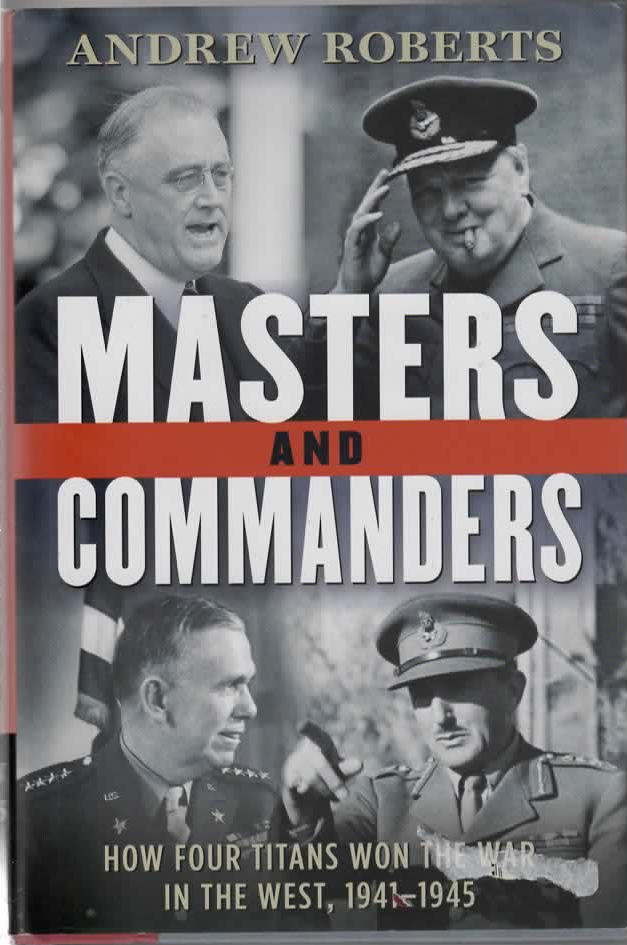
These days, most books appear with a flourishing sub-title, crafted to ensure that the prospective buyer knows what he or she is getting into. Thus it is with Masters and Commanders – ‘How Four Titans Won the War in the West, 1941-1945’. Yet, before you start thinking about the ‘Big Three’ (Roosevelt, Churchill and Stalin), and wonder who the Fourth might be, the photographs of these Titans appear on the cover. Roosevelt and Churchill are illustrated, of course, but augmented by two perhaps not so well-known figures, General George Marshall and Field-Marshall Sir Alan Brooke, the Chiefs of Staff of the two political leaders. Yet that immediately had me guessing. ‘The War in the West’? What was that? Separate from ‘The War in the East’? And what was ‘The East’? If you asked the crusty and Anglophobic Admiral King, US Navy Chief, he would have answered ‘the Pacific’, and he was always pressing for more resources to be placed in that theatre of war. Yet Roberts surely intends to contrast the War in the West with that engaged in Eastern Europe, implying that that ‘War in the East’ was definitely not won, even though the Soviet Union was one of the Allies.
Yet that stance provokes a couple of counter-suggestions. The first is that the USA and GB supported the Soviet Union with a vast amount of matériel that helped them defeat Hitler in the East, and thus they should have been justified in claiming that they contributed to that victory. The second is that a closer inspection of how it would be appropriate to consider how the Western democracies allowed the Soviet Union to conquer so much territory in contravention of their presumed military goals. The submission of so many countries to post-war Soviet dominance because of the loss in the East is an enduring point of contention, especially since Great Britain had originally declared war on Germany because of the latter’s invasion of Poland. Presumably, in Roberts’s geographical conception, Poland is part of the East. Moreover, Great Britain (and the USA) let down the Poles on multiple occasions, from the Katyn Forest massacres, through Monte Cassino, the Warsaw Rebellion, the Battle of Arnhem, the Lublin Government and even the Victory Parades in London, so it shows some dubious judgment to praise the successes in the western theatre of battle and to appear to forget the fate of Poland, in particular.
I thus approached Roberts’ book with an initial large dose of scepticism, questioning his geographical precision, and wondering why Stalin had been left out of this tussle of the titans. For a tussle it certainly turned out to be, what with Brooke constantly fuming at his boss’s interference in strategy, and at his whimsical impulses; Marshall seething frequently at the arrogance and informality of Roosevelt, who would do deals behind his back, and prefer not to have decisions recorded; Brooke and Marshall often feuding, with Brooke diminishing Marshall’s strategic understanding, and Marshall becoming quietly infuriated with Brooke’s assumed superiority; and Churchill’s romance with Roosevelt under pressure from Roosevelt’s outspoken goal to bring the British Empire down to size, and his belief that he could handle Stalin better than Churchill could, and bring the Soviet Union into a post-war partnership. Roberts’s book is thus the account of how they overcame these tensions.
One of Roberts’ major coups is his exploitation of a large number of sets of private papers that either became available in the decade preceding, or had simply lain unexploited in archives in Britain and America. He lists over sixty such offerings from around the globe, which must have involved a research exercise of Stakhanovite proportions if, as he declares, he spent only three years researching and writing the book. Yet his methods are illuminated by a strange paradox: from the sixty sources mentioned above, he uses only twenty in his Abbreviations for his Endnotes, excluding the rather terse and imprecise ‘CAB’ for ‘Cabinet papers at the National Archives, Kew’ and ‘NA’ for ‘British National Archives’, the latter being completely ignored, so far as I can tell. So why were those other fifty-odd sets of papers not used? Were they useless? In which case, why bother to include them? Or, if they did provide insights, why were they not recognized in Roberts’ Endnotes? It is all rather perplexing.
Perhaps the most important were the papers of Lawrence Burgis, who was present at War Cabinet meetings, and took copious notes – all strictly against the rules, of course. Roberts makes much of the valuable point that the official minutes of meetings of congregations such as War Cabinets are designed more to conceal than inform, and to paper over cracks of wild disagreement. (I had experienced some of that puzzlement when I was investigating the PROSPER disaster and tried to detect exactly what the War Cabinet had resolved.) Thus Roberts is able to shed a brilliant light on what really happened, and his research is complemented by the fact that (for example) Brooke’s war diaries (which had appeared in a severely expurgated, but still abrasive, fashion while Churchill was still alive) had been published in full in 2002. (I recommend them: they are scintillating.)
The author’s main thesis is that, over the course of the war between November 1941 (when Hitler declared war on the USA), and D-Day in June 1944 (by which time the USA had effectively taken control), two – or more – of the foursome co-operated to try to undermine some of the more misguided aspirations of others. For example, Roosevelt and Marshall were pressing for an early offensive across the Channel in 1942, but Churchill and Brooke convinced them that a premature landing would be disastrous, and prohibit any further attack for a long time. In 1943, Churchill was still prevaricating, despite the pressures from Stalin, since he may have been too mindful of Dardanelles-type disasters in World War I. Brooke, meanwhile, was strangely supporting the notion of a move through the ‘soft underbelly’ of Europe, which would have turned out to be a lot tougher than he imagined. Roosevelt and Marshall were insistent that the timing was right for May or June 1944, and that the forces and landing-craft would be sufficient unto the D-Day. Brooke and Marshall appealed to Churchill and Roosevelt to be tougher with Stalin, but failed.
The other aspect of this dynamic is that Roberts considers that the wheeling and dealing that inevitably arose from this quartet (and all the accompanying rivalries and discords that emanated from Naval and Air Force pressures on both sides of the Atlantic) were part and parcel of a necessarily democratic policy for waging the war. Roosevelt was highly sensitive to public opinion (too much, one might say, what with his perennial concerns about ‘the Polish vote’, as if he were not confident of selling ideas without considering such factionalism), and the approach of presidential elections in 1944 dominated his thinking. In the UK, elections were suspended during the war, but Churchill faced regular challenges as head of the coalition government. All this meant that it took longer to take decisions than it would have done had more authoritarian leaders been in place. Roberts invokes Thucydides and the Peloponnesian War, but only to show how the severe inspection of strategies that took place by the complex layers of staff in the USA and Great Britain meant that the analysis ensured that desperate measures, with little chance of succeeding, were rarely undertaken. (Roberts does not write about Operation MARKET GARDEN.)
On the other hand, Hitler received little criticism from his staff and generals, lest they lose their jobs, or be punished for ‘defeatism’. Thus the Führer’s suicidal plans went ahead: it is no good having firm and single-minded leadership if the man at the helm is half-crazy, a messianist. (Roosevelt would have been a poor authoritarian leader, as he was notably weak on military strategy.) Yet Roberts is vague and minimalist when comparing such structures to those of the Soviet Union. All he writes is: “Even Stalin, as the war progressed, gave more and more autonomy to the members of the Stavka (High Command) in Moscow, as well as to commanders in the field” (p 576). He gives no source for this airy claim, and it seems to me that he would have been better served if he studied the development and execution of policy in the Kremlin a bit more carefully. In fact, Stalin tightened his grip over the military in 1944. As Amy Knight writes, in her biography of Beria (p 128):
Stalin himself had mastered military affairs sufficiently to become deeply involved in military strategy and, as chief of the Stavka and commissar of defense, presided directly over the Red Army’s war against the Germans. Now he set about putting the military in its place. In November 1944, Stalin removed Kliment Voroshilov as his deputy commissar of defense, replacing him with a political commissar – and also a former Chekist – Nikolai Bulganin. This was a blow to the prestige of the Red Army.
Stalin also moved against General Zhukhov, who started boasting dangerously about his victories, and Stalin used his brutal sidekick, Lavrenti Beria, to help cut Zhukhov down to size.
After all, Stalin, having already ordered the slaughter of millions of his own innocent citizens in the previous decade, was able to dispatch hundreds of thousands of soldiers against the Germans as the Red Army reclaimed Soviet territory, while having his commissars shoot any who showed any cowardice, and issuing edicts that declared that any POWs taken alive by the Germans should be treated as traitors. The G.I.s and Tommies who plodded through Europe to seal the war in the West, when, unlike the Soviets, they were not even defending their native lands, wondered why the Germans did not simply surrender since the war was obviously lost. They just wanted to get home. It was not a ‘contest’ of equals.
The relegation of Stalin (and the Soviet Union) to the sidelines was for me the most disappointing aspect of Masters and Commanders. There was no such entity as ‘the War in the West’, there was a World War against Nazi Germany and the other Axis powers. Stalin manipulated Roosevelt and Churchill superbly, ever since Churchill’s maudlin and sentimental promise of help after Barbarossa (in a statement of policy that had not been approved by Cabinet). Stalin exploited Roosevelt’s repeated beliefs that Stalin would listen to him, that he could handle him better than Churchill could (‘he likes me better!’), that the vozhd had no plans for dominating eastern Europe after the war, and that he himself could bring the Soviet Union into the community of nations embodied by the UN, at the expense, of course, of dissolving the British Empire, which had always been Roosevelt’s goal. Roberts writes nothing about the vast army of spies that Stalin maintained in gaining access to the thoughts and plans of the Masters and Commanders. Perhaps that was beyond his brief, but he could have performed better justice to the rival case that reinforces the less obvious message that the Four Titans lost the war in the East.
Allies at War by Tim Bouverie (2025)
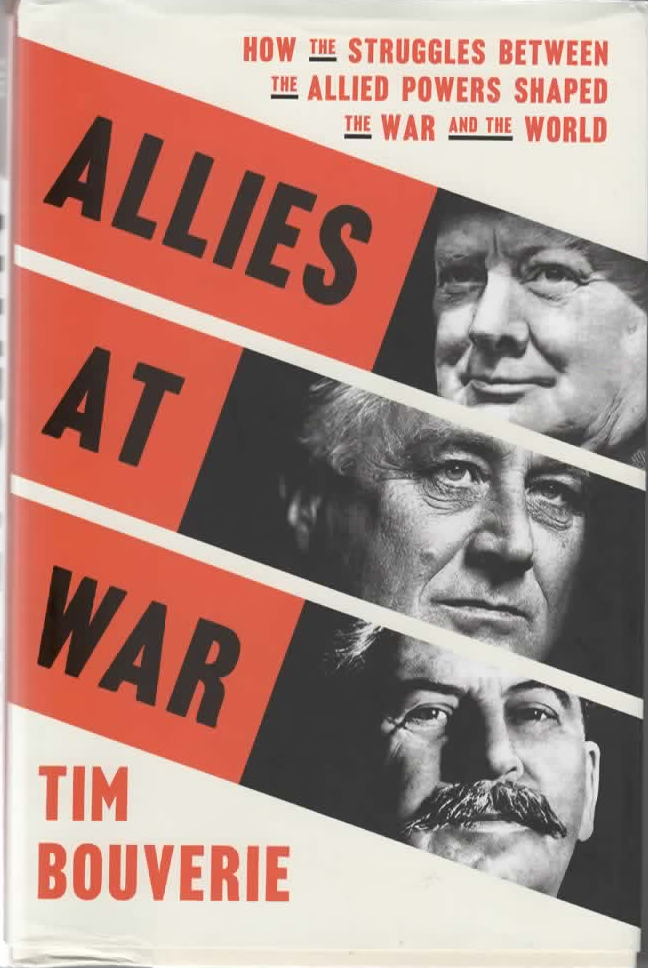
I was not very impressed with Bouverie’s first book, Appeasement, and I gave it a less than stellar review back in September 2019 (see https://coldspur.com/on-appeasement/). Allies at War is considerably better, Bouverie turning his attention to the sharp ideological and political differences that separated the USA, Great Britain and the Soviet Union during the time of their Alliance against the Axis powers. The author outshines even Andrew Roberts in his declared exploitation of private papers, yet I question whether this heat brings any dramatic new light on the proceedings, and Bouverie can be very vague and elusive when it comes to dissecting some really thorny issues.
First, those collections of private papers. Bouverie promotes the contribution that more than one hundred of such collections, in Britain and the United States, made towards his work, and, indeed, the archival sources are listed prominently before his extremely rich Primary and Secondary Sources of Bibliography (although how the distinction between the two sets was made is not explained). There is some overlap between Bouverie’s list and that of Roberts: Bouverie’s is dominated by British sources, while Roberts spent more time on papers in transatlantic locations. Like Roberts, Bouverie unfortunately does not list specific National Archive references, although such can be spotted liberally among his Endnotes (which are far more comprehensive than those of Roberts). He also provides no shorthand for the identity of collections, which makes it difficult to assess – without a deep trawl through all his Endnotes – which of the papers contributed the most breakthroughs (if any). Were they mostly anecdotes that reinforced a message, or were they disclosures of a Burgissian kind?
Overall, Bouverie displays solid mastery over his material, and the blurbs that adorn the back-cover, by such prominent historians as Antony Beevor, James Holland and Odd Arne Westad are accurate. They allude to the author’s ‘grand sweep of history’, the book’s ‘sweeping in scope’, and characterize it as ‘compellingly told, immensely wide-ranging’. I learned much that was new to me, and I was pulled effortlessly along by Bouverie’s strong narrative power. Bouverie offers many chapters that are excellent vignettes of a particular theme, such as Chapter 21, ‘The Special Relationship’, and he illustrates them by citing anecdotes and experiences at several layers of the subject under his attention. The book provides a very rich reading experience.
Yet the commitment to epic sweep, and an apparent desire to present an encyclopaedic analysis of the events, lead Bouverie to some reticence when it comes to addressing the major features of the conflicts between the Allies. For instance, take the ‘Second Front’ – a topic that has caught my attention before, and is one that I believe has been severely mishandled by the historians. In his Epilogue (which acts as a summing-up), Bouverie claims that ‘for the Soviets, the most important issue, between June 1941 and June 1944, was the opening of the second front.’ Well, maybe it wasn’t. Bouverie had not made that case beforehand. There was no such entity as ‘the Soviets’, representing the conclusions of a democratic give-and-take: Stalin made the decisions, and it was he who exploited the issue to its utmost. He knew that, if the re-entry to mainland Europe were undertaken prematurely, and failed, the pressures on the Soviet Union from the Nazis would be even more terrible. Yet there came a time (in 1943) when an assault could probably have been safely undertaken, and his forces would have gained much-needed relief when Nazi troops would have had to be moved to France. It was then that he became more aggressive about Churchill’s broken promises.
Bouverie rightly criticizes Stalin’s hypocrisy in appealing for a ‘second front’ as early as July 1941, just after Barbarossa, and he chronicles Churchill’s reproaches to the Soviet ambassador, Maisky, for the demands coming so soon after the Soviet Union was in an alliance with Nazi Germany, and assisting the latter’s campaign against the British and her allies. In September Churchill sent the diabolical Beaverbrook to Moscow, accompanied by Averell Harriman (the USA not yet in the war, of course), and the appeasement of Stalin began its ugly course. Roosevelt and Churchill later both made unwise commitments to Stalin about the timetable for the ‘Second Front’ (frequently omitting to mention that the Allies were engaged on multiple fronts against the Axis powers already), which led to distrust on Stalin’s part. In turn, the leaders of the democracies expressed concern that Stalin, unless he received encouraging help, might seek a separate peace with Hitler. (I consider that extremely unlikely, and I put it down to Stalin’s manipulative skills. Bouverie does not explore that possibility in depth, but does observe, on page 529, that, by 1943, ‘Stalin had no incentive for such a deal’.) Bouverie then moves on spasmodically to ‘popular opinion’ in Britain that applies pressure on opening the ‘Second Front’, but completely overlooks the fact that Stalin had an agent in the Ministry of Information, Peter Smolka (Smollett), who was allowed to have an utterly inappropriate influence on internal propaganda. Smolka has no entry in Bouverie’s Index, and the Cambridge spies barely feature, with Burgess, Philby and Maclean relegated to asides and footnotes, and Cairncross and Blunt not meriting any mention at all. And, despite what Stalin claimed, there was no ‘popular opinion’ in the Soviet Union.
Another example where I was disappointed in Bouverie’s unwillingness to stick his neck out concerns the stealing of Western technology and secrets. The breadth and depth of the Soviet effort to acquire capabilities that its own dysfunctional industries and academies could not supply were staggering. This was not just the stealthy insinuation into the Manhattan project for atomic weaponry (‘ENORMOZ’, in Soviet-speak): it also involved a massive and successful attempt to smuggle documents and samples of other advanced technology out of the USA, often under the Americans’ noses. Bouverie writes at some length about the tensions that in 1943 arose between the Americans and the British concerning post-war use of atomic power and weaponry, but analyses very superficially the progress of the Soviets to replicate the creation of the bomb.
Bouverie’s coverage is both paradoxical and casual. For example, on page 334, he writes: “For all his optimism about the Soviet Union, he [Roosevelt] never wavered in his determination to exclude the Russians from the secrets of the bomb, even if Soviet penetration of the Manhattan Project – of which he was aware – was already rendering this moot.” Really? What is the evidence that Roosevelt was aware of the Soviet penetration of the project? Bouverie offers nothing. And what were the implications for the USA, and the beginning of a policy to withhold information from Great Britain, if that indeed were true? I found this an astonishing abdication of responsibility by the historian. Moreover, on the previous page, Bouverie described the commitments made by Roosevelt and Churchill at the Quebec Conference of August 1943, where they resolved that ‘all information [on the bomb] would be limited to their two countries’. Thus the move to make a virtue of Roosevelt’s ‘determination’ to exclude the Russians, when an agreement with the British had recently been made, while at the same time claiming that Roosevelt was confidently reported as knowing what the Soviets were up to, appears to me as simply undisciplined.
Thus Bouverie fails to grab the nettle on some really important issues, while sounding authoritative on what he probably considers minor topics, but which also cry out for closer analysis. For instance, he records (on page 441) the death of the Polish Commander in Chief, General Sikorski, in a plane crash off Gibraltar in July 1943, adding a terse footnote: “Conspiracy theories claiming that Churchill or the Soviets were responsible for the crash are baseless.” If the author can be bothered to bring up the fact that conspiracy theories have circulated, he should explain them. Why should we trust his ex cathedra statement? He should not simply try to refute them through a simple denial, without showing what really happened, as if he were the established expert, and should be rusted unquestioningly.
Another example concerns his flimsy coverage of the Cambridge Spies. In his sole reference to Guy Burgess, he introduces the agent in a Footnote on page 181, where he is commenting on the summer 1939 negotiations before the Molotov-Ribbentrop Pact:
Although the British and French made plenty of errors during the Anglo-Franco-Soviet negotiations held in Moscow, their position was also undermined by SIS officer and Soviet spy Guy Burgess, who, during August 1939, provided his Soviet handler with a series of reports claiming that the British Government did not want an alliance with the Soviet Union since it was a ‘fundamental aim of British policy to work with Germany . . . and . . . against the USSR.
Apart from the fact that Burgess was not working for SIS at this time (he joined Section D in September), Bouverie offers no source for this release of opinion, nor does he offer any explanation as to whether the gobbet from Burgess was treated with any respect in the Kremlin, compared to all the other information that Stalin might have been processing. Was it significant? If Bouverie was keen on citing it, he should have explained more.
I could cite several other examples, where Bouverie’s tone is uncertain, or where he fails to interpret or put into context some very dubious statements. Duff Cooper’s justification for fearing Russia (page 462) is quoted at length (a totalitarianism ‘which appeals to the hearts of the people and which they have accepted with the enthusiasm with which men embrace a religious faith’) without commentary. Why bother to cite such nonsense, unless there is a broader and wiser lesson to be told about British naivety in general? Overall, he leaves the reader with the impression that the Soviet Union really mirrored the structure of British society, and that Stalin was subject to the same pressure from his citizens’ opinions as was Churchill or Roosevelt. He is inconsistent about the Soviet ‘liberation’ of eastern and central Europe at the end of the war, and, for my money, too forgiving of Roosevelt and his foolish admiration for Stalin, and too effusive about the legacy that Roosevelt left behind him, including the United Nations. Roosevelt’s avowed ambition to bring the British Empire to rubble – a vital component of ‘Allies at War’ – and replace it with an American model, is hardly covered at all.
His Epilogue serves a useful vade mecum to the tensions of his story, but for the educated reader really states nothing new. Moreover, it indulges in generalisations about what ‘the British’ and ‘the Americans’ were doing or thinking without doing justice to the varieties of opinions about Soviet intentions in the pluralist West. That there were alternative voices is confirmed by Bouverie when he cites George Kennan and Adolf Berle, but, while asserting that ‘the break up of the Grand Alliance was all but inevitable’, he leaves uninspected the political processes that might have allowed a more realistic assessment of the post-war Soviet Union. He does suggest that a firmer line with Stalin, taken at the outset, might have deterred the dictator – a point I made vigorously myself in my study of appeasement. So long as Roosevelt and Churchill were in charge, however, the die was cast until too late.
His judgment on the evils of communism is also questionable. He defends the alliance of the three nations against Hitler on ‘political and ethical grounds’, observing that ’the Soviet Union, despite the fact that it was responsible for millions more deaths than Nazism before 1939 (a point I strongly made in Misdefending the Realm) ‘was not attempting to subjugate an entire continent or exterminate an entire people’. Apart from the fact that that was exactly what Stalin’s objectives were, the truth that he set out to exterminate whole sections of his own people (‘the kulaks’, ‘the enemies of the people’) is overlooked by Bouverie. And then he corrects himself:
Not then, at any rate. Of course, this was no comfort to Stalin’s victims: to the millions of Poles, Estonians, Latvians, Lithuanians, Finns, Ukrainians, Belorussians, Romanians, Bulgarians, Moldovans, Georgians, Armenians, Azerbaijanis, Kazakhs, Turkmens, Uzbeks, Kyrgyz, Tartars and Russians who suffered and died under communism.
But most of that slaughter occurred before May 1941. So what is Bouverie’s point?
And he leaves one exceedingly important point to his last page – Stalin’s perceived requirement to have ‘a chain of proxy states along her frontier’, which was necessary for the security of the USSR. If such ‘buffer states’ existed, they could be relied on only if they were dominated and effectively controlled by the Soviet Union, and thus became part of the Soviet Empire. Moreover, Stalin built his own defensive pit when he signed the deal with Hitler: the strong Stalin Line that would have been a robust defensive shield was no longer relevant, and had to be replaced quickly by the new Molotov Line that was severely inadequate for purpose when Barbarossa took place. Why was this notion of exploiting satellite countries, and presumably allowing them to be sacrificed in the event of a western land invasion, in order to give Moscow time to defend itself, not more purposefully resisted by the democracies? And how soon would that notion become obsolete in an era of atomic weaponry? That dynamic could have been usefully explored by Bouverie.
In conclusion, it would have been a better book if Bouverie’s scope had not been so expansive, and he had concentrated on the few major themes that encapsulated his ideas of ‘Allies at War’ and had processed them deeply and innovatively. It is as if he hoped to hide behind his scintillating coverage of the war on all its fronts and thereby not have to put his head above the parapet, and thereby offer a more reflective and opinionated story that might get challenged. Above all, the ‘Missing Dimension’ rears its head again.
Advance Britannia by Alan Allport (2025)
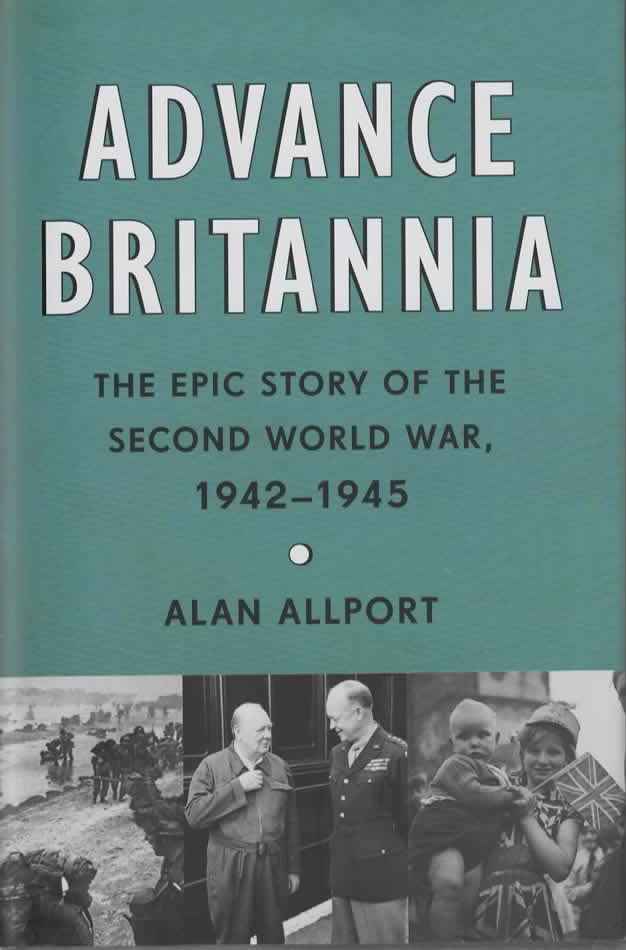
This work is a different animal. Allport is a British expatriate, who acquired his Ph.D. from the University of Pennsylvania, and is now the Dr. Walter Montgomery and Marian Gruber Professor of History in the Maxwell School of Citizenship and Public Affairs at Syracuse University – which must be quite a mouthful when he has to introduce himself at cocktail parties. This is not an institution with which I was familiar, and it puzzled me that History would be subsumed into this rather earnest-sounding faculty. What makes Maxwell different? “Maxwell is where diverse and collaborative problem solvers develop innovative solutions to move people, policies and communities forward” is the slogan that welcomes the visitor on the School’s website, offering a rather dreary 21st century business-speak to the domain of objective investigation. “Whither are they all moving forward?”, and “How is that mission different from those of many other similar institutions?”, one might ask. Yet the school enjoys good reviews, and Professor Allport appears to have had a supportive environment in Syracuse.
Allport is not afraid to break from the pack, speak his mind, and challenge some of the orthodoxies of his field of study. I like that. Advance Britannia follows on from his critically acclaimed Britain at Bay, published in 2020. One of the blurbs (by David Edgerton) claims that ‘there isn’t a better history of the Second World War than this remarkably fresh account’, which would appear to be a reckless assessment, implying that Edgerton has read them all, but also inappropriate, perhaps, because Allport’s focus is very much the effect that the war had on Britain, and the interchange of ideas and opinions between the citizens who experienced it, and the political leaders who managed it. Interestingly, a blurb for Britain at Bay (by Julie V. Gottlieb, in the Times Literary Supplement) observes that ‘the twist is that it is a tale of national decline on an epic scale’. That sounds on target, but then why would Allport showcase his follow-up with the progressive notion of Britannia in Advance? A crucial dialectic to be investigated.
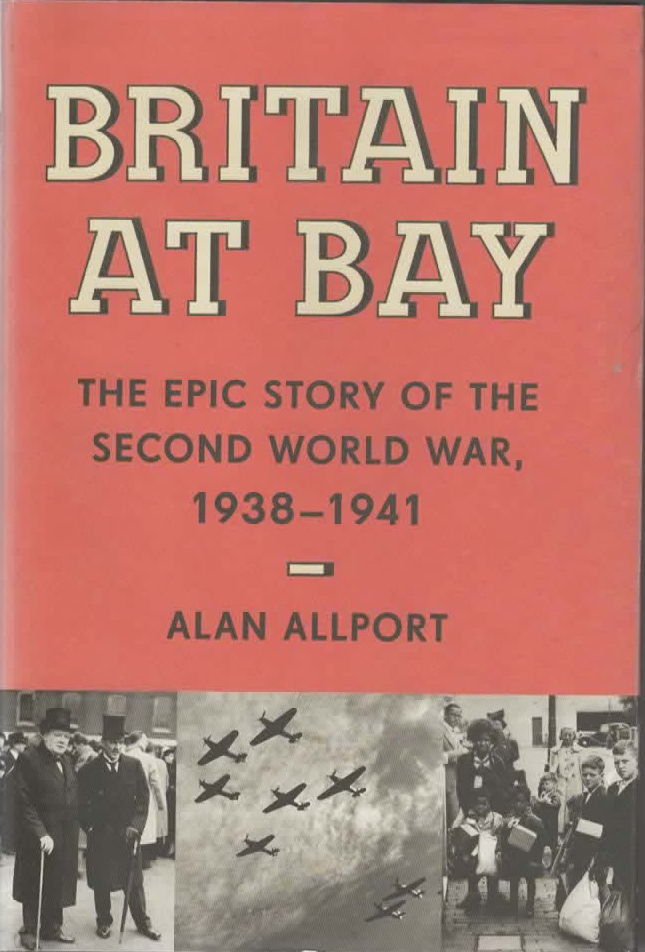
But first, the Sources, which are always a vital guide to determining in what fashion this work might be different and innovative, and the method by which an author parades his or her research. Allport informs us that Advance Britannia is the culmination of a ten-year writing project, so it must have overlapped with the production of Britain at Bay. And his effort is another in the Stakhanovite mould. Under Archival Sources, he lists, alongside the regulation Kew items (almost exclusively Cabinet Reports and a set of Home Intelligence Daily Reports from 1941 to 1944, in the INF/1 series), some valuable items with which I was not familiar – the reports from the Mass-Observation Archive held at Sussex University. He lists thirteen ‘Newspapers and Magazines’, undated, followed by almost one hundred ‘Article in Periodicals’. About fifty ‘Chapters of Books’ are tabulated, showing an unusual but useful discrimination, and then Allport piles on a further four hundred titles of books (all in English, so far as I could tell) that he has presumably studied from cover to cover. Moreover, while there is some overlap, this set is mostly different from his roster in Britain at Bay.
I really do not understand how such labours can be accomplished, especially if the author is carrying out a full-time teaching job as well. I can easily understand reading forty books a year (provided that they are in easy reach, or have to be bought), but I am not able to imagine the work required to annotate, extract, record, organize, and retrieve the critical passages necessary for the process of providing a fluid text. Perhaps all such authors have a photographic memory? And maybe not all those listed works provided material that was directly referenced through his Endnotes. (That is not a task I have attempted.) Allport does not explicitly refer to that notorious entity of ‘research assistants’, but he does acknowledge, over a list of names that ‘deserve special mention’, that some ‘provided assistance in obtaining primary source documentation’ – a rather elusive formulation. It would perhaps have also been useful to separate the Bibliography into ‘Critical Works’, and ‘For Additional Reading’. But I liked his joke when he goes on to write: “It goes without saying that any remaining errors of fact contained in Advance Britannia are entirely the responsibility of one or more of these people and not me.”
I had enjoyed Britain at Bay, but sensed that this was a writer finding his way. There were too many errors. I judged that too many generalities were being drawn from individual testimonies. Allport explored the vital notion of pluralism, but understated both its strengths and its weaknesses. Much of what he wrote (for instance, about Dunkirk) was very familiar, while he overlooked some crucial events, especially concerning the USSR in 1939. Yet he showed some innovative traits, in wanting to discuss some of the issues involving personalities, such as the dynamics between Churchill and Dill, and the roles of such as Portal, Dowding, Waverly and Harris: all of that I found fascinating and refreshing. Yet I was vastly put off by Allport’s continual allusions to Tolkien’s ‘Shire Folk’, to which he dedicated (and titled) the first chapter of the book, making what I considered some arch and completely unjustified comparisons to what those entities were, and how the British related to them.
I dipped my toe into The Lord of the Rings over sixty years ago, and swiftly withdrew it, vowing never to waste any more time on such nonsense. I am sure I am not the only reader of history to carry that aversion. That is why I think Allport’s metaphors are completely out of place. In that shy-making Chapter 1 he wrote: “What made the Shire Folk narrative so persuasive to the British, whether it was told by a man of the left such as Priestley or a conservative patriarch like Churchill, was that it explained the nation’s early wartime failures, as well as its subsequent success”. And he went on, comparing Churchill’s writing about Dunkirk to Tolkien’s writing about Hobbits, and regularly resuscitating his trope through the book. There is no evidence for such a claim, and it was for me a childish deviation from scholarship. Moreover, The Lord of the Rings did not appear until the mid-fifties, so it was a bit premature to make allusions to ‘Shire-Folk’ narratives. Allport almost steps back from his myth-making at the end of the chapter, writing: “Because the British people who fought and defeated Hitler from 1939 to 1945 were not nearly as innocent as hobbits. Nor as unprepared for the viciousness of total war. Nor anything like as nice.” So what is Allport’s point? Were they any different from ‘ordinary’ Germans, who may have had their trollish counterparts, until they were infected with Prussian militarism?
Thus I hoped that someone might have persuaded Allport to drop all that Shire Folk business when he came to write Advance Britannia. No such luck: he returns to his theme, although his message is more to debunk it as inappropriate after 1942. He picks it up on page 179:
The British are deeply invested in the idea of themselves as innocents [‘we are?’]. In the first volume of this history, I called it the Shire Folk myth – the idea that the British are fundamentally a gentle, ‘little’, Hobbit-like people, modest in their ambitions, full of good-humoured common sense, with a knack for amateur initiative (and a genius for ‘muddling through’), a stubborn resolve beneath their superficially mild and indolent character and, above all, a deep revulsion at violence.
He goes on to describe how victory was snatched against the odds not through a native talent for killing, but by gumption, guile, inventiveness and sheer bloody-mindedness (presumably the latent ‘Shire Folk’ national character). Yet he diminishes it by asserting that ‘with a little shoehorning here and there, the first couple of years can be made to fit this interpretation of events’: what the ‘victories’ were in this period are not identified. And then came such tactics as mass aerial bombing of Germany, and the innocence was lost.
The key to Allport’s obsession with the Shire Folk idea is explained on page 464, where he writes: “It was during the Second World War that the bulk of Tolkien’s three-volume The Lord of the Rings cycle, perhaps the single most influential British cultural artefact of the second half of the twentieth century, was written.” Was Tolkien basing his novel on his observations of British character under siege, or were the beleaguered islanders anticipating Tolkien’s future fiction? Wherefrom Allport gained the thought of the pre-eminence of The Lord of the Rings in the literary heritage, I have no idea, but I think it shows lamentable judgment. And his conclusion on the whole business is also in poor taste, when he contrasts the myth that Shire Folk virtues were critical in winning the war with the reality:
It is that version of the war that remains overwhelmingly popular in British mass culture today: the war of the Bletchley Park boffins, SOE’s spies, the escapees of Colditz and the Special Air Service, rather than (say) the firebombers of German cities or the mass production of convoy escorts. Actually Britain won the Second World War not because its people were plucky and Hobbit-like but because they proved to be very good at the cold-blooded application of immense state-directed violence. It is understandable that they have never really wanted to dwell too much upon this.
Despite one or two insightful truths, the conflict in this summarization is so off-beam that I do not know where to start. The ‘boffins’ of Bletchley Park were indeed the dominant factor in Britain’s ability to wage war, and their feats remain deservedly popular. SOE is another story: yes, popular culture has concentrated on individual heroics, while overlooking the misguidedness of its mission, and its highly-flawed execution. Similarly with Colditz escapees and the SAS, but I doubt whether anyone seriously regards such activities as war-winners. But to link firebombing of German cities with mass production of convoy escorts seems singularly maladroit. What was Churchill supposed to do to maintain food supplies for Great Britain, and to protect the convoys going to Murmansk? Who are these ‘people’ who turned out to be ‘very good at the cold-blooded application of immense state-directed violence’? Not the pilots and navigators of Bomber Command, I suppose, who lost their lives in appalling fashion, and probably not to be compared with the state-directed violence of the concentration camps in the Reich, the mass-starvation of Soviet prisoners-of-war, or the slave-labour that contributed to the construction of the V-bombs?
Ironically, elsewhere in his text, Allport does pay timely attention to the saturation bombing of Germany – passages that I found most novel and imaginative. It would suggest that the Shire Folk did not dwell much on the firebombing of German cities, with vast civilian casualties, because they were not told the full story. It was not because they were complicit in ‘immense state-directed violence’. Moreover, Britain did not ‘win the Second World War’ off her own bat: she received a lot of help, both from the Commonwealth and from her allies. She was in harness with two superior forces, and Britain’s role was steadily diminished after the USA entered the fray. Allport at times appears to be swimming around in a murky pond of his own myth-making.
Yet when Allport sets his mind to inspecting the awkward aspects of the War, he can be very good. As an example, I point to his chapter on ‘Bomber’ Harris’s campaign for saturation bombing of Germany, Chapter 7, ‘States of Terror’. I have always been fascinated by the apparent power that Harris had in standing up to Churchill. By the middle of the war, Churchill had lost much of his enthusiasm for strategic bombing, but was reluctant to divert Harris’s Bomber Command elsewhere, or even to sack the Air Force Marshall. After the fire-storm of Hamburg in 1943, Attlee was required to declare in the House of Commons that German civilians were not being deliberately attacked. By then, the public was perhaps accepting of whatever damage had been caused, as recompense for what they had undergone. Allport’s chapter is searing, however, on the horrors of the practical impact, and the psychological and physical damage experienced by the bomber crews. Allport reports that Portal backed down from sacking Harris in January 1945, when Harris told him that, if he had ‘lost confidence in decision-making at Bomber Command HQ it was time to find a new AOC-in-C.’ Portal hid behind the excuse that sacking Harris at that stage would have been a political disaster. But was that true? Why did Churchill not stop it? He had felt free to sack his failing military commanders in Africa. Why not fire Harris, if he resisted orders?
There are many similar pieces of insightful analysis in Allport’s work. I liked such judgments as: “There was something frankly wrong with Montgomery, something that only a heroically dedicated psychiatrist might ever have figured out, and it is fortunate that the Allied war effort was not hindered too greatly by whatever Freudian turmoil was taking place inside his head.” He has a refreshing iconoclastic approach to many great figures. At times I wish he had been more outspoken, for example, concerning Churchill’s appeasement of Stalin: “History has been altogether more forgiving of Churchill’s appeasement of the Soviet dictator than of Chamberlain’s of the Nazi one. Whether that is fair or not the reader can judge, but it is perhaps worth noting that both British leaders committed much the same essential error by mistaking personal conviviality for sincerity of purpose.” Why not offer his judgment here? Allport is good on Operation MARKET GARDEN, however.
I found a sometimes amusing set of errors. Allport refers to ‘the peacetime principle of “Gubbins’s turn”’, accidentally echoing the title I used for my assessment of the head of the SOE, when it should be ‘Buggins’ turn’. He echoes popular culture by writing ‘to-the-manor-born’, when it should be ‘to the manner born’. He is wrong in using Bletchley Park as an example of the government’s requisitioning of country houses: it was personally acquired by MI6 chief Hugh Sinclair in 1938. He has a firestorm ‘reaching a crescendo’. Orde Wingate is described as ‘a Plymouth Brethren’. In introducing Sir Hartley Shawcross Allport represents him as ‘Shortcross’ later in the same sentence, perhaps subconsciously recalling the amusing ‘Sir Shortly Floorcross’ cognomen that later dogged the politician. I found his switch from ‘Shire Folk’ to Thermopylae and Leonidas jarring: it is difficult to deploy references to popular culture and classical allusions on a broad audience these days.
So where does that leave the ‘Advance’? I really do not know, and neither does Allport, it appears. There is no Epilogue or summing-up. This is of course a book about Britain. Was it simply that Britain won the war – although not on its own? (Yet it was bankrupt and exhausted by 1945.) Or was it that it led to a breaking down of traditions and class barriers in Attlee’s Welfare State? Or to the more natural Conservative administrations in the 1950s? Sometimes Allport suggests the first, sometimes the latter. I do not understand whether his extracts from Mass Observation are intended to highlight a theme, or reinforce it, or are simply background music. After all, how representative are those scattered opinions? Overall, I think Allport fell in love with his Shire Folk idea, but then struggled with it, and did not have the guts to drop it. Yet, as I pointed out earlier, The Lord of the Rings did not appear until the mid-fifties. Those who experienced the war would have known nothing about those reputedly worthy creatures. Maybe it doesn’t matter, and we can just regard Advance Britannia as an innovative chronicle that is prepared to kick up the ashes covering some deeds that have lain undisturbed for too long.
Conclusions
What might a future historian produce by exploiting the sources of all three books? The prospect is quite frightening, in a way. It would simply be unreadable. I believe that all three volumes already show the flaws of trying to write new histories about the totality of such an epic conflict. Roberts’s work falls down over the misguided concept of ‘the War in the East’. Bouverie has the best theme, but is too tentative in his conclusions, and does not take into account the intelligence aspects, and the nature in which the Soviet Union was so different from the democracies. Allport fell in love with a metaphor, realized that it was perhaps not suitable, but could not disentangle himself from it. It all reinforces my belief that future histories of the war should take a thin slice, and drill down deeply, exploring all its aspects – say The Atlantic Charter, the Katyn Massacre, the Second Front, Bomber Command, the Battle of Arnhem, the PROSPER betrayal, without attempting to be encyclopaedic about the background. As examples that I have read, I have commended John Lukacs’ The Duel (1991), and Five Days in London (1999), but both topics need to be re-addressed because of recent archival releases. Jane Rogovskaya did a good job on Katyn in Surviving Katyn (2020), yet it could be expanded to cover the political tensions in the west; Walter Scott Dunn’s book Second Front Now (2009) was weak. My friend Patrick Marnham’s War in the Shadows (2020) could benefit from a refreshment, but the changes would be minor, and such an event would probably be too soon after publication. There is still much useful stuff to be written!
The Word Detective by John Simpson (2024)
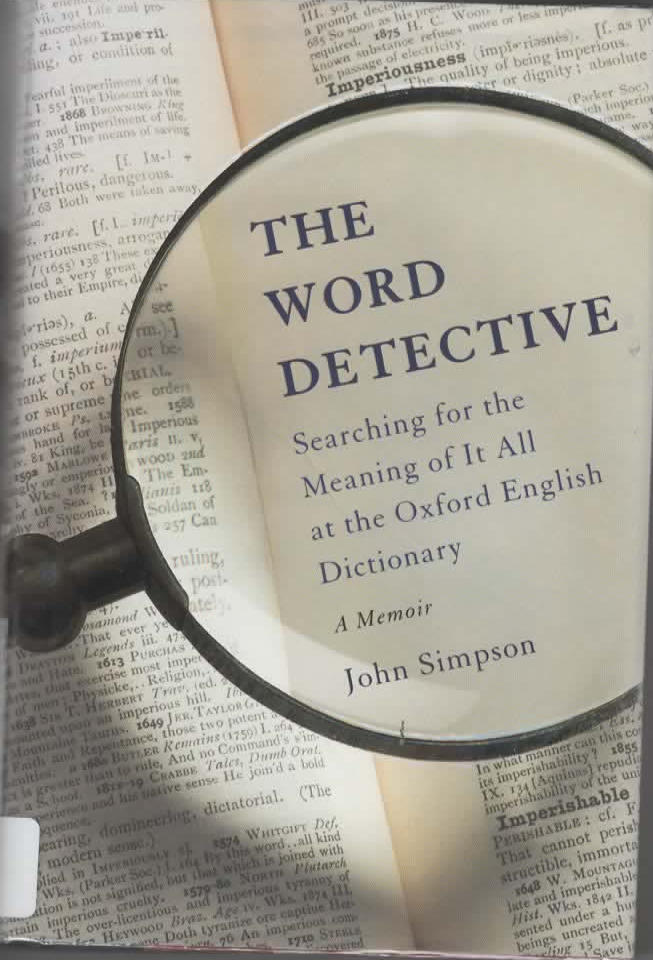
As a bonus on another subject, I offer a brief review of John Simpson’s Word Detective. I have (had) a large number of books on language in my library, including multiple dictionaries of quotations, slang, proverbs, idioms, catch-phrases, etymology, etc. etc., and I enjoy reading various authors explorations into the world of words. I was not actively seeking out Word Detective, but I happened to see it prominently displayed on a shelf at the New Hanover Public Library in Wilmington, so I decided to borrow it. ‘Searching for the Meaning of it All at the Oxford English Dictionary’, the subtitle, sounded a mite pretentious, but the memoir by the former chief editor at the OED promised to reveal some interesting insights and anecdotes.
The book turned out to be a largely diverting experience, although I could have done without the regular insertion of vignettes on the histories of certain words, which really had no place there, interrupted the flow, and consisted in a mild form of padding. Simpson turned out to be an engaging character, mild-mannered and industrious, and was responsible for the mammoth task of taking the dictionary on-line. I recognized some similarities with the lexicographer’s task of trying to determine the history of a word, and exactly when it entered the language, from what source, and that of a historian of intelligence, trying to follow clues in not always reliable archives. Indeed, Simpson himself makes this comparison, writing in his Introduction: “The lexicographer is the historical word detective trying to identify and explain these puzzles. If you don’t find the answer now, just set it aside and wait for more information to present itself later. But if you do latch on to a clue, then pursue it until the truth is revealed.”
Yet Simpson’s love of words had an odd exclusion zone. While noting that many of his friends and colleagues were crossword constructors/compilers, he baldly states at one point that he doesn’t like crosswords. As one of that breed, I should have imagined that the games that cluesmiths play with double meanings, and allusions, would have been of utmost fascination to him. He never explains why he has that antipathy, although the statement that he does not like them suggests that he has attempted them, but somehow failed to become enthusiastic. Was it a literal bent in his mind that did not take easily to puns and deception? Moreover, I should have expected a person in his shoes to be very careful about language, and I was disappointed in some repeated abuse of syntax in his text.
Simpson is careful to explain that it is not the lexicographer’s task to be prescriptive of the meaning of words. Again, from his Introduction: “It [the OED] doesn’t try to tell you – prescriptively – how to use the language. If you don’t like hopefully as a sentence-adverb (‘Hopefully, I’ll see you tomorrow’), then the OED will tell you that many writers avoid this usage, but ultimately, it will leave it up to you whether you choose to use it yourself.” This struck me as a bit naïve. Anyone who regularly uses the [Germanic] “hopefully” in the sense of “I hope that” is unlikely to check suddenly whether his or her usage is correct by delving into the OED. On the other hand, an inquisitive citizen who does refer to the Dictionary, on reading what it offers, might decide, on the basis that ‘many writers avoid this usage’, that perhaps he or she should likewise exclude it from his or her phraseology.
Incidentally, I have an idea that goes beyond how Simpson describes the history of the term, where he informs us that it could be found in the United States in the 1930s. As I suggested above, ‘hopefully’ echoes the German ‘hoffentlich’, which I learned was a very respectable term meaning ‘it is hoped’, when I was preparing for my German O-Levels in 1961. (It should be contrasted to ‘hoffnungsvoll’, meaning ‘hopeful(ly).) I suspect that there were many German influences on American English in the preceding century, and that ‘hopefully’ might have been reinforced through that process. As another example, I offer ‘the longest time’, representing the German ‘die längste Zeit’. When I first heard Billy Joel singing ‘The Longest Time’, released in 1983 a few years after I moved to the United States, my reaction was: “What is he talking about? No one uses that phrase in English!”
Thus, as a lexicographer, not a grammarian, Simpson has nothing to say about ‘correct’ use of English syntax, although I suspect he might not be quite so laid-back in that domain as he appears over word meanings. Nevertheless, I found him curiously tin-eared over prepositional usage – a particular bug-bear of mine – especially in his unawareness of the distinction between ‘I’ (the subject), ‘me’ (the object) and ‘myself’ (the reflexive). I have frequently picked up the confusion shown by such celebrated authors as Anthony Powell and Kazuo Ishiguro as to which of these forms should be used, especially in long sentences where the authors lose their way, and have forgotten how they started them.
Consider the following. Simpson early on shows that he is familiar with the correct constructions:
P 66 “To me, the new offices symbolised the palatial old-world dignity . . .”
P 81 “My colleague Ed Weiner and I were now informed . . .”
P 86 “ . . . the chef editor moved Ed and me into the graduate roles . . .”
P 87 “ . . . my colleague Ed and I had established . . .”
And then he goes off the rails:
P 90 “ . . he insisted on a meeting with Ed and myself . . .” (‘with Ed and me’)
P 98 “This . . . became a matter of great interest to Ed and myself.” (‘to Ed and me’)
P 136 “ . . . to revise the dictionary on-line was extraordinarily attractive to editors such as myself.” (‘editors such as me’)
P 148 “The Shark and the Admiral constantly reminded Ed Weiner and myself that that wasn’t an option for us.” (‘reminded Ed Weiner and me’)
P 150 “ . . . and nursed through to publication by Ed, myself, and Yvonne Warburton.” (‘by Ed, Yvonne Warburton, and me’)
P 180 “ . . . insisted that the image . . . should feature the real-world characters, Ed and myself.” (‘Ed and me’)
P 192 ‘What we did experience, Hilary and myself, and our daughter, Kate . . .” (‘Hilary and I’)
P 223 “ . . . The recently funded Kellogg College . . . had elected Ed and myself as Fellows.” (‘Ed and me’)
P 224 “For myself, the Fellowship meant and important shift of emphasis . . ” (‘For me’)
P 287 “They were used to manipulating their mobile phones and SMS communications in a way that the old guard, such as Ed and myself, were not.” (‘such as Ed and I’)
P 317 “There were three OED lexicographers (Peter Gulliver, Tania Styles, and me) sitting behind the inquisition table . . .” (‘Peter Gulliver, Tania Styles, and I’)
It is a shame. With English, as a largely uninflected language, it is easier to undermine the underlying beauty and logic of its syntax than in other languages. Yet such careless traits serve to damage its coherence, and I find the sloppy deployment of pronouns – like the failure to distinguish between indicative and subjunctive conditionals in verb forms – very regrettable, especially when exercised by language mavens. For that aspect is another of my bugbears: the familiar songs correctly and naturally run ‘If I Were A Rich Man’, and ‘If I Were A Carpenter’, and we say ‘If I were you’. In contrast, we might declare, of a known fact in the past, ‘If I was there, I don’t recall it’. When serious writers start writing about historical hypotheticals, the subjunctive is so often forgotten. They should know better. It is not helped by the fact that the forms of the indicative and subjunctive in the Second Person are the same (‘If you were the only girl in the world’, and ‘If you were there, I don’t recall it.’), and the lazy writer simply mimics that formation. Hopefully, things will improve, but I wouldn’t bet on it, if I were you.
And then I was coming to the end of the Oxford-educated Michael York’s luvvie memoir Travelling Player (I shan’t explain why I was reading this: the sleuths among you will work it out), when I read: “Nineteen eighty-seven saw Pat and I back in familiar territory”. Heaven help us all!
(Recent Commonplace entries – not many this month – can be seen here.)