Ruth Ellis was hanged on July 13, 1955 for murdering her lover, David Blakely – the last woman to receive the death sentence in the United Kingdom. This was a very disturbing event for persons of my generation.
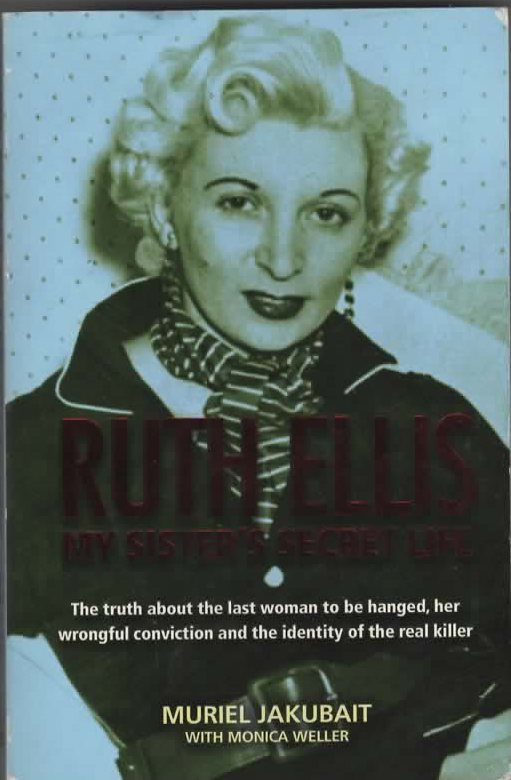
I have just read Ruth Ellis: My Sister’s Secret Life, by Muriel Jakubait, published in 2005. It is an extraordinary work, written by Ruth’s sister, Muriel, with the help of Monika Weller. It has many gruesome aspects. Buth Ruth and Muriel were raped by their father, and Muriel gave birth to a son, an issue of that horrendous relationship. Her mother issued threats when forbidding her daughter ever to disclose who the father of her child was. Many suicides took place, including that of Ruth’s son by a Canadian soldier, Andre McCallum. Despite such experiences, Muriel trained herself to be an effective sleuth, tracking down books, court records, newspaper files, census records, archival material, etc. etc., and she makes a very convincing case that her sister’s conviction was a gross miscarriage of justice. She believes that there was a conspiracy, probably headed by MI5, to eliminate both Ruth and her motor-racing lover David Blakely. Ruth fired one shot at Blakely, but the author offers strong evidence that the fatal shots came from another of Ruth’s lovers, Desmond Cussen, who had provided Ruth with the pistol she used.
Unfortunately, Jakubait’s analysis is not as strong as her talent for discovery. Her theory is that Ellis and Blakely had to die because they knew too much about the secrets behind the escape of Burgess and Maclean – a story that was about to break in that summer of 1955. Her text is liberally sprinkled with circumstantial facts concerning social groups and geography – with most of the action taking place in that territory (Maclean country) that I have described on coldspur and know so well, namely South-East Surrey and North-West Kent between Croydon and Fort Halstead. Yet she never suggests what deadly secret the pair might have known (that MI5 and the Foreign Office were behind the escape!? – an idea which she only vaguely mentions), and she never offers a theory as to why Ruth so meekly accepted her death sentence instead of disclosing the truths she was supposed to have known. (On the day before her hanging, Ruth told her solicitors that to have revealed anything would have been traitorous.) Moreover, Jakubait introduces too many irrelevant facts that surely can have no bearing on the case, for instance that the Green Line bus that carried Maclean to Tatsfield actually passed the house of Ruth’s estranged husband, George Ellis (another possibly dubious suicide), on Sanderstead Hill.
Yet many aspects of the story intrigued me. Jakubait believed that Ruth’s estranged husband, George Ellis, may have been a Soviet agent. In addition, the character and role of Desmond Cussen are very problematic. The author describes him as being ‘with British intelligence and keeping track of double agents working for the Soviets’, and she links Cussen to the known MI5 agent Stephen Ward several times. Elsewhere she writes that Cussen was ‘in MI5’, and that he had a cousin. This may be a case of mistaken identity, or it may conceal a previously uncovered relationship. Indeed, there was a famous Cussen in the legal department of MI5 for many years, namely Major Edward James Patrick Cussen, who was involved in the cases of P. G. Wodehouse, Ormond Uren, David Springhall, Juan Pujol (GARBO), and others, and was considered as a possible interrogator of Kim Philby.
I thought that it would be interesting to investigate the family tree. A simple search of ancestry.com led me to the astonishing discovery that E. J. P. Cussen (1904-1973) was the first cousin once removed of Desmond Edward Cussen (1923-1991), i.e. the son of Desmond’s great-uncle. Desmond was Ruth’s lover, supplier of the fire-arm to Ruth, and probable co-murderer of Blakely. I cannot believe that, given the evidence provided by Jakubait, this is purely a coincidence. In seventy years, I do not believe that anyone has made this connection. There must surely have been something darker going on beyond an attempt to hush up the assistance by MI5 and the Foreign Office of the escape of Burgess and Maclean.
This might be the crime/intelligence story of the decade. It might turn out to be a dead end. But I think it needs a researcher based in London to chase down the leads. Moreover, the Ellis files at The National Archives are almost all undigitized. I can do only so much from North Carolina.