Tag Archives: hollis

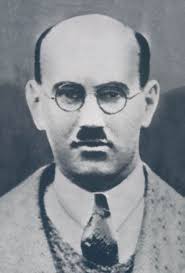
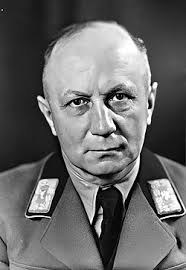
Roger Hollis in WWII

‘The Truth About Hollis ‘ – or Maybe Not?

Introduction

This bulletin, the first of two, or possibly three, dedicated to Roger Hollis, started out as a ‘B’-class (‘Businesslike’) report, but soon developed ‘A’-class (Advanced’) tendencies. I discovered a wealth of intriguing new facts concerning Jane Archer and the organization of MI5 at the time war broke out, facts that have been in the public domain for over two decades, but which have apparently been overlooked. I have thus included a deeper analysis of the phenomenon, since it reflects sharply on the role of Hollis. I have overall sacrificed digestibility in the cause of compendiousness, as I believe that it is important that a full story as possible concerning Hollis is recorded.

I have set out to describe Hollis’s responsibilities and achievements during the war, first covering his time within MI5’s B Division until the re-organisation of June 1941, and then his work thereafter in the new F Division until the summer of 1945. In November of 1941 Hollis replaced John Curry as head of F Division, and he led the group for the remainder of World War II. I do not believe that a proper account of Hollis’s role has been written anywhere, and, in that absence, Chapman Pincher’s distorted story has lain as the default, and has probably influenced public opinion in a notorious fashion. In his authorized history of MI5, Christopher Andrew wrote a few paragraphs about Hollis’s contribution, but hardly did justice to the complexity of Hollis’s charter, or his activities. I exploit accounts from various sources: this is not an integrated profile of the MI5 officer, but the process does enable the formulation of some patterns of behaviour and policy.

Confirmed Pincherites should read the whole article: others may wish to jump to the Conclusions and then decide whether they want to study the supporting material.

Contents:

Chapman Pincher’s Mythology

What the Histories Say:

            ‘Defend the Realm’

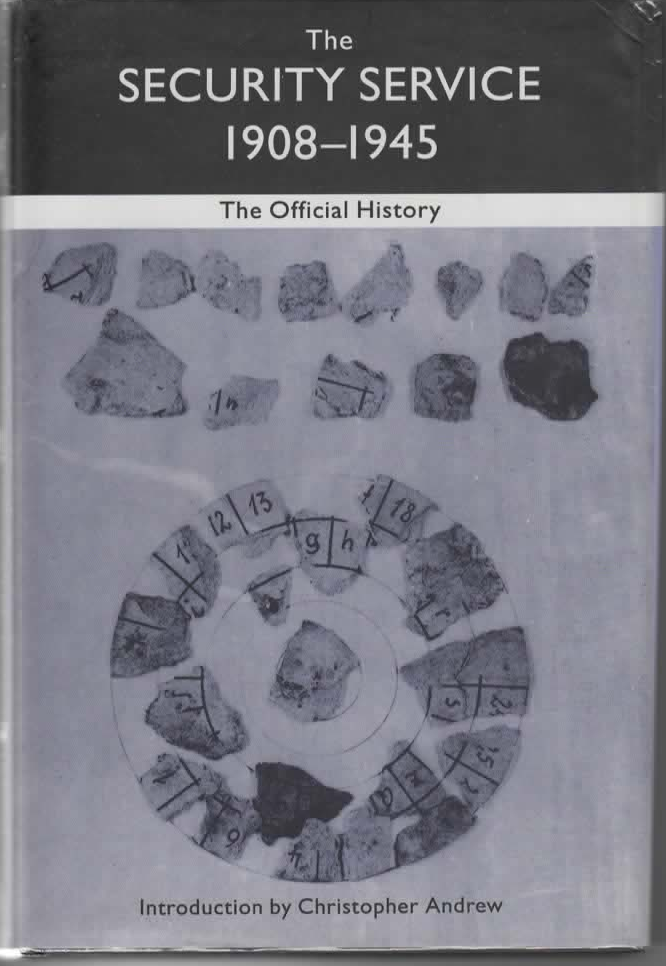
            John Curry’s ‘Official History’ of the Security Service

            F Division Reports (KV 4/54-58)

Nigel West’s ‘MI5’

Other Sources

Guy Liddell’s Diaries

Other Archival Sources

            David Springhall

            The Communist Clamp-Down

            Engelbert Broda

            George Whomack

            Claud Cockburn and ‘The Week’

Conclusions

*          *          *          *          *          *          *          *          *          *          *          *          *

Chapman Pincher’s Mythology

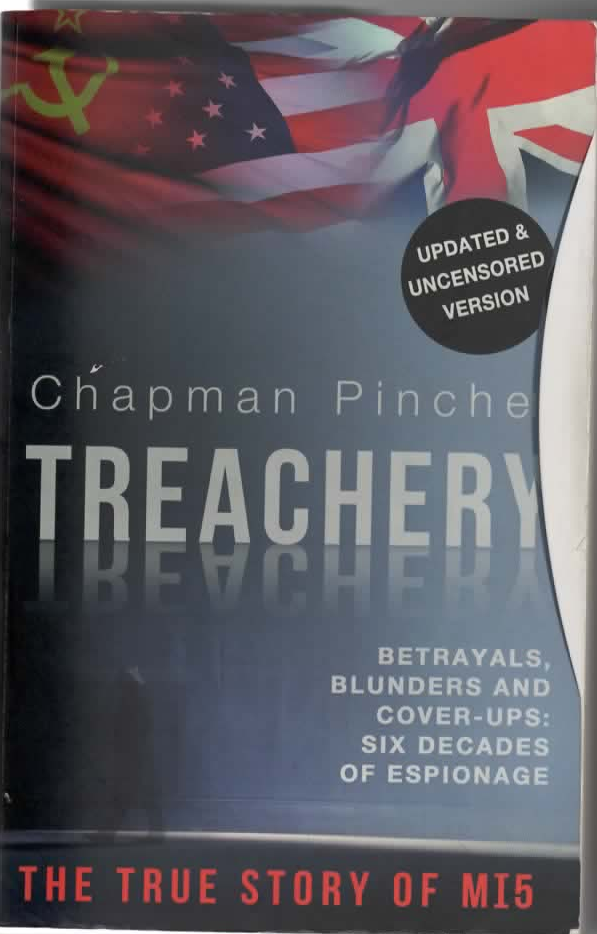
I use as a springboard for my analysis Chapman Pincher’s revised version of Treachery (2012), in order to record and comment on his representation of Hollis’s role and actions, since it has received an unprecedented and unjustified degree of respect in pseudo-academic circles. For example, in the infamous 2015 Institute of World Politics investigation into Hollis, chaired by the FBI’s Ray Blatvinis (see https://fbistudies.com/2015/04/27/was-roger-hollis-a-british-patriot-or-soviet-spy/), the Australian Dr. Paul Monk was introduced in the following terms: “Over the past two years or so he has carefully extracted all the salient facts about Hollis from two major sources. The first is Treachery, a monumental examination of the Hollis case written by the late British journalist Harry Chapman-Pincher [sic]. The other is Defend the Realm authored by Dr. Christopher Andrew, Chairman of the Department of History at Cambridge University and the Official Historian of the BSS.” The consideration that the largely spurious account by Pincher unerringly contained ‘salient facts’ represented such a gross error of judgment that it undermined the whole proceedings. I thus outline here the primary anecdotes that Pincher relates concerning Hollis, as well as the broad allegations against him, annotating them with facts and statements from other sources to highlight the discrepancies.

‘Treachery’
  1. Hollis’s Induction

Pincher correctly uses much ink in describing Hollis’s rather unusual path into MI5 – the abandoned degree course at Oxford, his seeking his fortune as a journalist in China and his subsequent employment in that country by British American Tobacco, his passage through the Soviet Union on leave in 1934, his eventual return to the UK because of tuberculosis, a period of unemployment before joining BAT again, his marriage to Eve Swayne and an enigmatic visit to France at the end of 1937, a stimulating lecture he gave to the Royal Central Asian Society, and a possible introduction to MI5 by Major Meldrum.

The problem is that Pincher’s account is riddled with so much speculation – in China he was friendly with Arthur Ewert, Agnes Smedley and (possibly) Ursula Hamburger (Agent Sonia) and Richard Sorge, and was thus, in Pincher’s mind, recruited into the GRU network. Every time that Hollis is associated with a communist or left-winger, such as in his friendship with Claud Cockburn, that fact confirms for Pincher Hollis’s true affiliations. Each time Hollis disparages communism (such as in his criticism of the state of Moscow), or shows patriotic loyalties (in letters home), that phenomenon is judged as part of his disguise. Pincher has made his mind up that Hollis was recruited, either in Oxford, or in China, or in Paris, to the Comintern cause, and thus began his long career as ‘ELLI’.

There seems to be some confusion as to exactly when Hollis was recruited by MI5, and for how long he was on probation. The tennis-match at Ealing, arranged by Jane (Kathleen) Sissmore, did probably occur in August 1937, and Hollis was asked to submit his qualifications as a potential MI5 officer. Dick White told Pincher that Hollis ‘did not volunteer any special knowledge of international communism at any stage of his recruitment’. Pincher characteristically remarks: “Perhaps wishing to conceal his past association with notorious people like Ewert and Smedley, and possibly Sonia, he remained silent, as he certainly did about his connection with active British communists such as Cockburn.” On the other hand, White and Sissmore might have been impressed by Hollis’s ability to ingratiate himself with such persons without betraying his true allegiances. In any event, Peter Wright told Pincher that Hollis was rejected, first by MI5, and then by MI6, before Jane Sissmore convinced MI5’s director-general, Vernon Kell, to accept him. It is difficult to verify that account, yet Sissmore definitely took Hollis under her wing when he became a regular employee of MI5 in the summer of 1938. A 1938 organizational report has Sissmore listed as B4a, with Hollis, somewhat surprisingly, already given the same designation.

  1. Hollis in B4

Despite his less than auspicious background, Pincher has Hollis becoming, in 1940, ‘the driving force in his speciality, quickly being recognized as MI5’s expert on communism and the prime understudy to Jane Sissmore in that respect’ (p 71). Somehow, ‘driving force’ and ‘Roger Hollis’ do not sit well in the same sentence: Pincher appears to contradict himself by going on to write how dull and reserved Hollis was viewed by his colleagues at this time. In addition, Hollis had been with the service for only two years, and Pincher openly recognizes Sissmore (in fact now Jane Archer) as the premier expert on Communism, while understating the knowledge of Dick White and Guy Liddell in that sphere. John Curry specifically named Jasper Harker and Liddell as the experts. Yet an organizational listing, from December 1939 (viewable at KV 4/127), lists Hollis as the sole officer in charge of B4a, with the Misses Cotton, Creedy, Ogilvie and Wilson working for him. What happened to Jane Archer?

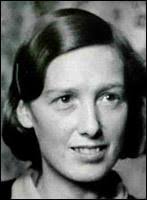
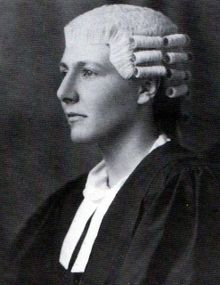
Kathleen (aka ‘Jane’) Archer, nee Sissmore

That KV 4/127 file reveals another startling fact. By December 1939, Jane Archer appears (assisted by Miss McNalty and Miss Small) as the officer in charge of a mysterious unit B14, an entity which I cannot find mentioned in any of the histories. Indeed, the first Krivitsky file (KV 2/802) shows her signing herself as B14 as early as September 1939, in a memorandum to Jasper Harker and Gladwyn Jebb. Thus she had been transferred from her B4a post well before the Krivitsky interrogations in January 1940 – probably in preparation for his arrival, so that she might work on the project investigating Soviet espionage. John Curry mentions this scheme in his history, without ever identifying B14. Strangely, Liddell makes no mention of the creation of B14 in his diaries, although an entry for October 13, 1939, records a discussion he had with Archer after she had visited Percy Glading in prison. On November 16, he writes, rather clumsily, that ‘Jane has got a new man at the Russian trade Delegation that she would like to get at’. That gentleman may have been A. A. Dostschenko, who, as Jane reported on November 24, was found distributing a questionnaire to an informant. Yet, in a note soon after, on November 29, Liddell would appear to be instructing Jane to step into what was domestic territory, namely the investigation of ‘applications for employment in restricted occupations from the Reading area’ – the notorious ‘Russo-German case of F. R. Brown’, who may or may not have been the future England cricket captain of that name. Liddell had also been watching carefully the developments in the Krivitsky case, and shows that he discussed his interview with him with Jane on January 30, 1940. Yet he does not describe her intense involvement, or what the charter of B14 was.

All this would strongly indicate that Archer had a far more serious mission in covering the risks of Soviet penetration than did Hollis, who, with only a year’s experience in MI5, was left in charge of less dramatic domestic issues, such as inspecting Brian Simon’s passport papers, or (after the war started) handling policy on the export of newspapers. Moreover, in December 1939, Hollis was in charge of B4a only – not of B4b, which was led by the more serious student of Soviet intrigues, Milicent Bagot. For example, Guy Liddell’s diary entry for September 17, 1939, shows that B4b (not B4a) was responsible for assessing how many Soviet citizens might have to be interned. An entry for October 9 shows that B4b was likewise charged with investigating the Czech communists in residence. (Extraordinarily, at the end of 1939, all the officers in the numerous B units – up to B18, with Curry as B15 –  seem to have reported directly to Liddell: there was no intermediate head of any entity named ‘B’. Dick White was merely the leader of a two-person band in B2!) Hollis was thus never ‘the prime understudy’ to Sissmore (actually ‘Archer’) in 1940, because they did not work together after September 1939.

Yet Jane Archer, shortly after completing her report on the Krivitsky interrogations, was mysteriously moved over to managing the Regional Security Liaison Officers (RSLO) in the summer of 1940. Hollis, the only officer in B4a, thus did not take over her job at this time: what happened to the B14 operation is not clear, but the dissolution of Archer’s work has very ominous overtones. Neither Curry, nor West, nor Andrew ever acknowledges the creation or dissolution of B14. (Andrew’s first mention of B4 after the 1930s, even, is of its surveillance teams trailing Fuchs in 1949!) One might expect Andrew and West to have overlooked B14, given the lack of archival material, but Curry was there at the time, and he had a professional interest in its activities! Why the coyness? The fact that the existence of a unit that was specially set up to investigate the intelligence from Krivitsky has been suppressed and excised from the authorized history of MI5 is damning. White probably subsumed B14’s role into his own department after the reorganization (an idea that I shall investigate below), but the archival record is woefully bare.

Pincher is thus completely misguided about Hollis’s true role, but he sets about his assault anyway. In a passage that is characteristically vague about dates he accuses Hollis at this time of being responsible for failing to give rigorous advice to the Security Executive about the probably seditious publications of his communist friend Claud Cockburn. Pincher writes: “The Security Executive had repeatedly asked MI5 for the necessary evidence for a prosecution, but Hollis had insisted that he could not provide any that would stand up in court. This may have been true, but it had also been against his interests that his past association with such a notorious Communist activist might become known. Eventually the war cabinet decided to suppress both The Week and The Daily Worker, with or without evidence, and the file on the event shows that Hollis was definitely the MI5 officer required to deal with the case.”

This account is a distortion of what happened, suggesting that Hollis was an influential advocate, acting alone. While the fresh interest in Cockburn started well before Hollis had been given sole control of B4a, in early 1940 several senior MI5 officers weighed in with their views on Cockburn and The Week. (Since the writer W.J. West expands on this story with archival references, I shall explore the events surrounding Cockburn later in this piece.) Hollis admittedly may have mis-stepped in his handling of Cockburn, and in his negligence over George Whomack, but Pincher attributes this behaviour to the obstructionist actions of a penetration agent rather than the inexperience of someone feeling his way. In any event, Pincher asserts that Archer’s eventual sacking for impertinence, in November 1940, immediately elevated Hollis as the ‘acknowledged expert on communism and Soviet affairs’ (p 99). Where he acquired this expertise throughout 1940, and who acknowledged him in this role, are not explained by Pincher, who has failed to recognize the organizational realities of that year, and has given a totally erroneous picture of MI5’s set-up.

iii)       Hollis in F Division

Pincher then grossly misrepresents the re-organization initiated by David Petrie in June 1941, when a new Division F was established under John Curry, responsible for ‘Subversive Activities’, namely domestic challenges to the system from disaffected groups. Hollis was an assistant-director under Curry, responsible for a small team (F2) covering ‘Communism and Left-Wing Movements’, which in turn had one officer tracking ‘Policy Activities of C.P.G.B. in UK’ (Clarke, F2a), ‘Comintern Activities generally, Communist Refugees’ (F2b, immediately  filled by the capable person of Milicent Bagot), and ‘Russian Intelligence’ (Pilkington, F2c). Pincher was excited by Curry’s careless and imprecise statement in his official history that F2c was responsible for ‘Soviet Espionage’. While Curry pointed out the successes in the cases of Oliver Green, David Springhall, and Desmond Uren, Hollis was never charged with assuming Archer’s responsibilities, namely a serious re-assessment of the possible implications of the Krivitsky revelations, the structure and polices of the NKVD and GRU, and the whole phenomenon of deep penetration agents.

Pincher then writes that ‘the deference quickly paid to Hollis as the Soviet expert greatly increased his influence’, although he never describes how Hollis showed his expertise, nor does he identify who the subjects paying deference were. He notes that, when Hollis replaced Curry as head of F Division in October 1941, his access and authority were increased still further. Pincher states that Hollis then brought in his ‘Oxford University drinking companion’, Roger Fulford to help him. Yet Curry’s organization chart for July 1941 shows that Fulford was already responsible for F4, covering Pacifist movements such as the Peace Pledge Union, and thus reporting to Curry, not Hollis. By 1943 Fulford has moved on. Pincher then criticizes Hollis for failing to monitor properly, or restrain, the more than a dozen KGB (actually NKGB) and GRU officers active in London at the time, although how he was supposed to do that with a combined team of probably only three officers and other personnel in F2 in 1941 is not clear. Pincher claims that Kemball Johnston was hired at this time, but the April 1943 chart shows a weakened F2 organization with Clarke still covering F2a, and Shillito now responsible for both F2b and F2c.

That MI5 leaders were not seriously trying to bolster a force against Soviet espionage through F Division was reinforced by a written statement that Dick White made to Pincher in 1983, namely that ‘Hollis and F Division had never been responsible for Russian [sic] counter-espionage, which had always been part of B Division’ (p 102). White was partially correct (as Curry confirms in his official history), if by ‘Russian’ he meant initiatives starting from overseas, as opposed to those native to the CPGB. Yet that supposition was making very fine distinctions, and would have opened a whole field of hazards. Moreover, White, now the Assistant Director to Liddell for B Division, was indeed the officer heading both B1 (Espionage) as well as Hollis’s old section B4, now called ‘Country Espionage’, including B4a. B4a was the unit responsible for non-Nazi counter-espionage, i.e. investigations into espionage deriving from ‘individuals domiciled in the United Kingdom’: White no doubt wanted to keep some measure of control over the function. That did not mean, however, that the task of countering Soviet espionage was being carried out with aplomb. For instance, by June 1943, B4b, charged with investigating espionage in Industry and Commerce, still headed by J. R. Whyte, had been reduced to a small band covering ‘Escaped Prisoners-of-War and Evaders’. (By then, of course, its original function may have well been passed on to Hollis.) Yet the failure to grapple with the Soviet espionage threat was a source of much discussion between Liddell and Petrie as the war progressed. Archival evidence shows that Petrie and Hollis discussed the potential Soviet menace, as did Petrie and Liddell, and Liddell and Hollis, but White is largely absent from the conversation.

The fact that Hollis was not responsible for handling the broader and more sinister aspects of Soviet intrigue does, however, not fit in with Pincher’s view of the world: he argues, somewhat bizarrely, that he does not attribute this ‘misconception’ of White’s to his failing memory, but instead to his willingness to accept responsibility for any incompetence himself, as part of the theme that his protégé needed to be protected. If anything, White’s assertion was a criticism of his boss, Liddell, who was responsible for all of B Division during the war. Certainly, after June 1941, when the Soviet Union was an ally (albeit a difficult and temporary one), the task of countering direct Soviet espionage – as opposed to domestic subversion – was largely buried, and White in particular wanted to shield the potentially embarrassing business of MI6’s enabling of Sonia’s marriage to Beurton, and of assisting her passage to Britain, from prying eyes.

  1. Hollis, Fuchs, Sonia & Springhall

Yet Pincher continually beats the drum that records Hollis’s failure as the wartime Soviet counter-espionage officer, as if he had been responsible for allowing the Cambridge spies to purloin so many documents (p 103), in the years when they ‘perpetrated their worst crimes’ (p 108). Hollis was reputedly lax in allowing Sklyarov and Kremer to meet Klaus Fuchs in Birmingham in August 1941, since, even though new to his job, he had been involved in the takeover procedure for his new assignment for several weeks (p 134). Pincher admittedly would appear to be making a shrewd observation when he points out that D. Griffiths, in F Division [actually F2b], had noted that the source Kaspar had reported that Fuchs was ‘well-known in communist circles’, and Pincher follows up by claiming that Hollis took no action (p 136). Yet this report was made as late as October 10, and Griffith [sic] judged that they could not put off any longer the requests from the Ministry of Aircraft Production for permission to hire Fuchs. The final approval was given by Joe Archer (AI1d) a few days later, on October 18.

The truth is that the investigations had been carrying along at a much higher level by then. For example, MI5’s request to the Chief Constable in Birmingham, C. C. H. Moriarty, for information on Fuchs’s political activities, was dated August 9. It went out, however, under the name of Director-General Brigadier Petrie, signed by Milicent Bagot, as if both Curry and Hollis were out of the loop. (The item is designated “F.2b/DG’.) Moreover, the request to the ‘Watchers’ (Robson-Scott in E4) for information on Fuchs, again under F.2b/DG, was sent to Robson Scott in E1a on August 9, and Bagot and Petrie had to wait over two months for a reply, namely the report from Kaspar. Hollis was thus not the lead officer on the project, and his name never appears in the archive during these months. For him to insert himself in the project at that late stage, when his boss’s boss had been personally involved, would have been inappropriate. Pincher’s slur is simply unjustified. More at fault was perhaps Petrie, for managing the investigation himself, but not taking action during the long delay. What Petrie was doing, delving down to F2b to collaborate with Milicent Bagot early in his career as Director-General, remains a mystery.

Other archival material tells us that Hollis did complain about the recruitment of communists to the Tube Alloys project, but was overruled by the Ministry of Supply and the Department of Scientific and Industrial Research. The Ministry was not concerned about political persuasions if those holding them could help in the war effort against Hitler. Remarkably, Pincher then cites Hollis’s absence, in November 1941 (i.e. immediately after his promotion, but a date that is highly questionable), because of a bout of tuberculosis, as a reason that Moscow Centre broke contact with Fuchs for a while, as they were no longer receiving the ‘regular assurances of safety’ from their man in MI5! How Hollis would have known about Fuchs’s current security, or how he would have delivered such messages of comfort to the Embassy under normal working conditions is not explained by Pincher. By January 1943, when Fuchs’s naturalization papers were being considered, agent Kaspar had changed his tune: Fuchs then bore a ‘good personal reputation’ and was considered ‘a good fellow.’

The next major theme is Hollis’s close collaboration with Ursula Beurton, née Kuczynski (agent Sonia). By some weird reasoning, Pincher interprets the way by which Sonia came to service Fuchs as proof that she had been posted to Oxford from Switzerland for the purpose of supporting someone else – Hollis, who had been working out of Blenheim after the transfer from Wormwood Scrubs (p 158). Shortly after Sonia moved to Avenue Cottage in North Oxford, in October 1942, Hollis returned to duty after his convalescence from tuberculosis. Thus her ‘task of servicing two major suppliers in the area’ was substantially eased, according to Pincher. He then blames Hollis for his negligence in not following up Hugh Shillito’s suspicions concerning Sonia’s possible spying, or the discovery of a large wireless set at the Laski residence where she was staying (pp 160 & 161). Pincher claims that Shillito actually passed up his message, expressing doubts about Len Beurton’s testimony, through his boss, Hollis, to the deputy Director-General. Yet Hollis was, in Pincher’s eyes, solely responsible for ignoring Sonia’s ‘traitorous activities’.

The problem is that Pincher completely distorts what happened. Shillito’s letter, available in KV 6/41, is not addressed to the deputy director-general (who would have been Jasper Harker at the time), but to Major Ryde, the Regional Security Liaison Officer in Reading. His information was gained by virtue of a joint interrogation of Beurton carried out at MI5 alongside a Mr. Vesey and a representative from MI6. D. I. Vesey, who worked for B4b, has already appeared on file, as he had been on the Beurton case all through the summer, and had arranged the interview referred to by Shillito – as his letters and memoranda prove. Thus Dick White’s group was indeed (moderately) active in pursuing cases of possible Soviet espionage, in this case a person who had earlier been tracked now arriving from abroad – even if he was a British subject. In March, 1941, Shillito (then B10c), whose interest in Ursula Beurton had been piqued by her recent arrival to the country, alerted Ryde to that event, and also passed her file to B4b as the natural home for it. So it appears to confirm that an active cell of tracking potential communist threats had endured in B Division, as White claimed, and F Division had not assumed in toto the various B sections, contrary to what Curry claimed in his official history at the end of the war [see below].

What is also interesting, however, is that Vesey, in his memorandum of October 20, 1942, that records the interview with Beurton, does describe the presence of an officer (name redacted) from MI6, but makes no mention that Shillito was present. Clearly, the investigations of Shillito into domestic subversion, and Vesey, into international espionage, had crossed because of the Kuczynski-Beurton shenanigans, and Vesey was anxious to put Shillito in his place. Of course, if the high-ups had wanted to pursue the investigation of the Beurtons, they would have insisted upon it, and they would not have allowed Hollis to display any negligence by showing no action. Moreover, Pincher completely ignores the role played by Vesey and B4b in these incidents.

Pincher next uses the success over the Springhall arrest and prosecution in 1943 to make another wrong conclusion. “Springhall’s conviction should have finally convinced Hollis and his colleagues that Russian intelligence was prepared to use flagrantly open communists as agents”, he writes (p 164). In fact, Springhall’s exploits were firmly in opposition to Moscow policy, which ruled that CP members should take no part in espionage. The NKGB was not at all happy about the way that the CPGB had dragged itself into notoriety. Yet Pincher again blames Hollis for being a major influence in the failure to investigate such characters as Philby, Maclean, Blunt, Klugman, Fuchs, the Kuczynskis, Norwood and Kahle. Apart from the fact (as I have indicated elsewhere) there were special considerations with each of these menacing personalities, it is unlikely that the combined wills of White, Liddell, Petrie and Menzies would have caved in to Hollis’s presumed appeals for inactivity. And Pincher again misrepresents the dynamics, by suggesting that Burgess and Blunt must have experienced extraordinary thoughts when they drank socially at the Reform Club with Hollis, ‘the man they knew to be responsible for detecting Soviet [sic] spies’ (p 167).

  • Hollis and Section IX

The next episode in the saga is Hollis’s apparent shrewdness in recommending that MI6 establish a new Section, Section IX, to ‘intercept and possibly decipher’ wireless messages being transmitted between Moscow and the CPGB headquarters’, especially since ‘certain London members of the party [were] known to be operating illicit transmitters and receivers from their homes’ (p 169). This statement is a distortion of the truth. Apart from the obvious fact that, if CP members were known to have been operating radio sets from their homes (an illegal activity), they would instantly have been picked up, Pincher throws in a completely irrelevant observation that this initiative coincided with a USA attempt to interpret KGB [sic] transmissions between New York and Moscow. (That would been the first few weeks of the VENONA project, and it has nothing to do with the case.)

It is difficult to know what to make of this. Pincher cites Curry’s official history as the source. Indeed Curry does give Hollis a large amount of credit for encouraging the formation of Section IX. He also reports (p 358), that there was one isolated incident of detected wireless traffic involving James Shields of the CPGB, and a former member, Jean Jefferson, who operated from her home in Wimbledon, and that they were being watched. Curry states, however, that there were much broader reasons for MI6’s needing to have a section dedicated to Soviet counter-espionage at the time. In any case, such a technical challenge was the province of the Radio Security Section (RSS) and GC&CS: MI6 would not have brought any fresh skills or insight to the operation.

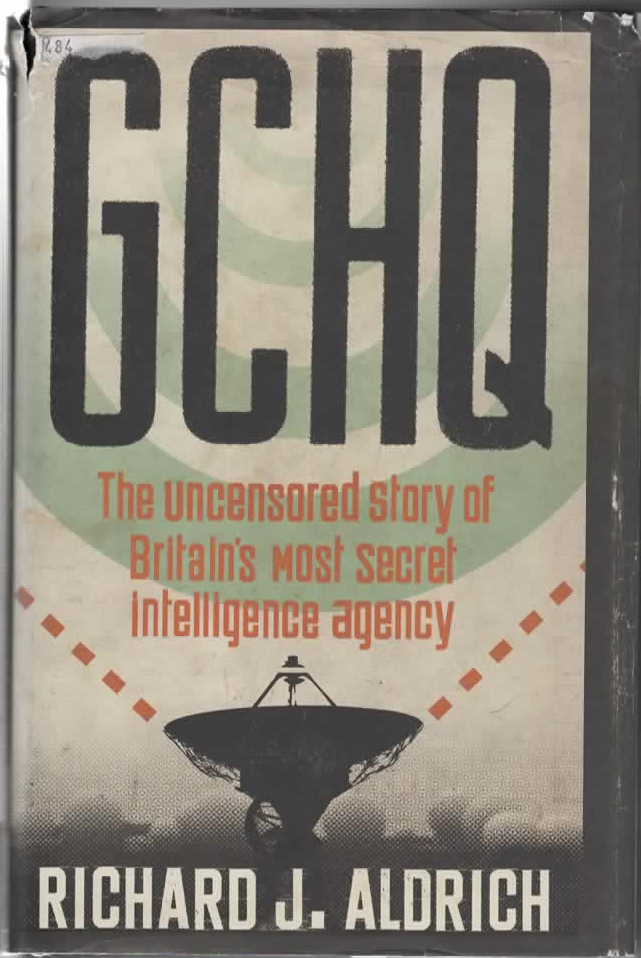
‘GCHQ’

Pincher also cites Richard Aldrich’s book GCHQ, suggesting that Aldrich had recorded a meeting between Alastair Denniston, ‘the head of the forerunner of GCHQ’ [wrong: Denniston had been ousted by then, and was working on Comintern traffic in London], and ‘a senior member of the RSS’ (actually, our old friend Ted Maltby) to discuss ‘the interception of KGB messages being sent from Soviet agents in various parts of Britain to the Soviet Embassy’ (p 169). If true, that would have been an immense shock to all concerned. But Pincher got it wrong. What Aldrich wrote about was ‘the interception of certain apparently illicit transmissions from this country which have been “DF-ed” [direction-found] to the Soviet Embassy” (p 79). These were messages transmitted from the Embassy, not to it, and were part of the ISCOT project that later revealed information about Soviet post-war plans for Eastern Europe. Moreover, transmissions could not have been characterized as being targeted to any particular location such as the Soviet Embassy. They were available in the ether for anyone in suitable range to pick up. Pincher shows his technical ignorance, mixes up three entirely different projects, perhaps deliberately and out of mischief, and posits the absurd notion that there was a large number of Soviet spies transmitting undetected across Britain.

Richard Aldrich

Yet Pincher’s whole chapter is amplified into a paeon to the ‘two-headed colossus’ of Philby and Hollis working in partnership to thwart any attempt by the British intelligence services to identify and prosecute Stalin’s agents. One of their apparent successes needs to be cited in full (p 170). “A particular significant aspect of this remarkable situation, which was to last throughout the war, ensured that any intercepted messages to and from illicit radio operators in Britian, including Sonia’s, would automatically be passed by Phliby’s section to Hollis for possible action. The messages would be in code, and it was Hollis who would decide whether to have them deciphered or not.” This is utter nonsense. If such a volume of messages had been picked up, RSS and MI5 would have been obsessed with discovering whether any of them derived from German agents first. An undeciphered message would not betray the allegiance of its source –unless the authorities had already pinpointed the location of its sender by direction-finding. Such messages would never have been sent to someone like Hollis, and he would never have been able to make any decisions about their importance if they were undeciphered, anyway! This is all pure fantasy on Pincher’s part. Pincher claims that Hollis was so proud of his achievements in this MI6 initiative that he apparently described it as his ‘best, personal wartime shot’ in his post-war account of his unit’s history (p 175). That report can be seen in KV 4/54. Hollis never mentions radio interception at all, let alone his unique contribution to MI6’s innovations.

vi)        Hollis and the Quebec Agreement

The dual themes of ‘Hollis as ELLI’, and his collaboration with Sonia, are amplified in Chapter 23, ‘A High-level Culprit’, (pp 184-190), which is dedicated to the notion that Sonia betrayed to Stalin the secrets of the Quebec Agreement of September 1943. This is a very involved saga, and I spent much ink analyzing it in my bulletin of over eight years ago, at https://coldspur.com/sonia-and-the-quebec-agreement/. I shall thus not examine it again here, merely summarizing that the case for Sonia’s being the source of any leaks rests on very flimsy evidence, including some reported Soviet archives that are unavailable, and hence inscrutable. It also assumes a very dubious timeline concerning departures of scientists to the USA, and the release of further nominated experts to follow, as well as some highly questionable claims about Sonia’s movements when she was heavily pregnant. Nevertheless, Pincher chooses to portray the incidents as further evidence of Hollis’s guilt (and Hollis at this time, inevitably ‘was regarded as MI5’s atomic expert’ – p 186), while his narrative is riddled with so much speculation concerning events that might have happened, and persons who ‘could have known’, that his argument turns out to be very flabby indeed. Again he emphasizes how Sonia had been sent to the Oxford area specifically to service this important GRU agent. The lack of any direct pointer to Hollis either in Sonia’s memoirs, or in GRU files (which have, incidentally, not been released in any form) is, in Pincher’s twisted mind, attributable to the high level of security that was attached to this supermole. If Hollis ever wrote anything in favour of prosecuting communists, it was a cover for his real designs, claims Pincher. And if there is no evidence for any of his clandestine assignments, that is because they were all carefully covered up.

  • Hollis and Fuchs’s Move to the USA

Pincher would appear to be on firmer ground in his criticism of Hollis’s negligence in allowing Fuchs to proceed to the United States in November 1943, in the chapter 24, ‘Calamitous Clearance’, pp 191-195). His account runs as follows: Fuchs received his visa for transfer on November 22, 1943, and told Sonia that day about his planned departure, which ‘eventually’ was scheduled for December. On November 17, MI5 had been asked if there was any objection to an exit permit, and Hollis had taken charge of the case himself. He reported specifically to an American questionnaire that Fuchs was politically inactive and that there were no security objections to him. On January 10, 1944, Hollis compounded the deception of failing to reveal Fuchs’s communist background by recommending that the dishonesty be continued. In fact, Fuchs had arrived in the USA on December 3 (thus nullifying Pincher’s earlier observation about the scheduled sailing), and on January 10, the Ministry of Supply informed MI5 that he might be required to stay on in the USA longer than expected. Hollis immediately approved such an arrangement, and noted that ‘it might not be desirable to make any mention to the US authorities of the earlier allegations of Communist affiliations’.

Hollis’s coup, according to Pincher, was not only to ensure Fuchs’s entry into the heart of the Manhattan Project, the operation to build the atomic bomb, but also to place the seeds of bitterness on the part of the Americans when they found out about Fuchs’s treachery a few years later. “The fact that Fuchs had been able to betray so many secrets because Hollis had repeatedly ensured his security clearance is regarded by MI5 as pure coincidence”, writes Pincher (p 194). He adds that, early in 1944, Churchill, unimpressed by MI5’s performance, reacted by giving vetting responsibility to a ‘secret panel of Whitehall officials’, and that Hollis insisted, in a memorandum to David Petrie, that all such cases should be referred to him. (As with all of Pincher’s references, no source is given.) Thus (according to Pincher) Hollis’s communist watch was totally ineffective.

The truth was somewhat different, as Mike Rossiter explained in The Spy Who Changed the World, and as I summarized in Misdefending the Realm. Unfortunately, Rossiter does not offer precise references, and his attribution of memoranda is a little awry, but the details can be found in the relevant Fuchs file at KV 2/1245. The sequence of events in the latter half of 1943 is as follows: on July 7, Miss Bosanquet in F2b contacted the RSLO (Captain Dykes) in Birmingham to ask for his opinion of Fuchs. Dykes replied promptly (although his letter is not on file), and Bosanquet wrote again on July 14, stating that ‘as he [Fuchs] has been in his present job for some years without apparently causing any trouble, I think we can safely let him continue in it’. Now that judgment should probably not have been delegated to a junior officer (what kind of ‘trouble’ was she expecting?), and it was the RSLO who immediately challenged it. He wrote the very next day, saying: “Surely, however, the point is whether a man of this nature who has been described as being clever and dangerous, should be in a position where he has access to information of the highest degree of secrecy and importance?”, and he concluded his objection by suggesting that Fuchs should be referred to the Police. Well said, Captain Dykes.

Bosanquet, oddly, continues the exchange, pointing out to Dykes that, in his earlier (unfiled) letter, he had indicated that he had already alerted the Police, since he had then informed her of what the opinion of the local constabulary had been. On July 28, she wrote again, indicating that she had been the officer who had dealt with Fuchs’s application for naturalization earlier that year (May), and that nothing had been found to his detriment. She diminishes the Communist claim as coming from the German consulate in Bristol, and thus being possibly tarnished. (That was a very cloistered and outdated judgment, since Fuchs’s communist activities had been reported from other sources, including Kaspar. It is not clear why Miss Bosanquet was entrusted with this task.) She strongly hints that Rudolf Peierls is the person who has testified to the important service that Fuchs is providing for the country. On August 30, Bosanquet concludes that nothing can be done about Fuchs, and on September 4 Hugh Shillito in F2c agrees, stating that he does not ‘regard Fuchs as being likely to be dangerous in his present occupation’. A fellow named Garret concurs.

The next we learn is that, on November 18, MI5 offers ‘no objection’ to a request for approval for Fuchs’s overseas mission on behalf of the Department of Scientific and Industrial Research. A scribbled and undecipherable couple of letters appears below the stamp ‘No Objection’, but a large stamp, as well as the rubric at the bottom of the document, indicates that it is D4a1 (probably Lt. T. Nesbitt) who has made the judgment, D4A being responsible for travel control, visas and exit permits. The formidable Milicent Bagot, on November 22, records her surprise that Fuchs, ‘who has now applied for an exit permit’ [my italics] is now a British subject, indicating that the approval of his naturalization process had not reached her desk. On November 28, Michael Serpell (F2a) approaches Garret (now shown to be D2) as to whether any period has been set on Fuchs’s visit to the USA, suggesting that he believes that Fuchs has not departed yet. Yet the extraordinary fact is that Fuchs had departed on November 11, as Rossiter reports, under conditions of haste and secrecy. The approach to MI5 for approval for Fuchs’s mission was all a sham. Pincher’s account was well off the mark.

In this fashion another obscure section gets in on the act. On November 29, Major Garret of D2 (Naval Security Measures) informs Serpell that Fuchs’s name was not on the original list of workers going to the USA, and thus must have been added at the last minute. A few weeks later, however, on December 6, Garret seeks confirmation, and writes to Michael Perrin at the DSIR, inquiring whether Fuchs should be considered as one of the party of ‘workers’ who have gone to the USA. (It seems as if MI5 has not been informed of the details of their departure: if there was any expression of outrage from anywhere in MI5, it has been suppressed.) Perrin replied awkwardly two days later, confirming that Fuchs was indeed now in the USA, but regretting that he could not give a firm statement as to the longevity of Fuchs’s mission. He personally believed that Fuchs would remain in the American organization. By January 10, 1944, Perrin appears to have been more alarmed. He confirms that Peierls wants to keep Fuchs out in the USA, but now does raise the security angle, about which the Americans are most concerned, and he expresses some urgency in gaining from MI5 its opinion of Fuchs, and any risk associated with him.

A quick telephone call must have been arranged, because on January 17 Garret writes to Perrin again, saying that he has consulted the relevant department after their recent telephone conversation, and he reinforces the opinion that Fuchs is a reliable character. “It is considered that there would be no objection to this man remaining in the U.S.A. as he has never been very active politically, and recent reports endorse the good opinion you have of his behaviour in this country”, he writes, but adds, ominously, “It would not appear to be desirable to mention his proclivities to the authorities in the U.S.A., and we do not think it at all likely that he will attempt to make political contacts in that country while he is there.” Garrett had been updated by an enigmatic note from a colleague in D2, who has obtained a full picture of Fuchs’s communist activity from Serpell, F2a (although someone has inscribed ‘B1a’ above it). The note adds that “Clarke’s opinion [Clarke being the established officer handling the CPGB in F2a: Serpell has presumably recently been transferred from B1a] is that he is rather safer in America than in this country, and for that reason he is in favour of his remaining in America where he is away from his English friends. Clarke’s opinion also was that it would not be so easy for Fuchs to make contact with communists in America, and that in any case he would probably be more roughly handled were he found out.” Whether ‘safety’ in these circumstances refers to Fuchs’s individual ability to be kept free from harm, or whether it describes the degree by which the authorities might be protected from Fuchs’s possible treacherousness, is left for the reader to decide.

The whole charivari appears to be a ridiculous mess, with senior MI5 officers staying out of the business (having presumably been squared by Perrin), and the junior officers floundering around in the dark – a perennial phenomenon in the execution of MI5’s charter. There was no serious attempt – let alone an opportunity – for F2a and F2b and D to voice their concerns about Fuchs’s proposed mission until after he had left. And thus Hollis must be judged to have been part of that conspiracy to pretend that sending Fuchs to the USA was not a risk, and to have gone along with the insistent demands of Perrin and his department. Yet Pincher’s account is erroneous. He gets the date of departure wrong, and inserts Hollis (alone) as the dominant figure in the imbroglio, ascribing all manner of statements to him that were in fact made by other officers, as can be verified by the wording that Pincher uses, and the evidence of the files. Unless the files were subsequently weeded (Pincher’s book appeared in 2012, Rossiter’s in 2014) there is no archival record that indicates Hollis’s direct involvement. That does not mean that MI5 was not involved in some very weird backroom business, but it does negate Pincher’s highly distorted account of Hollis’s dominant role in the catastrophe.

And that effectively brings Pincher’s coverage of Hollis during the war to a close, as the next event he covers is Gouzenko’s defection in September 1945.

What the Histories Say

While Pincher’s accounts of Hollis’s activity are obviously a distortion of the truth, we should expect any ‘official’ or ‘authorized’ history of his department to be markedly better, and that independent historians would offer a cooler, unbiased assessment of his career.

Christopher Andrew’s Defend the Realm

[Andrew’s history is a problematic compilation. He provides many insights, but his sources usually cannot be verified. His coverage of Hollis is very spotty, although he does provide a different strategic perspective on the Fuchs business of 1943 through his description of concurrent moves at Cabinet level to restrict communists from undertaking sensitive work.]

In his authorized history of MI5, Christopher Andrew is very restrained about Hollis’s career. He records that Hollis was recruited by Kell in June 1938, but, extraordinarily, Hollis’s first appearance in the history is not until 1943, when he is already ‘F2, in charge of monitoring Communism and other left-wing subversion’. Andrew does throw in a retrospective comment that Hollis had regarded the main SIS Communist expert, Valentine Vivian, with veneration, but says nothing about his studentship in Communist affairs under Archer (whose name changed from Sissmore to Archer when she married Group-Captain John Archer, of D Division, the day before war broke out). He briefly covers the reorganization instituted by the selected new leader, David Petrie, who had been approached in November 1940 to take over MI5. Petrie, after performing a study of MI5 and gaining a commitment from Swinton and Churchill that he would be able to run his own ship, decided to create new Divisions, breaking up the overloaded B Division (responsible for counter-espionage) into a new B Division concentrating purely on anti-Nazi counter-intelligence, E Division charged with alien control under Ted Turner, and F Division with a mission of counter-subversion, under Jack Curry. As I have shown, this is an oversimplification of what changes occurred.

Andrew does appear confused about timing: he states that, after the eyes of the Security Service were opened by Krivitsky (in February 1940), it was handicapped in investigating Soviet espionage by lack of resources. “B Division (counter-espionage) was wholly occupied with enemy (chiefly German) spies. Wartime Soviet counter-espionage, which was considered a much lower priority, was initially [sic] relegated to a single officer (F2c) in F Division (counter-subversion).” This is erroneous and misleading: F Division was not created until August 1941 – after Barbarossa. This assessment completely misrepresents a critical year of negligence. There were no potential ‘enemy’ spies apart from Germans until June 1940, when Italy declared war on Britain: Andrew has his categories wrong, and he is careless with dates and responsibilities.

The most thoroughly covered aspect of Hollis’s tenure is the Springhall case in 1943, and the subsequent discussions about open communists working for sensitive government departments. Andrew records how, after Springhall’s sentencing, Hollis and Felix Cowgill (the head of Section V in MI6) interrogated the MI6 secretary Ray Milne, who admitted that she had passed information to an ally (the Soviet Union), and was dismissed but never prosecuted. For some reason, Andrew thereafter emphasizes the role of David Clarke (F2a) rather than Hollis himself. As the file KV 4/251 shows, on October 21, 1943, Clarke submitted a long report that showed how dozens of communists were then working in government institutions, and that many of them had access to information of the highest secrecy. He provided numbers, but did not list names. Hollis passed this report on to Duff Cooper, a rather ineffectual protégé of Churchill, who was Chancellor of the Duchy of Lancaster, and head of the Security Executive at the time. Cooper soon responded (on October 27) that he had drafted a memorandum for the Prime Minister, at the same time asking for a list of those implicated. Hollis obliged the next day. Churchill indicated that he agreed with the recommendations in the memorandum, and the overall approval was minuted on December 13 – with Churchill’s famous decision to have vetting performed by a special panel under the Chairman of the Security Executive.

Hollis had, however, been active in the meantime. On November 4, he noted a discussion with Cooper, who had in turn spoken to the Home Secretary, Herbert Morrison. Hollis looked to the Cabinet for guidance on how to execute any restrictive policies, as he had noticed that high-level officials, while agreeing with such a policy in principle, had problems executing it when it affected their departments. On November 9, Morrison made a strong case to the Prime Minister about removing communists from sensitive work, although he offered an exception for a man ‘whose specialist abilities are so valuable that it is better to take any risk in continuing his employment than to lose his assistance on the specialist job in which he is engaged.’ On November 10, Hollis reported that he had spoken to the Home Secretary, Sir Alexander Maxwell, who informed him that Morrison had expressed concern about MI5’s excluding anybody with left-wing views. Hollis had said that such the number of cases demanding transfer of the employee would be small, and that MI5 ‘would be very conscious of the desirability of being prudent.’ A few days later, on November 16, Director-General Petrie showed his approval of the moves, encouraged Hollis to address such cases himself but to be sure to gain approval from either Petrie or his deputy (Harker).

Of course, in the middle of this exchange, Fuchs had set sail for the USA. It is as if Perrin had got wind of the planned restrictions, maybe gained approval at a high level, and surreptitiously arranged for Fuchs to join the party of scientists. How much did Hollis know of the energetic attempts in his group to restrain Fuchs at this time? It is not clear. It seems more likely that he was in on the secret, maybe alongside Petrie, and that Fuchs had been acknowledged as one of those with ‘specialist abilities’ who could not be surrendered. It would appear that, far from insisting on indulgence towards communists like Fuchs, Hollis was trying to promote the integrity of F2 while acknowledging the political realities of his position. And Churchill’s desire for any future vetting procedure to be taken out of the hands of MI5, as well as to keep the whole process as secret as possible, reflects his need to control the whole process himself, as well as not make any overt gesture that might upset Stalin – a special sensitivity of his at the time.

Andrew elides all the subtleties of these dynamics – as well as the fact that Fuchs’s departure came in the midst of the negotiations. And he quickly runs through the events of 1944 which followed the mini-crisis. KV 2/451 shows that Hollis was involved in intricate negotiations with Edward Bridges (the Cabinet Secretary), Alexander Maxwell, and others throughout 1944 and early 1945, but the attention on possible ne’er-do-wells in sensitive positions was always focused on Communist Party members, and thus bypassed the less hidden but more dangerous threat from penetration agents. Andrew’s final flourish, as far as wartime is concerned, is to trumpet Hollis’s valiant attempts to bolster the efforts countering Soviet espionage. In a telling (but unverifiable) observation, he writes: “The leadership of the Security Service was also well aware that it was failing to keep track of Soviet espionage. With at least partial justice, it blamed its failure on the severe restrictions placed by the Foreign Office on investigation of the Soviet embassy and Trade Delegation, and therefore of the intelligence residences for which they provided cover.” (pp 279-289) He cites a March 1943 entry from Liddell’s diary where Liddell and Hollis discussed the risk, as well as the exposure of doing nothing, although exactly what ‘action’ MI5 might have undertaken, apart from surveilling arrivals and departures at the Embassy more closely, is not clear.

Hollis is described as ‘the senior MI5 officer most alert to the continued threat from Soviet espionage’. Hollis regarded Valentine Vivian in MI6 as the most expert in the field, but he disliked his successor, Felix Cowgill, and was also dismissive of MI6’s overall efforts to investigate international communism. In another unsourced reference, from a memorandum to Petrie in April 1942, Hollis claimed that his group had ‘started, rather belatedly, to follow the activities of the Comintern wherever it appears’ (a project no doubt spearheaded by Milicent Bagot), admitting that F Division was stepping beyond its charter. Petrie encouraged him, but, apart from a voiced suspicion about Blunt, Hollis directed his section’s energies more against members of the CPGB, who, he misguidedly judged, would be the most obvious candidates for espionage. Yet there is no doubt that Hollis was not acting alone, or that he enjoyed the close attention of the director-general. Chapman Pincher chose to ignore these passages from Andrew.

John Curry’s ‘Official History’ of the Security Service

John Curry’s Official History of MI5

Curry’s history, which was written in 1946, and published in 1999, is in some places much more explicit than Andrew’s work. Curry was a complex character: he comes over as insecure and a bit neurotic from his exchanges with Liddell, always wondering where his career was going, and articulating disappointment that his contributions were not being properly recognized. He was probably not a very good leader, but he was a dedicated officer, and attentive to detail. Thus his history – which, as far as WWII was concerned, was much reliant on the assessments made by Division heads of their groups’ performance, but also contained much of his personal interpretation  – is an important contribution to MI5’s form and function, and contains much information (such as on organization) in which Andrew showed only superficial interest.

For instance, the history contains organizational charts after Petrie’s restructuring in August 1941, as well as for April 1943, when Hollis was well-established as the head of F Division, with assistant-director status, after Curry left for a new position in ‘Research’ in November 1941. Curry states that the instructions for re-organisation were issued on April 22, 1941, but were not brought into effect until August 1. He also declares (p 146) that Petrie’s plans were based on Swinton’s proposals, which Swinton, as head of the Security Executive, had not been able to force upon a reluctant MI5 in December 1940. Yet Curry is vague about exactly what Swinton proposed, since the only function allocated to F Division is identified as ‘dealing with the B.U.F.’ – surely an understatement.  As far as the evolution of the new structure is concerned, the charts in Curry’s volume show that Dick White and Major Frost were Assistant Directors of B Division under Guy Liddell in August 1941: Hollis and Aikin Sneath worked under Curry, who had been appointed Deputy-Director in charge of F Division (’Subversive Activities’). F Division was split into four sections: F1, under Lt. Col. Alexander (who worked with a large degree of independence from Curry), responsible for security in the forces; F2, under Hollis, responsible for Communism and Left Wing movements, where Clarke was charged with watching the CPGB (F2a), and Pilkington Russian Intelligence (= Soviet espionage, F2c), by default Hollis being responsible for the vacant slot of watching the Comintern (F2b). Sneath was responsible for Right Wing and Nationalist movements (F3), while Fulford in F4 watched pacifist groups. F3 was the reincarnation of B7 from the previous organization. Curry writes that, after April 1941, there was confusion as to whether MI5 or MI6 was responsible for maintaining adequate records about the Comintern, and that the expert knowledge of Miss Bagot in F2b was the only palliative to the situation.

Curry’s coverage of F Division is a bit erratic, and his account of Hollis’s contribution especially so, as if he bore some resentment for his successor’s responsibilities and achievements. He dedicates a long section on F3 (Fascist, Right-Wing, Pacifist and Nationalist Movements: pro-German and defeatists) in the main body of his tome, since its work was most relevant to the direct war effort. Yet Hollis is not mentioned once in the dense five pages (pp 308-312), and much is written in an irritatingly passive voice (‘it was felt  . . .’). Thus the rest of F Division’s work is relegated to Volume 3, in what is called Chapter V, Part 2: ‘Communism and the U.S.S.R 1941-1945’. Here he introduces the challenges facing F Division in its attempts to defend against the unchanged long-term threats of the Soviet Union while dealing with a Whitehall that (after Barbarossa) regarded it as an ally. He writes that ‘the work of F.2.c has been discussed in detail under “Soviet Espionage”’, but that section does not appear until later.

Thereafter, Curry seems keen to present himself as the expert on Soviet counter-espionage. He provides a fascinating list of known ‘leakages” (without sources, of course), and a decent overview of the post-Springhall turmoil (without mentioning the Fuchs imbroglio). His main trumpeting of Hollis’s achievements occurs when he describes the creation of Section IX in MI6 (see above), but his discourse thereafter is more about MI6 than MI5. He returns to the theme of espionage in returning to Krivitsky, Glading and Springhall, and then describes the constraints placed upon MI5 by the Foreign Office’s prohibition of any attempts ‘to penetrate Russian official or Trade Delegation circles in this country’. He notes that the large Russian [sic] diplomatic establishment in London – over ninety individuals at the end of the war – were allowed to visit every sort of establishment and factory in the country, and had been detected attempting to see much more than that to which they were entitled. Hollis’s job in attempting to harness such activity had indeed been impossible.

F Division Reports (KV 4/54-58)

One gets more of the nitty-gritty, but not so much high strategic insights, from the reports that Hollis submitted to Curry. Hollis’s overview (KV 4/54) has been liberally marked, as if by sixth-form teacher, with question-marks, the occasional ‘No!’, and several ‘Xes’, which presumably mean approval. The assessor is presumably Curry, but a ‘corrected’ version has not been filed. After defining ‘subversion’, Hollis appears to credit himself with the claim that, in the face of the fact that the Communists and Fascists behave so differently, ‘the Head of the subversive division [sic] can give a certain political unity to policy’. What exactly Hollis meant by that, since the Division’s policy against communists had turned out to be largely ineffectual, is not evident, but Curry has indicated his endorsement of this rather woolly claim.

Hollis’s report is a muddle, and is not delivered elegantly. His introduces the incorporation of F Division with the following statement: “At the outbreak of the war the staff of the four sections was seven: B.1. two, B.4.a two, B.4.b two, B.7 one. Of this total two were women. These sections, reconstituted into F. Division, reached high water numerically in 1943, when the staff reached twenty-nine.” That assertion strongly indicates that the four sections were brought over lock, stock and barrel into F Division. Yet MI5’s organization in 1938 shows that Soviet counter-espionage, oddly designated as ‘Civil Security – home & foreign’, B4a and B4b respectively, came under Sissmore and White, with Mr Younger supporting Sissmore. Hollis became the sole B4a officer, of course, during the curious events of September 1939, but Younger does not appear in F Division in the July 1941 chart. Hollis goes on to explain that, in autumn 1940, a new section, B4c, had been formed ‘to deal specifically with Soviet espionage in this country’, and that it was placed alongside B4a and B4b ‘under a single head’. He does not name that head, but the impression given is that it was not Hollis.  That B4c unit presumably became F2c, described by Curry as a one-man band under Pilkington, but presented as ‘Russian Intelligence’.

Yet B4b already existed, set up to investigate Soviet espionage in the UK, and Bagot was described as being its head in December 1939. Perhaps B4c represented the assimilation of Jane Archer’s B14. Since White had been in charge of B4b since 1937, was he perhaps the ‘single head’ to whom Hollis anonymously refers? White is listed simply as ‘B2’ in the December 1939 charts, but he was probably placed temporarily in charge of B4 before the Petrie restructuring took place (the autumn 1940 changes that Hollis described briefly). John Curry can be frustratingly vague over dates and structure in his history, but he does offer the insight in his paragraph concerning that year of 1940 (p 161) that ‘Mr. White was supervising the work connected with the Communist Party and the Comintern and the arrangements for liquidating the Nazi Party  . . .’ I thus conclude that White was indeed the ‘single head’ whom Hollis reluctantly had to acknowledge without identification.

In any event, the records [see Curry, above] indicate that Dick White, when he took over control of B1 in June 1941, retained, as ‘officer in charge’ a B4 section headed by Whyte (who had previously been B2b, responsible for ‘Counter-espionage Germany’) that covered any traces of espionage, whether ‘enemy’ or not,  by UK citizens. That unit may have included other names (such as Boddington and Badham) that appear on the earlier chart, but have not found their way into F Division. A perennial challenge for the chronicler of MI5’s activities is trying to determine what happened to officers who disappear from the radar screen – and sometime return to it. Such a task requires meticulous recording of appearances scattered around files, something that I have not undertaken with any thoroughness, but which is a project that I would cheerfully delegate to my research assistants – if I had any.

Hollis describes how F4 was created in July 1941 (presumably prompted by Swinton-Petrie concerns) to investigate ‘new politico-social or revolutionary movements’, but was dismantled in April 1942 when no signs of such could be found – incidentally when Hollis was at a convalescent home with tuberculosis. The work was absorbed into F3 and F4, and Fulford with it, no doubt. A similar fate awaited F1, commissioned to study the internal security of the Armed Forces, but eventually absorbed into F2a and F3. Hollis provides no date: the section is still present on Curry’s organization chart for July 1943. He then jumps to 1944, when the question of ‘renegades’ (which meant persons who may have helped the enemy, excluding spies) was magnified. That required a new section under the name of F1 to be created on September 30, 1944 – presumably a decision of Hollis’s, although it would have required board-level approval.

There follows a rather cryptic paragraph, where the considerable help provided to the Division overall by ‘new sources’, presumably spies within the CPGB HQ at King Street, is outlined, with redactions. Hollis then closes with summary histories of the different sections. He introduces them by stating that the functions of F Division are ‘only in small part preventive or punitive, since its role is to provide information to various government departments, and to act as adviser to them on subversive activities’. That might be deemed to be too passive by some critics (certainly Chapman Pincher), and Hollis should perhaps have taken on a more energetic part in selling his ideas. We must, however, bear in mind that he was in constant communication with the director-general, who was very sensitive to the political situation, and who would surely have prodded Hollis to do more if he judged a more aggressive approach were merited.

Perhaps the most fascinating account is that of F2b, where the author laments the fact that the section had to shoulder the burden of compensating for the incompetence of MI6’s Section V in handling the threat of Communism, and describes how MI5’s superior Registry personnel even helped its rival service to ‘get in touch with their own records’. Hollis states that the only success that F2c had during the war was that of Green – another surprisingly thin and inadequate account. Oddly, Hollis says nothing about the radio interception issue of which Curry so proudly boasted. Whether that was out of modesty, or whether Curry simply got the whole matter wrong, remains another enigma of F Division’s history.

Nigel West ‘s ‘MI5’

Nigel West’s ‘MI5’ offers a strange account, although it does add some names to the pot. His organization charts refer to ‘wartime organisation’, which is a very fluid concept. Thus Alexander, Boddington, Watson and Curry are shown working under ‘Military Subversion’ in an unreconstituted B Division, whereas ‘Soviet Affairs’ contains Saunders, Bagot, Sissmore and McCulloch. An accompanying chart for F Division indicates it was under Ede, as Director of Overseas Control, with a loosely attached group named ‘Political Parties’ containing Hollis, Kemball Johnston and Fulford under ‘Communists’, and Mitchell under ‘Fascists’. It is a mess. West does not cover the re-organization, and refers to Mitchell as joining F Division’s [sic] anti-Fascist section in 1939. In his narrative, West indicates that, when Frost was inserted into B Division in June 1940, Hollis had recently succeeded Colonel Alexander on the latter’s retirement. But Alexander is presumably the same individual whom Curry shows to be leading F1 in July 1941, still active and unretired. Moreover, West asserts that Hollis was promoted to Assistant Director rank in 1940, after two years in F Division [!], ‘and was also appointed to serve on one of Lord Swinton’s sub-committees, the Committee on Communist Activities, a Whitehall interdepartmental group formed to monitor CPGB sympathizers and the growing diplomatic presence in London.’ (What this committee achieved seems to have been lost.) West thus lazily backdates the functions of F Division in counter-subversion to 1938, the year Hollis was hired.

Other Sources

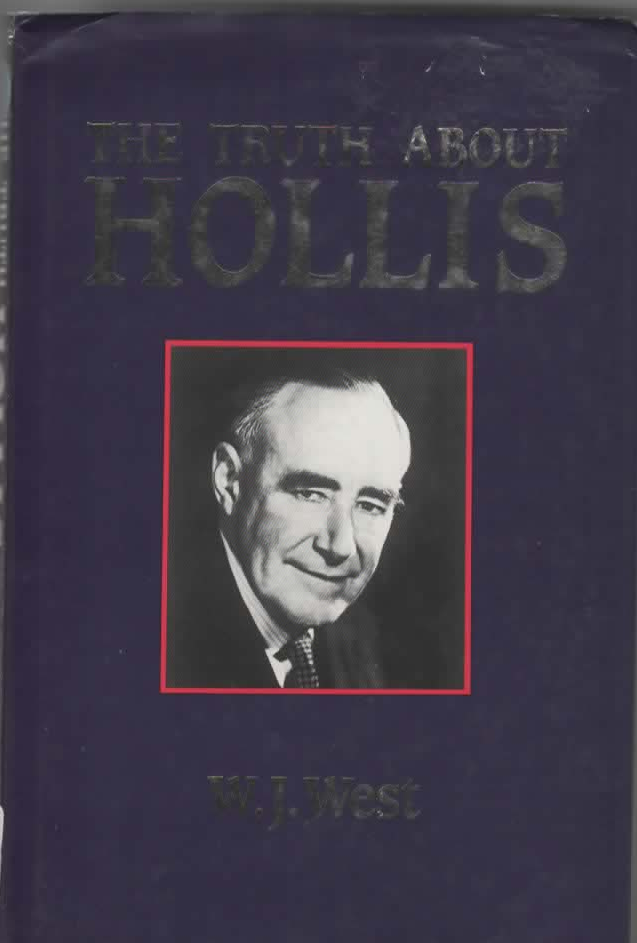
Hollis turns up in several other books. W. J. West’s The Truth About Hollis (1989) (re-printed in the USA as Spymaster: The Betrayal of MI5) contains much useful information about Hollis’s early life, but it is a rambling work, expressing Pincheresque tendencies, that sheds little detailed light on Hollis’s activities during World War II, and it indulges in a lot of speculation. West does provide some useful insights into Hollis’s relationship with Claud Cockburn, especially during the process to ban the Daily Worker in 1941. West had access to the file on the banning of the Daily Worker (HO 154/25140), but the PF on Cockburn (KV 2/1546-1555) was not released until 2004, five years after West died. West did manage, however, to extract from the National Archives in Washington a document provided by the Security Executive to the FBI which summarized Hollis’s admittedly favourable opinion of Cockburn. (I pick up below the threads of Pincher’s and West’s accusations against Hollis.) West also stresses that Hollis was solely responsible for the oversights concerning Klaus Fuchs. The recurrent problem of such analyses that suggest that Hollis was a dangerous lone wolf undermining the nation’s security is that they credit him with a large amount of inexplicable influence over his senior officers.

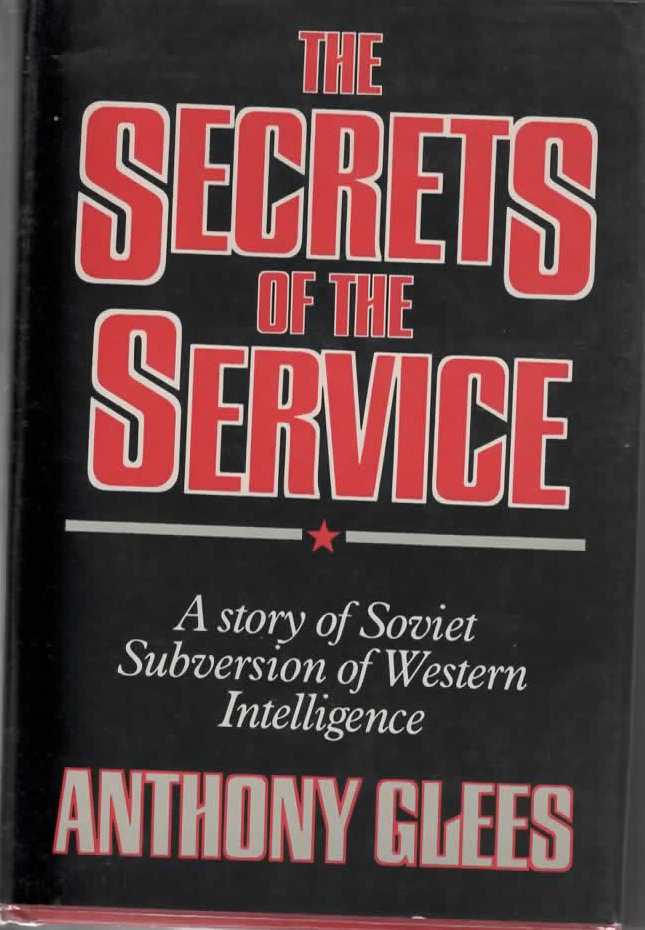
‘The Secrets of the Service’

In his Secrets of the Service (1987), Anthony Glees offered a spirited defence of Hollis against the allegations made by Chapman Pincher. Glees presented some searching and highly logical, analysis, but his book is marred by a) his taking Pincher’s accusations too seriously; b) his being too easily impressed by Foreign Office mandarins (in particular Patrick Reilly); and c) his lack of access to archival material. In addition, the introduction of possibly useful material is flawed by its anonymity. For example, on page 326, Glees refers to a document titled ‘List of Foreign Communists considered dangerous by MI5’, reportedly passed by ‘Hollis’s section’ (B4?) to the US Embassy on December 26, 1940. This is a document that Pincher had ‘come across’ (‘how?’, one might ask), and which he had generously passed on to Glees. Yet the document is neither identified, nor described fully, nor re-presented (photographed). Moreover, Glees then goes on to write about ‘the MI5 reports that I have seen’, without explaining how he gained access to them, or who wrote them, when. This is not good historiography, and Glees’s claims cannot be followed up for verification.

Mike Rossiter’s profile of Klaus Fuchs, The Spy Who Changed the World, is intelligently written, but does not mention Hollis until the events of 1949, when Fuchs returned to Britain. Trinity, the compendious biography of Fuchs by Frank Close, is generally excellent, offering meticulous inspection of the archives. Close covers the oversights concerning Rudolf Peierls’s approaches to have Fuchs join him in Birmingham in July of 1941 (see below), which triggered exchanges between C. C. H. Moriarty, the Chief Constable of Birmingham, and Milicent Bagot of F2B. What is extraordinary is that Bagot signs the letters under David Petrie’s name, as if they were working in close co-operation. Close rightly observes that Hollis did not appear to be involved in these discussions. But the author mistakenly presents Hollis as being head of F Division at that time, when he did not replace Curry until November 1941. Hollis’s role as head of F2 should have required him to be closely attentive to the Fuchs case, but Petrie appears to exclude him. Thus a remarkable phenomenon is overlooked: both Hollis and Curry were for some reason kept out of the loop over Fuchs’s recruitment, while Petrie’s involvement can hardly bolster a case that claims that Hollis behaved wantonly, as opposed to carelessly, over allowing Fuchs into a sensitive project. While sometimes challenging Pincher on his more questionable claims, Close is also a bit too willing to use him as one of his primary sources.

‘A Matter of Intelligence’

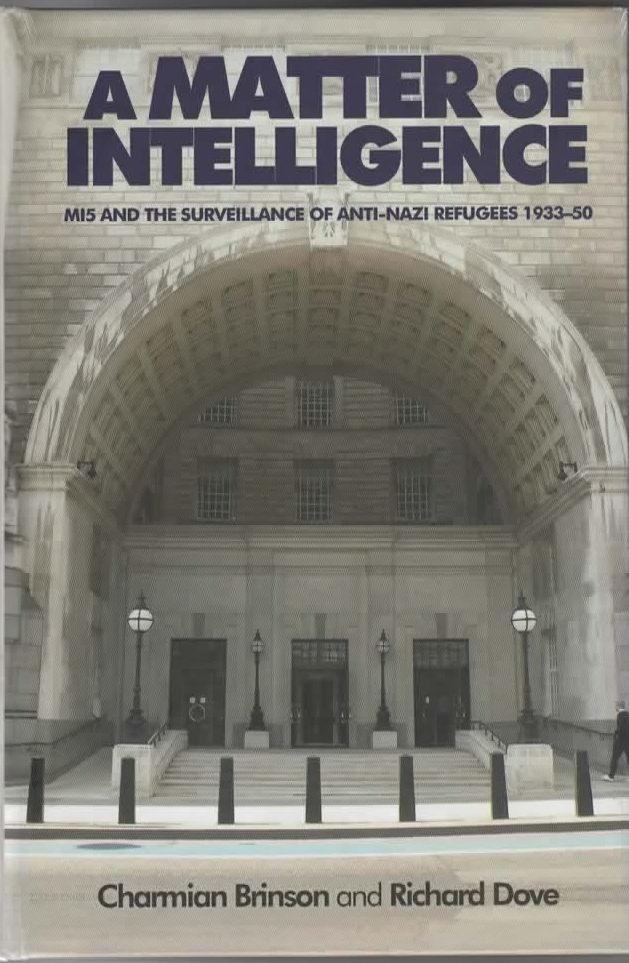
A Matter of Intelligence, the 2014 work by Charmian Brinson and Richard Dove, subtitled MI5 and the Surveillance of Anti-Nazi Refugees 1933-50, is an uneven work. The authors are a bit too keen to tilt the balance in favour of Pincher’s claims about Hollis. Their book contains much valid scholarship, as well as some sloppy attribution. For example, on page 199 they claim that, on June 2, 1942, Hollis, writing as C2B, after making ‘only desultory checks’ on Fuchs’s application for naturalization, approved the process, citing KV 2/1245. They quote the report from him that stated that MI5 had no objection The trouble is that the request for information truly did originate from C2b (Mrs Wyllie) on May 28, C Division being responsible for Examination of Credentials. The note was addressed to F2b, in the person of D. Griffth. Griffith replied on May 30 that MI5 had no objection, allowing Wyllie to contact the Home Office, as she did, on June 2, confirming the judgment. Hollis does not appear anywhere in this exchange: he was in fact absent in the sanatorium at the time. Thus another myth entered the books. In addition, Brinson and Dove also misrepresent the attitude that Hollis took to the suspected espionage of Engelbert Broda in May 1943, when he expressed his opposition to applying surveillance on him (see KV 2/2350). They do not faithfully reflect Hollis’s complete statement, which I explore below. They intriguingly assert (without giving evidence) that Hollis was known as ‘the master of inaction’ within MI5.

The substantial volume produced by K. D. Ewing, Joan Mahoney, and Andrew Moretta, titled MI5, the Cold War, and the Rule of Law (2020) contains a few pages on the post-Springhall clamp-down on Communists in government, using KV 4/251. They do, however, miss the main point, echoing the untruth that the CPGB encouraged espionage, and even annotating the absurd tale that Springhall had been named (by Andrew Boyle) as ‘running the Cambridge Five’. (I cover those episodes below.) Finally, Ian Maclaine’s Ministry of Morale (1979) cites a memorandum written by Hollis to the Foreign Office in October 1940, which gives a ringing endorsement of Hollis’s insights as he took over Archer’s role. It is worth quoting: “MI5 voiced astonishment at the Ministry’s failure to appreciate the link between the British communists, the Soviet Union and the Comintern, an attitude largely irrelevant to the matter at hand but one shared by Lord Swinton’s Committee on Communist Activities, an interdepartmental body which monitored the doings of British communists.” (INF 1/910). [This was a new one on me: file CAB 123/55 at TNA indeed covers this Committee’s activities, and I have added it to the list to be photographed.]

Guy Liddell’s Diaries

[Liddell’s Diaries, if interpreted with caution, can provide some valuable insights into the dynamics of MI5’s operations. Yet we must bear in mind that they are episodic, not comprehensive, and thus not necessarily representative, and may even show biases. Hollis assuredly had significant conversations with other MI5 officers (particularly White and Petrie) that were never recorded for posterity.]

Guy Liddell maintains a running commentary on his interactions with Hollis through the war years. Immediately war broke out, with the Soviet Union a party to the Non-Aggression Pact with Nazi Germany, Guy Liddell brought Hollis in to try to resolve how MI5 should treat the Communist Party. In this respect, it may be with deliberation that Liddell apparently bypassed Jane Sissmore, since he chose the day of Sissmore’s marriage to Joe Archer (September 2, 1939) to have this first recorded conversation. Here Liddell cites Hollis as saying ‘that the Communist Party shows strong signs of supporting the war on grounds of Germany’s aggressive action to deprive the Poles of their independence’ (a line shortly to be undone by Moscow’s rebuke of the CPGB), but, oddly, Hollis is also brought into consultations on British Fascists (September 25). On December 11, Liddell reports that Hollis’s notes on Willie Gallacher and Captain Archibald Ramsay (the fascist sympathizer) have been shown to the Prime Minister.

Moreover, on February 13, 1940 (just before Krivitsky returned to Canada), Liddell records that he ‘had a talk with Roger Hollis about the Communists in the event of a war with Russia’, suggesting that Hollis already had an authority beyond what the managerial structure would indicate, and that he was not solely involved with communist subversion. Jane Archer was no doubt completely occupied with Krivitsky at this time, and preparing her report, but it is clear that she has nothing now to do with possible suppression of the British press. Liddell has further discussions with Hollis on how the CPGB and Communist shop stewards should be dealt with should war with the Soviet Union break out. By March 18, Liddell is able to report that ‘Roger’s plan for dealing with the Communist Party here is now complete and is being sent to the Home Office’, a plan that includes arrangements for internment. It is Roger’s plan, not Jane’s.

It is now that the pair go to talk to the mysterious G. H. Leggett (see https://coldspur.com/astbury-simon-long-and-blunt/), Hollis’s actual status and office in MI5, and his professional relationship with Archer in MI5, remaining undisclosed. They seek Leggett’s advice on ‘what to do about Communists?’. Yet Liddell had gone to see Leggett, without Hollis in attendance, on January 4, when he reported that Leggett thought that the Daily Worker was making a fool of itself over the Finland business [the Soviet Union’s attack on the nation], and that Labour leaders were revelling in its clumsiness. Thus Leggett believed there was no point in trying to suppress the newspaper now, although he thought it should not be exported. Did Liddell use this occasion to feed Hollis with guidance on what would be a sensible strategy? It is all very strange. On February 20, Hollis had gone to see Leggett, alone, and Leggett strongly suggested that interning CP leaders would receive strong support in Trade Union circles. Liddell (to whom Hollis must have reported this conversation) reflects that he is not so sure, and shows himself to be a ditherer, and not a good delegator.

Soon afterwards, Hollis is indisputably collaborating with Dick White, as in early April they jointly present a memo that outlines the threat for espionage and sabotage represented by communists. The advice is firmly in favour of internment, and restrictions of movements. By June, however, Hollis visits Leggett again, who does not want to use 18b (Defence Regulation B, allowing internment without trial) against communists, unless there were exceptional circumstances. This advice would suggest that Leggett was at this time part of the Legal team in MI5. The service had enough on its plate at this stage of the war, since, with Churchill’s arrival as Prime Minister, the pressure for interning more right-wingers – as well as any refugees from Germany –  intensified. From an intelligence standpoint, however, the moves would suggest that MI5 was taking the Nazi-Soviet Pact seriously, and did not yet regard it as merely a tactical convenience.

In echo of this assessment, a significant entry for August 26, 1940, contains the startling conclusion by Hollis that Moscow is intent on fomenting conflict, revealing its message that ‘no steps should be taken to oppose a German landing in this country since a short period under a Nazi regime would be the quickest way of bringing about a Communist revolution’. Hollis had studied CPGB documents that had been in the possession of one Eric Godfrey (a mysterious figure who was something of an irritant within the CPGB: how MI5 gained access to such papers is not explained). While he seems to have taken on a responsibility that should properly have been handled by the Joint Intelligence Committee, a crisper reminder of the danger from Moscow could not be asked for. In fact, Hollis’s concerns did reach higher echelons, since he and Liddell met with the Vice-Chief of the Imperial General Staff on October 5 to discuss Communism and troop morale.

The record on Hollis for 1941 is sparse, although tensions can be seen by early April, with the new Director-General, Petrie, devising plans that would effectively relegate John Curry (who had become Liddell’s deputy in September 1940), and Hollis, in favour of Theo Turner, who would command an overriding ‘Aliens block’. After Curry, Hollis and Liddell conferred with Menzies and David Footman about setting up a cross-service group to handle ‘contemporary social movements’, that initiative was quashed by Petrie’s re-organization of April 22, when the new F Division was set up under Curry, relieving B Division of subversives and aliens control. Curry, with his keen insights into the Comintern’s machinations, felt he was being sidetracked. Liddell wrote how depressed Curry was at his loss of status, and in early October, he was moved into a staff position under Petrie. (Curry elsewhere stated that he could never work under Dick White.) Thus the position of head of F Division, with the title ‘Assistant Director’, fell into Hollis’s lap.

Soon afterwards, Hollis was out of action because of a recurrence of his tuberculosis. Pincher records his succumbing as occurring in November 1941 (a date that should not be trusted), and Liddell’s next mention of Roger is not until October 7, 1942, when he records that he has returned ‘after a long illness’. Presumably F Division marched on without him. (Elsewhere, Roger Fulford is recorded as standing in for him.) Hollis was not known as a very inspiring leader: he kept information to himself, and behaved rather disdainfully towards his troops. Yet he had been keeping an eye on matters from his sanatorium. Maxwell Knight had written a paper in September 1941 titled ‘The Comintern is not dead’, thus warning of casualness in interpreting the new alliance with the Soviet Union. Apparently Petrie (and Roger Fulford) had implied that the Comintern had ceased to function. (How Curry, in his research position, and with his confidence that he understood the communist threat as well as anyone, had contributed to that idea is not stated. Stalin did not formally dismantle the Comintern until 1943, and that move was a bluff.) Pincher reported that, on July 6, 1942, Petrie passed to the Home Office and the Foreign Office a memo from Hollis on the subject, showing that he must have been cogitating from his sick-bay.

That diary entry for October 7 shows that Liddell and Hollis were well alive to the danger, and were resisting Petrie’s complacency. It includes this passage: “Neither Hollis nor I think that there is any evidence to show that the policy of the Soviet Govt. and the Comintern has changed one iota. Clearly the second front campaign is dictated from Moscow. Whether the instructions come by courier or through the Embassy makes no difference. There is no doubt that the Russians are taking every possible advantage of the present situation to dig themselves in and that they will cause us a great deal of trouble when the war is over.” And a few weeks later Liddell writes (on October 27): “Roger Hollis came to talk to me about the Communists. We appear at the moment to be extremely well informed about their activities. There is no doubt that they are trying to make hay while the sun shines, and serious efforts are being made to penetrate the armed forces.” There is an irony about this: by ‘Communists’, Hollis no doubt means the CPGB, since he and his fellow-officers were obviously not well-informed about the activities of the penetration agents.

While Hollis had been away, furious arguments had been going on about the ACE (Amalgamation of Counter-Espionage) project, an initiative to combine the CE forces of MI5 and MI6 into one unit, which had been provoked by the phenomenon of MI6’s (and SOE’s) agents arriving in the country, and thus immediately coming under MI5’s bailiwick. MI6 resented the intrusion, and was protective of them. On the other hand, MI5 did not trust MI6’s records, and insisted on interrogating possibly dubious characters who arrived at the London Reception Centre in Wandsworth. Memoranda were exchanged between (predominantly) Petrie and Vivian. Liddell and White judged that Petrie did not acquit himself well, and there were obvious concerns on both sides about which service would take control if there were some sort of merger. Claude Dansey was a malign influence in the background. Hollis had largely escaped this controversy, as if the challenges of overlap in counter-espionage were restricted to the threats of disguised German agents, but as 1943 drew on, the subterranean threat from Soviet communism moved closer to the surface.

In March 1943, Section V of MI6 actually asked for Hollis’s help in providing someone versed in communism to help them. And, later that month, a meeting between Hollis, ‘Tar’ Robertson and White expressed concern about how Hollis should contribute to the monthly report on MI5’s activities to the Prime Minister – a recently initiated procedure, agreed to by Petrie and Duff Cooper, about which MI5 was necessarily nervous, given Churchill’s inclination to meddle. ‘How much should Hollis reveal about Soviet espionage?’ was the voiced worry, with Liddell describing it in ambiguous terms that suggested that the matter went further than CPGB intrigues. Liddell noted it as follows: “I had a talk with Hollis about doing something more about Soviet espionage. There is no doubt to my mind that it is going on and that sooner or later we shall be expected to know about it. On the other hand if we take action and get found out there will be an appalling stink. Hollis and I are going to discuss the matter with Loxley on Monday.”

This may have been referring solely to the David Springhall affair. After being surveilled for a while, Springhall was arrested in June when caught red-handed with a document provided by Olive Shehan in the Air Ministry, but the nervousness and indecision suggest darker subversions. Liddell senses that more is going on than MI5 can confirm, and it could be interpreted to mean that the espionage may go beyond disclosures by CPGB members to Soviet Embassy officials to hostile acts undertaken by the Soviets themselves. It is impossible to tell, although, much later, in a diary entry for February 3, 1947, when Liddell recorded his view that Blackett should not be on the Scientific Advisory Panel for the London Controlling Section, he strongly intimated that Blackett had passed confidential material to Springhall. In any event, Liddell appears, however, to be torn between conflicting objectives: investigating possible Soviet espionage might lead to obloquy if such ventures were detected, given the sensitive relationship with Soviet Union as an ally, and its ongoing claims that Britain was being dilatory over the ‘Second Front’. On the other hand, if MI5 did nothing, it would likewise be criticized for ignoring a durable threat. Peter Loxley was a well-respected ally in the Home Office (and lost his life in an air-crash on the way to Yalta in 1945). Maybe Liddell did not trust Petrie to try to gain a clearer statement of policy from the Prime Minister himself.

‘Churchill’s Spy Files’

As it turned out, Hollis was excluded from the list of officers who provided reports, and Petrie took it on himself to summarize the Springhall affair for Churchill. Nigel West’s compilation titled Churchill’s Spy Files shows that the reports focused almost exclusively on Nazi espionage, and especially the exploits of the ‘double agents’. Petrie’s brief accounts of the Springhall episodes describe how he and other CPGB members were disclosing secrets to the Soviet Embassy, but Petrie is careful to point out that the danger to British security comes from the undeniable loyalty to Soviet Russia of CPGB members, and makes no mention of externally driven espionage – such as might have been pursued from Krivitsky onwards. I also point out here that the officer entrusted with gathering all the information for the monthly report was Guy Liddell’s assistant, Anthony Blunt.

Hollis was certainly alive to the multi-headed communist threat. He knew that the Fighting French were riddled with communists, and looked for guidance as to how to warn them of the fact, given that they seemed insouciant. On June 7, 1943, he told Liddell that he wanted telephone checks and special facilities on certain doubtful members of the Russian Trade Federation, who were probably roaming around stealing industrial secrets. He was closely involved with the Springhall trial, its security implications, and its aftermath, and he tracked how Springhall’s diary led to the identification of Ann Greeson and Ray Milne, a Soviet loyalist in Section V of MI6, who was in due course dismissed, and to the SOE spy Desmond Uren. (I cover more deeply Hollis’s actions during the Springhall investigation below, under ‘Other Archival Sources’.)

The end of the year saw Liddell and Hollis discussing succession-planning, with Liddell starting to campaign for himself as Petrie’s successor, and recording that both White and Hollis judged that he was the right man for the job. (Harker, while nominally deputy, had discredited himself in the early days of the Security Executive.) Hollis had opinions of his own – specifically on Maxwell Knight’s organization. He deemed that Knight had in general done a good job running his agents, but was too removed from the action in his Dolphin Square fastness. It appears that Hollis also disapproved of some of the enticement efforts undertaken by Knight’s intrusions into fascist cells. Liddell had brought up the Marita [Perigoe] case, expressing the desirability of flushing out such dangerous persons, and Hollis perhaps shows here a depth of character otherwise concealed. Liddell writes (October 4): “Roger’s view is that the country is full of evilly-intentioned persons but that there is no necessity to drag them out of their holes. They had much better be left to rot in obscurity, and will be swamped by the common sense of the community as a whole.”

In fact, Hollis was so concerned about the isolation of Knight’s group that he wrote a paper in November, claiming that it was completely out of touch with F Division. He stated that he had not seen Knight for three months – but does not explain why he had not himself made overtures. That was characteristic. Hollis often waited for people to approach him rather than taking initiatives himself – and he suffered from some of the same traits of not adequately mingling with his own people (‘Management by Walking Around’ it was called in the 1980s), or engaging with other officers. Liddell appeared to agree with Hollis that Knight’s agents should be managed by a relevant officer from F Division, but again, Liddell must have been equally responsible for not approaching Knight directly. On November 29 Hollis came up with an example where Knight’s agents wasted time on a known miscreant, a stateless Russian who was known for telling everyone that he was an agent of the OGPU, and he pointed out that Knight should have consulted him.

Post-war reorganization dominated discussions in 1944. Curry continued his prima donna poses, wanting to enjoy seniority over White and Hollis, not realizing his zenith was over. According to Hollis, Curry wanted to keep on working with the ISCOT project (decrypted Comintern messages from Eastern Europe) when Hollis himself had set his eyes on owning it. Hollis was also under pressure from MI6, who wanted to annex F Division, and he had written up some original ideas for the amalgamation of MI5 and MI6’s Sections V and IX, recommending they be housed in one building, with a shared registry, but separate managements. Hollis seems to be leading the debate, and influencing Liddell, although Liddell shows a rather naïve opinion on how the Soviets might plan to use the CPGB to apply pressure on the Government.

No doubt concerned about his own future, Hollis also made some territorial moves of his own. In a cryptic diary entry for September 26, 1944, Liddell wrote that Hollis had approached him about ‘taking over B.4a and the formation of a renegade section under Shelford’. It is clear that it was not the section itself that was renegade, but the class of defaulter that would be tracked. Under Hollis, Shelford led F3, which bore the rather ponderous title of ‘Fascist, Right Wing, Pacifist and Nationalist Movements, pro-German and Defeatists’ and whose job may well have been less onerous by then. Seymer may have replaced Jock Whyte in B4a (‘Escaped Prisoners of War and Evaders’ – hence the ‘Renegades’), and Hollis might have made a good case that this group did not belong under ‘Espionage’, and had more of an affiliation to F3’s work. Liddell managed to convince Hollis that there was no special value in getting Shelford and Seymer collaborating in the same room, and the matter was dropped pending a proposal to Petrie. Ominously, on November 27, Blunt approached Liddell seeking assistance from Hugh Shillito, who worked for Hollis. Hollis responded to this by telling Liddell that Shillito was ‘lazy’, and therefore of not much use to Blunt. Was this a feint? Shillito had earlier shown himself to be more perspicacious and eager than his senior officers in investigation into the Beurton affair, and he had been congratulated by Hollis on his report on Green, but was discouraged from following up further. It is difficult to discern exactly what games were being played here.

Hollis does not come off well in the final months of the war. Curry was still after his job. Hollis might have had an ally in Jane Archer, however. Jane brought over from MI6 to Hollis (rather than to White or to Liddell or even Cury) her report on the ISCOT decryptions, and Hollis presented it to Liddell on March 30, 1945. Despite Hollis’s professed desire to take over the project, it seems a formality rather than based on any idea that Hollis might have insights into the Communist Internal Liquidation Committee, which, as Liddell pointed out, had replaced the Comintern. Yet Hollis had other staff problems. In April, he said that he wanted to get rid of Shillito, and then the redoubtable Milicent Bagot expressed her frustrations with working for Hollis, saying that she wanted to join the Austrian Control Commission. Hollis would not stand in her way. Perhaps he had given up on his own future: he even suggested that Russian espionage should be handed back to B Division (despite the fact that White claimed that he had never relinquished it completely). Again, there may be confusion between CPGB-based espionage and more clandestine Soviet agents: Liddell again showed his naivety by indicating that all Soviet espionage occurred through the Party. In any case, where Soviet counter-espionage went, Bagot should have followed. Right at the end of the war, John Marriott expressed his frustrations with working for Hollis: it seemed that his boss kept too much close to his chest, and was not easily approachable. It was not a very distinguished performance by Hollis and Liddell as the war wound down.

Other Archival Sources

In my analysis above, I have used the single Fuchs file from this period (KV 2/1245) to show Hollis’s actions (or inactions). The other major items of evidence are the substantial collection of files on Douglas (‘Dave’) Springhall (KV 2/1594-1598, and KV 2/2063-2065), and a file on the challenge of known communists working on secret government work (KV 4/251). I also inspect the Home Office file on the suppression of the Daily Worker (HO 144/21540), which event excited Chapman Pincher when he considered the friendship between Hollis and Claud Cockburn. The Kuczynski files (specifically KV 2/1871-1877 for this period) are remarkable for Hollis’s complete absence from the scene. Milicent Bagot industriously tracks all of Jürgen Kuczynski’s movements (while his mail is also intercepted), but, even after Hollis returns from convalescence, Bagot handles everything, including granting explicit permission for Kuczynski to be recruited by the USAF as a statistician. The Engelbert Broda material, in KV 2/2349-2354 includes a few provocative items. A short item in the file of George and Edith Whomack (KV 2/1238) is also worth noting. These excerpts are by no means inclusive, but they should be representative. (I encourage any reader who has tracked other significant actions by Hollis to contact me.)

David Springhall

Douglas ('Dave') Springhall
Dave Springhall

The Springhall case was a coup for F Division, exploited by Hollis to highlight the insidious nature of the CPGB, and the misplaced loyalties of its members – not that those phenomena should have been of any surprise, but the conviction proved to be a propaganda opportunity with the British public. Springhall had been a very obvious, militant communist rabble-rouser for years, and had been closely monitored. Hollis appended his initials, as F2a (actually W. Ogilvie), in a memorandum to Special Branch, on December 11, 1941, advising the unit of Springhall’s change of address. Matters began to heat up in early 1943, when the Home Office showed renewed interest in Springhall’s activities. Hollis provided evidence to Sir Alexander Maxwell of Springhall’s visit to the Soviet Union in August-September 1939. Because of the close surveillance, Springhall’s clumsiness, and the sharpness of the flat-sharers of his informant Olive Shehan, Springhall was caught in the act of receiving confidential documents concerning the RAF’s ‘Window’ project.

On June 6, Hollis wrote a detailed report describing the circumstances around the decision to arrest Olive Shehan, with Special Branch and Major Cussen of the MI5 legal team. By June 18, Springhall had been arrested as well, and Hollis effectively handed the case over to Sir Frank Newsam in the Home Office. Thereafter, Hollis’s role was to negotiate with such bodies as the Air Ministry, the Home Office, the Foreign Office and SIS over the nature of Springhall’s trial, whether it should be held in camera, how much publicity should be given to it, and, afterwards, how to use the conviction for propaganda purposes. On June 24, he accompanied Petrie and Harker to the Foreign Office, where Alexander Cadogan gave them a very enigmatic opinion about the implications for relations with the Soviets. The detailed analysis and follow-up were very competently managed by David Clarke of F2a (that same person highlighted by Christopher Andrew), who presented detailed reports on the findings arising from a study of Springhall’s diary, and the activities of his friends (such as Peter Astbury). His outstanding report of August 25, 1943, can be seen on page 16 of KV 2/1596-1.

The Communist Clamp-Down

As for the project to transfer communists from sensitive government positions, the record (in KV 4/251) shows how Hollis was prompted to use the Springhall case to effect a clamp-down on communists in sensitive government positions, but was frustrated by Petrie’s caution, and by Churchill’s meddling. [This section is effectively a re-statement of how I earlier represented Andrew’s analysis of the matter.] Yet other paradoxes remain. Hollis engaged Duff Cooper, then Chancellor of the Duchy of Lancaster, to present his case to the Prime Minister. In Cooper’s report appears this sentence: “Attached to this memorandum is a list of known members of the Communist Party employed on secret work in various Government Departments or in the Services, from which it will be seen that their net is very wide.” The offering contains no list of members, however: instead it lists all the affected departments, with a number opposite indicating how many CP members were known to be working for it. In a separate note of October 28, Hollis records that he handed to Cooper the list of names of the relevant Communists, thus indicating that the material needed to be kept confidential.

Cooper’s submission is accompanied by a report from David Clarke, dated October 21, 1943. Its overall tone is almost apologetic. It points out how the vetting system may have failed, but that the mishaps may have been due to out-of-date information. It records how risky decisions had sometimes been made in favour of dubious persons (specifically mentioning Professor Haldane), and points out that MI5 was frequently not informed of the nature of the secret work, precisely because it was ‘secret’. It declares that much ‘secret’ work has been carried out by private undertakings, such as I.C.I., and thus remains outside the vetting process. It stresses the loopholes that exist in vetting recruits for the Armed Forces. While describing the extent of the problem, however, Clarke carefully suggests that the exposure is primarily one of the CPGB’s gaining information illegally to further its own objectives. It never indicates that the Soviet government has been behind any such schemes of espionage, although it admits that it may have benefitted from being passed such information illicitly.

Cooper’s memorandum, in one of the additions inserted on Hollis’s recommendation, makes a stronger claim about the role of the CPGB in espionage: “Though the Communist Party disclaimed all knowledge of Springhall’s activities, it is known that in fact the Party machine is regularly used for espionage and that this has continued since the conviction of Springhall.” This was a weaselly and provocative assertion by Hollis. The passive ‘it is known’ calls out for a ‘by whom?’ If MI5 knows about the continuing espionage, why has it done nothing about it? In what forum has the CPGB disclaimed all knowledge, and how should that intelligence be interpreted? Neither Cooper nor Hollis appears to have been challenged over these opinions. That assertion about the Party’s continuing involvement in espionage, apparently invented by Hollis on the spur of the moment, never appears in Clarke’s submission.

Moreover, Clarke wrote a very deep and insightful report on August 25 (viewable on page 16 of KV 2/1596-1, and well worth reading) that provided support for the theory that the CPGB (‘King Street’) had not been aware of Springhall’s network, and that it strongly disapproved of it when he was arrested. MI5 had various means of tapping what the CPGB leaders were saying to each other, and Clarke’s introduction to his section ‘Soviet Espionage’ starts off as follows: “Although Springhall denied that he had any organization for his contacts, Pollitt is convinced that a special apparatus exists in this country for Soviet espionage. He has expressed his determination to get to the bottom of it and to cut the Party away from it. The use of Springhall as an agent has aroused considerable animosity against the Embassy among certain Party leaders. According to Pollitt the trial has caused some perturbation among Embassy officials.” All this seems to confirm that Springall was a rogue agent, acting without authority, whose escapades embarrassed both the CPGB and the Soviet Embassy.

Thus Hollis surely had some motive in ascribing to the CPGB an involvement in espionage that it did not deserve. Maybe he hoped that that formulation would aid his cause of taking Communists out. Perhaps he thought that such a framing of the proposal would distract attention away from the vaguer knowledge that agents well distanced from the CPGB were involved in dangerous espionage. In any event, his appeals met with resistance. Petrie was a cautionary advisor at his shoulder, as was Herbert Morrison, the Home Secretary, who performed a classic piece of fence-sitting. The Home Office and the Prime Minister were against any type of publicity for the initiative. Furthermore, Churchill wanted to replace the authority of MI5 with a panel led by members of the Security Executive, which Hollis and Petrie considered a bureaucratic nightmare, as the panel would require justifications of accusations made by MI5, while the Security Service would be reluctant to disclose from what ‘secret sources’ it gained its intelligence. The panel idea fizzled on throughout 1944. Hollis reported to Petrie, in November 1944, on Clarke’s deeper investigations into ‘certain high-class secret groups of the Communist Party’. Petrie noted that ‘we must proceed with the utmost caution’.

Engelbert Broda

Engelbert Broda

The contemporary case of Engelbert Broda is also enlightening. I earlier pointed out that Brinson and Dove inexplicably misrepresented the facts. They notoriously recorded that Hollis had been opposed to applying surveillance on Broda, even though he was probably passing on confidential information on the Tube Alloys project to the Soviet Union (July 7, 1943, in KV 2350/1). Hollis was responding to a request for verification on Broda from Captain Bennett in D2, since Broda’s employer, the DSIR (Department of Scientific and Industrial Research), had started to have misgivings about him. Moreover, Broda had been involved with more sensitive work recently. It is worth citing what Hollis said earlier in his note, citing records of the Broda case that appears in the file: “These show that the Department of Scientific and Industrial Research was warned of BRODA’s history, and that in spite of this took the responsibility of employing him, stating at the time that he would not be employed on the more secret part of the work. Apparently this latter undertaking has now been broken.” In other words – why does the DSIR not simply take action now, instead of coming crawling to us? Hollis’s late reasoning is nevertheless a bit perverse: he recommends that the DSIR might not want to fire Broda, as it might ‘embitter’ him. ‘Who would care?’, one might say: it would be better than continuing to nourish a snake in the grass.

These facts can be verified by earlier exchanges. Despite warnings from MI5, Sir Edward Appleton, the Secretary of the DSIR, declared in December 1941 that ‘the exigencies of this Department do override objections on security grounds to Mr. Broda’s employment on the work for which his services are desired; and that it is essential to ask that a permit may be issued accordingly for his employment by the University of Cambridge in the Cavendish Laboratory.’ He added that Broda would not be employed on the more secret part of the project. When the matter of his continued employment first came up in May 1943, Milicent Bagot (F2B) wrote: “There is evidence from his lectures that BRODA has followed the regular Party line both before and since the entry of Russia into the war. There is, therefore, a definite risk that any information that BRODA may get will be passed on to the Communists.”  One cannot be surprised that Hollis would express his frustrations over the obtuseness of the bureaucrats. Yet it is also astonishing why academics like Brinson and Rose would overlook such obvious facts.

George Whomack

In comparison with the Broda business, the incident with George Whomack is trivial. Whomack, who had been convicted alongside Percy Glading in the Woolwich Arsenal spy case, had been released from prison at the end of 1940. KV 2/1238 shows that, early in February 1941, the Bexley Labour Exchange had passed Whomack on to a firm called Napier’s, which made aircraft engines. The Exchange had then informed his employer that it had discovered that Whomack had served two years in gaol for espionage. Joe Archer (D3, the husband of Jane), responsible for RAF liaison, was not happy. On February 22, he registered his strong protest to Hollis in B4 at the exposure invoked when MI5 allowed convicted spies to be employed in munitions factories, and he described the firm’s ‘indignant’ reaction. Hollis had to apologize, admitting that he had failed to ask Special Branch to keep a watch on Whomack (although he had done so with Williams). He explained how difficult it was, in any case, to keep track of such released prisoners unless MI5 took the Labour Exchanges into their confidence. This was a rather sophistical argument by Hollis: the problem was convicted spies with Communist backgrounds, not simple felons. Yet his error would appear to be mere carelessness and oversight rather than malicious intent. If Hollis had really been a Soviet agent, he surely would not have made such a self-evident and revealing decision!

Claud Cockburn and ‘The Week’

Claud Cockburn

Claud Cockburn had been in MI5’s sights for years. His PF, specifically KV 2/1552, shows that, at about the time war broke out, he was not considered particularly harmful. An anonymous and note in that file, undated (but surely created in August 1939), in the context of positioning Cockburn’s weekly newsletter The Week, runs as follows: “Cockburn is an important member of the Communist Party and is said to be closely connected with the Western European Bureau of the Comintern. It is certain that he has large number of very knowledgeable contacts in this country and on the continent, and he is general well-informed. The Week is written from a left-wing angle, but it is not openly communist. It has been issued regularly since March, 1933, and so far nothing to which we could take exception has been published in it.”

This is rather feeble and provocative item, to my mind. For whose eyes was it intended? Since Cockburn was an important member of the Communist Party, what was the distinction between ‘a left-wing angle’ and a Communist line? What would make its opinions ‘openly’ communist? Why the passive ‘it is said’? Does MI5 not have firmer intelligence than this? Why is there no concern expressed about his ‘very knowledgeable contacts’ in the UK? Yet the fact that the author reports that MI5 has been tracking The Week for six years – apparently without dismay – suggests that it was not written by Hollis, who had, after all, been with the Service for only just over a year, and would not have been entrusted with making such a judgment.

By then, The Week was expanding its distribution, and had been available in the USA since July 1939. Complaints started arriving that autumn, and in November MI7 (a Military Intelligence section), distressed by an article written by Cockburn in the Daily Worker, wrote to Hollis asking why ‘this stuff’ was not being suppressed. Hollis replied that MI5 had taken up the matter with the Foreign Office and the Home Office, but he did not state the obvious – the fact that MI5 was not in the business of censorship. Hollis issued a modified version of the August note on January 9, 1940. Two weeks later, he wrote to Frank Newsam in the Home Office, advising against Cockburn’s being allowed to visit Finland, declaring that MI5 believes that he is a member of the Comintern, and signing off by stating that ‘Cockburn is in our opinion one of the most dangerous members of the Communist Party in this country  . . .’ That was pretty forthright.

Yet Hollis was not the only MI5 officer involved. On March 13, the US Embassy complained to Guy Liddell, who in turn (as B4b!) asked Gladwyn Jebb in the Foreign Office whether Cockburn’s cables to the USA were being given preferential treatment. On April 8, Director-General Vernon Kell informed the Commissioner of Police in Trinidad that The Week had not so far ‘given the censors any cause for complaint’. On April 16, Lord Halifax, the Foreign Secretary, wrote to Sir John Reith at the Ministry of Information, requesting tighter censorship procedures. Jebb replied to Liddell on April 20, saying that the Foreign Office was not responsible for censorship. On May 6, Kell informed the Defence Security officer in Hong Kong that MI5 had ‘no objection to the circulation of The Week’: his letter mysteriously went out under Hollis’s signature, but he must have approved it, even though, apart from alerting the Home Office to possible leaks of information on May 15, it may have been one of his last acts as D-G. He echoed that opinion on May 28 to the Inspector-General of Police in Singapore, and likewise to the Commissioner of Police in Kenya on June 10.

By July, Jasper Harker had taken charge. On July 12, Maxwell in the Home Office informed Harker that the Home Secretary (John Anderson) was under some pressure to stop the publication of The Week, possibly by interning Cockburn, and asked Harker whether he could send Anderson a report on him. Harker advised caution: Cockburn’s detention would cause ‘a good deal of trouble in journalistic circles’, although Cockburn would be on the list for immediate arrest should the Communist Party be banned. He recommended that Defence Regulation 2C or 2D should be invoked if the Home Office wanted to stop The Week. On October 11, Hollis declared to the Home Office that he had conferred with the legal people at MI5, who had opined that certain passages from The Week amounted to sedition under Common law. Hollis called for checks to be applied to Cockburn, and he added that MI5’s legal section was contacting the Director of Public Prosecutions. The DPP was cautious, trying to pass the buck to the Secretary of State to apply Regulation 2D. Everyone appeared to be wary of being the first to exploit the emergency powers that had been granted. On October 25, the Home Secretary decided that prosecution for seditious libel against Cockburn would not do any good.

The next item in the file is a copy of a letter to his subscribers by Cockburn, dated January 31, 1941, which explains that The Week has been suppressed by the Home Secretary under Regulation 2D. I thus turn now to HO 144/21540, which covers a variety of possibly seditious and anti-war activities. By late 1940, several ministries had become concerned about the number of communist leaflets that were being distributed outside factories, and in general assemblies, and at a meeting of the Security Executive on January 25, it was unanimously recommended that the Daily Worker be suppressed, but that the Communist Party itself not be banned. Curiously, another note records, on January 23, that the War Cabinet had already decided, before January 17, to suppress the newspaper. This memorandum reflects the fact that the procedure to enforce it had been discussed with Mr. Hollis of M.I.5., with others. This is the only occasion when Hollis’s name appears in the file.

What is extraordinary is the fact that W. J. West relies exclusively on HO 144/21540 for his accusations against Hollis, including an assumed request in 1940, when the Security Executive sent a strong request to Harker, requesting immediate action over a seditious article in the Daily Worker. According to West, who quoted the words of Harker from an undated memorandum, Harker replied that nothing could be done, referring to a file that indicated that nothing published ‘could be produced in court as evidence about the secret machinations of the communist party’. West illogically goes on to suggest that this statement shows that Hollis was keeping direct control over Cockburn’s file, or was even using him as an agent. He affirms that Hollis continually objected to the ban, but provides no evidence. Yet HO 144/21540 contains no such item: either the file has been severely bowdlerized since West saw it, or he was shown extracts that may have derived from other files – such as those belonging to the Security Executive. The absence of any decision on The Week in the records of HO 144/21540 suggests that West may well have been shown other material, and then blurred his story to protect his sources. (In his Preface, he claims that all the documents he cites have been derived from files made publicly available in four sets of National Archives.)

In any case, the range of opinions articulated by other MI5 officers shows that Hollis was not an independent instrument with a unique ability to contradict and confound the judgments of his superiors. Whether he was truly honest over his relationship with Cockburn, or even warned him about the investigation, is hard to tell, but for an apprentice agent for the Soviet Union to stick his neck out over such a matter, and presumably gain only disdain and disapproval from his superior officers at the beginning of his career, would have been quite absurd. On the other hand, it is clear that Pincher deliberately ignored the evidence in Cockburn’s PF because it was inconvenient to his story, while West, who did not have access to that same file, elaborated his own account out of faulty record-keeping, or because he was leaked information by someone who wanted to blacken Hollis’s reputation. And, of course, HO 144/21540 (which has enjoyed a convoluted history) may well have been weeded since its original release – a date that is not shown in the registry of the archives.

Incidentally, Churchill rescinded the ban on the Daily Worker in February 1942, and a similar decision allowed The Week to resume publication later that year.


Conclusions

  1. Roger Hollis spent a workmanlike but undistinguished career during World War II. 1940 was spent on relatively mundane tasks after the transfer of Jane Archer in September 1939. In 1941 he had to come to grips with Petrie’s re-organization. He was absent sick for most of 1942. 1943 was dominated by Springhall, Fuchs, and the renewed attention to the CPGB. 1944 and 1945 were consumed by preparation for post-war organization. Hollis showed no sign of potential Director-General material, nor did he offer any evidence that he was a deep penetration agent for Soviet intelligence.
  2. Hollis’s instincts were in the right place, but he did not give indications that he was a profound thinker. He may have struggled orally, and he probably preferred to marshal his ideas in written format. At least, Guy Liddell liked some of his reports. Hollis made a number of errors in logical thinking in his reactions to events.
  3. Hollis was not a good personnel manager. He was aloof and often unapproachable. It seems that he misjudged the talent he had working for him, such as in his opinions of Shillito. When he was in charge of F Division, it would have been highly irresponsible if he had allowed Milicent Bagot (who must have been frustrated that her warnings were ignored) to leave the service. Hollis showed a lack of engagement with Bagot as she tried to unravel the malign influences of Soviet intelligence, surely because he considered that she was going beyond her charter.
  4. As the war drew to its close, Hollis rightly started to be concerned about his future. Fortunately, he had an ally in Jane Archer, and Guy Liddell seemed to appreciate his insights and underplay his weaknesses, which worked in his favour.
  5. The September 1939 break-up of B4 into the highly strategic B14 unit and a new, stripped-down B4a is highly significant, but has been ignored by all historians. Hollis’s B4a was left with a more mundane mission investigating possible subversion in British institutions: moreover, he was not responsible for Miss Bagot’s more strategic B4b. The clandestine way in which B14 was set up, and then dissolved, points to alarming equivocation by Liddell and White (whose fingerprints are on the schemes). The saga undermines the whole Pincher story.
  6. It is clear that Soviet counter-espionage was badly mismanaged beyond those events, and throughout the war. Petrie and Liddell admitted it. Hollis was given neither the directive nor the resources to tackle the broader threat, and his energies were focused on the activities of the CPGB and other subversive groups. Dick White managed his own unit watching Communist agents. Petrie was in close contact with Hollis throughout the war: if he had wanted Hollis to perform otherwise, he would have directed him to do so.
  7. The evidence above reinforces the idea that a cabal of senior officers in MI5 withheld information from their junior officers, leading to much wasted time and frustration. Apart from the Philby, Blunt and Burgess fiasco, the circumstances of the Beurtons, Kuczynskis, and Klaus Fuchs confirm that some secrets were too sensitive to be shared with the troops responsible for carrying out the real investigations.
  8. Petrie and Hollis were nervous about upsetting the ministries over communist suppression. After Barbarossa, government ministries were much more indulgent towards useful scientists with communist backgrounds. In addition, the government bureaucracies showed a great deal of pusillanimity in handling troublesome situations, unwilling to take the bull by the horns, and keen to pass decisions on elsewhere. That behaviour was totally different from how the Nazis or the Communists behaved, but it was in the cause of such pluralist muddle that the war was being waged.
  9. Chapman Pincher was a charlatan: his poisonous attacks performed long-lasting damage.

Lastly, for those who have not yet seen them, I direct readers to my verses on Liddell and Hollis, at https://coldspur.com/the-diary-of-a-counter-espionage-officer/.

(This month’s Commonplace entries can be seen here.)
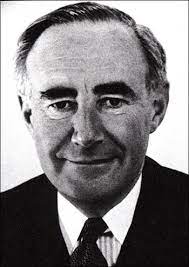
7 Comments

Filed under Espionage/Intelligence, Management/Leadership, Politics, Warfare

Summer 2025 Round-Up

Contents:

  1. Publicity
  2. Richard Davenport-Hines
  3. The coldspur Library Project
  4. Blunt Lessons
  5. Detective Work
  6. Roger Hollis in Australia
  7. VENONA
  8. Victor and Venetia (continued)
  9. Car accidents?
  10. The Illegals
  11. ‘Murder in Cairo’
  12. Other Books Read
  13. Ethnicity
  14. British Magazines

Publicity

Every week, I receive several unsolicited emails from around the world, coming from consultants who have discovered coldspur, and want to improve my SEO (Search Engine Optimization) performance. The messages follow a regular pattern: the firms have detected multiple errors on my site, with their help I could vastly improve coldspur’s rankings with Google and other search engines, and I could therefore dramatically increase the number of visitors as well as the revenue derived from them. They all want me to respond by requesting a cost proposal. Fortunately all these messages go into my Spam folder, and individually they trouble me no more.

Yet I believe these outfits would not have noticed coldspur unless it had already cropped up frequently in search engines. These chaps have clearly not even looked at what I publish, since they would have realized that the tight editorial procedures imposed by the coldspur team mean that coldspur does not contain errors – and if one or two do slip through, they are quickly rectified. Moreover, if they had spent only a cursory glance at the coldspur format, content and delivery, they would have understood that it is a vanity project, with no advertising, and no subscription service, and thus carries no opportunity for increasing revenue. Lastly, I believe that coldspur already ranks very highly with search engines. For example, I have just typed in to the Google search bar ‘Missing Diplomats’, and the first relevant item listed is a page from coldspur. I next typed in ‘Peter Smolka’, and coldspur appears second, after the Wikipedia entry. That looks to me as if my reports are receiving due attention. Or is some kind of AI bot gratifying me? Is this the experience of others? ( I suspect Google results vary from country to country, and maybe by user.)

Thus I do not think that my visit to the UK in September is going to make much difference to the visibility of coldspur. I had vaguely thought about putting some effort into arranging further talks around the one arranged at Whitgift School, in order to help publicize my research, but I am not now going to bother. I have been let down in this area before. Readers may recall the nonsense with the University of Aberystwyth a few years ago, as well as the incident of the Norwegian professor who last summer promised me a slot in Oslo to talk about the PB614 disaster at Nesbyen. Stimulated by his enthusiasm, I started to make plans in the UK, and then his deal fell through. Earlier this year, I was grossly insulted by the Friends of the National Archives (who completely ignored me), the Friends of the Bodleian are too busy, and after four weeks of waiting for Christ Church to respond to my offer to speak on Dick White, I have given up in disgust. I shall probably abbreviate the length of my stay by a few days, and simply enjoy meeting individual friends and contacts, and maybe visiting one or two archives or museums – especially the MI5 exhibition at the National Archives, which is reported to be displaying some special items on Philby ‘loaned’ from MI5.

Richard Davenport-Hines

Richard Davenport-Hines

Readers will recall my expressed frustration with trying to get in touch with the renowned historian, biographer and critic Richard Davenport-Hines. The Times Literary Supplement had published a letter from him on the Borodin business, and, in a correspondence with the Letters Editor at the weekly, I had sought an introduction so that I could discover what the source of Davenport-Hines’s very fragmentary – and dubious – evidence was. I had worked out that D-H had discovered my review of Agent Sonya, but he declined to contact me. Eventually, however, I was able to get an alternative email address from an acquaintance of his, and I was very gratified to receive a response from him. Sadly, D-H had undergone a stroke, which had affected his memory, and he apologized to me, since he had assumed that he had already communicated with me.

In the meantime, I had stumbled upon the source of his intelligence – some items at the front of the Goronwy Rees file that I had overlooked beforehand. I had not come across the Borodin affair when I first studied the file, and those components had meant nothing to me at that time. Since then I have discovered much more about the very bizarre goings-on involving Guy Liddell, Goronwy Rees, Guy Burgess and Anthony Blunt and the attempted disinformation campaign (as I am confident it was) to deceive the Soviet Union, as well as details of how the 1949 Conference at Worcester College, Oxford was set up, and what its detailed agenda was. These details are all to be found in Guy Burgess’s Personal Files, and I shall report on them at a later date. I was happy to explain my ignorance to D-H, pointing to my coldspur posts to demonstrate why I thought much more sinister activities were afoot.

D-H was gratifyingly very positive about my research. I was amazed that the first paragraph of his message to me was: “What a wonderful source Coldspur is! I have been reading through it, & have learnt much, & been given much to think about. I had consulted Coldspur in the past, but because of my brain damage, had forgotten all about it: I won’t forget again: it is too good to miss.” He went on to compliment me on Misdefending the Realm: “Your mastery of the sources, and your fairness in evaluating them, is first-rate,” and he went on to encourage me to get the Borodin story published in a book, since it was ‘very original stuff’. We exchanged some thoughts about Donald Maclean and David Footman, but the exchange has since died out. No matter: I am enormously pleased that such a celebrated expert should have recognized my contributions to intelligence research, and just deeply sorry that his skills as an analyst and story-teller may have been impaired by his disability. Here I publicly wish him a full recovery.

He is not the only coldspur-reader who has urged me to write another book. Yet I doubt that will happen. After my last experience, when I had to do practically everything myself (even ordering a review copy from amazon.uk for the TLS since my publisher had gone on holiday to India without informing me), I do not really want to embark on another book-production venture, with no agent and no publisher, and being domiciled 3,500 miles from the action. The opportunity cost of tidying-up, repackaging, index and sourcing one of my major stories in the hope that a publisher would accept it is too high. I have too many other projects that I wish to address before I shuffle away in my slippers, hang up my boots, or pop my clogs. My stuff will continue to appear on coldspur – subject to the accessibility of my library.

The coldspur Library Project

‘The Percy Family Support Fund’

Progress has been made in transporting books from my library to the Percy Family Special Collection at the University of North Carolina in Wilmington. In January, a team arrived at my house to box up over a thousand volumes – items not critical for my ongoing research, but still significant. (I have already reached out for a volume of the old Dictionary of National Biography only to be reminded that that set was included in the first shipment). At the end of this month, a further two thousand books – history, biography, poetry, miscellaneous –  were boxed up and transported. It is with mixed feelings that I see the departure of these items: I have to keep telling myself that this is what I wanted. It was my strong desire to see my collection housed properly in an academic institution, but I shall adjust poorly to trying to work when I can no longer have immediate access to a vital publication. Eventually even the ‘core’ component of one or two thousand books on intelligence and espionage will have to go too, and my ability to perform my traditional research will dissipate. A visit to the university, thirty-five miles away, will have to be carefully planned so that I shall be able to access efficiently what I need.

Thus I can envisage the day – perhaps at the end of 2026, when I shall have entered my eighty-first year – when the nature of coldspur will change. I may then focus on shorter analyses of digitized archives, and on book reviews, and not attempt such deep, multi-dimensional analysis. I may concentrate on more autobiographical entries, and gradually wind the blog down. Yet the whole purpose of the exercise is to ensure that the coldspur archive, already over three million words almost exclusively on intelligence matters, will be permanently available. Not only will my library be available for visitors, but an electronic portal will be constructed that will introduce visitors to my research, and provided indexes to other paper archival material (articles, letters, magazines, clippings, etc.) as well as the vast electronic vault of information (notes to books, registers of personalities in intelligence, summaries of archival meta-data, articles and other digitized information, photographs of undigitized archives, correspondence with other researchers and historians, etc., etc. as well as my ‘Crown Jewels’, the enormous Chronology of Events for the twentieth century that comprises over four hundred pages of line entries on Word, with sources.

My objective is that, as the National Archives eventually declassify more material during the rest of this century, historians will be able to pick up my research, and extend it when they interpret the files that have been hung on to for far too long. That is why proper organization of the portal, and appropriate marketing of the facility, are essential. When future historians need to consult original published volumes on intelligence, they will find no more comprehensive collection of texts available in one place than in the Percy Family Special Collection. I have to report with some regret that I have had some problems convincing the authorities at UNCW of the seriousness of the project, but I am hopeful about sorting out such teething problems soon. In that respect, the Bodleian Library has since reacted with greater interest to my announcement from last year than has UNCW! I have been a Lifetime Friend of the Bodleian for many years now, and, in its centenary Special Edition magazine, the story of my arrangement with UNCW, and long-standing relationship with the Bodleian, were featured. (I do not believe that this periodical is on-line, but I can send a pre-release electronic version to anyone who is interested.)

Blunt Lessons

The nature of my research frequently encourages me to move towards a culmination of a particular topic, as in my recent theory about the management of the disappearance of Burgess and Maclean. Yet that is an illusion: the research process is endless, and my continuing study of the Burgess, Maclean and Blunt Personal Files has unveiled events and accounts that are vital for extended interpretation. Thus I occasionally insert fresh discoveries into what should be summary pieces. It may appear clumsy, but I am in a hurry to publish new analysis, with sources identified. Occasionally I go back and revise an earlier piece, a practice I dislike (as an anecdote below exemplifies), but I am careful to annotate where and why I have done so. That is, at least, a benefit of having control of an on-line publication.

Two recent experiences with the vast Blunt (‘Blunden’) Personal Files – KV 2/4700-4722 – highlight the challenge. I decided, in mid-May, that I needed to start work on them even though I had not finished with the Burgess and Maclean PFs. After showing a useful miscellany of pieces from 1935, KV 2/4700 starts the ‘modern era’, i.e. post-May 1951, at sn. 24f, on page 186 of 316 (working backwards). It consists of a very familiar report, ‘Concordance Of Events Immediately Before And After The Disappearance Of Burgess And Maclean On 25th May, 1951’, the original of which appears in Maclean’s PF 604558 at sn. 98z, on page 10 of KV 2/4140-2. Yet I immediately noticed an anomaly (see image below). A hand-written entry has been inserted for Burgess’s activities on the evening of May 24, reading as follows: “Talked to BLUNT privately for a long time at the Reform Club”, with a reference of PF 604582 1112 bc.

The Modified Concordance

This was rather shocking. When had that entry been made? If the fact had been known early on in the investigation, it should have provoked a serious inquisition of Blunt, in order to determine what he and Burgess had been discussing the day before the escape. This version of the report is undated, but I verified that the original was compiled by J.A. of B2B on October 14, 1952. I needed to inspect the source at 1112bc in KV 2/4720. It turned out that it derived from an interview with Squadron Leader Richard Leven undertaken on August 18, 1972. (I wrote about that encounter in last month’s coldspur.) The MI5 officer Maconachie who wrote up the meeting added, helpfully, that ‘the information that BLUNT and BURGESS had a long conversation in the Reform Club in the early evening of either day [sic] seems to be new to us.’ Who are the ‘us’, one might ask? Who in 1951 was still around in 1972? And might that information have been known at the White level, but withheld from junior officers?

In any case, I think the insertion without a date was a very irregular and irresponsible practice. It could lead a researcher to believe that the information had indeed been officially known in October 1952, and thus should have been acted on. The implications are very controversial: maybe someone decided to insert the annotation for that very reason. If Burgess had been under such strict surveillance as the rest of the record suggests, and his activities at the Reform Club closely monitored, such a meeting would have had profound significance, and Blunt should have been questioned about it. In the master schedule in KV 6/145 (which was compiled in June 1953), Blunt is indicated as being seen with Blunt at the Reform Club on May 23, and as speaking with him on the telephone at 10:00 am on May 25, but no record of the May 24 meeting is presented. In fact, it presents a conflicting dinner engagement between Burgess, Peter Pollock and Bernard Miller at the Hungarian Csardas Restaurant that evening. (Did that event really take place?) Moreover, all questioning of Blunt on his involvement with Burgess before the disappearance is restricted to the telephone call on the morning of May 25. It is outrageous that Blunt’s inquisitors had not familiarized themselves with the chronology, and had let him get away with claiming that his short meeting with Burgess on the morning of May 25 was his first exchange since the Monday of that week.

So, how to interpret the insertion? Remember, these events occurred between Blunt’s confession (1963) and his unmasking (1979), at a time when MI5 was concerned about the truth coming out. J. A. Cradock (of K7, which was responsible for investigating Soviet penetration), to whom Stella Rimington gave her report on Leven, appears confused by the chronology in his memorandum of January 3, 1973 (at sn. 1128a). Another hand-written annotation appears on it, apparently by ‘LK’, drawing attention to the ‘long talk’, but inexplicably getting the date wrong (May 25). The handwriting is the same, so LK must have been the officer who made the amendment to the Concordance in KV 2/4700. [Unfortunately, Stella Rimington makes no mention of her personal projects on Blunt, Burgess and Leven in her memoir, Open Secret.] Yet both items are undated, so it is impossible to determine when, and with what authority, the change was made. My enduring questions: “What did he or she know at that time, and what did he or she see as her task?” face perpetual challenges.

The fact that the annotation was made on a file that would not have been generally available suggests to me that it was made with high authority. Leven must have been deemed a trusted source, and LK must have judged that the omission was important enough to appear on the record, perhaps as a subtle hint that the investigation into Blunt had not been as thorough and objective as the official story told. On the other hand, the utterly careless approach to chronology is bewildering, as is the lack of open recognition that the several meetings or exchanges between Blunt and Burgess in May 1951 should have come under closer scrutiny. There must be fresh secrets to be revealed – especially when I come to unravel the antics of Peter Wright (whom Rimington did not think highly of).

The other lesson derives from an interview of Blunt carried out by Ronnie Reed and Courtenay Young on May 15, 1956 (sn. 207c in KV 2/4702). It makes painful reading: the inquisitors are anxious to extract information from Blunt without antagonizing him, which means they do not challenge him vehemently on the obvious holes in his stories. One topic does, however, appear to rattle Blunt, and that is when Courtenay Young informs Blunt that a member of British Counter-Intelligence in London had handed over to the RIS dossiers on members of the Soviet Embassy, so that they could be photographed. (Razin is not mentioned by name, but this episode clearly has its roots in the Petrov affair.) While Blunt is given time to collect his thoughts, Young interpolates that the only candidates who had access, and were in London around that time were Hugh Shillito, Young himself, and Blunt. Young then excludes himself, claiming that he was also out of London at the time. “I think this certainly is a real tougher one,” ponders Blunt, earnestly.

Blunt’s explanation is that, to his immense chagrin, he took documents back to Bentinck Street to read in the evenings. Young interrupts to ask whether Burgess was a photographer (the implicit suggestion being that, if the dossiers were to find their way to the Embassy, Burgess would have had to photograph them quickly, before he was noticed.) Blunt does not think that was one of Burgess’s talents, so Reed helpfully suggests that Burgess must have handed over the originals for photographing. Yet, instead of querying how Burgess could have managed to convey the dossier to the Soviets without Blunt’s noticing (when he had, after all, brought them home only for the evening), Young disastrously lets Blunt off the hook, suggesting that Burgess, who came into the MI5 office frequently, could have gained access to the documents – which were presumably lying around instead of being locked up. (Young and Blunt agree that security was pretty shambolic.) Of course, Blunt cannot remember clearly whether he had left Burgess alone in a room or not. Despite the fact that the evidence points to a stream of files being passed on over a period of time, the conversation peters out, as if three old codgers were reminiscing.

The whole exchange was recorded, and can thus be read. Young’s summary of the discussion (dated June 5, 1956) is feeble. He admits that Blunt could offer no plausible explanation as to how the leakage occurred, and instead he reports Blunt’s revised assertion that he would have not taken the dossiers back to Bentinck Street, since there was no reason for him to study them, or to take action. Young concludes his paragraph by quoting Blunt again: “I think this is extremely obscure and I am sorry I cannot offer any help.” Ten days later, the Deputy Director-General Graham Mitchell noted: “D.1. [Young] and Reed conducted the interview with pertinacity and skill.” It makes one weep. [Calm down, coldspur. It’s just counter-espionage. Ed.]

The ineptitude in not following up the obvious holes in the case is enormous: If Blunt took the dossiers to Bentinck Street, how could he consider such an appalling security lapse? How big were the dossiers? When did Burgess have the opportunity to inspect them? Read them? Photograph them? Then why did the report state that the originals had been taken to the Embassy for photographing? And why did Blunt change his mind and suggest that Burgess had borrowed them at St. James, where MI5 was housed? And how come such files were conveniently left hanging around, over a period of time, for Burgess to pick and choose? [I note here that, in his ‘confession’ to Arthur Martin in April 1964, Blunt claimed that he had never seen any PFs of Soviet Embassy staff!] Even if Mitchell and his crew felt uneasy challenging Blunt over such points in their ‘interview’, they should have returned for a much colder and well-prepared interrogation at a later date.

Lastly, this episode represents a spooky echo of what happened in June 1951, when Dick White undertook his similarly disastrous interview of Philby immediately after the latter’s return from the United States. It is not clear what White’s objectives were in this interview, but he gives every impression of trying to let Philby off the hook, instead of challenging him on the points of the critical dossier on his subject that he had just sent to the FBI. In my earlier report (https://coldspur.com/special-bulletin-not-the-kim-philby-personal-file/) I explained how White raise the notion that Burgess might have got wind of the HOMER investigation by snooping around the British Embassy in Washington – a notion that Kim Philby encouraged. It is almost as if White had trained Blunt what he should say should he ever be confronted with the embarrassing evidence coming from Razin. I shall be exploring these conundrums further in next month’s coldspur.

Detective Work

Richard Osman

A few weeks ago, I was irritated by the theme in the Spectator crossword puzzle, in the issue of February 22, titled ‘Very large fellow’. It concerned someone named Richard Osman [‘OutSize – Man’ – geddit?], and the unclued entries were all characters in some obscure book that he had apparently been responsible for.  The Spectator is supposed to be a magazine with an international audience, and the puzzle, by Doc (Tom Johnson), who is the periodical’s crossword editor, was typical of the trivialization of themes that he has encouraged over the past couple of years. Having to resort to the Web to hunt down the names, I discovered that Osman had written a book titled The Thursday Murder Club. I thought little of it, submitted my entry on-line, and awaited next week’s puzzle.

Some time afterwards – perhaps on Facebook – I picked up the fact that the movie rights to the book had been acquired, and that Helen Mirren and Ben Kingsley would be appearing in the film, which was impressive. Netflix has started advertising it. The reviews of the book seemed quite glowing (it had been a New York Times best-seller, but, since I no longer subscribe to that journal, the fact had escaped me), and I hence inspected a copy of the book at Barnes and Noble a few weeks ago, and bought it. It started off well and wittily – hokum, of course, but a pleasant diversion from my customary gritty reading – but then became rather tiresome as it wound down, with too many unlikely complications and some slip-ups in chronology. Yet it reminded me that what I try to do in my analysis of intelligence conundrums is precisely what the members of the Murder Club (Elizabeth, in particular) set out to do when a body drops in front of their eyes.

Take my latest puzzler – Milo John Reginald, Lord Talbot de Malahide, who was accused by some of being another Cambridge spy, and, in his highly dubious role as deputy Security Officer in the Foreign Office at the time of the Burgess/MacLean disappearances, spoke up much too late about his knowledge of what his cronies had been up to. Based on what Malahide’s friend Tony Scotland has recently written about him, he had been interviewed intensely at the time, but nothing had happened. Indeed, when his boss, George Carey-Foster, moved on the following year, Malahide was appointed acting Head of Security, which provokes all manner of observations about foxes, chickens and henhouses.

Lord Talbot de Malahide

Moreover, was there a murder angle? On April 14, 1973, Malahide was found dead in his cabin on the M.V. Semiramis, ‘lying in bed as though asleep, with what looked like a broken blood vessel under the skin on his forehead’. His companion Hugh Cobbe assumed it had been a heart attack, and the ship’s doctor, who carried out a careful examination, formally confirmed death by natural causes. No post mortem was required. Now, I have been in this business long enough to be very suspicious when anyone associated with Soviet intelligence is found dead, alone, in a hotel room or other secluded area, with symptoms of having had a heart attack. I think of Harold Gibson and Herbert Skinner alongside the more well-recognized victims. Had this been some kind of revenge attack, or punishment, by the Special Tasks unit? Speculation in the Irish media afterwards suggested that it could have been a KGB or MI5 job.

Maybe that was going too far, but the case of Malahide is very odd. He had had a career in MI6 and the Foreign Office, and was brought into Carey-Foster’s security team (‘Q’ Section) in 1950, although his attendance was erratic. Yet, if he came under suspicion in June 1951, what happened to the transcript of his interview? Why was he allowed to leave for a holiday in Tasmania soon afterwards? Why, if there were undeniable claims about his close relationship with Guy Burgess from their Cambridge days, was he not invited to resign, as was David Footman in MI6? Why, in those circumstances, was he appointed as acting security officer when, in 1952, Carey-Foster moved on (to Rio, and then Warsaw, where he maintained a close interest in the Burgess-Maclean post-mortems)? Was Carey-Foster pushed out? Why, when the Foreign Office was cracking down on homosexuals and other dubious characters in the wake of the Cadogan Report, was Malahide promoted? And what was the role of Patrick Reilly, who had been a close friend of Malahide’s at Winchester College, and had gone on holiday to France with him in 1930? Had Reilly contrived to insert Malahide into the Security Office, since Carey-Foster’s attempt at broom-cleaning was proving very unpopular with the Foreign Office mandarins? Was Reilly behind Malahide’s promotion? And why was Malahide eventually forced to resign in early 1954 – before the Petrov incident blew up? Was he suspected of having been a Soviet agent in the Ankara Embassy in 1945, shortly before the Volkov incident? Had Malahide really been a Soviet agent, or was he perhaps an agent-of-influence, like Rothschild or Berlin, who was careful never to touch or pass on any confidential material, but could certainly help to manipulate events?

Rothschild himself is a conundrum. He was willing to dribble out names to MI5’s investigators, but may have deliberately concentrated on small fry. Why did Rothschild not identify Malahide when he was providing ‘helpful’ tips to MI5 about Burgess’s cronies? Malahide’s name first comes up overtly in March 1966, so far as I can tell, when Evelyn McBarnet and Peter Wright interview the Rothschilds. At sn. 74a in KV 4532, after a long discussion about Klugmann, Harris, Walter and others, the following note appears: “PMW read out a list of members of the Foreign Office who, by virtue of their age and university background, might have been connected with the ring. Only three names provoked any reaction. And the first was Milo TALBOT (Lord Talbot of Malahide), who was remembered as a friend of Richard LLEWELLYN-DAVIES, and ‘who certainly knew all the members of the Group very well’.”  Yet what the reaction was is not recorded, as if Victor and Tess had nothing really to say.

There may, however, have been a hint to Malahide the previous year. In November 1965, Rothschild was passing on names of dubious characters to Peter Wright, and admitted that ‘he had always been extremely suspicious of xxxxxxxxxxxxxxxxxxxx’, a very long name redacted in KV 2/4531, sn. 49a.  (See Item 7 in the image.) But why, if he had always been so suspicious of Malahide, had he not mentioned his name earlier? And why was the name redacted at this late stage in the game? And why did Peter Wright not do anything about it? William Tyrer, who has studied the complete Blunt files, let me know that Blunt had casually brought up Malahide’s name in one of his ‘interrogations’ by Peter Wright a few months beforehand, so Blunt may have warned his old friends, Tess and Victor, to be ready for any reference.

From the Rothschild PF

You can see what I mean. It is like a detective story. Too many dogs that did not bark in the night-time. And I continue to dive around archives and memoirs looking for clues. It never stops. I thought I had processed the Rothschild files comprehensively, taking extensive notes, but I go back, and find that there are extracts from the recorded interviews with David Footman that I had not considered significant, as well as a tantalizing reference to an anonymous person whose redacted name looks suspiciously like that of Lord Talbot de Malahide. Just count the characters. This one will run and run.

Roger Hollis in Australia

Later this year, I plan to provide a detailed analysis of Roger Hollis’s service to MI5 – including his time in Australia, where he helped set up ASIO, the Australian Security Intelligence Organisation.  As part of my research, I have read David Horner’s rather dry The Spycatchers; The Official History if ASIO, 1949-1963, where Hollis’s contribution is described. It presents a typical Hollisian endeavour – plodding, and with little imagination, since he recommended replicating the MI5 structure and procedures on the Australian continent, when its size and devolved political organization, as well as the nature of the Communist threat, really called out for a more inventive approach. Soon after, I started discussing Horner’s book and the story of Hollis with one or two of my Australian contacts, but was rather shocked by what I heard.

Hollis is viewed unfavourably by many influential Australians, it seems. I recall the infamous investigation by the FBI, seeded by the Australian Paul Monk, that used ‘argument-mapping’ to come to the conclusion that there was an ELLI in the heart of MI5, and that Hollis probably fitted the bill. (See https://fbistudies.com/2015/04/27/was-roger-hollis-a-british-patriot-or-soviet-spy/). Monk advertised how much he had relied on Chapman Pincher’s Treachery for extracting ‘all the salient facts about Hollis’, as well as exploiting Christopher Andrew’s Defend the Realm. If that was the extent of his research, he should have been banished from the investigation, but he nevertheless participated remotely from Melbourne. It was all a very shallow exercise, far too much influenced by the lies and distortions peddled by Pincher, but it seems to have lasted well over the ten years since it was so earnestly presented.

The reason I say that is that I was astounded by something one Australian colleague wrote to me. He had described himself as a long-time enthusiast for Misdefending the Realm, and a fan of coldspur, and we enjoyed some very cordial exchanges by email. In February of this year he introduced me to a book by a former secret intelligence officer Molly J. Oliver-Sasson, who had died last year at the age of 101. At her funeral, my contact had delivered a tribute to her (written by a friend who could not be present), and he also sent me a review by the notable intelligence author Hayden Peake of the memoir, titled More Cloak Than Dagger. (The book contains a gratuitous and out-of-place slur against Hollis, simply reproducing Pincher’s assertions.) My colleague then introduced Peake’s review by stating that ‘an unexpected bonus’ in it was ‘that he was prepared to go on the public record to describe Hollis as a “suspected Soviet agent”’.

‘More Cloak Than Dagger’

I immediately challenged such a crass error of judgment, considering that it was undignified and unscholarly. It is one thing to harbour doubts about Hollis, but quite another to welcome some superficial analysis as confirming what I can only call a prejudice – especially from someone who was presumably familiar with my coverage of ELLI, Gouzenko, and Hollis. I wrote, very politely: “And why would you be so enthusiastic about this opinion being aired, I wonder, given that the case against Hollis has almost entirely been dismantled, with no solid evidence against him. Is the prevailing opinion in ASIO, and in Australia generally, that Hollis had been a Soviet agent?” My colleague provided me with some further information about the defector Tokaev (whom Sasson had nursed), and promised to provide more detail about Peake, and his judgment, but I have not heard from him since.

I thus took up my case with an experienced Australian in this business (who has asked to remain anonymous), asking him where the conviction that Hollis had been a traitor derived. In all seriousness he replied: “Ethnocentric bias. He was a Pom.” He went on to describe some of Hollis’s operational failings, but I was already dismayed. I told my contact that his explanation was feeble. Now, I understand some of the bias held against Britons (I have experienced it myself on business trips Down Under) because of the patronizing way some of them/us behave, but this was absurd. I can also understand that, in the Spycatcher trial, Robert Armstrong made a fool of himself in the courtroom trying to defend the indefensible actions of the Cabinet Office, and he would have provoked further Oz mockery of the typical British toff.

Yet the prime accusers of Hollis, Peter Wright and Chapman Pincher, were both members of the upper drawers of British society (although Wright’s later costumes and habits tended to undermine that status), and they should thus have been regarded with the same disdain. This pervasive judgment shows an utterly casual and sloppy attitude to what should be a serious business. Is Dick Ellis considered not to be a traitor because he was Australian-born, and thus not a Pom? But, of course, there were many Australian citizens revealed by the VENONA transcripts who, despite their presumably working-class background, and non-patrician manners, became willing and eager servants of the Soviet state. One of the criticisms given by my friend was that Hollis was too ‘impressionable’, but I could lay that accusation on a large number of the ‘thinking’ Australian public, it seems. Hollis in Australia – that would be a good idea for an opera, on the lines of Nixon in China. A great sequel to that blockbuster, Who Framed Roger Hollis?

VENONA

During my work on the investigation of Donald Maclean, I was constantly reminded of the role that the VENONA transcripts had played in his identification as the spy in the Washington Embassy, while I remained uncertain of exactly what cryptological breakthroughs had been made when. (VENONA was the program that decrypted – at least partially – a large number of messages sent between various Soviet Embassies at the end of the war, when the security of such was undermined by the reuse of One-Time-Pads by the cryptographic staff.) Indeed, it was VENONA itself that revealed that vital messages exchanged between Halifax and Churchill concerning the fate of Eastern European countries had been purloined, and then paraphrased, and that an important agent ‘G’, later expanded to ‘GOMER’ (= HOMER) had been responsible for passing them over. What civil servants reminded each other consistently at the time was the necessity of saying nothing about this source, for fear, presumably, that the Soviets would learn that their methods had been broken.

Yet I could never understand why such an attempt at secrecy was necessary. William Weisband, a linguist at Arlington Hall, had informed his Soviet masters of the project, and by 1948 the Soviets were able to undertake a total overhaul of their encryption procedures. Kim Philby also informed them of the progress made on the exercise. Yet the Foreign Office (who admitted to being controlled by MI5’s demands) stubbornly insisted that there was a security risk. As late as September 28, 1953, Talbot de Malahide (yes, he!), responding to a request by Patrick Dean as to why the Office was against releasing all our knowledge of the Maclean/Burgess affair, wrote:

The argument roughly is that it is most important to conceal from the Russians our knowledge of Bride [i.e. VENONA] material. They cannot, of course, now prevent us from extracting what we can from it. But if they knew we were doing this, they could take defensive action which would probably ruin any chance we still have of making use of the knowledge we obtain in this way. [FCO 158/126]

Dean annotated: ‘Thank you! I agree.’, thus endorsing the code of silence. Yet why Malahide and co. thought that the Soviets would not already be taking ‘defensive actions’, based on their knowledge of the exercise, rather than waiting for the British to declare to the world what they had discovered, defies explanation. Of course, those illusions would shortly be shattered by the Petrov revelations a few months later.

For some reason, American institutions also decided to try to keep the details about VENONA secret until writers like Chapman Pincher and Robert Lamphere started leaking details in the 1980s. It was not until 1995 that an admission was made, and a bi-partisan commission started releasing materials. From my study of the archives, I would conclude that the professed anxiety about admitting the VENONA programme to the public was attributable more to the embarrassment over the way that British institutions had been infiltrated, and to the decisions made about re-instituting Burgess and Maclean in prominent positions, than it was to the concern about divulging damaging secrets to the Soviets.

While there was a justifiable conviction that trying to use the transcripts themselves as evidence in any criminal trial, because of the use of cryptonyms and the lack of transparency in how the decryptions themselves had been made, it seems to me that a substantial propaganda coup could have been made by explaining the stunning achievements of the exercise. It was not that it would have alerted the Soviets: they had made the necessary adjustments as soon as they learned of the exposure. It was not like the secrecy over the ENIGMA project, and the corresponding British Type-X equipment, which had been supplied to other countries after the war, and thus might have provoked embarrassing questions. This was a once-off example of a lapse in procedure, and a spectacular effort to exploit it. Chrsitopher Andrew wrote: “The value of VENONA as a counter-espionage tool was diminished, sometimes seriously, by the extreme secrecy with which it was handled.” (Defend the Realm, p 380)

It seems to me that a fresh re-appraisal of VENONA is needed. I have been trying to work out who called the shots in that critical period between 1948 and 1951 – how much did Dick White know when Maclean returned to Britain in April 1950, for instance? MI5 was supposed to be in charge of the whole project (to the chagrin of Carey-Foster in the Security section of the Foreign Office), but several tensions existed. Sir Robert Mackenzie (ex MI6, and the Security representative at the Embassy in Washington) clearly did not appreciate receiving instructions from a greenhorn like Carey-Foster. Valentine Vivian of MI6 spread his wings, sometime misinforming his boss, ‘C’, Stewart Menzies, while communicating with his own representative, Peter Dwyer, in Washington, and busied himself investigating wartime British Security Co-ordination and retrieving missing telegrams from the Moscow Embassy. Arthur Martin, Dick White’s assistant, seemed to be working in parallel with Guy Liddell, but occasionally he and White veered off on tracks not aligned with those of the deputy director-general, while Martin communicated with MI5’s representative in Washington, Dick Thistlethwaite. Edward Travis of GCHQ was negotiating on cryptographic sharing with his counterparts at Arlington Hall, but often very secretively. And they all had to consider how to deal with the FBI, and how they could make inquiries concerning the lamentable security procedures at the Embassy without upsetting anybody, or alerting the spy (who might still be in residence) as to what they were up to.

I see a number of opportunities. First of all, a renewed attack on partially deciphered messages, using much faster computers, and probably advanced AI techniques, could surely reveal much more about the traffic and persons involved than was decrypted decades ago. Second, an integrative approach to the interpretation of information would be highly desirable since records released during the past twenty years for the Foreign Office, MI5, and GCHQ, as well as resources like the Mitrokhin Archive, would probably point to conflicting missions, and oversights in analytical opportunities. Third, much of the material that has been published has been redacted because of old sensitivities to living persons, and also contains errors or partial information that could be easily corrected based on intelligence that is now available. With the passage of time, and the deaths of such persons, such names should be restored. One of the most frustrating aspects of VENONA decrypts is that it has been impossible to determine what breakthroughs were made, when, which has complicated the task of historical interpretation.

Nigel West’s book, VENONA, and that by Haynes and Klehr, VENONA: Decoding Soviet Espionage in America, were published in 2000. Defend the Realm (2009) has a decent and provocative chapter on it.  Romerstein’s and Breindel’s Venona Secrets appeared in 2014, but it has a strictly American focus. Andrew’s coverage in The Secret World (2018) is shallow: he could not even find room for an entry to VENONA in his Index. John Ferris’s Behind the Enigma (2020), the history of GCHQ, is feeble. A fresh look is required. Intellectually, I would find it an appealing challenge, but much of the material is contained in undigitized GCHW (HW 15 series) files that would have to be photographed. Furthermore, I am still working my way through the Burgess and Maclean PFs, and some residual FCO files, and still have (for example) the Philby and Blunt files to work on. Ars longa, vita brevis.

Victor and Venetia (continued)

Readers may recall my investigation into the society figure, Venetia Montagu, and her dalliances with men young enough to be her son, from last December’s Round-up (see https://coldspur.com/2024-year-end-roundup/). At that time, I stated that I was not going to shell out $100 to read Stefan Buczacki’s My Darling Mr. Asquith: The Extraordinary Life and Times of Venetia Stanley in order to learn more. Well, the price came down, I acquired it, and have since read it.

‘My darling Mr Asquith’

I was intrigued by Mr Buczacki’s interest in this range of not very attractive aristocratic persons from the Edwardian era, and beyond. I sought to learn more about him, since it sounded as if he might have fascinating antecedents deriving from some corner of the Austro-Hungarian Empire (actually, more likely to be Poland, though borders in that region have been very fluid over the past one hundred and fifty ears). I was delighted to discover that he simply describes himself as ‘English’, but I have been unable to determine whether he comes from the Huntingdonshire or the Somerset branch of the Buczacki clan. No matter. He has written a vastly entertaining book, although his understanding of the correct use of the comma is woeful, as are his occasional lapses into ‘from whence’, and the occasional erroneous ‘whomsoever’, when ‘whosoever’ was required. And, of course, no qualified editor was around to help him.

I shimmied my way through the perverse attentions to young women of the Prime Minister, Herbert Henry Asquith, and the assortment of Wodehousian characters of whom Venetia’s set consisted – such as ‘Crinks’ Johnston, ‘Scatters’ Wilson, ‘Bongie’ Bonham-Carter – to find my way to the meat of the book, where Venetia meets Victor. Sadly, there is not much more to learn. Venetia probably met him because Victor’s father must have known Edwin Montagu, Venetia’s husband, in the Ministry of Munitions in 1916, and both were keen naturalists with an interest in East Anglian fauna (although Edwin liked to advertise his infatuation by shooting many of them). Buczacki states that Victor was at Trinity when Venetia ‘was passing through a phase of taking a sightly unorthodox interest in young research students’.

Buczacki does not believe that Venetia and Victor ever had an affair, but they remained friends, and Victor apparently took a ‘surrogate paternal interest’ in Venetia’s daughter Judy (thirteen years younger than him) after Edwin’s premature death from an infection picked up in South America. She did meet William Grey Walter through Victor, however, and he became ‘the most unlikely of all her lovers’, but, for some reason, that distinction does not merit Walter’s gaining an entry in Buczacki’s Index. Walter was just eight months older than Victor, was elected to the Apostles at the same time as Victor in 1933, and later became the Society’s secretary. “He was further to the left however and a serious fellow-traveller,” notes Buczacki, so MI5 were probably justified (to the extent that any of these surveillance activities were at all useful) in opening a file and keeping an eye on him. Isaiah Berlin met Venetia, but there is no mention of Guy Burgess or Donald Maclean, and that strange summer get-together in Cap Ferrat goes unnoticed. I tried to contact Buczacki via his website, but was put through such a hostile privacy rigmarole, being required to download some software that I did not trust, that I abandoned the idea.

I did discover, however, a reference to the sojourn in the Blunt archive, from August 27, 1969, when he was interviewed by Peter Wright and Cecil Shipp (sn. 729a in KV 2/4713). Blunt said that he was sure that the incident occurred in 1934, and that, apart from him and Burgess, the following had attended: ‘Dadie’ Rylands, Anne Barnes, Venetia Montagu, Penelope Dudley-Ward, Gerald Cuthbert, Claude Phillimore and Arthur Marshall. (Isn’t it extraordinary how reliably Blunt’s power of recall worked when it would not adversely affect him?) When Wright later jolted his memory about Grey Walter, Blunt did reflect that he might well have been in the party. He judged that Walter, also an Apostle, was an ‘extremely cold fish’, an opinion that one must assume was not shared by Venetia Montagu, whose embraces Walter was enjoying. He reinforced the laboratory link between Victor Rothschild and Walter, but did not remember him as a friend of Burgess, adding the intriguing observation that he thought ‘Burgess would have got to know him through Lettice Ramsey, whose boyfriend he had been for some time.’ History does not tell us whether Wright followed up this intriguing lead.

Car Accidents?

I mentioned earlier the suspicious circumstances in which Lord Talbot de Malahide died, and referred also to similar cases involving Harold Gibson and Herbert Skinner. When reading recently Michael Braddick’s biography of Christopher Hill, I learned that Hill and his second wife, Bridget, in August 1957 ‘were involved in a tragic car accident, in which their eleven-month-old daughter, Kate was killed’. That set my mind racing about other car accidents that had befallen Communist apostates or traitors, or their families. What about the death of George Graham’s son in 1949, in High Wycombe, when an errant wheel flew into his face? Or that of Paul Dukes, who died in South Africa in 1967, the result (according to his wife) of a serious motor accident in England the previous year? And what about Tomás Harris, who died in a mysterious motor accident in Mallorca in 1964? Nor should we forget Goronwy Rees, who almost died from a hit-and-run-accident in 1977. It seems to me that, statistically, these persons who had defied the KGB suffered an unusually high accident rate from motoring exploits.

I mention again the long list of deaths of such characters – including those who maybe simply knew too much – under other suspicious circumstances. Added to Malahide (found on a yacht with mysterious markings on his body), Skinner (found alone in a hotel room in Geneva, with symptoms of a heart attack), Gibson (found shot in his apartment), I would list the following deaths that have not been properly examined and explained:

  • Humphrey Slater, died in Linea, Spain, at age 51
  • George Placzek, physicist, died in Zurich in 1955‚ ‘probably a suicide’
  • John Costello, journalist, died on flight to Miami in 1995
  • Aileen Philby, wife of Kim, who might have committed suicide, or been murdered, in 1957
  • High Gaitskell, who was diagnosed with lupus after visiting the Soviet Embassy in January 1963
  • Victor Serge, who died ‘of a heart attack’ in Mexico in 1947, and whose son believed he had been poisoned by NKVD agents
  • Konstantin Umansky, who died in a plane crash in 1945, cause unknown
  • Victor Kravchenko, defector, who died from a gunshot wound in New York in 1966, his son believing he had been murdered

I have come across rumours affecting other premature deaths over the years, such as Alexander Kojève, Gordon Lonsdale (Molody), Alexander Foote, George Orwell even. These may simply be ‘conspiracy theories’, and easily debunked. I don’t know. And a whole host of earlier assassinations have been recorded by such as Boris Volodarsky, including (but not limited to) Miller, Serov, Kutepov, Krivitsky, Poyntz, Frunze, Agabekov, and Ryumin, as well as the famous cases like Trotsky. I noted Nikolay Zorya, found dead from a gunshot wound in his hotel room at the time of the Nuremberg trials in 1946, in an earlier coldspur. Molly Oliver-Sasson [see above] writes about the assassination attempt on the defector Tokaev, whose handler she was. I am thus sure that there were more assassinations than have been officially recognized. A project for someone else to pick up.

The Illegals

This spring I read two books on the Soviet-Russian ‘illegals’ programs, Russians Among Us (2020), by Gordon Corera, whom I knew through his Art of Betrayal, and The Illegals (2025) by Shaun Walker. As a reminder, the project for inserting long-term agents behind the borders of the western democracies, with false identities and ‘legends’, outside the protection of ambassadorial conventions (the ‘Illegals’), originated in the 1920s, and has continued well into Putin’s term as President of Russia. These two books take very differing approaches to updating the public, however. Corera’s book is a more journalistic effort that concentrates exclusively on the project since the dismantling of the Soviet Union in 1991. Alexander covers the same territory (and describes the actions and betrayals outlined by Corera in almost identical terms), but sets out to cover Russia’s century-long mission to infiltrate the West, as well.

‘Russians Among Us’

Russians Among Us is more a work of its time. It contains no bibliography, and its sources are primarily reports from the press, and on-line blogs and bulletins. Corera tells a pacy story, well-crafted, with Macintyreish flair, about the Heathfields, the Murphys, and the notorious and glamorous Anne Chapman, who apparently inspired The Americans (a television series I own, but have not yet viewed). They were all betrayed to the FBI by Alexander Poteyev, who worked for the KGB, and then its successor, the SVR, and who was recruited by the Americans. Amazingly, he managed to escape just before the FBI started its arrests.

‘The Illegals’

Walker is far more ambitious, setting out to describe the whole program since its inception by Meer Trilisser, born in 1883. I judge that Walker misses his mark in several ways. He offers a large bibliography, which includes the obvious work, Nigel West’s volume of the same name (1993), but fails to recognize a very important book, William E. Duff’s A Time For Spies: Theodore Stephanovich Mally and the Era of the Great Illegals (1999). Moreover he fails to cover this ‘era’ adequately. ‘Mally’ (or ‘Maly’) has no entry in his Index, and Walter Krivitsky is related to a minor footnote. He provides a chapter on the buccaneering character Bystrolyotov, but adds little new to what has already been published. It is a very disappointing coverage for anyone looking for a comprehensive and fresh approach to the subject.

Instead, Walker veers from his topic. He includes detailed coverage of an exercise from World War II, where NKVD agents were infiltrated behind German lines – but still on territory from the Soviet Union – to assassinate Wilhelm Kube, the governor of Belarus. Now, this is a gripping story – one that I had not encountered before – but the fact that the agents masqueraded as German officers in uniform does not make it an ‘illegals’ programme. Nor, by classifying the insertion into Afghanistan of a troupe of commandos to assassinate the troublesome Communist Party leader, Hafizullah Amin in 1978 as the birth of the ‘Fighting Illegals’, does the author shed any light on his core thesis. It is a muddle.

Wilhelm Kube

Both authors point out the drawbacks of the project as it was resuscitated in the 1990s. In the 1930s, the arrival of émigrés from Eastern Europe, bearing vague genealogies and questionable certificates, was hardly a cause for concern for the western democracies, what with the feverish ideological clashes between fascism and communism, and no obvious reason for the authorities to be on their guard against hostile penetration. And the period of the ‘great illegals’ came to an end because Stalin liquidated most of them. But it became increasingly difficult as the century wore on, with greater attention to stolen identities from gravestones, and better exchange of records between security departments.

When the program was resuscitated (with the USA especially targeted), intense energies were spent in providing watertight identities for apparently genuine citizens (normally originating in Canada). But part of this exercise meant that the illegals were a genuine married couple, living a typical American life, with a house in the suburbs – and children. That proved to be the most troublesome aspect of the arrangement, since the kids were encouraged to grow up as normal teenagers when they were being deceived by their parents, who were never supposed to reveal their true allegiance. This led to tensions when the fervent communist dad clashed with the natural interest in western delights shown by his son.

One last observation I make is that both authors appear to be tone-deaf to the possibility of the Americans running illegals in the Soviet Union – or Russia. Corera very naively attributes the lack of any such program to the obvious objection any CIA officer would have to spending decades in the country, completely ignoring the fact that attempting to live as an illegal, even if one had been born there, in totalitarian Russia would have been utterly impossible. Allen Dulles found that out the hard way (as Alexander briefly notes), but he should have worked it out before he initiated the CIA’s disastrous attempts to insert rebels into Belarus and other places in the 1950s. I also think that the authors misjudge the issue of allegiance in the twenty-first century, and why an illegals program was necessary. The illegals of the 1930s were able to recruit nationals to work for Moscow because of the ideological appeal of international communism, but once the horrors of Communism were laid bare after the war, what educated Briton (or American) would want to dedicate him- or her-self to that cause (as opposed to spying for financial reasons, or because of blackmail)? And why would Putin’s weird brand of Orthodox Christian ethno-nationalism motivate anybody outside Russia? It is no wonder that the resolve of the new illegals vacillated, with their bosses in Moscow never having any idea of exactly how they had to operate, but also fearful that they would adjust too well to their masquerades, and come to prefer the freedoms of a liberal democracy.

The project has now moved into the cyber space –  a whole new game of subterfuge. For that reason, Alexander’s chapter on the ‘Virtual Illegals’ is worth reading.

‘Murder in Cairo’

‘Murder in Cairo’

I stumbled on Murder in Cairo, by Peter Gillman and Emanuele Midolo, in a review in the TLS of May 9 by Stephen Glover. It concerned the killing of the journalist David Holden in Cairo in November 1977, and sounded intriguing. I consequently went to order it from amazon, although for some reason the book was described there as Desperate Times, by Peter Brookes, published in 2021, while the image of the cover indicated the current, correct title. Furthermore, when I tried to find it on LibraryThing with the correct ISBN, amazon likewise came up with the ‘ghost’ version (a phenomenon familiar to my colleague Andrew Malec). I thus ordered it anyway, thinking perhaps that a ‘ghost’ book might demand only a ‘ghost’ payment, and the book arrived, as Murder in Cairo, a few days later.

It comes with the conventional arresting and gushing blurbs, from such as Daniel Finkelstein, Tina Brown, and Richard J. Aldrich. Yet I wondered: did they read the same book as I did? Were they all pre-publication tributes, before they actually got round to working through it? (The back-cover did not say.) Going back to Glover’s critique, I judged it very fair. He was not unconditionally positive about the book, writing: “On finishing the book, some readers may reasonably exclaim: so what?” That was very much my reaction, as the denouement does not reflect any breakthrough analysis that was not apparent after about page 10 – that Holden was probably some kind of KGB asset, and that the CIA was somehow tied up with his assassination, and too embarrassed to discuss it.

Gillman had returned to the investigation after forty years, when Times editor Harold Evans had originally sent a crack squad to Egypt to work out what had happened. With the help of the more Internet-savvy Emanuele Midolo, he was able to discover a raft of new leads and tidbits, and to interview several more people who may have been involved (or had known, or were related to persons who had been involved, since most of the latter were dead by then). Yet they never found a smoking-gun, and the obvious questions were never answered. For what transgression had Holden been killed? And why would the murder have been carried out in such a gruesome and clumsy manner? And why then, on Holden’s first visit to Egypt for several years? And if Holden had somehow upset the applecart of Egypt-Israeli-Arab relationships (or whatever), why would the CIA have been involved in arranging the execution of a British citizen? Hadn’t other journalists done such, or worse? Even if he had been some kind of KGB agent of influence, he did not have access to confidential information, so was therefore not a spy.

The reader has to engage in a mass of tense investigation, which the authors are no doubt extremely proud of, but it involves a cast of thousands. It can be difficult to track the personalities, since the authors sometimes refer to persons by their first name, sometimes by their second, sometimes by the identity of their second (or third) marriage. Fathers and sons can be mixed up, and Gillman and Midolo provide no useful charts of organizations and relationships. The book contains references to most of the intelligence elite of the late twentieth century. For the aficionados, you will find here Kim Philby, James Angleton, Dick White, Frank Wisner, Allen Dulles, George Blake, Ralph Deakin, Archie Gibson, Edward Crankshaw, Antony Terry, Patrick Seale, Jeremy Wolfenden, Jan Morris, Peter Smolka, Phillip Knightley, Nicholas Elliott, Donald McCormick (aka Richard Deacon), Seymour Hersh, Fred Halliday, Oleg Gordievsky, Ian Fleming, Andrew Cavendish, Guy Burgess, Anthony Blunt, Donald Maclean, and many more. The only obvious names missing were Goronwy Rees, Ursula Kuczinski, and Dame Edna Everage. (Yes, in case you asked, Ben Macintyre was interviewed.)

The problem is that, as the investigators search for ‘facts’ they come across persons who are dissembling half the time, and they do not know which half it is. The authors admit (and even boast of) this technique, inherited from the Sunday Times ‘Insight’ team, as if an accurate story could miraculously evolve from such a barrage. The impression I got from the descriptions of the actors is that a lot of unattractive people, if they were not plotting against their rivals, sat around in various watering-holes in the Middle East, getting sloshed at the tax-payers’ or their employers’ expense, while imagining that their gossiping constituted some advance in intelligence-gathering. My reaction is that Holden’s death might have been more because of what he might reveal than what he had actually written. Why he could not have been disposed of quietly, in an isolated hotel-room, with symptoms of a heart-attack, as the KGB’s Special Tasks squad would have carefully managed, is as much a puzzle as the reason for his being taken out. The assassins did not just want him killed, as retribution for his defiance or betrayal, they wanted to send a strong deterrent message. But who would have picked up any pattern? November 1977, eh? At exactly that time, Dick White was warning Andrew Boyle not to persevere with his questions about Blunt. That was a few years after Malahide met his sudden end, and a couple of years before Blunt was eventually outed  . . .

‘Manifest Lies’

As I was contemplating all these matters, I discovered Manifest Lies, a fictionalized version of the Holden case, written by Max Heaton, and published in 2024. As coldspur readers will know, I am not a fan of this particular genre. This novel is, however, quite well done, although I found the motives for Holden’s assassination far-fetched. Yet Heaton appeared to have trodden exactly the same research trails as had Gillman and Madioli, which set me wondering – who could he be, and why was he hiding behind an alias? I could find no footprint for Heaton on the Web, which was strange: moreover, the copyright notice in Manifest Lies was very odd. Perhaps Gillman was masquerading as Heaton, and, having been severely warned off publishing his real story by the CIA, had decided to write it up as fiction under an assumed name?

I took my theory to the Editor of hugejam, the publisher of Manifest Lies, first asking her whether she could tell me anything about Max Heaton. She replied promptly, saying that Heaton did not want anything about him disclosed, but she did not explicitly deny that Gillman could have been he. I thought that was provocative, as eliminating Hillman would not really have reduced the field by much. My next step, therefore, was to approach Gillman himself, and describe my interest and my hypothesis. He likewise responded promptly, energetically denying that he was Heaton.

I had a very fruitful exchange of emails after that. Gillman is a charming man, and happens to come from the same part of the world as I. We differed politely on one or two points of investigative journalism (he had read my quote from his book in my May coldspur by then), but I reinforced my view that, while the Sunday Times Insight team had performed a marvellous job in the 1960s and 1970s, too many authors today still followed the procedure of indiscriminately gathering as many ‘facts’ as they can about a case, and trying to weave a coherent story around them. Having been pointed to my website, Gillman said it was ‘terrific’, which was very gratifying. He said that he was also intrigued by the hidden identity of Max Heaton, who, he believed, had probably relied on Harold Evans’s My Paper Chase for much of his research. He also stated that he was close to homing in on him.  I am hoping to meet Gillman when I come to the UK in September. (Despite the collegiality I developed with him, I have not altered my less than stellar review of the book by him and Madioli.)

Other Books Read

I present here a few thumbnail comments on other books on intelligence and history that I have read this year, and which have not been mentioned elsewhere (either in this report, or in earlier coldspur bulletins in 2025).

Red List by David Caute (2022)

Caute provides a compendium of the leftist intellectuals whom MI5 tracked in the twentieth century, rightly pointing to the enormous effort that was expended to little effect in surveilling hundreds of persons who may have been naïve, but whose influence was meagre. His work is marred by the fact that he appears to believe that all relevant information consists solely of the Personal Files released by MI5, and to show a barely concealed admiration of Stalinism and the Soviet Union. (B-)

The Mysterious Case of Rudolf Diesel by Douglas Brunt (2023)

A timely investigation of the life and mysterious death of the inventor of the diesel engine, Rudolf Diesel (1858-1913), who may have conspired with Germany’s adversaries when he saw how his technology was going to be used. Brunt has performed some innovative research, and has a lively journalistic style, but he pads out his story with too much repetition and digression. (B-)

‘The Traitor of Arnhem’

The Traitor of Arnhem by Robert Verkalk (2025)

Verkalk’s thesis is that Anthony Blunt passed on to the Soviets information about the Arnhem operation, which they in turn gave the Germans, as a ploy to help the Red advance on Berlin. While his text contains some major errors, Verkalk presents some engagingly fresh research on the leaks of 1944. I am going to have to read this book again, very carefully, before passing full judgment, but it seems to me utterly impossible that Blunt (who did many stupid things) would have consciously leaked information to help the Germans, as he would have known that he would face the hangman’s noose if detected. Verkalk may have made some major mistakes of identification. (B)

Paris 1944 by Patrick Bishop (2024)

An original approach to telling the story of Paris’s liberation, by describing it from the standpoint of an eclectic set of observers and participants. I was drawn to this book since I enjoyed Bishop’s The Reckoning, about the Stern Gang. Perhaps a bit too much on Hemingway, for my liking, but Paris 1944 is a refreshing and informative account of an ambiguous period, frequently misrepresented, and it gives an arresting account of the summary justice that was meted out before de Gaulle applied discipline. (B+)

The Secret History of the Five Eyes by Richard Kerbaj (2022)

Be very wary of books that announce themselves as the ‘Secret History’ of anything. For if the history is published, it is no longer secret. And, if it is based on insider leaks, it may well be unreliable, and certainly will not be verifiable. Much of the material published here has been presented before, but the later chapters provide a useful compendium to information-sharing between the USA, the UK, Canada, Australia and New Zealand – the Five Eyes of the title. (B)

Operation Biting by Max Hastings (2024)

A typically lively and gripping account by the renowned journalist/historian of the February 1942 Bruneval raid on the French coast to steal secrets of Germany’s radar network, specifically the Wûrzburg apparatus. This story was already familiar to me from George Millar’s Bruneval Raid (1974): Hastings has dug out some fresh sources, but the overall conclusions are not new. He does quote, however, one astonishing statement made by de Gaulle to a confidant that Patrick Bishop overlooked: “Between ourselves, the Resistance is a bluff which has succeeded.” (B+)

The Strategists by Phillips Payson O’Brien (2024)

O’Brien came up with the rather absurd notion that Churchill, Stalin, Roosevelt, Mussolini and Hitler were all competent ‘strategists’, and he inspects their individual experiences in World War I to show how their expertise was developed. Yet the idea is a clunker: none of the five really understood grand strategy or military strategy, and the occasional biographical insights do not make amends for what is an ill-conceived and clumsy book. (P.S. This book received a stellar review in the TLS issue dated June 13. I do not change my opinion one iota.) (C)

‘The Spy Who Helped . . . .’

The Spy Who Helped the Soviets Win Stalingrad and Kursk by Chris Jones (2025)

This book wins my award for Worst Title of the Year. Jones (who consulted me on his subject, and has some nice things to say about coldspur), has valiantly attempted a biography of Alexander Foote, the radio operator for the Lucy Spy Ring in Switzerland, who later ‘defected’ back to the British. Jones has dug out some useful facts about Foote, but offers a very uneven assessment of his life, neglecting, for example, an explanation as to why two versions of his ghosted memoir Handbook for Spies were published. (B-)

Operation Splinter Factor by Stewart Steven (1974)

Professor Haslam encouraged me to track down Operation Splinter Factor (a CIA project to foster insurgencies in Eastern Europe) in the work of Richard Deacon. I found nothing in Deacon, but discovered Steven’s journalistic work – in many ways fascinating, but not very scholarly. It offers a bibliography, but no individual references, and grossly exaggerates the role that Allen Dulles played, as well as that of the Communist dupe Noel Field. The trials and purges were more a factor of Stalin’s paranoia. (B-)

The Future Is History by Masha Gessen (2017)

An essential volume for understanding how totalitarianism returned to Russia under President Putin. The author skillfully weaves personal stories of friends caught up in the maelstrom into an account of Putin’s rise and manipulative methods. The book is probably 100 pages longer than it needed to be, and it focusses rather too much on what I shall reluctantly have to refer to as the ‘LGBTQ’ aspect of suppression, but digesting it was still a very rewarding experience. (A-)

‘The Determined Spy’

The Determined Spy by Douglas Waller (2025)

A comprehensive biography of Frank Wisner, the obsessive and bipolar head of the CIA’s Office of Policy Coordination, who committed suicide at the age of 56. Supported by Dulles, he pursued a relentless quest for subverting Soviet influence around the world, an activity that caused much havoc, and rebounded badly on the reputation of the USA. The author spends too much space on familiar exploits (such as Guatemala and Iran, where Wisner was not closely involved), and not enough (in my estimation) on Wisner’s capacity to charm, despite his demons, and on his personal relationships – such as why persons like Isaiah Berlin and William Deakin were drawn to him. (B+)

Naples ’44 by Norman Lewis (1978)

Brilliant! I was drawn to this book by a Lewis revival presented in the TLS, encouraged by my previous analysis of Allied invasions of Italy in 1943-44, and by my vague knowledge that my father must have taken part in them. Lewis, an intelligence officer, shows that not everything the American and British forces did was valorous and heroic, and he sheds an ironic and insightful eye on the superstitions of the Neapolitans, the inherent cruelty in a society driven by vendettas, and the baleful influence of the Camorra. I even forgive this fabled writer for his ugly deployment of unrelated participles. (A)

Christopher Hill: The Life of a Radical Historian by Michael Braddick (2025)

This could have been an engaging life of the Stalinist dupe, Christopher Hill. Braddick knows the ins and outs of CP factions in the 1950s, and the trends in historiography since, and he writes tolerably well. Yet he is so much in sympathy with Hill’s Marxism that everything is reduced to ‘class’ terms – ‘bourgeois’ culture, the ‘capitalist ‘press (when there were ten competing daily newspapers in England alone!), as well, of course, as ‘the capitalist class’, sounding as if it were taken from a cartoon in Krokodil, but in truth deputising for a variegated world of free enterprise, which itself consists of a complex set of entrepreneurs, small business-owners, investors, risk-takers, losers, profiteers, managers, directors, pensioners, regulators, competitors, unions, etc. Then there is the dreary figure of Hill himself, who as his life drew to a close, admitted that he did not really understand economics, and was no longer a Stalinist, a communist, or even a Marxist. It was a shame it took him so long to work that out. (B-)

‘The Theory and Practice of Communism’

Postscript: Reading the above book prompted me to go back and re-read R.N. Carew Hunt’s The Theory and Practice of Communism (I still own my 1964 Pelican edition). Carew Hunt was an advisor to MI5, and this book was distributed to MI5 officers after the war. It drives home how utterly stupid today’s ‘marxists’ are to adhere to the absurd, ponderous, self-contradictory ramblings of someone who lived one-hundred and fifty years ago, had no clue as to how the world worked, had no imagination, and saw society only through artificial class-dominated eye-glasses.

Ethnicity

Regular readers will be familiar with my disdain for sociologists and bureaucrats who try to classify me by ‘race’ or ‘ethnicity’. I am reminded of a management training course that I attended shortly after I arrived in the USA in the summer of 1980. The shiny and very confident instructor stressed to the class that it was against the law to inquire of any job candidate what his or her race was. (Ethnicity had not really made an impression by then, Human Resource departments were still called ‘Personnel’, and employees were not yet classified as ‘associates’.) Then, twenty minutes later, he was telling us that companies had to keep track of promotions and evaluations by racial classification, in order to ensure that no discrimination was taking place. I perked up, and asked, if employers did not know what the race of each employee was, were they relying on the employees to declare their race to Personnel, and how would the department know that they were telling the truth, and how would this information be divulged to each employee’s manager? Or did Personnel make a categorization of race based on what the employee looked like? It all sounded very invidious and unscientific to me. (This is the dilemma that the French and German governments have avoided by prohibiting the collection of such data.) The instructor was speechless for several seconds. I cannot now recall how he resolved the issue.

I am always on the lookout for intellectuals who are open about debunking these absurd notions, as a way of countering the proclamations of such as Ta-Nehisi Coates, and his calls for reparations. They are of course based on marxist ideas that each of us belongs to a class, and we are either ‘oppressors’ or ‘victims’, depending on what we have inherited. The fact that amongst one’s forbears there might be imperialists and slave-traders as well as serfs and slaves appears to have escaped such analyses. I have a well-developed resistance to any methodology that attempts to package people into oppressed ‘minorities’, and Thelma, my chief Sensitivity Reader, carefully goes over my text each month to make sure that I have included a slur against at least one of such groups, and that I have not been discriminatory in insulting any particular group less  than another.

Thus it was with some pleasure that I chanced on a review by Professor David Abulafia in May’s Literary Review, where his subject was Laura Spinney’s Proto: How One Ancient Language Went Global. Professor Abulafia, when discussing the spread of Indo-European languages six thousand years ago, carefully dissected the myth that migrant tribes were united by language or ‘ethnicity’, and he went on to write: “Ethnic purity is a myth and we are all mongrels.” Splendid stuff! Yet, towards the end of his review, he wrote: “She [Ms. Spinney] makes it clear that there are still mysteries about how languages spread and are adopted, and about the relationship between language and ethnicity  . . .” I was dismayed. Having just dismissed the notion of ethnicity, Abulafia professed to endorse it. I had to write to him for an explanation.

His response was prompt and charming. He apologized for the fact that the exigences of a short book review imposed simplifications of an argument, and he explained that his comment about ethnicity and language related to the lack of congruence between the origins of a tribe and the origins, real or imagined, of a language. We enjoyed a brief exchange where we agreed that many persons, encouraged by these experts to mix up ‘ethnicity’ with ‘identity’ (two notions at cross-purposes) often very selectively picked which one of their forebears they regarded as dominant in their ‘ethnicity’, and were taken in by the false notion that such culture was inherited, or ‘in their DNA’. The Professor signed off by stating that he was once asked by the British Academy to indicate his ethnicity after a public lecture he had attended, and he wrote down that he was a Martian. I (who once declared on a USA government form that I was a ‘South Sea Islander’) responded that the Academy probably paid somebody to check whether it was attracting a ‘diverse’ enough audience. Not enough Venusians, perhaps. Thank you, Professor! A true mensch.

And then I read, in The New York Review of Books (June 26), a review of a book titled Proust: A Jewish Way by Maurice Samuels, who wrote: “The debate over Proust’s relation to his Jewish identity ultimately turns not just on his personal attachments but on how he represents Jewish characters in his novel.” No it does not, Maurice! Proust’s father was a Catholic who insisted that Marcel was baptised at birth! So he could hardly have a Jewish identity, could he? Your so-called debate is completely artificial. Zut alors!

Lastly, I read a passage in the Spectator (June 7) by a man I generally admire, Sir Anthony Seldon. (He was one of the examiners of my doctoral thesis: I notice that he has encountered some controversy recently over his Vice-Chancellorship at the University of Buckingham, but I do not know the facts.) He wrote: “As the son of a Jewish father who married a Jewish woman, I believe strongly in Israel’s absolute right to exist.” I first read that as indicating that his father married a Jewish woman. Is that not an extraordinary way to describe one’s parents? For his father, Arthur Seldon, married Marjorie Willett (née Stenhouse), who appeared to come from a  traditional English Christian background (see https://www.dailymail.co.uk/home/you/article-2711061/Love-loss-shadow-war.html). Maybe, like Victor Rothschild’s first wife Barbara Hutchinson, Seldon’s mother converted to Judaism before the marriage. And then it occurred to me that what Seldon meant was that he himself married a Jewish woman. Again, his first wife (Joanna Papworth) would appear to have been traditionally ‘English’. He married his second wife (Sarah Sayer) a few years ago. Is this a roundabout way of stating that Seldon does not consider himself ‘Jewish’ since membership of that ‘tribe’ is conventionally passed through the mother? And, in any case, why should such a pairing appear to guarantee from their offspring a belief in the Zionist project  (‘as the son . . .’)? There are many more seriously ‘Jewish’ couples who reject the whole notion. I wonder why Sir Anthony believes that his opinions are in some way determined by the arrangement to which his parents came, or by the background of his second wife. This whole ‘ethnic’ business, and how it encourages even intellectuals to go down illogical paths, and to publicize their misconceptions, continues to astonish – and dismay –  me.

British Magazines

For keeping current on what is happening in the United Kingdom, I rely a lot on magazines. I subscribe to the Times (primarily for the crosswords), so I can inspect its website for news and analysis, although I find much of the coverage shallow and repetitive. I am currently a subscriber to three print magazines as well, Private Eye (since 1965), the Spectator (since 1985), and Prospect (since 2015). Yet I have recently found that all are going to the dogs.

A recent ‘Private Eye’ cover

Private Eye rarely makes me laugh these days – which was the main objective of subscribing. Its cartoons are mostly weak, and its satire and parody usually repetitive and unimaginative. Its serious coverage obsesses over the media, and the knavery of local government. I can read only so much about fourth-rate persons, severely overpaid, who perform abjectly at administering services for the populations who presumably voted them in –  and that goes especially for my home town of Croydon, Surrey, which seems to be an utter basket-case. The letters are uniformly dreary. And, of course, I recognize the players in any forum, from the BBC to the Street of Shame, less and less, which makes the whole exercise become gradually more pointless. The magazine occasionally offers some first-class investigative journalism, such as in the Post Office Horizon scandal, and the further inquiries into the Nurse Lucy Letby case, but I did offer the Editor a scoop on my Flight PB416 research, and he did not even acknowledge my email.

The Spectator has for a long time been a vital organ for the distribution of generally conservative but independent and insightful analysis – both of domestic and European affairs, and it occasionally still provides respectable and useful articles. Its recent change of ownership, however, seems to have occasioned a tilt to preachiness and promotion of superstition, with far too many interviews of clerical personnel, columns by obvious Christian enthusiasts, articles about the Papacy and the Church of England, and letters from such sympathizers. For its recent Easter edition, it even recommended that ‘society’; should take the Easter story ‘seriously and literally’. Its new editor, Michael Gove, seems to be a bit barmy. In a recent long article (April 5), he wrote enthusiastically about ‘progressives’ from ‘the left and the right’ who have ‘thoughtful plans for long-term welfare reform’, and he even twittered on about making ‘social justice’ the ‘lodestar for policy’ in an attempt to tackle ‘entrenched economic inequality’ through ‘a coherent industrial policy’ – hardly the opinions of a conservative-leaning thought-leader, and resembling more a Labour dirigiste from the 1980s. I like to be challenged intellectually (why else would I have subscribed to the New York Times for so long?) but I cannot put up with such nonsense. Moreover, the crossword has deteriorated sharply over the past year, with too many ill-conceived ideas poorly executed. Doc should retire.

Prospect was given a new editor about a year ago – Alan Rusbridger, who used to be editor of the Guardian. He has quickly taken the magazine into the land of leftism and wokery, and its columns are generally filled with familiar complaints about inequality and ‘late-stage capitalism’, and the trumpeting of DEI initiates, ethnic identity, and grievances. Prospect has always been very think-tanky, with its absurd annual assessment of the ‘Best Thinkers of the Year’, but I have tolerated that for the occasional fine article on an important issue. Likewise, I cannot put up with its stale and irritating nonsense for long.

So – where do I turn to? The Oldie?

(This month’s Commonplace items can be viewed here.)
6 Comments

Filed under Economics/Business, Espionage/Intelligence, General History, Geography, Literature/Academia, Management/Leadership, Media, Personal, Philosophy, Politics, Travel, Warfare