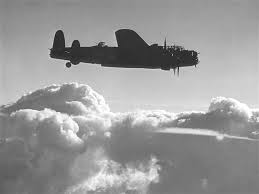
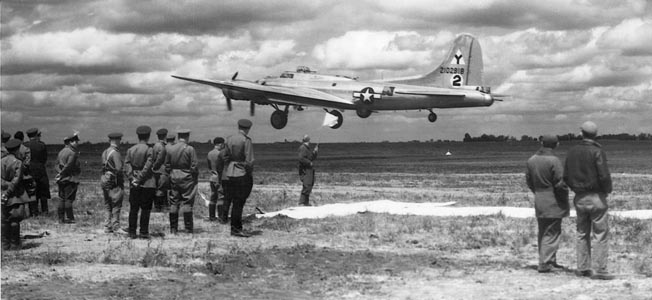
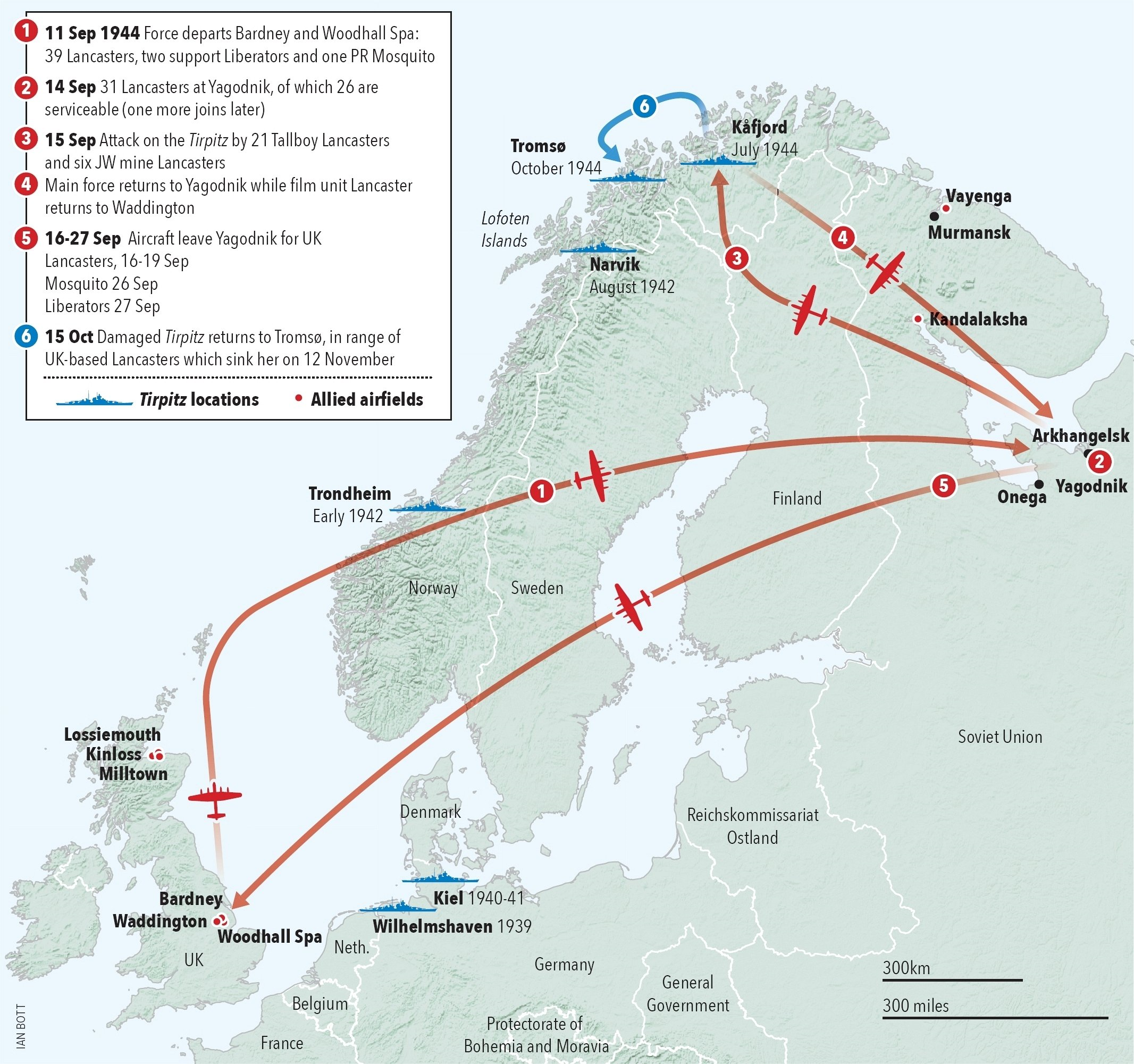
I reported earlier this month that I was awaiting the Casualty File for Flight PB416 from the Ministry of Defence. PB416 was the Lancaster bomber that crashed near Saupeset in Norway on September 17, 1944, with the loss of life of all on board – the subject of my articles on ‘The Airmen Who Died Twice’: see https://coldspur.com/the-airmen-who-died-twice-synopsis/ for the synopsis of them. The official historian of the Foreign and Commonwealth Office had encouraged me to make an application under the Freedom of Information Act, and, on July 11, the package arrived by email.
It consisted of two PDFs. The first was a standard letter, pointing out some of the security concerns that had occasioned redactions, primarily to disguise the names of relatives. Letters to such persons had also been omitted. It also described what actions I should undertake if I had any complaints about the procedure. The second was a 93-page file containing a variety of documents and photographs. What surprised me was that no restrictions on the use of the material were imposed upon me, so I judge I am free to quote, or even reproduce, freely from the material provided.
The file is very poignant – but also disturbing. It comes home to me that the registration processes shown here, which seemed very singular in relation to my quest over the individual flight that took place almost eighty years ago, must have become a sad routine for the RAF personnel who constantly had to record such mishaps. Yet the collection is also very alarming: it is fragmented, and inconclusive, and is in no way comprehensive. It complements rather the other archival information that I (benefitting largely from Nigel Austin’s predecessor activity) have revealed in my essay on the disaster. I conclude that the Squadron617 ‘historian’ has either never inspected this file, or has chosen to ignore some of its more provocative segments.
The last entry in the file is dated March 31, 1980, in which the author attempts to close out the story once and for all, while ignoring much of the archival record. (I shall return to that item later.) Perhaps a generation of interested contemporaries was dying out. The story was lost, and was relegated to a footnote. It has taken another forty-four years for the investigation to be resuscitated. My impression is that some institutional memory has endured over the decades, and enough knowledge has survived to foster the need for the incident to remain buried. My knowledge of RAF terminology and abbreviations is poor, but I hereby attempt to interpret the various reports contained.
The file starts with a very plain Air Ministry statement, dated the day of the crash (17/9/1944), and simply recording the names of those airmen missing. As a foundation for the evolving story, I list their names here:
F/O Levy, F.
Sgt. Groom, P. W.
F/O Fox, C. L.
F/Sgt. Peck, E. E. S.
F/Sgt. McGuire, G. M.
P/O McNally, H. C.
F/Sgt. Thomas, H. D.
F/O Shea, D. G.
P/O Naylor, J. F.
‘Passenger’ is written under this list, reflecting the knowledge that the standard crew of seven had been complemented by two others, the result of the inability of damaged Lancasters to return from Yagodnik, with their crews consequently allocated to other planes.
An unenciphered telegram, dated September 17, at 4:45 pm, from the Squadron to the Air Ministry follows, recording that the flight was missing, ‘returning to base after an operational sortie’ – an ambiguous phrase with severe implications, as I shall explore later. It provides more details of the crew, listing next of kin (although, surprisingly, only four such connections have been redacted). It states that Levy and Fox were Jewish, a fact that has repercussions later, and confirms that Shea and Naylor were passengers. The next day, the Squadron Leader writes a formal letter to the Air Ministry, confirming the details, but classifying the incident as a ‘battle casualty’, which it surely was not. He adds that a wireless-telegraph message was received at 2:27 am BST, but does not offer the co-ordinates, merely adding that it was ‘over Norway’.
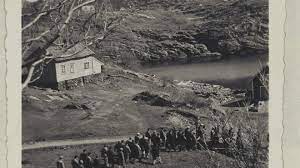
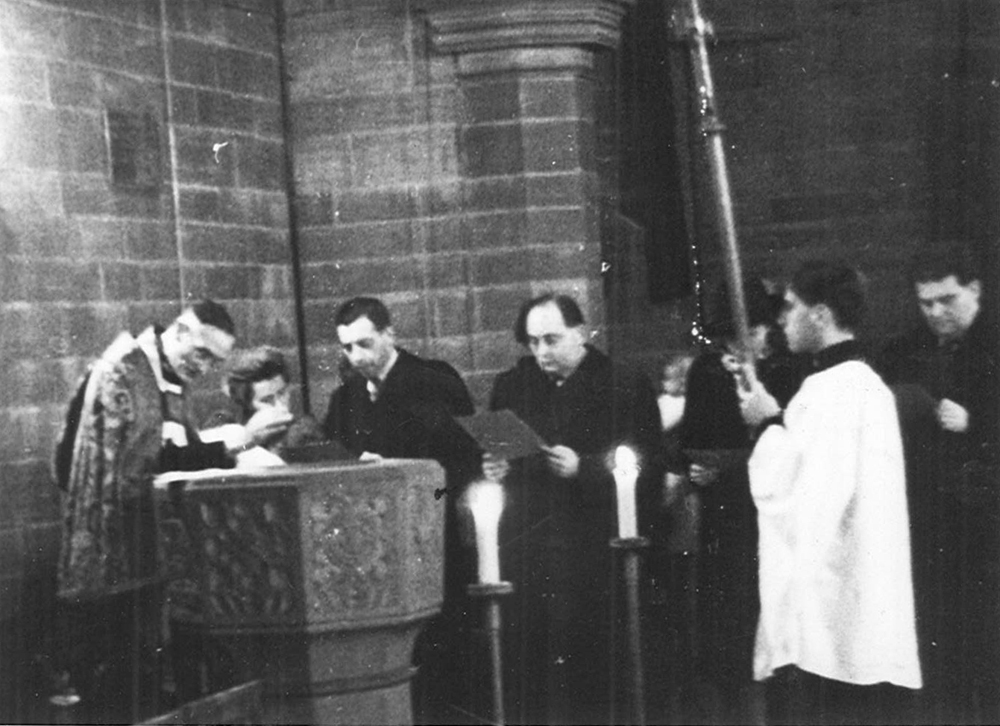
The next item is startling. It comprises a translation of a letter received via the Norwegian legation, in which a Norwegian describes how a local party of citizens was assembled to provide a ceremony for the dead airmen, and how they prevailed upon the Germans to allow them to lay a wreath on the rude grave that the local (Quisling) police had dug in the mountains, by arrangement of the Nazis. The writer describes the location of the crash, and then adds: “The entire crew, consisting of two Russian, two Australian and seven British airmen, was killed, and their identity plates were found.” He ends his script by asking whether the Red Cross could provide them with the names of the airmen’s mothers so that they might learn that some Norwegians tried to give them their last honours.
The Grave on the Mountain
I found this astonishing – for the confidence that the writer expressed in the identification process, as well as for the insouciance over the presence of Russians among the crew. Yet it is also puzzling: if all identity plates were found (presumably the only way to determine that two were Russians), why did the local authorities conclude that two of the crewmen were Australian? A photograph of Shea’s ID-tag provided later in the file, in which all information is clearly visible, indicates name, rank (OFFR), number, and religion (C E), but no clue towards nationality. (It happens that one member was Canadian, and one Rhodesian, which leads me to believe that perhaps their status as a ‘colonial’ was included: perhaps the Germans assumed that all colonials were Australian. I seek guidance.) Nevertheless, the uncompromising assertion that there were eleven identifiable bodies, and two of them were Soviet citizens, supports my hypothesis about these authorized ‘stowaways’.
The Report from Stockholm
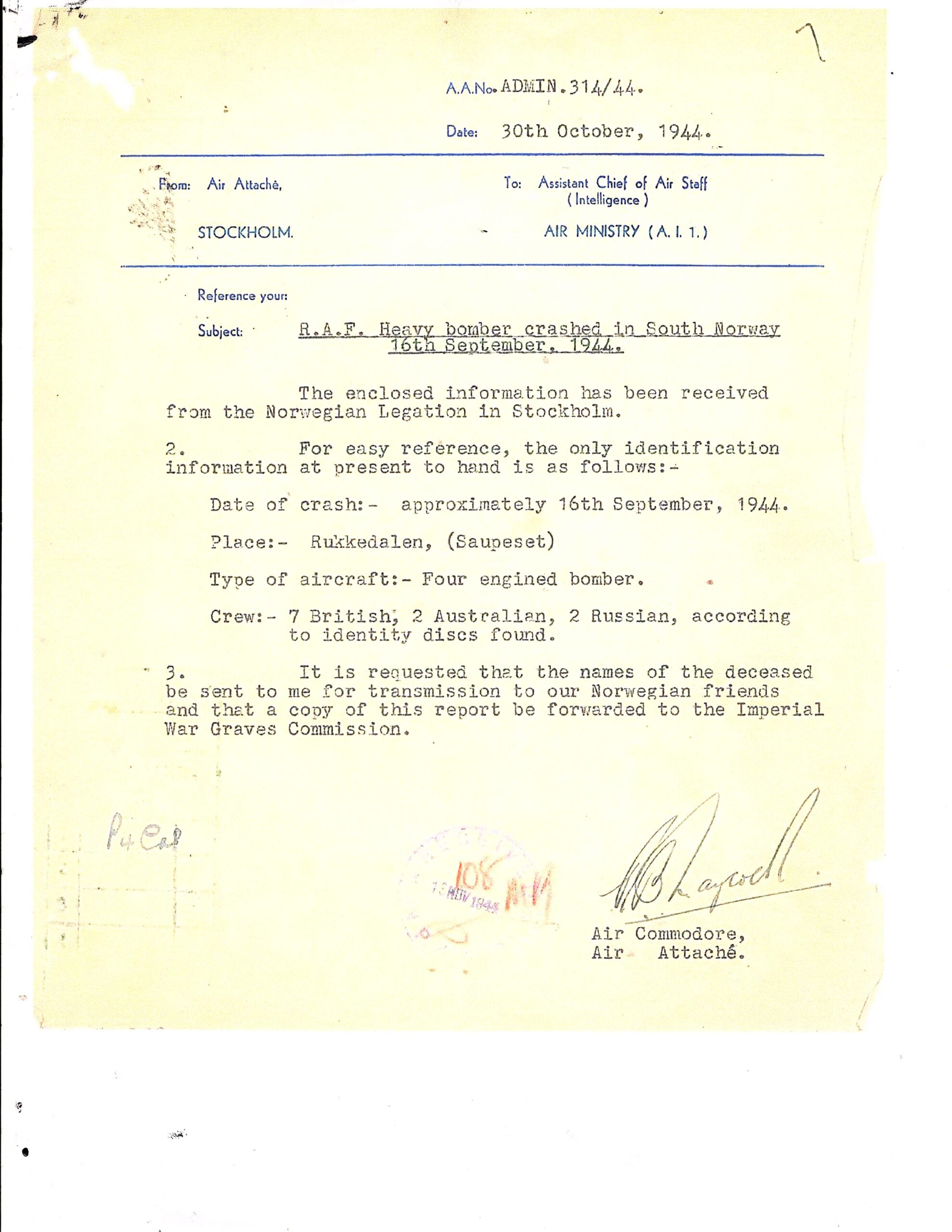
On October 30, the Air Attaché in Stockholm formally presented in a letter the same information to the Assistant Chief of Air Staff (Intelligence), and he requested that a copy of his report be sent to the Imperial War Graves Commission. The Attaché bewilderingly expressed no surprise that a pair of Russians could have been companions of the RAF airmen. Yet he went further: he was, however, explicit that the tally of the crew, seven British, two Australian, and two Russian, was derived from the identity discs found. This provocative report prompted a stern message from the Director of Personal Services at the Air Ministry, in a letter to the Commanding Officer at Woodhall Spa, dated December 4. He cites the report from Norway, adds some details about items recovered at the scene, but also shows a large degree of disingenuousness in his attempt at detective work.
The most surprising aspect is that he had up till then not recognized or confirmed the identity of the crashed plane. He lists a few scraps of clothing that the Germans had left behind, and uses the fact that one item marked ‘511 Peck’ leads to the conclusion that ‘despite certain discrepancies, it is thought that the crash is that of Lancaster P.B. 416’. How such bureaucratic stodginess could occur when a confident statement about the identity of the sole missing plane had been made the day of the disaster is incredible. Moreover, he refers to the squadron’s report about the crew of seven, and two passengers, so he must have been familiar with the details. He highlights the anomaly of the recorded eleven victims, stating: “The reference to Russian occupants may be due to the fact that the aircraft had taken off from Archangel and might have been carrying some Russian souvenirs.” He leaves unexamined the evidence (though not verifiable) from the Germans that two Russian identity discs had been found, or how the presence of a few souvenirs could have caused the Germans to lead the Germans to identify two corpses as Russian.
The officer adds a couple of perplexing details. He writes that the Germans removed everything of value from the site, leaving only four items. Apart from the Peck item (and an anonymous clothing tab), he lists ‘a clothing label in marking ink marked 544 T (?) Smith’, and ‘the remains of a pocket book marked 225/2 marked Ormestad or Ormestond’. His final request is for the Commanding Officer to verify that the co-ordinates received by W/T concerning the location of the aircraft correspond to the site of the crash, and for the mystery of the Smith/Ormestad clothing to be resolved. “Possibly one of the occupants was wearing someone else’s flying clothing.” Indeed. But the overall impression is of someone not overdosed with intelligence, concentrating on exactly the right protocol so that the office can inform the next of kin.
In his reply, dated December 12, the Wing Commander crisply tries to dispense with any anomalies. He confirms the coordinates, and echoes the vague conclusions about the challenges of identification, and the probability of the existence of souvenirs, while using the passive voice (‘it is believed’), rather than admitting to a formal judgment. Yet he completely ignores, or tacitly views as irrelevant, any suggestion that there could have been more than nine persons on the crashed plane.
The fragmented and discontinuous nature of the file is shown by the next item. It appears to be an internal memo within P.4.CAS, dated December 19, 1944, and makes it official that the Canadian member of the crew, McNally, was on the flight. In recording the burial ceremony, however, the anonymous writer concludes: “The next of kin of the R.A.F. occupants have been informed.” That strikes me as a very bizarre form of words, implying that not all of the occupants were members of the R.A.F. Otherwise, why qualify the statement with ‘R.A.F.’?
The next letter, apparently by the same writer in P.4.CAS, with the same date, is also revealing. It is directed to A.I.1, presumably Air Intelligence. It records the facts of the flight of PB416, but carelessly notes that the plane took off from Archangel ‘to return to base after having carried out an operational sortie’. This is the first occasion in which a report has openly stated that the sortie was scheduled after the plane had left Archangel, and it directly contradicts the claims that I have listed elsewhere that the plane had probably been blown off-course. I believe this statement constitutes further proof (alongside the unsurprised checking of co-ordinates) that PB 416 was on a mission to southern Norway. The writer then dismisses any notion that there could have been more than nine persons on the plane, and he lists the nine, as given above. He judges that souvenirs must have been taken as identity discs, thus pretending to counter the assertion of eleven passengers.
On December 19, the Director of Personal Services felt comfortable enough with the investigation to inform the Director General, Graves Registration and Inquiries that, indeed, there were only nine members in the crew, not eleven, and he attached the previous letter for details. On January 11, 1945, a ‘Missing Memorandum’ (no 5889) was issued, in which the status of the nine was changed from ‘Missing’ to ‘Missing believed Killed’ (MBK). The Air Ministry passed on this decision to the HQ of 5 Group, 617 Squadron. On January 8, the RAF Casualties Officer had challenged this reclassification to MBK (and to WBK – the meaning of which is not spelled out), however, and awaited further justification in a letter.
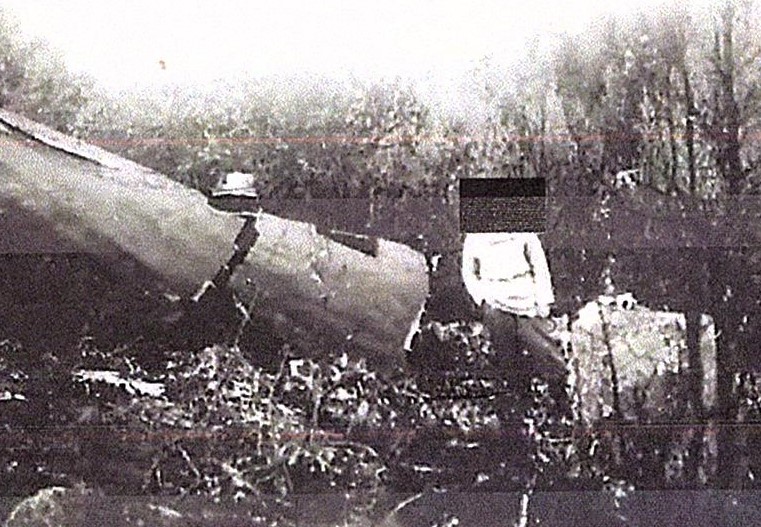
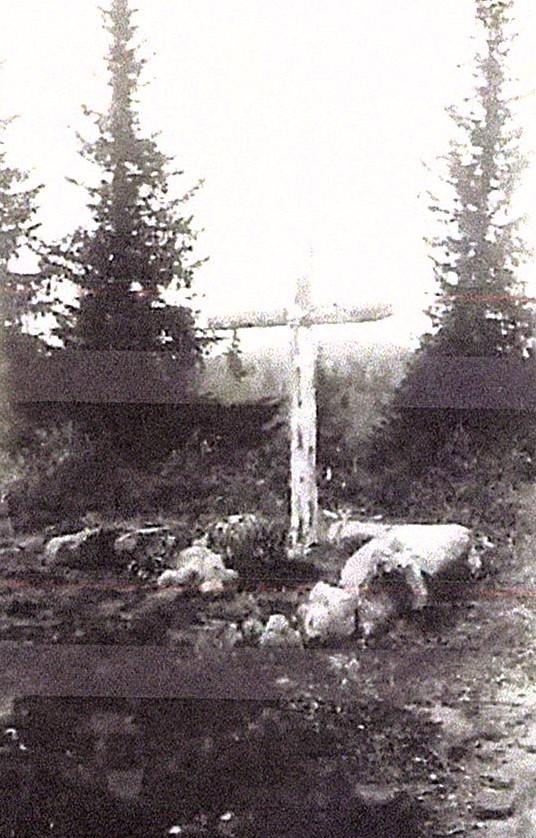
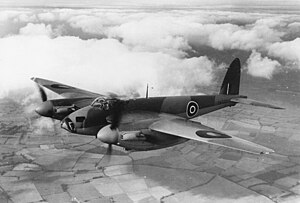
Another letter from a Group Captain, acting for the Director of Personal Services, and dated February 6, confirms the status of the dead, but allows a separate process for the presumption of death to be taken by the Canadian section in the case of McNally. This letter extraordinarily still records that ‘The entire crew, believed to comprise eleven personnel, were all killed’, without making any commentary on this enduring enigma. The letter confirms the reality of the operational sortie. Following the letter, photographs of fragments of clothing, of the cross constructed at the crash-site, and of the airplane itself, are provided.
A new twist is next provided by an undated memorandum from an address in Oslo (the identity of its owner redacted). It repeats familiar information, but comments: “Eleven men were buried accoring [sic: ‘according] to the Germans, but the Norwegians say it was only ten.” This development may reflect the testimony of a Norwegian present at the time, who was reported on social media over a decade ago as saying that he had seen a body transported from the site. The file then reverts to October 28, where the Air Attaché in Stockholm writes to RAF Intelligence that the crew was believed to consist of eleven or twelve men! Where the twelfth person came from is not explained.
German list of Booty
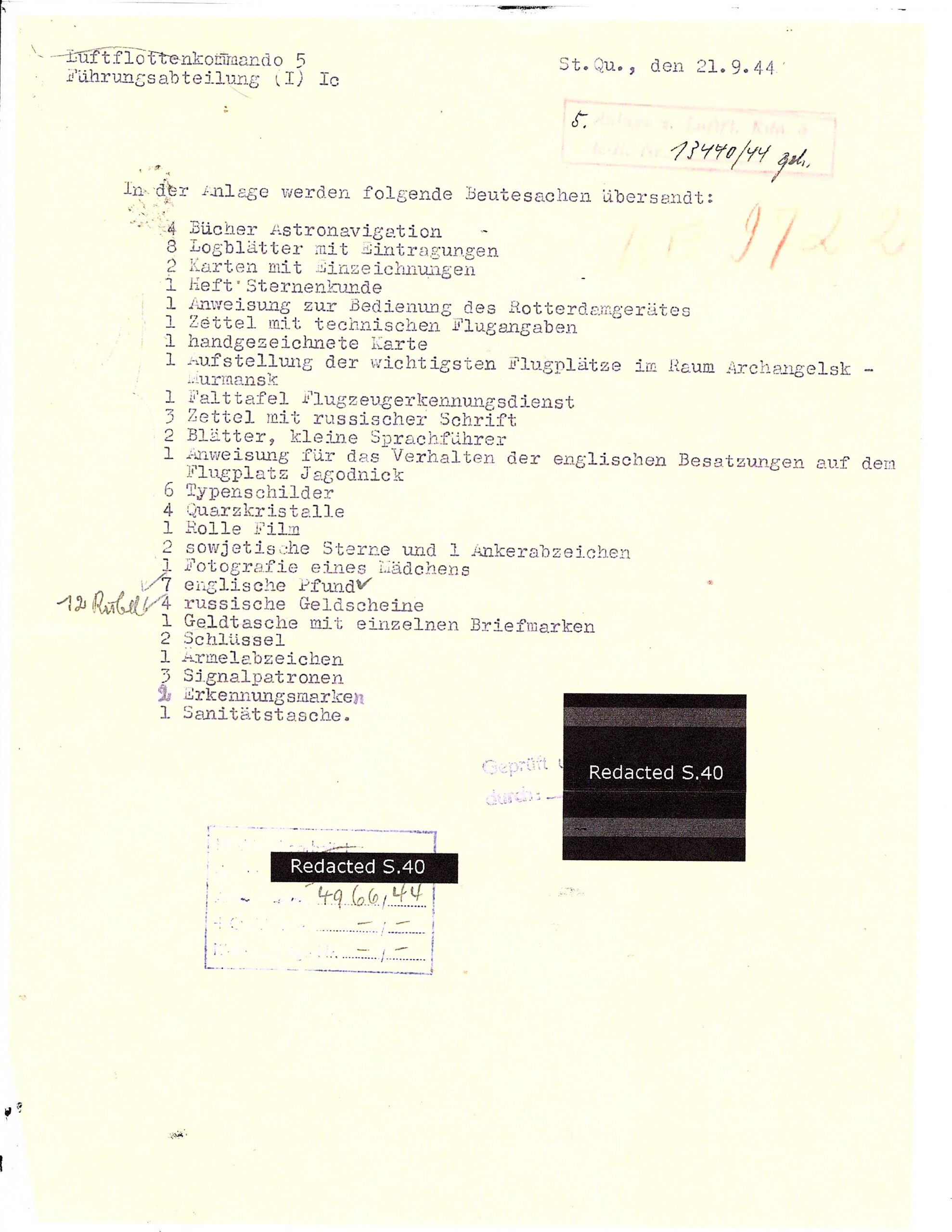
The file takes another sharp turn when some German documents are revealed. It is not clear when these were discovered, but it must surely have been after the war. The first is dated as early as September 21, 1944, and consists of a list of ‘loot’, or ‘booty’ retrieved from the site. Notable among the effects are a ‘Zettel mit russicher Schrift’ [scrap of paper with Russian writing on it], ‘2 sojwetische Sterne und 1 Ankerabzeichen’, [2 Soviet stars and 1 Anchor medallion] as well as ‘4 russiche Geldscheine’ [4 Russian banknotes]. While the latter two items could conceivably be interpreted as being souvenirs (although foreigners taking Soviet money out of the country was strictly forbidden), the scrap of paper would point indisputably to the presence of a Soviet citizen on board. The anchor medallions would suggest that at least one of the pair was a member of the Soviet navy.
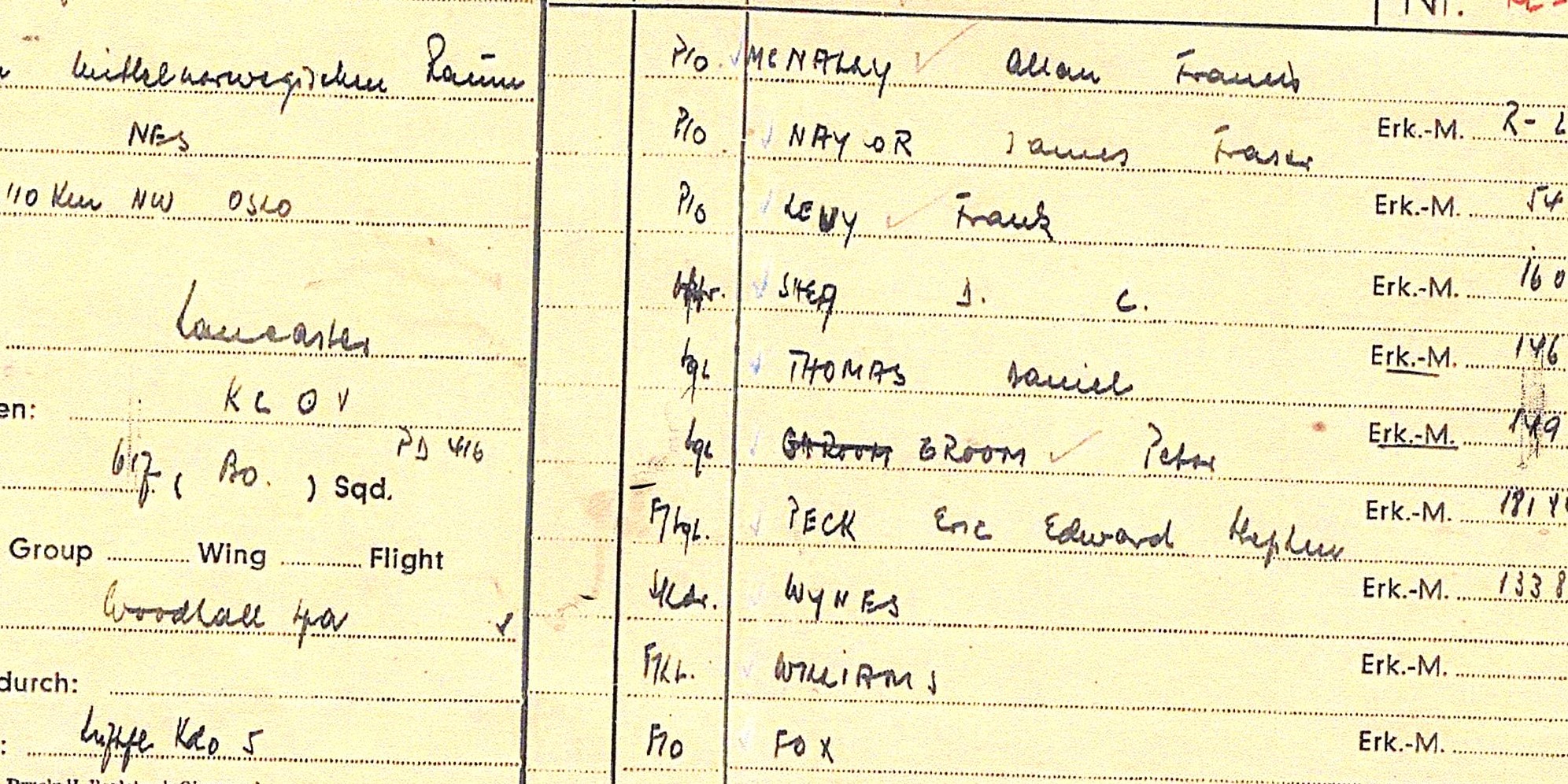
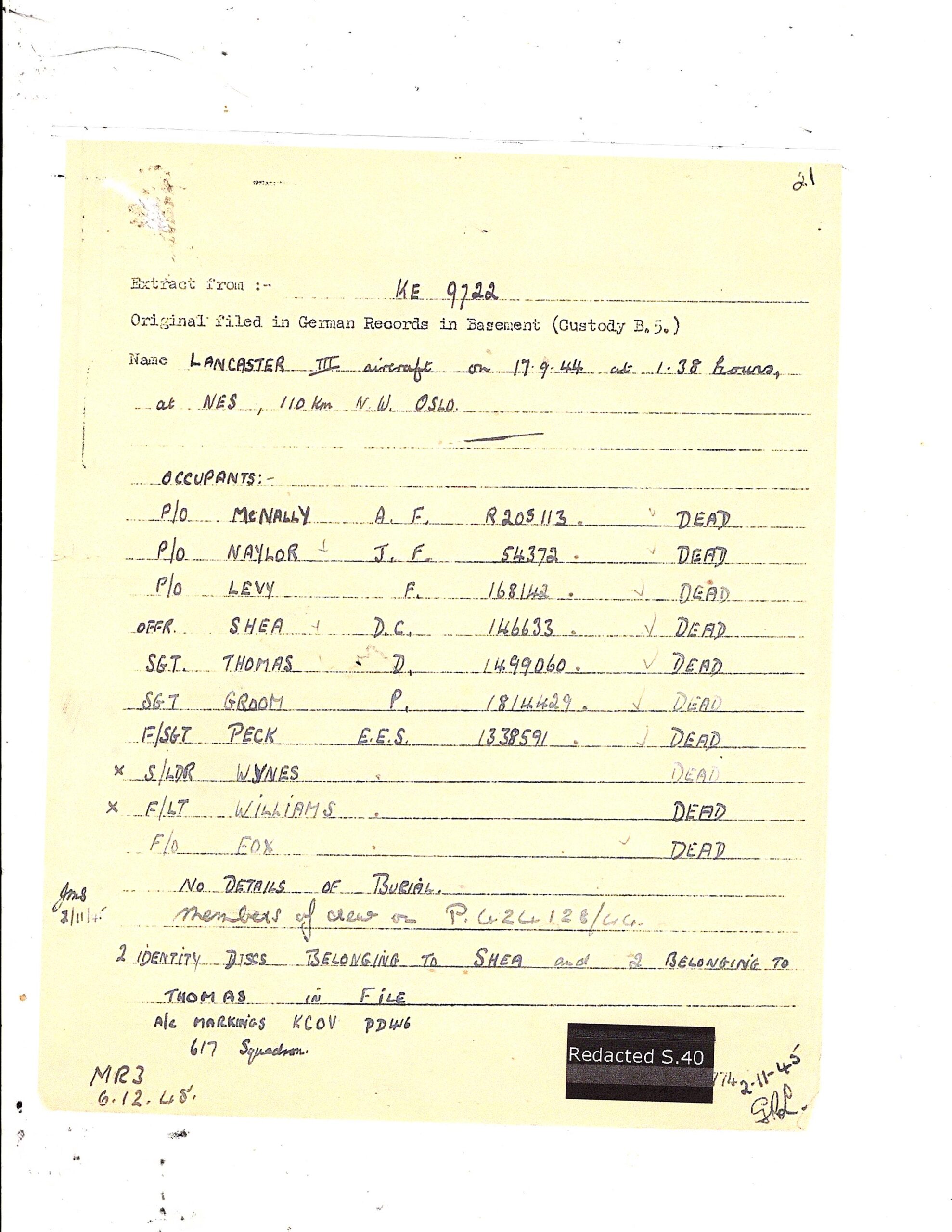
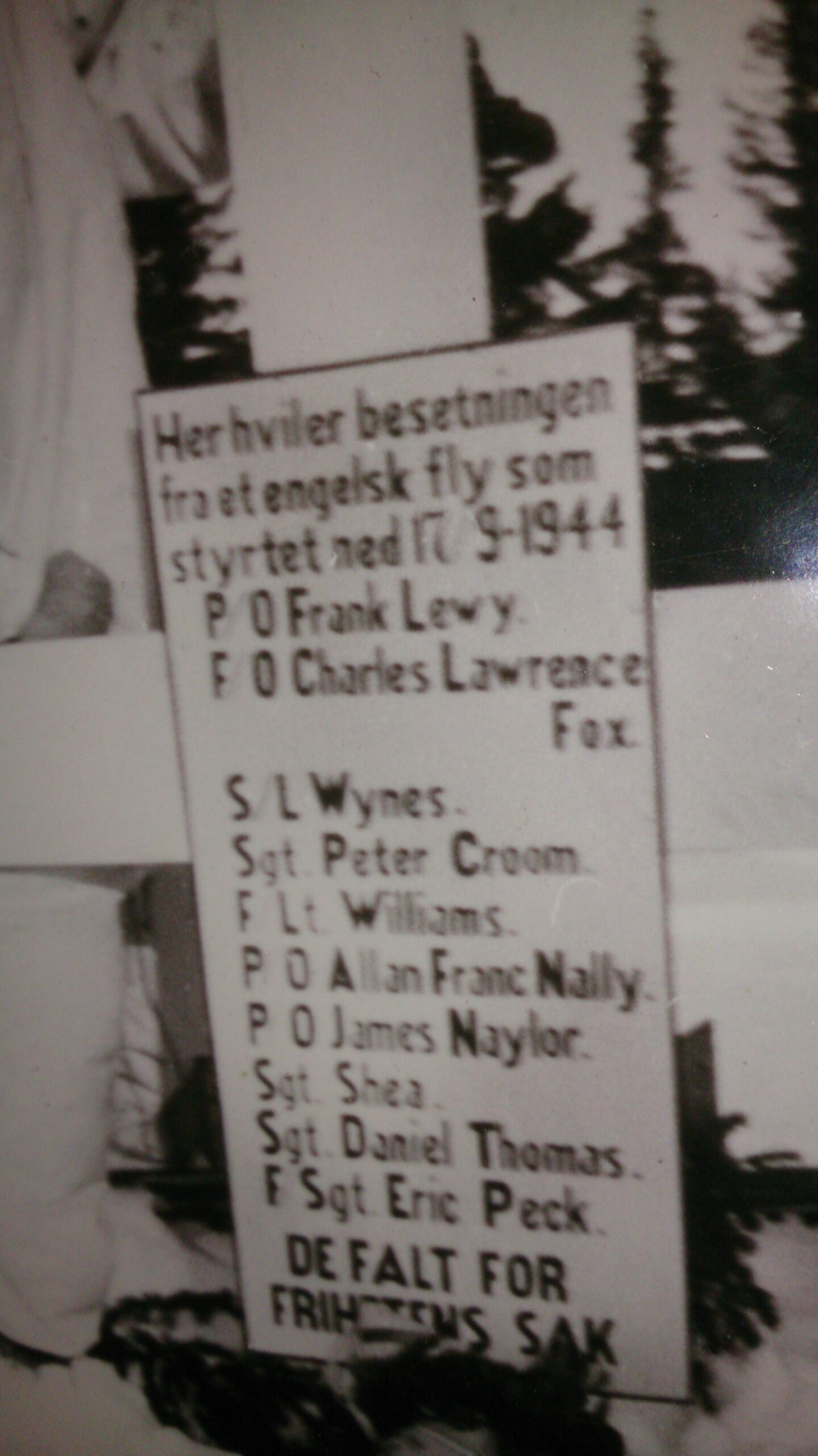
A brief report from an Oberleutnant, dated September 27, refers to the fact that the personal papers of seven crew members of the Lancaster will be handed over soon to the Air Command. It is followed by the shocking first revelation of the phantom members of the crew, Wynes [sic: ‘Wyness’] and Williams. On an official form for reporting British airplane crashes, dated January 24, 1945, ten crew members are listed, comprising the standard roster (but without McGuire), but including Squadron Leader Wyness and Flight Lieutenant Williams. Yet the latter two, as well as Fox, are listed without their ID-tag number, which is a surprising phenomenon, given that earlier reports had indicated that all the IDs had been found. This report appears to have been picked up on November 2, 1945, and is reproduced, with no apparent challenge. Yet the absence of McGuire is not noted, while two crosses appear against the names of Wynes [sic: unchanged, as if the writer is not familiar with the real Wyness] and Williams.
German report of crewmen found
The Director of Graves Registration and Inquiries is confused. On October 16, 1945, he writes to the Under-Secretary of State, Air Ministry (Casualty Branch), informing him that ‘the Graves Registration Service, Norway, have been alerted to visit the location and register the grave of the nine members of the crew’, who have been interred at the top of the mountain. Yet he adds that the names of Wynes and Williams have been included, without declaring the anomaly in count, or even checking his own records, where he would have found that the two airmen were already deceased. He ends his letter by asking if the two might be correctly identified, and their ‘full Service particulars furnished’.
Wynes [sic] and Williams from German records
The request for clarification is echoed in a letter from the Squadron Leader in Oslo, the officer commanding Section 6 in 88 Group. He is addressing the Casualty Department of the Air Ministry, and requests full information so that he may supply the Graves Registration Unit with accurate information. The quota of the crew has been restored to eleven, with McGuire present again, and Wynes and Williams still in view. He adds that the GRU wants the graves to remain where they are for the time being.
This causes a flutter with the Director of Personal Services. Without offering any evidence, in a letter back to Norway, dated January 2, 1946, he asserts that the aircraft carried only nine men, and notes that ‘the inclusion of Squadron Leader Wyness and Flight Lieutenant would appear to be an error on the part of the German authorities’. I notice that this is the first time that Wyness has been spelled correctly, and the Director has obviously done his homework, as he relates how the pair went missing in October 1944. His proffered explanation is that other members of the crew had somehow been carrying some of Wyness’s and Williams’s effects with them, as if that resolved all the issues. He then sends a shorter letter conveying the same message to the Under-Secretary at the War Ministry. Meanwhile, the Director of Graves Registration is getting impatient. On January 3, 1946, he reminds the War Office that he is still awaiting a response to his October 16 letter. If he received a reply, it has not been filed.
The scene then switches back to Norway, and the gravesite. An undated report explains how the bodies have been re-interred in the graveyard at Nesbyen Church, probably in April 1946. “Local reports say that eleven bodies were buried but only the remains of ten could be found,” it runs, continuing: “These were badly burned and mutilated and in all cases only parts of each body were found.” The evidence from the ground would tend to reinforce the notion that one body had been removed, while it fairly conclusively indicates that ten separate bodies could be recorded, though not confidently matched to the known crew members. The result is that some guesses had to be made.
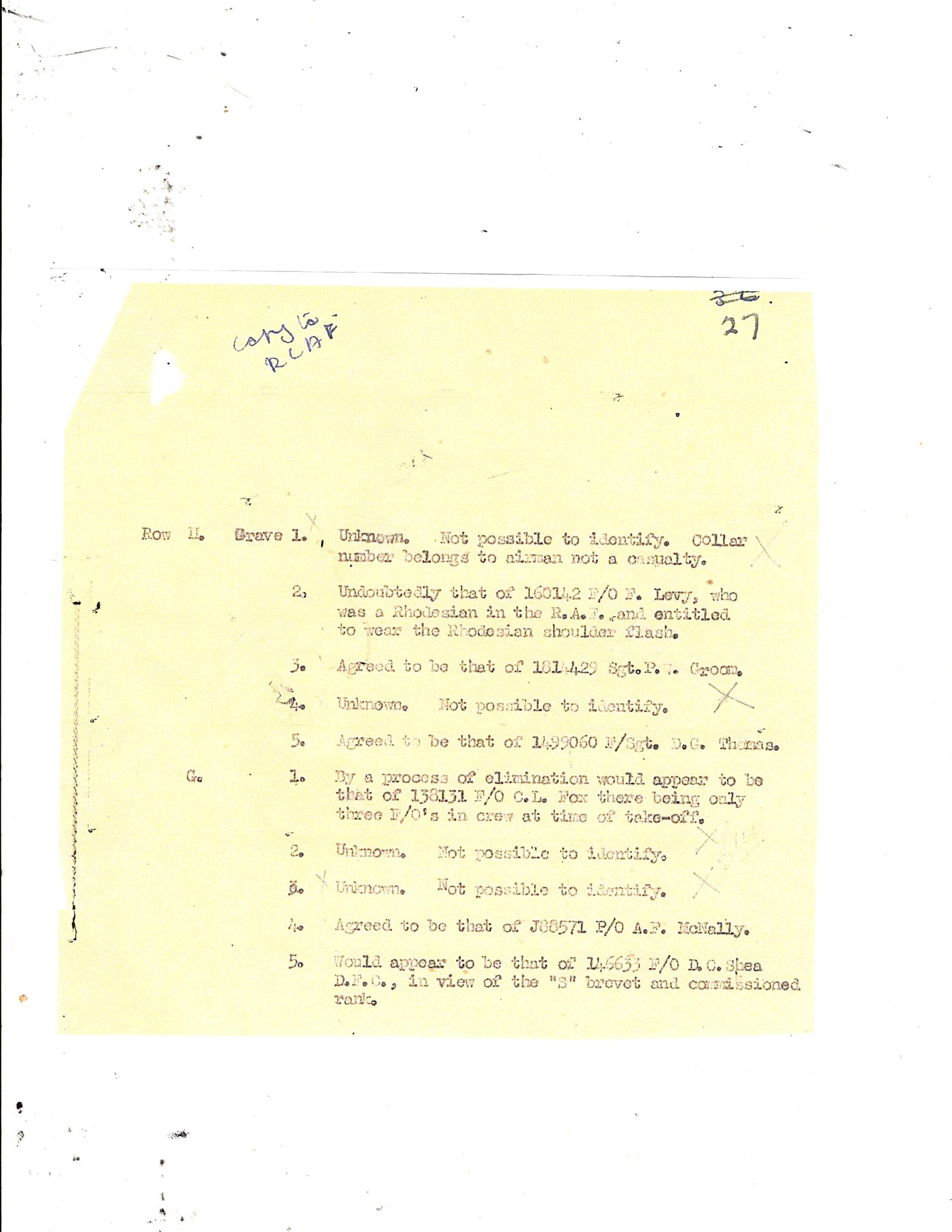
I show below the summary of the allocation of graves to victims. One extraordinary supporting note for the body placed in Row H, Grave 1, states that one of its markers was ‘part of collar bearing the number 1435510.’ Someone has inserted the name of the airman holding this number, but it has been redacted. Next to it appears the rubric: ‘Not a casualty’. A quick search on the Web reveals that Pilot Reg Payne of the same Squadron held that number, but his name does not appear in the Operations Book of the PARAVANE mission. Why his id-tag should appear in the remains is yet another mystery. What the summary does tell us, however, is that only Levy, Groom, Thomas, Fox, McNally and Shea could be confidently identified, leaving Peck, Naylor and McGuire perhaps incorrectly identified on the eventual tombstones, with the possibility (not evident to the authorities) that McGuire’s body had been removed, and that one of the Russians had taken his place. And, of course, the tenth man is the extra whose existence could not be recognized by the R.A.F.
First Analysis of Gravesites
The details concerning the body interred at G2 are fascinating: “This body was very badly burned and only part of civilian type [missing] with blue and white stripes could be found.” Whether the pattern of this clothing could lead to clearer identification was apparently never investigated, but was it perhaps a Soviet prison uniform? Why would the authorities choose to ignore this unusual but discomforting factoid?
In any event, on May 2, 1946, the Squadron Leader of the Oslo RAF mission passed on the report to the Casualty Department at the Air Ministry, pointing out the discrepancy between the ten bodies and the nine names supplied, and asking for the Ministry’s findings on the matter. The Director of Personal Services replied on July 27, seeking to close out the business. He concurred with the identification of the six above, and then wrote: “It is not possible to identify the occupant of grave 2, row G, from the civilian wearing apparel, and it is suggested [that passive voice again!] that the remains be concentrated [sic: ‘consecrated’?] to one of the unidentified graves.” Further, he recommended that the unidentified graves be registered collectively in the names of Peck, McGuire, and Naylor. He finally attempted to wipe away all controversy about the number of bodies found by referring to the general state of mutilation, which must have made counting difficult, and requested the Graves Registration Unit to accept what he had decreed.
Initial Internment at Nesbyen
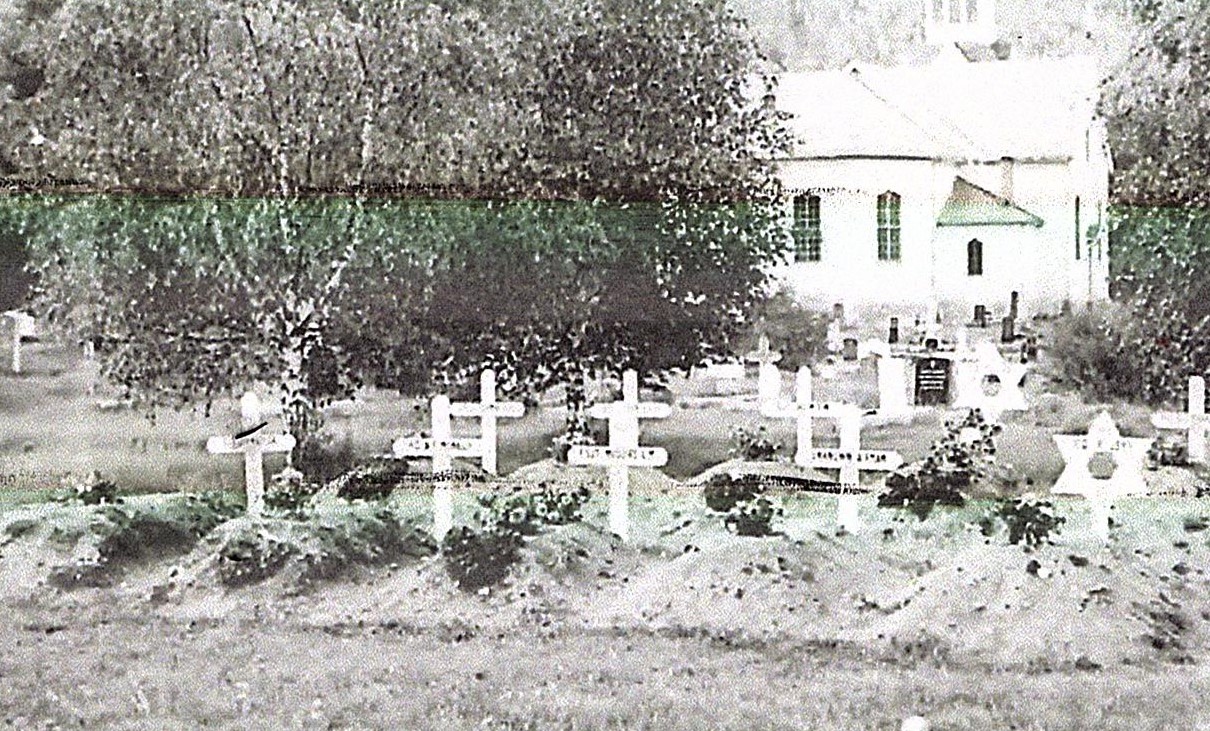
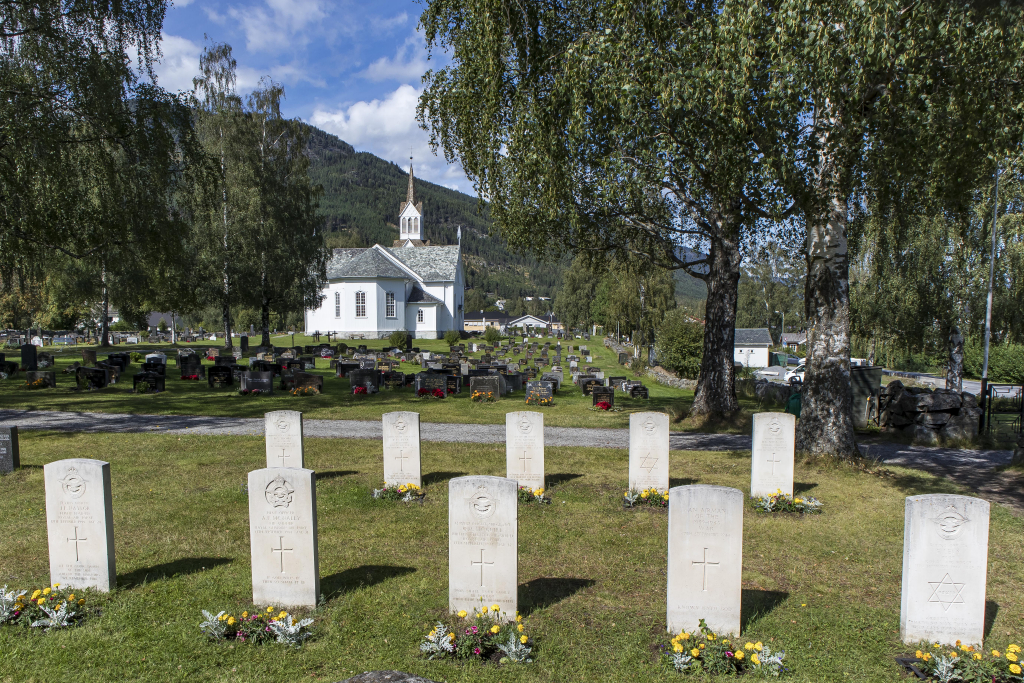
There then follow a number of identical photographs of the graves and their markers, on which the names can be clearly viewed. These were taken in October 1946 by an unnamed tourist from Leeds who happened to be in the area. There are two St. David’s Stars (for Levy and Fox), eight Christian crosses, and, very curiously, an unmarked grave to the left. That is provocative, because photographs taken recently at Nesbyen Church, with new granite headstones provided, indicate that the number of graves has been reduced to ten. This anomaly caught the eye of the officer in CAS, and he wrote to the submitter, on February 18, 1947, that ‘the arrangement of the graves shown thereon does not tally with the arrangement quoted in the exhumation reports’, and that he would not be able to forward the photographs to the next of kin until the discrepancies were cleared. The fact that these sixteen photographs still sit in the file suggests that those discrepancies remained unresolved.
There were several problems, and the officer had to send a sharp note to Oslo the same day, pointing out that the location of the graves as displayed by the private photographer contradicted the findings issued by his office. He did not describe the conflicts in detail, but it is obvious that the presence of not only a tenth, but an eleventh, grave disturbed him, and the locations of the named victims had been moved as well. “In these circumstances”, he writes, “can it be stated please on whose authority the crosses shown in the photograph were erected and inscribed?”.
He was not to receive any useful answer. On March 1, the Air Attaché in Oslo wrote back that the addressee, ‘No 14. M.R.E.S’, had left Norway five months earlier, taking all his files with him, and he routed the inquiry to Headquarters, No. 3. M.R.E.U. In Karlsruhe, Germany. Thus the investigation was tactfully allowed to grind to a halt. The officer issued his final official burial records, all nine of which appear on file, as follows, with precise data about Row and Grave No.:
Levy G1
Groom H3
Fox H2
Peck H4
McGuire G3
McNally G4
Thomas H5
Shea H1
Naylor G5.
His instructions were followed, in the main, except for the fact that a headstone existed at G2, dedicated to an ‘Unknown Airman’ – someone that the Air Ministry did not want to recognize, although the gap would have stood out like a missing tooth. And, of course, the remains described as McGuire probably belong to the second Russian citizen.
Nesbyen Cemetery Today
Nevertheless, the officer received confirmation on November 26, 1947, that the graves had been shifted according to instructions, and that the registrations were correct. Oslo declined to remove the remains of the ‘Unknown Airman’, and London remained in ignorance of their durability. And that was effectively that. Apart from corrections to the named rank of Naylor and Fox, the case was closed on December 7, 1950, with the list of the dead stubbornly remaining at nine. The last entry, dated March 31, 1980, shows that one inquisitive private sleuth was trying to decipher the mystery, having seen the grave for the Unknown Airman at Nesbyen. A letter to him from the Ministry of Defence confirms that there were only nine passengers on board the flight, and the author observes: “Unfortunately we have no knowledge of the identity of the airman who occupies the grave in the churchyard which is marked ‘Known Unto God’”. That in itself reinforces the paradox: if there were only nine on board, how is it that a real but unidentifiable tenth airman could be implicitly acknowledged?
Conclusions:
This was a sad and ignoble project. The file, while straining to provide its own narrative, omits many other significant items, such as those I have displayed in my analysis. It desperately cries out for an integrated assessment of all intelligence. It is characterized by a petty, bureaucratic lack of imagination and curiosity, and a failure of anyone to take proper responsibility for resolving the many conflicts. The question cries out for attention: Why was a Special Inquiry into this tragedy not carried out at the time?
Of course, that may have been the intention – to maintain the investigation in such a state of confusion that the bureaucrats would eventually tire of its twists and turns. Someone in authority surely knew the whole story, and how volatile it would be if the truth came out, and issued clear instructions that the anomalies were not to be pursued with any diligence. And the obstruction was successful.
Yet, some irrefutable clues persist as to the nature of the deception. The last flight of PB416 is more than once described as an operational sortie over Norway, and its unorthodox course can thus not be attributed to the weather. The Germans were able to identify two of the bodies as Russians (although their technique for doing so is not clear), and the markers erected on site (which the Report does not reproduce) clearly indicate the presence of the remains of airmen bearing the markers of Wyness and Williams. Effects showing Russian heritage, including handwritten notes, which could not have been created by any of the R.A.F. crewmen, and banknotes to the tune of 70 rubles, were recorded by the Germans. Unexplained anchor medallions and ‘civilian clothing’ were found. A suggestion remains that not all occupants were R.A.F. members. The count of eleven corpses endured, despite all the efforts of the Air Ministry to quash it. It is time for the Ministry of Defence to acknowledge the patent errors and oversights that characterized the investigation of its predecessor Ministry, conduct a proper inquiry that considers all the evidence, and prepare to apologize to the relatives of all those who died.
Readers can probably imagine the flurry that takes place in the days just before the publication of the monthly coldspur. After I have submitted my copy, my team of fact-checkers goes over it, verifying names, dates, titles, and professional positions. Thelma, my lead grammarian and Sensitivity Reader, goes over my text with a toothcomb, looking for dangling participles and ensuring that the subjunctive mood is deployed properly, checking nounal and verbal agreements, and verifying that colons and semicolons have been used correctly. She also has an eye out for any offensive remarks I may have made concerning disadvantaged minorities. (She is not certain whether the category of ‘authorized historians’ comes under that rubric.) My Editor next reviews the overall style of my piece, and analyzes it for any opinions or assertions that may have legal implications: we discuss them, and make any necessary changes. Meanwhile, my Graphics Editor has been scouring the Web for suitable images to decorate my pallid prose. Lastly, cross-referenced urls have to be reconciled and verified, and the posting properly indexed for optimization by search engines. On the last day of the month, before breakfast my time, the piece goes into Production status, and eager readers, from Memphis to Murmansk, from Montevideo to Melbourne, can pick up their monthly fix.
I was relieved to have completed writing the saga of the 1944 crash at Saupeset, and to be able to publish it, by the end of March. I have had several complimentary messages from coldspur readers around the world, and it has been my intent to drum up interest in the story in time for the eightieth anniversary of the incident in September of this year. I strongly believe that the relatives of the sacrificed airmen deserve a full explanation and apology from the Ministry of Defence. I also believe that my story is strong, and very defensible, with incontrovertible evidence about the impersonated airmen and their subsequent tragic deaths, even if the documentation behind the conspiracy is sadly missing. I also feel it is appropriate, among all the celebrations surrounding the liberation of 1944, that honest appraisals of mistakes be made as well. For example, several recent books have disclosed the massive French civilian casualties that were caused by RAF and USAAF bombing after the D-Day landings, in places like le Havre, and the manner in which such slaughter was given justification, in the context of the objective of destroying German units, is receiving fresh attention from historians.
One of the early converts to my story was Professor Torgrim Titlestad, who has a very special interest in Peter Furubotn, the Norwegian Communist who defied Stalin. He has spent a large amount of time in updating a biography of Furubotn, one first published in Norwegian in 1997, but not yet published in English (A synopsis of his life is available through his website at https://furubotnarkivene.no/en/about_peder_furubotn/index.html). The Professor believed that what I wrote shed fresh light on Furubotn’s career – and on his avoidance of an early grave. Moreover, he had a close connection with Furubotn, as his father had been Furubotn’s security officer in 1944, and had accompanied him in his escape from the Gestapo. If any academic were to be sceptical about theories of assassination plots via RAF aircraft, it would have been the Professor.
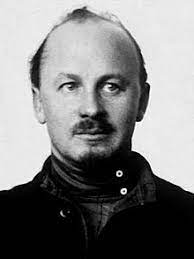
At one stage earlier this year, Professor Titlestad even invited me to speak on the subject at a conference in Oslo later this year. I jumped at the opportunity, and started planning possible speaking events in the United Kingdom to leverage my presence in Europe, believing that I had interesting stories on such as Philby and Smolka to relate, as well as the ‘Airmen’ saga. I very much enjoy public speaking, and dug out my passport to see if it needed renewing. The Professor even asked about my expenses, and how I thought they should be met. I responded promptly –and generously, I think – but then the Professor went quiet. I did not go begging to him to determine what happened, but am dismayed by his behaviour. I do not know whether a political dispute interfered with the invitation (the Norwegians are still at loggerheads over some aspects of the wartime resistance), or whether the Professor decided he did not care for my revisionist views of Furubotn. As the conclusion of my piece clearly states, I am dismissive of the Professor’s attempt to present Furubotn as some kind of ‘Eurocommunist’ liberal, and found the references to Bukharin ill-advised. In any event, I had to withdraw my preliminary approaches for other speaking events, which was very annoying.
I thus turned my attention to media outlets who I considered might be interested in the story. My on-line colleague Keith Ellison had kindly converted the web pages of the story into PDFs, so I now had a version I could distribute rather than simply referring addressees to coldspur. I saw two classes of outlet – a) institutions with some responsibility for, or ownership of, the case, and b) investigative journalists with a penchant for uncovering breakthrough stories. In the first category, I picked the Squadron 617 Association and the magazine RAF News (‘the official voice of the Royal Air Force’). Neither entity even acknowledged my email. As for the second, I wrote to Private Eye and the Mail on Sunday (who had used material by Anthony Glees and me on Sonia a few years ago). Again, neither even acknowledged my message.
I had to change tack, obviously, and approach individual names. Having exchanged emails with the historian Andrew Roberts a few years ago (before he became Baron Roberts of Belgravia), I had joined his distribution list for updates on his new books. I thus tried to invoke his help. He responded very promptly, said the domain was however outside his sphere of interest, but immediately copied in a journalist at the Daily Mail, one Andrew Yates. I never heard back from him, either. I contacted a couple of historians with whom I had become acquainted via the SOE chat-site: they were both very enthusiastic about my research, but they could not offer any leads to further promotion. At about this time (early May) I also reached out to the journalist Mark Hollingsworth, with whom I had created a friendly rapport after I had reviewed his book Agents of Influence on coldspur.
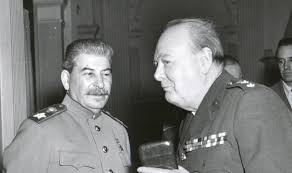
Mark was very supportive (he was impressed with my research on Smolka), and he suggested that I create a synopsis of the material, in order to enable easier assimilation of the rather complicated story, and that I contact historians and journalists with expertise or interest in the war in Norway. I thus boiled the story down to 2000 words (see https://coldspur.com/the-airmen-who-died-twice-synopsis/) , and prepared to search out a list of likely candidates. I disagreed, however, with part of Mark’s guidance. He felt that no journalist or historian would touch the story without documentary evidence of the major plank in the story – that Churchill and Stalin must have exchanged messages of some kind in order for the flight and impersonations to have occurred. As my conclusion boldly stated, I felt it extremely unlikely that anything would appear, given the extraordinary circumstances of the enterprise. I could quickly list multiple events from World War II that have been discussed in serious terms when primary documentary material was not available. The authorized historians Foot, Hinsley and Andrew had all made categorical statements about events that had no documentary back-up. There were enough established facts about the case to warrant its broader promulgation. Besides, everyone likes an aspect of mystery. So I continued.
I picked out the names of six prominent historians whose books related to the subject I had read: Tony Insall, Ian Herrington, Richard Petrow, Patrick Salmon, Olivier Wieworka, and Max Hastings. Sadly, Petrow has died. I then tried to find email addresses for them, but such figures normally hide behind their agents and publishers. Apart from Insall, this was the case, so I had to craft individualized messages to those who represented them, asking for my package of synopsis and PDFs, with a brief explanation of what I was trying to achieve, to be forwarded to the relevant author. That was on May 16. The same day I made a separate approach to the Chairman of the Squadron 617 Association. Soon after, I sent personalized emails to journalists Ben Macintyre (of the Times), and Ben Lazarus (of the Spectator), both of whom I had exchanged messages with – concerning Sonia, of course – a few years ago, and suggested that they might be interested in promulgating the story. I never heard back from either of them. At the end of the month I posted a piece on FaceBook that drew attention to the new Synopsis now available on coldspur.
And then, at the end of May, I had two glimmers of light. None of the other historians responded to my approach, but Professor Patrick Salmon, who had edited Britain & Norway in the Second World War, published almost thirty years ago, responded with interest. He regretted that he was no longer close to Norwegian affairs, but he would try to help. He is now Chief Historian at the Foreign, Commonwealth and Development Office, which sounds like an influential position. Shortly afterwards, I received a long email from Dr. Robert Owen, Official Historian, 617 Squadron Association, to whom my message had been routed. A few days later I responded in kind, with a polite and thorough analysis of his points. The outcome was, however, tremendously disappointing. I felt that our communications deserved greater publicity, and I accordingly posted the exchange as a Special Bulletin on coldspur on June 11 (see https://coldspur.com/the-617-squadron-association-historian/).
Professor Salmon, meanwhile, has continued to be very helpful. He recommended that I contact the Air Historical Branch of the RAF, and make a request for the Casualty File for Flight PB416 under the Freedom of Information Act. This I performed on June 13: Professor Salmon told me that the Branch has to provide a reply within twenty business days. On June 15, I received a confirmation of my request, and an indication that I should receive a reply by July 15. On the other hand, disappointments still occur. Mark Hollingsworth recommended that I contact a prominent historian of RAF matters, Paul Beaver. Through his publisher, I made contact, and he responded promptly, and with apparent interest in my story. After ten days, I had heard nothing, so I emailed him again, and he disappointingly wrote that he had been too busy to read it . . . And Nigel Austin, the man who initiated this whole project because he had a relative who was killed in the crash, expressed great enthusiasm when I completed the project, and vowed to promote the story. Yet he has now disappeared from the scene, and no longer responds to my emails.
I am finding this tepid response not only demoralizing, but also a little eerie. As one of my coldspur colleagues wrote to me, my story would make a great documentary. It has everything: mystery, disaster and tragedy, war, Nazism and communism, institutional confusion and cover-up – as well as a very timely anniversary. Yet several experts do not even show any interest in its potential or topicality, let alone engage in debate to challenge my hypothesis. It is almost as if a celestial D-Notice has been placed on my research. My mission at coldspur has been to reveal when government institutions – in my domain of interest, primarily MI5, MI6, the Home Office and the Foreign Office – have covered up the facts out of a desire to protect themselves, in the belief that the British public cannot be trusted to know the truth. Thus my investigations into (for example) the concealment of knowledge over Klaus Fuchs, the cover-up over Kim Philby, the refusal to divulge the clumsy attempt to manipulate Agent Sonia, the colossal mis-steps over Peter Smolka, the censorship of activities behind the demise of the PROSPER network, and the improper release of rumours to journalists to discredit officers like Hollis were all prelude to my research into the shenanigans with the disaster of PB416.
In the past few months there have been resounding echoes of such governmental misbehaviour in the willful mishandling of the Post Office HORIZON project, the revelations concerning the tainted blood fiascos of the 1970s (of which my sister was a victim, I believe), and, very recently, the investigation into the cover-up of Nazi crimes on Alderney. Not solely in the world of intelligence and military history are the issues too important to be left to the authorized and official historians to analyze and report on, and I shall continue to plough my furrow without concerning myself about upsetting anybody in authority, or the repercussions therefrom.
The coldspur Archive
As I reported a few months ago, I successfully arranged a home for my library of books and archival material (see the press release from the University of North Carolina, Wilmington at https://giving.uncw.edu/stories/new-special-collection-to-make-randall-library-a-destination-for-researchers-worldwide.). This is an important agreement, since it relieves me of the distress of fearing that my collection might be dispersed or even destroyed when I go to meet the Great Archivist in the Sky. (By the way, I shall not ‘pass’: I shall die.) I believe the value of the complete set, and its availability for researchers from near and far, greatly exceed the usefulness of the individual volumes. I suspect that, as an assemblage of books on intelligence and twentieth-century history and literature, primarily British but also American, it may be unmatched by even the most learned institutions. The University, as part of our deal, has committed to providing administrative support to catalog properly the whole collection, and to provide enhanced capabilities for an electronic portal to all my coldspur research, and the documents and systems that have supported it, such as my epic 400-page Chronology (my Crown Jewels and secret sauce), and notes made on a vast number of books and archival material.
The transfer of books will probably start at the end of this year. This will be a wrench, as I dread the idea of losing direct access to all the volumes that I have become accustomed to exploiting each time I create a coldspur posting. The Library at UNCW is about forty miles away, so I shall have to plan my visits very carefully if I am going to continue with my conventional research. I suspect, however, that I shall have to cut back the depth of my investigations, and gradually wind down to a more routine and less dramatic series of postings. Thus I shall spend the remainder of this year reviewing what important commitments I still have, and identifying what files I have on my desktop that have not been processed properly. I also have a lot of work to do in cleaning up electronic files and references, as well as documenting carefully the various paper items (letters, printed reports, sets of old magazines, many of which contain important articles, clippings, etc.) that will constitute an important part of the archive.
Meanwhile, the project to register all the books continues. Every Sunday morning I allocate a couple of hours to entering another hundred items on LibraryThing. I am now approaching 5,000 volumes recorded in my private on-line library, with a lot still to be processed. This can be an easy task, if the book contains an accurate ISBN, but the older volumes require some digging around to find the correct year and publisher, and some of the more antique items have to be entered completely manually. It has turned out to be a revelatory exercise, in which I have encountered books I had forgotten about – or even lost. (Some have been retrieved from obscure niches, having fallen down behind others.) There have been some duplicates, some deliberate, as I had purchased newer editions, but others by mistake, such as when I had acquired an item in a second-hand book-shop, and did not recall that I owned it already. Some I bought because the title was different – as often happens when a publication appears under a different name when it is released in the USA.
And there have been several interesting finds. Titles that I only skimmed, and shall probably never read cover to cover. (I am sure no other bibliophile has this problem.) Some classics that I should have read years ago: I think that, in my declining years, I would prefer to re-read Raymond Chandler or Kingsley Amis than tackle Joseph Conrad’s Heart of Darkness. And all those Trollopes! I enjoy him, but they simply take too long. Items that I had carelessly overlooked, and should have read long ago, such as E. P. Thompson’s account of his brother Frank’s death in Bulgaria on an SOE mission – which oversight was remedied last month. A few gems revealed, such as a very old guide to Oxford bequeathed to me by my father, in which he has written ‘1775?’ in the margin. And a few books that I had thought lost, such as the paperback of Raymond Williams’s Keywords, which I had been searching for a few months back. (It had been woefully misplaced in the Travel and Mountaineering section: members of staff have received a reprimand.) This had been a useful, though very earnest and cautious, guide for me back in the late 1970s, and had comprehensive entries on such concepts as ‘Class’, ‘Progressive’, ‘Status’, and ‘Imperialism’ (but not ‘Colonialism’). But it had no room for ‘Equity’, ‘Diversity’, ‘Inclusion’, ‘Identity’, or even ‘Populism’, ‘Race’ or ‘Ethnicity’– let alone ‘Intersectionality’! How did we manage to interpret social trends accurately and engage in intelligent discourse in those days, I wonder? [I was not aware that you tried, coldspur. I thought you were too busy playing cricket and having a thrilling social life. Ed.]
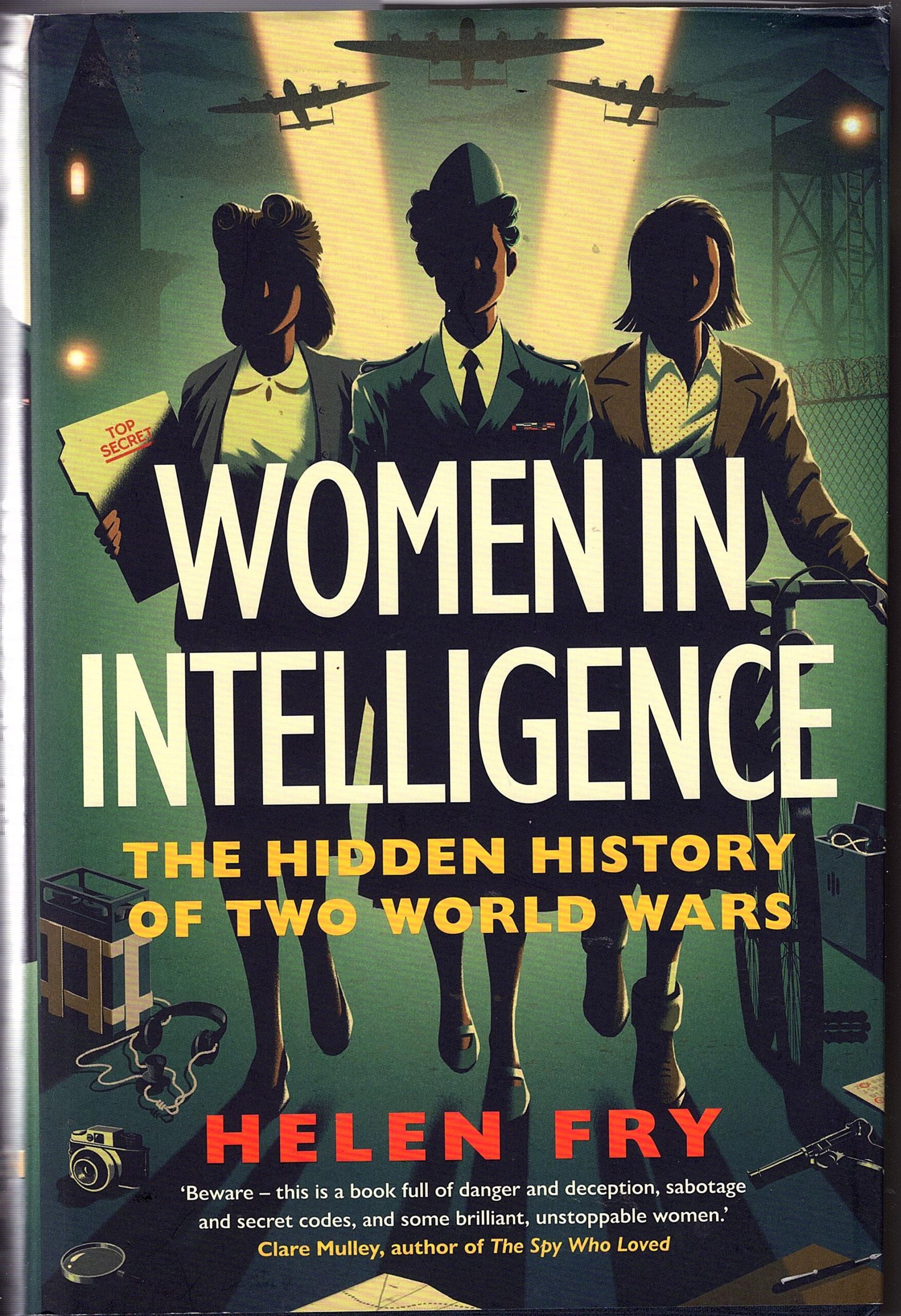
Helen Fry’s ‘Women in Intelligence’ (2023)
I did not have high hopes with this book, published last year, as I have found Fry’s approach to writing history lacking in discernible method and suffering from a very sloppy style. Yet I considered this item a necessary part of my reading agenda. As it turned out, I was pleasantly surprised in some ways. Fry has performed her usual diligent research, reveals a host of new facts, and someone has obviously given her some guidance on how to write more crisply and less elliptically. (In one of the blurbs, Kate Vigurs writes that ‘all is told in her usual inimitable style’. It occurred to me that the comment might not have been intended as a compliment, but I shall instead conclude that perhaps Ms. Vigurs has not been paying close attention.) I must question the whole endeavour, however: while it is important that the contributions from women be given their proper credit (as Jackson Lamb said somewhere: “You won’t find a more ardent feminist than me”), a description of exercises and operations that focuses almost exclusively on the achievements of the fair sex [is that expression still allowed, Thelma?] will be bound to distort the picture.
And so it turns out. Fry offers no explanation of how she approached the subject, or how she made her choices. (She mercifully does not engage in a debate about what ‘woman’ means in this decade, and how that term should be applied retrospectively to simpler days.) The blurb on the cover merely states: ‘The first full history of women in British intelligence across two world wars’. In many aspects, Fry’s work is a remarkable achievement. She has excavated some fascinating stories about women in the various intelligence services that had evaded this particular reader, and we should be very grateful to her. Unfortunately, the text reveals itself as a rather relentless catalogue of female success, and frequently distorts the broader picture, and misrepresents the facts. Along the way, a vast amount of familiar material has to be regurgitated to give the unwary reader context. Moreover, there is little room for records of failure, as one glorious contribution follows another. We are told, for instance (p 265) that ‘Hodgson and Holmes were the “brains” behind all operations into Austria, Yugoslavia and Hungary’, and (p 272) that ‘women such as Holmes, Stamper and Hodgson were the driving-force behind SOE’s success’, yet the incursions into those countries were largely disasters, and the unqualified trumpeting of SOE’s success when it clearly made a large number of mistakes does not contribute to valid and objective scholarship. Fry is also a little too trusting of what Vera Atkins’s personal file states.
Moreover, the history is not ‘full’, or consistently accurate. The author is strangely errant over the career of one of the most impressive of intelligence officers, Kathleen (Jane) Sissmore, who married John Archer (of MI5’s RAF liaison, a fact she does not mention) on the eve of the war. She mistakenly says that Archer was killed in 1943: it was his son who perished. Fry claims that Archer was fired because of her disrespectful comments on the previous MI5 director, Vernon Kell, when it was the acting director Jasper Harker who had been the subject of her derision. She overlooks Archer’s transfer to lead the group of Regional Security Liaison Officers, which task she performed very creditably for several months in the summer of 1940, and she suddenly places her with Philby’s counter-intelligence group in MI6. Archer did indeed move to MI6, but did not work for Philby until his new section was created in 1944. Fry says nothing about Archer’s subsequent return to MI5 at the end of the war, and what projects she was involved with, although the archives mention her occasionally. Nevertheless, Fry is confident enough to assert that Archer ‘would have made a brilliant director-general of MI5’.
And there are some notable omissions and mistakes. Fry writes nothing about the highly important Freya Stark, or Ann (Nancy) Lambton, who both played important roles in propaganda and intelligence-gathering in the Middle East. Since Fry does include a section on post-war activities, one might have expected her to mention MI5’s Evelyn McBarnet, who played a prominent part in the molehunts of the 1960s and 1970s, and had earlier worked on the Robinson papers of the Red Orchestra. (Peter Wright wrote that she had had many years more experience in counter-espionage than he or Arthur Martin, which suggests she was active in the war years.) Fry also neglects Anne Last (actually ‘Glass’), who had a very significant career in MI5, having joined in May 1940, and who later married Charles Elwell, an MI5 officer. Fry’s sketch of Joan Miller fails to mention a vitally significant episode of her career, when she detected the Major (probably but not incontrovertibly Leo Long) stealing information and passing notes to his communist contact in 1944. Ray Milne, the communist agent inside MI6, who was detected and forced to resign, is overlooked (perhaps because she was a baddie).
(I should also mention that, in the September 2023 issue of Magna, the Magazine of the Friends of the National Archives, appears an article by Phil Tomaselli, titled ‘MI5 women spies during WW2’. It is not a very accurate title, since MI5’s charter was counter-espionage rather than espionage – although it did maintain ‘agents’ who spied on subversive groups – and much of Tomaselli’s text is taken up by women who served during World War I. Nevertheless, Tomaselli lists a number of names who should be added to the roster, including Mary George, and Hilda Matheson of the Joint Broadcasting Committee.)
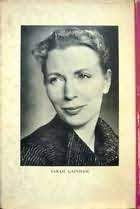
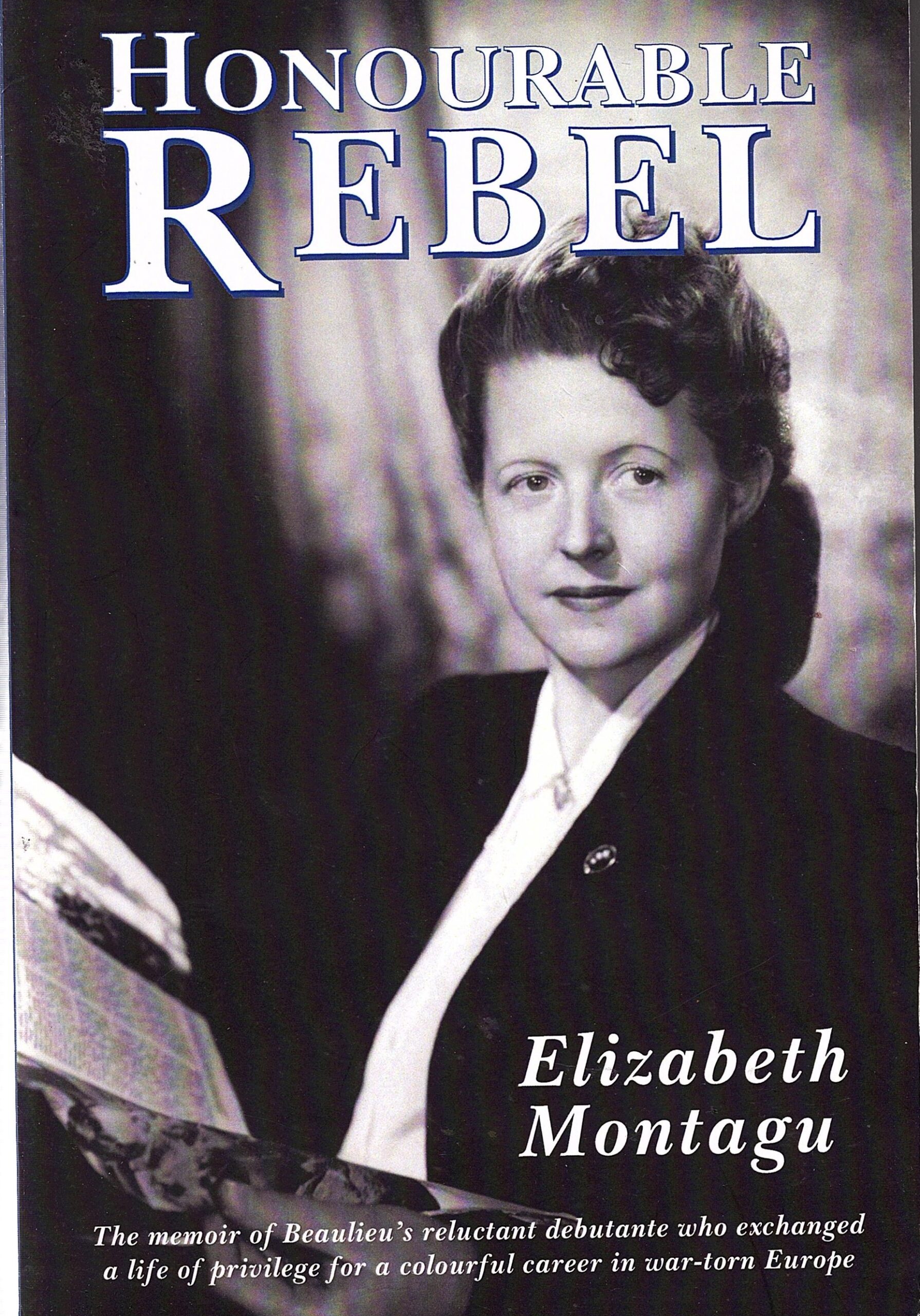
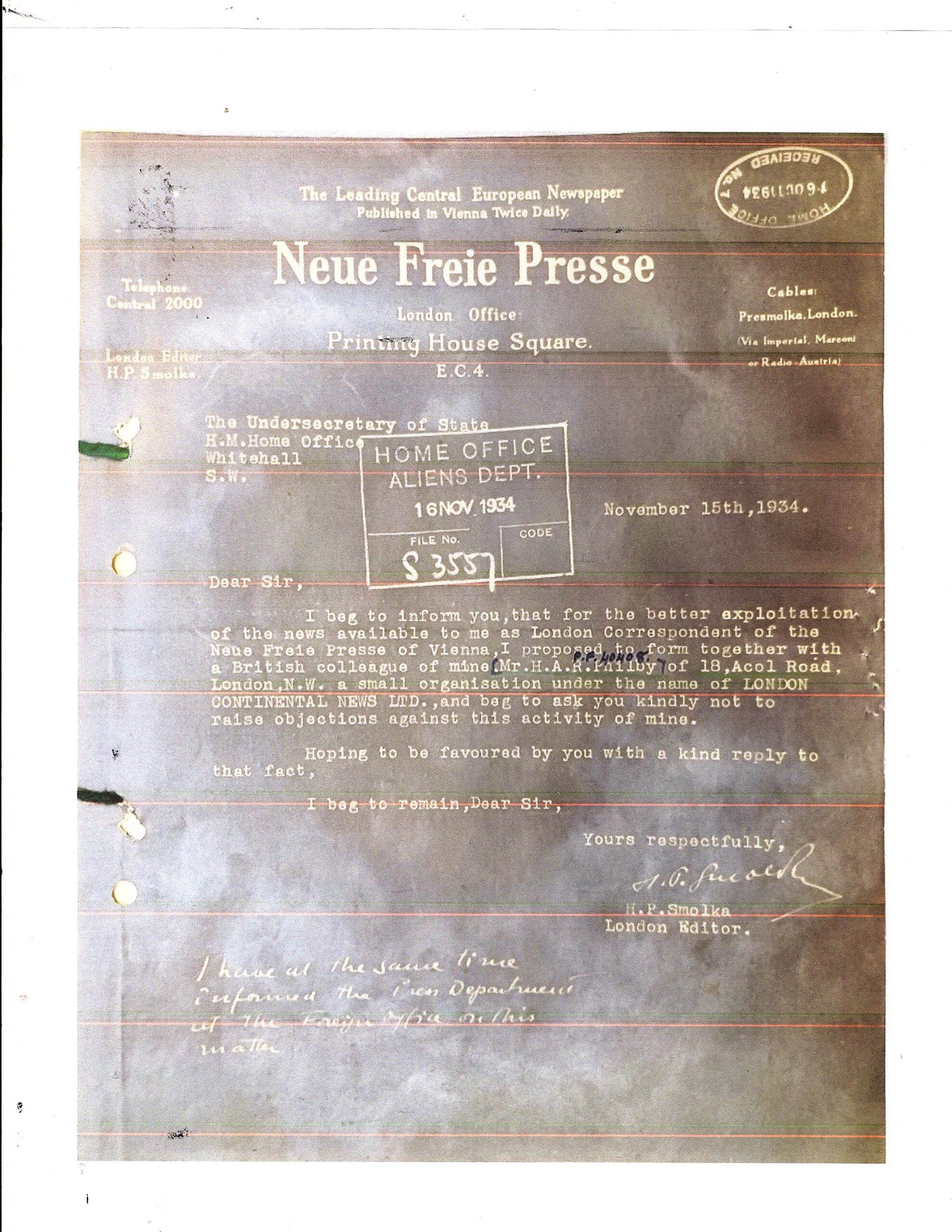
Fry briefly covers the five years that the highly dubious Tess Rothschild (née Mayor) worked in B18, the anti-sabotage section of MI5, but she presents a very odd interpretation of MI5’s suspicions of her after the Blunt confession. The failure to recognize the important pair of MI6 agents in Bern in WWII, Elizabeth Wiskemann and her sidekick Elizabeth Montagu (aka Scott-Montagu), is particularly egregious. Wiskemann received a prominent biographical treatment by Geoffrey Field last year (see https://academic.oup.com/book/44709/chapter-abstract/378977699?redirectedFrom=fulltext), and I have referred to Montagu in my writings on Smolka. The novelists Sarah Gainham, married to MI6’s Antony Terry, and Helen MacInness, married to another MI6 officer, Gilbert Highet, should perhaps have been covered as well, to give some variety and useful perspective. Of course there were some other notable British subjects, naturalized through marriage, working in intelligence such as Ursula Beurton, Edith Tudor-Hart, and Litzi Philby aka Feabre – and at least two native-born, Jenifer Hart, married to the MI5 officer Herbert Hart, and Melita Norwood – but since they were communist agents working against the interests of the United Kingdom they presumably fell outside her purview. Nevertheless, Nigel West returns the compliment that Fry recently granted him on his recent book: “A fascinating, minutely researched study of women in the espionage business.”
Thus the reader has to wade through a lot of extraneous material to pick out some splendid nuggets about meritorious heroines whose careers have very creditably been brought to light at last. The relentless feminist propaganda begins to chafe. Moreover, Fry can be both very risk-averse and highly provocative. At critical points, she steps back from providing any analysis of controversial incidents. For example, in wrapping up her section on SOE, she writes: “Exactly why Buckmaster and Atkins continued to send their agents into Europe remains the subject of debate.” That is a very cautious insertion that screams out for a more incisive inspection, and invites an examination of the dynamics of the situation, and whether there was any male-female dimension to the disastrous decisions that were made by the managers of F Section. On the other hand (as I pointed out in last month’s bulletin), she can lob a grenade over the parapet, as she does when she gratuitously reports (p 92) that, in 1933, the MI6 head of station in Vienna, Thomas Kendrick, alongside his agents and secretaries was tracking the movements of communist spies and activists ‘through journalists like Eric Gedye and a young graduate, Kim Philby’. This is a much more assertive and provocative statement than she allowed herself in Spymaster, and represents the claim that brought my female academic contact into apoplexy when I mentioned it to her a couple of months ago. So what say you, Westy? Did you spot that?
Because of the repetition, and the lack of valuable new insights, the volume should in my opinion have been better compiled as a biographical dictionary rather than a conventional narrative. It would in that way have been more usable, more concise, and more easily maintained. New histories of SOE, for example – focussing on country campaigns, rather than conventional broad-brushed approaches – are certainly desirable, and in such works the successes and failures of men and women should be clearly explained, as opposed to the romanticized and gung-ho narratives that are so frequently found. I entered in last month’s Commonplace collection what I considered a pertinent observation by a woman called Imogen West-Knights: “Perhaps I am letting feminism down to say it, but just because a group of women organised something, this does not mean that the organisation of that thing is naturally interesting.” Indeed. There should be no ‘feminist’ history – just history that gives comprehensive credit to the contributions of women and men equally.
The Darkrooms of Edith Tudor-Hart
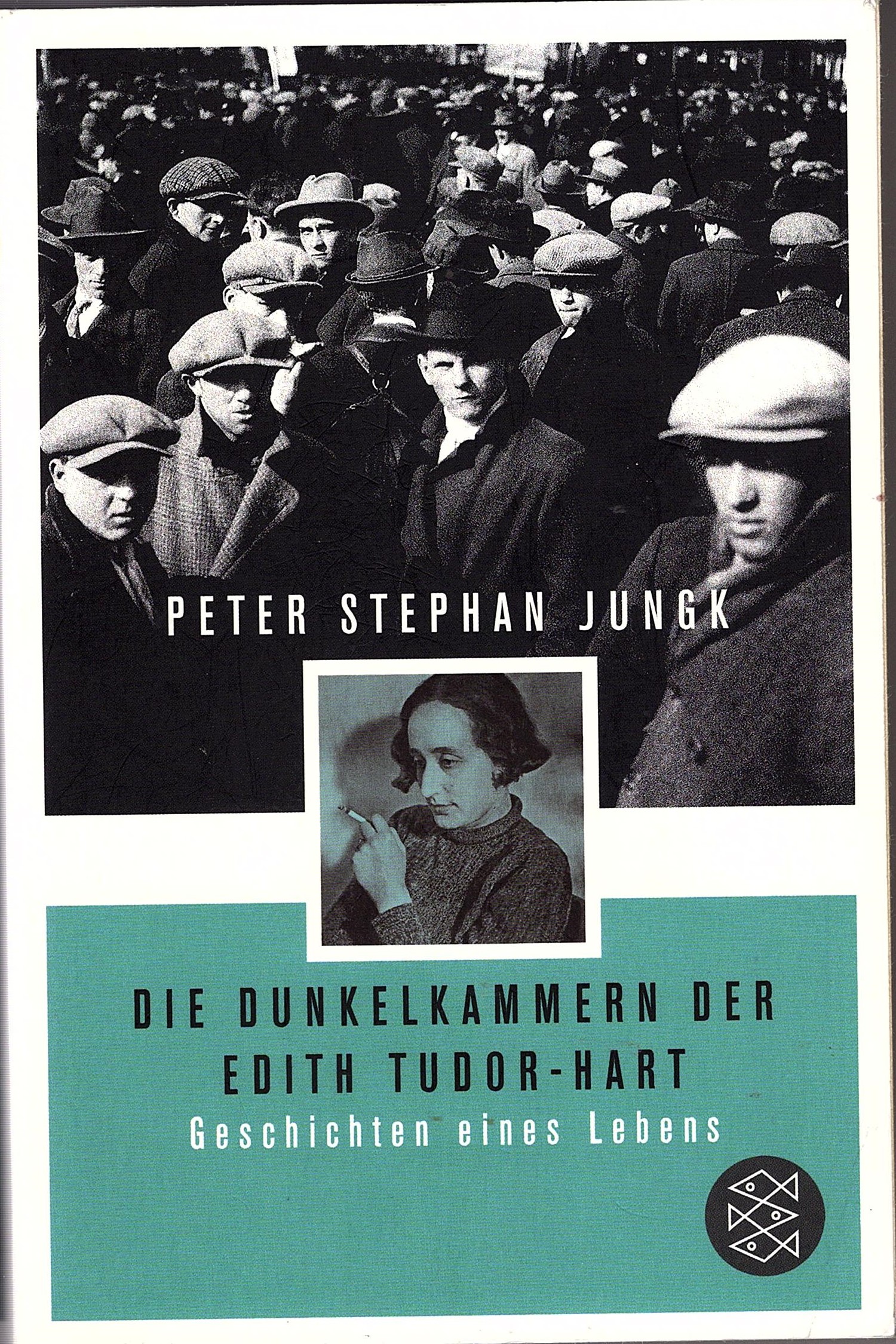
I have always been prepared to admit to erroneous analysis and faulty conclusions displayed in my research. As Keith Ellison has pointed out to me, the Major observed by Joan Miller secreting notes may not have been Leo Long, as I claimed in Misdefending the Realm, and one of these days I am going to have to return to the records to verify the place, the time, and the institution, in order to confirm what was going on. Likewise with Edith Tudor-Hart: I have constantly expressed my amazement that such a transparently subversive, neurotic and muddle-headed woman could have played a major role in Soviet espionage, and I have treated Anthony Blunt’s claim that she was ‘the grandmother of us all’ (when she was in fact born a year later than the art historian) as a sour joke designed to disguise someone else. (Of course, similar doubts and objections were raised over the outrageous Guy Burgess.) And yet the attention swells, what with Charlotte Philby’s very bizarre Edith and Kim, and Edith’s great-nephew (or second-cousin once-removed) Peter Stephan Jungk contributing a biography in German, Die Dunklekammern der Edith Tudor-Hart (2015), which reinforces the myth that she not only led a parallel life to Kim Philby, but was as significant as he was, and that it was really she who was astute enough to identify Philby as a worthy candidate for Soviet Intelligence, and introduce him to Arnold Deutsch. I recently read Jungk’s book very carefully.
Thus I continue to inspect the evidence to check whether I am wrong. (Care is need when treating sources such as Wikipedia and Spartacus, which are very cavalier with dates, and the accounts of Tudor-Hart’s activity in Deadly Illusions and The Crown Jewels, both of which boast Oleg Tsarev as a contributing author, are so riddled with errors, contradictions and anomalies than I am inclined to treat them as disinformation.) What I find extraordinary is that MI5 opened a file on her (as Edith Suschitzky) in 1930, when she was noticed mixing with known communists at a demonstration in Trafalgar Square, and she was expelled from the country. From Vienna, she immediately wrote to Tudor-Hart, asking him to testify that she was a solid communist, as the local cadres mistrusted her! Thus, while the evidence undermined any official authority she might have had, she stupidly drew attention to her subversive objectives.
MI5 (and MI6, when she was in Austria) thereafter kept a close watch on her for over twenty years. She was known to be a communist, she married her lover Alexander Tudor-Hart in Vienna in August 1933 when she got into trouble with the law there, and consequently was able to flee to Britain as a subject through her marriage. She was allowed to have her mother join her in 1937 (her father having committed suicide). In 1938, she was interrogated by MI5 over her undeniable involvement in the Percy Glading case, since a receipt for her Leica camera had been found on Glading’s premises, but the authorities did nothing. Despite the constant surveillance, she was allowed to continue her associations with subversive groups in exile unhindered. MI5 devoted an enormous amount of time tracking her activities – all to no avail. Perhaps it was because they thought that she would lead them to bigger and more dangerous fish, but maybe, since they could not haul her in on any charge, they just wanted her to know that she was under constant watch, in order to frighten her. Yet they overlooked some of her most obvious activities, such as her affair with Engelbert Broda, the atom spy, and her role as a courier.
Yet the burning question remains: Why would the NKVD entrust any clandestine role to a person who so obviously was a communist agitator? She was expelled by the British early in 1931 for that reason. From Vienna she appealed for help from her lover to confirm her communist credentials, she was imprisoned for suspected subversive activity in May 1933 (when another lover Arpad Haasz, left the country in a hurry), and Tudor-Hart, who had at last divorced his wife, arranged their marriage in August 1933 so that she could escape to the UK. Agents of the NKVD normally took instructions from their bosses concerning their marital arrangements, but, if the agency had serious plans for Edith, it surely would have forced her to provide a better cover story than this, and it would have been very wary about the British authorities’ picking up where they left off when Edith had been banished in 1931.
And, indeed, her romantic entanglements were a mess. The management of her affairs tended to be clumsy, and she was often mistreated and manipulated by the men in her life. She fell in love with Arnold Deutsch in the late 1920s, but his girl-friend Josefina, absent from Vienna for much of the time, discovered her love-letters to him, and Deutsch soon married ‘Fini’ in 1929, and then left with her for Moscow. Jungk says that Edith had several other meaningless affairs during this time. When she returned to England, she picked up with the still married Tudor-Hart. After her expulsion to Vienna, she took up with Arpad Haasz, a fellow-conspirator, who fled when the going got hot. After Edith’s marriage to Alexander, he mistreated her, and abandoned her and her young son when he went to work as a doctor helping the Republicans in Spain. During the war, she developed a relationship with Engelbert Broda, but he also left her, in 1945, telling her that he was going back to Austria to marry his girl-friend (a decade older), from whom he soon separated. Edith then fell in love with the psychiatrist, Dr. Donald Winnicott, who was treating her severely autistic son, and they had a very unprofessional relationship. But Winnicott would not leave his wife, and tired of Edith’s clinginess. Edith developed a crush on the architect Baron Holford of Kemp Town, but he had to reprimand her in writing for stalking him.
I shall be writing further when I have completed a deeper analysis of her files, and the stories built around her, but here I simply want to mention two items that caught my eye recently. In his 2012 profile of Philby, Young Kim, Edward Harrison made a very shrewd observation over some text in a letter (in German) that he found in Edith’s file, sent to Tudor-Hart on June 22, 1933, and intercepted by Special Branch. It makes a reference to students at Cambridge, and the need to convert intellectuals to the cause, and asks the question: ‘What is M.D. doing?’. At the time, Special Branch interpreted ‘M.D.’ as referring to Alison Macbeth, who was a doctor, and then married to Tudor-Hart. It was not until December 1951 (in the heat of the Burgess-Maclean-Philby investigations) that MI5 went over the passage again, and decided that ‘M.D.’ stood for Maurice Dobb. So Edith had been acquainted with Philby’s tutor at Cambridge.
This should perhaps not have come as any surprise, since Dobb had written to Alexander Tudor-Hart in December 1930, in dismay, offering sympathy at the detention of Edith after the Trafalgar Square incident, and the subsequent report of her expulsion order. (All letters to Tudor-Hart were being intercepted.) Thus an immediate link between Soviet conspiracy, and the planned contributions of a Cambridge academic, are visible three years before Philby was sent on his way to Paris/Vienna by Dobb. And there is even an attempt by Edith to mask Dobb’s identity – a successful one, of course. What had the three of them discussed, one wonders? Tudor-Hart was a contemporary of Dobb’s, and both had studied under Keynes at Cambridge, so they were natural communist allies. Tudor-Hart had also studied orthopaedics in Vienna in the 1920s, so may have encountered Edith there. 1930 would obviously have been an early date for Philby’s potential to have been recognized (he did not enter the university until October 1929), but Dobb’s interactions with Edith are undeniable.
The other item of interest to me is Edith’s exposure to Philby, and her supposed role in recommending him to her former lover, Deutsch, in May 1934. I find it difficult to pin down the exact relevant dates of the early autumn of 1933, as even Jungk’s account is vague, but the other accounts (which claim to be based on KGB archives) are divided as to whether Edith became impressed with Philby’s potential when she knew him in Vienna, or whether she came to that conclusion when her friend Litzy introduced her to him in May 1934, soon after the Philbys arrived in London. Jungk first tells us that Edith married Alexander on August 16, and that they left for the UK a few weeks later. Yet, later in his book, he informs us that, on her release one month after her imprisonment in May, she went immediately to the apartment of her best friend, Litzy Friedmann, and discovered that Litzy had a lodger named ‘Kim’, who had been there just a few days. This is, of course, nonsense, as Kim did not arrive in Vienna until late August, at the earliest. Moreover, The Crown Jewels asserts that Edith’s famous photograph of the pipe-smoking Philby was taken in Vienna during those precious few days before she left with her new bridegroom, while Jungk asserts that it was taken in Hampstead the day after Philby met Arnold Deutsch in Regent’s Park. It is all an inglorious muddle.
The irony is that Jungk, in his eagerness to find out the truth about Edith, went to Moscow in the 1990s, and tried to chase down historians and archivists to let him see the secret files on her. He was devastated when the officials (including Dolgopolov, the biographer of Philby) directed him solely to Deadly Illusions and Borovik’s Philby Files. Whether they had more which they were not prepared to reveal cannot be determined. But the implication is that the mess that has accumulated and been carelessly echoed over the decades in the western media may be all that there is. There are too many competing narratives tripping over each other, of which I have shown here only a sample. I shall explore all the paradoxes and conflicts of 1933 and 1934 in my end-of-July posting.
‘Nothing Short of a Scandal!’
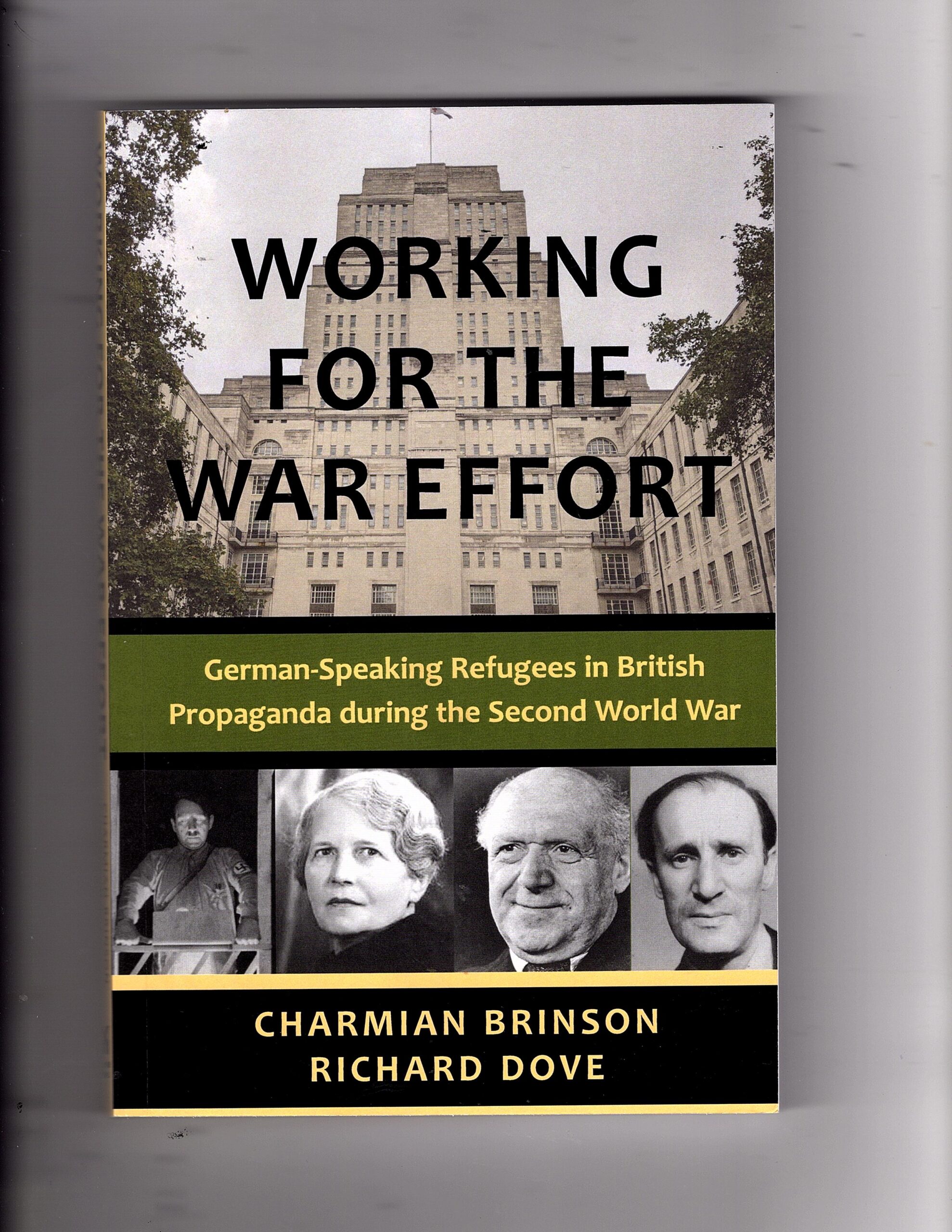
In my February bulletin I reported that I had located an article by Charmian Brinson on Peter Smolka, titled ‘Nothing Short of a Scandal’, but had been frustrated in my attempts to read it, as neither Professor Brinson nor the Austrian periodical that published it had acknowledged my emails. Thanks to Andrew Malec, I was able to find the complete text at academia.edu (of which I am a member), and, as promised, I am now offering a summary of what Brinson brought to the table. (She is not, incidentally, the mystery female academic who behaved so ill-manneredly to me in the email exchange on which I reported in March.)
I have to characterize Brinson’s contribution as ‘workwomanlike’, but not very imaginative. She has performed a vast amount of relevant research: she has read (almost) all the right books, memoirs and histories, British and German, and gone deep into the archives, from those of MI5 and the Home Office, to the records of Czechoslovakia’s show-trials. She has dug our articles in remote places, located papers from obscure universities, accessed old items from newspapers such as the Times in the 1930s, and recovered interviews with Smolka’s sons. And yet her conclusion is simply the rather bland: “So Smolka was and remains a man of contradictions”, as if that could not be said of countless other persons in intelligence who have left a confusing trail behind them. It is as if Brinson wants to serve up all she can find and leave it to the reader to make a judgment. Each time that she appears to be about to explore a fascinating aspect of his life – such as the confirmation that Smolka was a spy, with the cryptonym ABO – she steps back from providing any penetrating analysis. I believe historians – as opposed to chroniclers – should go farther than that.
So I simply note here some of the information that was fresh to me, and some observations on her commentary. She exploits the memoirs of Bruno Kreisky, who was the Austrian Chancellor from, and those of Hilda Spiel, the novelist. Both were close to Smolka in his teens. Brinson supplies the background to Smolka’s highly biased view of Siberia evident from his reports in the Times, and his subsequent book, but shows no interest in trying to discover why he received so much good publicity. She does not attempt to explain why he received the degree of support from the Foreign Office in the late 1930, or what the oily Rex Leeper was up to. She leaves the ‘nothing short of a scandal’ incident undeveloped, treating Smolka’s apparent redemption as routine.
On the other hand, her coverage of Smolka’s work for the Ministry of Information during the war is very thorough, although she doesn’t attempt to adjudicate on the tricky question of when Smolka was recruited to Soviet intelligence, and by whom (a topic which I dismantled a few months ago.) She highlights some important questions about Smolka’s energetic pro-Soviet stance, raised by MPs and others, but offers only a lukewarm explanation as to how he was able to get away with it, before moving calmly on to the discovery of papers produced on his typewriter that were found in Guy Burgess’s flat. And then she suddenly jumps from 1951 to 1961, where she briefly covers the Arthur Martin interview, without astonishment. She does, however, offer an insightful anecdote about the extent of Smolka’s anglicisation, sourced from Hilda Spiel, who also expressed surprise that Smolka would want to return to war-damaged Vienna with his young family once he had had a taken up British citizenship. Brinson also offers useful evidence of Smolka’s pro-communist reportage in Vienna after the war, and describes his relationship with Ernst Fischer, the Minister of Education.
One thing that caught my eye was the statement, again from Spiel, that one George Knepler, a musician, had been living in Smolka’s house at this time (1948). Knepler was a name I knew, as it was he to whom Kim Philby had been directed in 1933. Knepler described the lavish parties that Smolka held for leftish acquaintances and public figures. What did surprise me, however, was the fact that Brinson dedicated only one sentence to the complex ‘Third Man’ business, apparently trusting the story that Smolka provided Greene with his anecdotes. She does not explore any of the contradictions of this bizarre chain of events. On the other hand, she does provide more substantive details on the accusations against Smolka at the Slansky trials, made by an unfortunate liar, Eugen Loebl, who had probably been tortured.
Brinson accurately covers the stories of MI5’s vain hopes to convince emigres like Smolka to ‘defect’, but without any attempt to explore the sense or stupidity of such ventures. She appears to trust the accounts of Smolka’s deteriorating health, which did not prevent him from founding and editing, in the 1970s, the journal Austria Today, at Kreisky’s request. Both Kreisky and the Times gave him a generous obituary when Smolka died in 1980, which leads to Brinson closing her piece with the radically different opinions of Siegfried Beer, who deemed Smolka a Superspy, and those of Smolka’s widow and elder son, who perversely continued to claim that he had never been a spy at all. Thus, for the Smolka devotee who wants to hoover up all the bare facts about his life, Brinson’s article will be a valuable contribution, but as a work of historical analysis it is disappointingly sterile.
Guy Burgess at Kew
I have previously drawn attention to the scandalous state of records pertaining to Guy Burgess at Kew. My detailed analysis of the FCO 158 series (“Foreign Office and Foreign and Colonial Office: Record Relating to Guy Burgess and Donald Maclean (known KGB spies) and subsequent investigations and security arrangements”) shows that nearly three hundred separate files are listed, most of which have not been digitized. Many of these are needlessly fragmented: thus we can see, for instance, FCO 158/111, ‘Correspondence with member of the public on Burgess & Maclean’, followed by FCO 158/112, ‘Question from member of the public’. There is no reason why several of such items could not have been collected into one file. The objective must be to make it more onerous for anyone to order these files and trail through them.
Moreover, a large number are closed, without proper justification. For example, FCO 158/15, ‘Guy Burgess Private Papers’ is simply listed as ‘Closed and retained by FCO’, with no release date, as are a variety of other papers on topics such as ‘Foreign Office Key Points 1951’, ‘Security Recommendations at DWS’, ‘Correspondence with Irene Ward’, and dozens of records of individual vetting operations from the 1950s that are described only in terms of ‘Vetting of “name withheld”’, with the relevant year following. A file on Petrov, the defector from Australia, is similarly marked.
Others indicate a release date, sometimes with highly spurious reasons for the retention period. Thus some extracts from the contact of Burgess and Maclean with Foreign Office officials under the PEACH inquiry (FCO 158/30/1) – which sounds very bizarre – has been declared ‘closed for security reasons: open January 1, 2035’). One vetting of ‘name withheld 1951-80’ will be made open on January 1, 2073 [should any of us live that long . . . And will left-wing academics still be railing against ‘late-stage capitalism’ in the London Review of Books at that time?]. A file titled ‘Allegations against “name withheld” 1948-1955’ has been ‘closed for Health and Personal info’, but will be available the same date. A closed extract from the Cadogan Inquiry (FCO 158/206) will be opened on January 2032. There are many others of similar characteristics: a minute of September 5, 1952 (FCO 158/254/1) has been closed ‘for health reasons, and will be opened on January 1, 2073’. Maybe the frail subject of that inquiry will have recovered by then.
I believe this is all shameful and scandalous. Why the public cannot be trusted with seeing these records of seventy years or so ago, or why the Foreign Office believes that the disclosure of such items would harm national security, is beyond belief. It must point only to an enormous institutional embarrassment, or simply a loss of any expertise with any incumbent officials to know how to make proper judgments about the material. It is just simpler to pretend that no problem exists, and to hope it goes away. Yet the registration of all these incriminating morsels, and the sensitivity of the Foreign Office about them, points to the existence of highly disturbing testimony to the foibles of British intelligence at the time.
What should happen, of course, is that Freedom of Information requests should be made over all these files. I am advised, however, that block requests are unlikely to have the desired effect, which means that individual files would have to be selected. But where to start, and who has the time to do that? Can some sort of mass public protest be mounted? Come on, ye doyens, get weaving!
Lastly, I was intrigued to read, amongst the Rothschild papers (KV 2/4533-1), in a report dated January 27, 1971, that Guy Burgess’s file was created only in 1942! (That note suggests to me that the writer thought it should have been created earlier.) Of course, MI5 has never admitted that it existed, and his Personal File 604529 (one of dozens created during the PEACH investigations of 1951) is the only one recognized in the various letters, notes, reports and memoranda that emerged during the interrogations of Blunt and the inquiries with the Rothschilds. What prompted that 1942 event is something worth considering. It was a fairly quiet year for Burgess, since he was working for the BBC in the Talks Department, arranging pro-Soviet speakers. Was it perhaps his selection of the Soviet agent Ernst Henri, masquerading as a journalist, that triggered MI5’s fresh interest in him?
A Death in Nuremberg
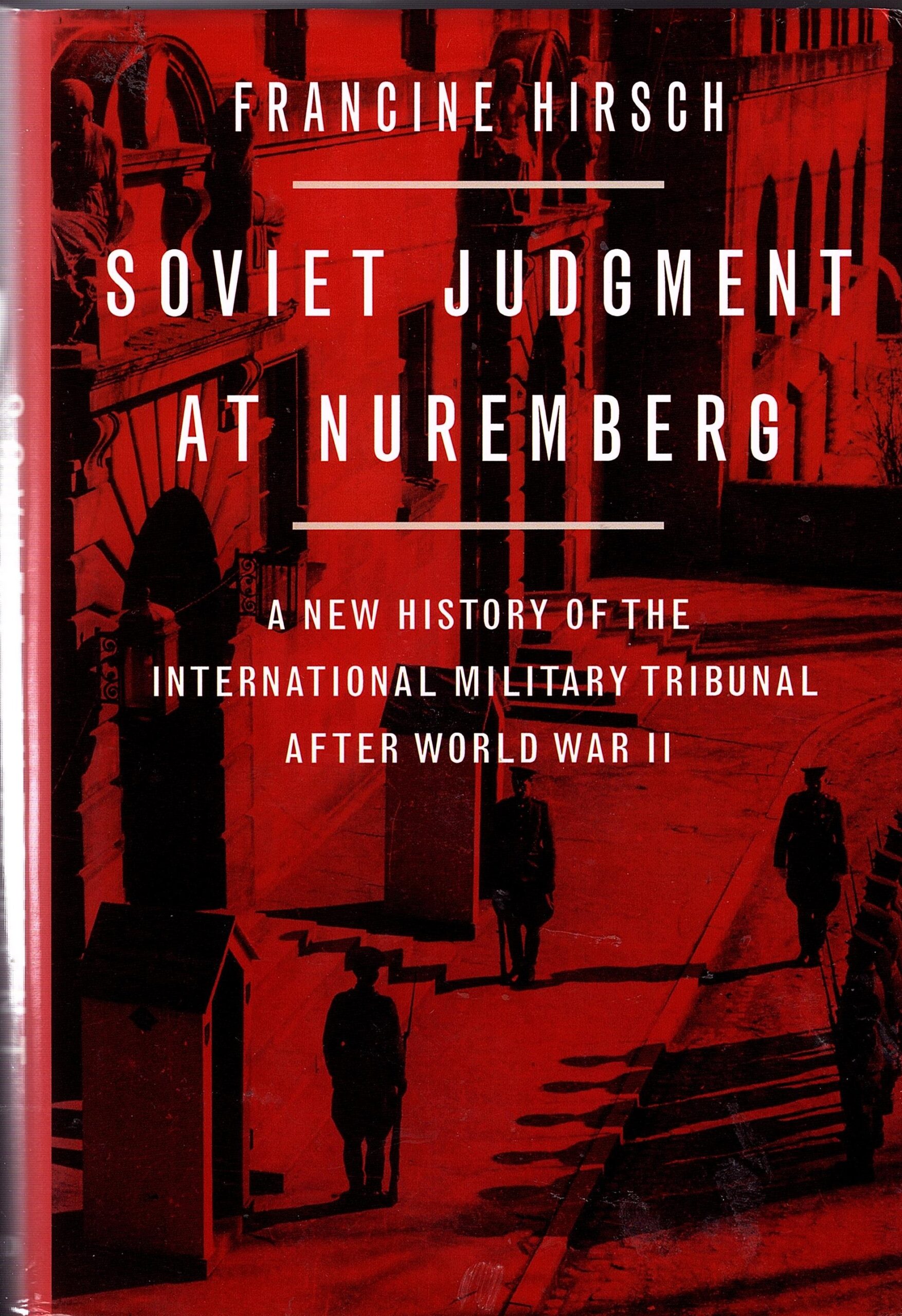
After an important reference somewhere, I was prompted to acquire Francine Hirsch’s 2020 book Soviet Judgment at Nuremberg, since it claimed to provide fresh information on the trials derived from an analysis of Russian government files. I was especially interested because I wanted to know more about Nikolai Zorya, one of the Soviet prosecutors, who was found dead in his hotel room during the trial. This had been judged by Western participants as very suspicious: the Soviets claimed that it had been an accident that occurred as he was cleaning his rifle, but others considered that his mishandling of the episode of the Katyn Massacre had been the event that led to his demise.
I have long been interested in cataloguing the deaths, in mysterious circumstances, of western civilians with possible past ties to Soviet intelligence. While Boris Volodarsky’s 2009 book The KGB Poison Factory provided a solid guide to many prominent cases, I do not believe that enough attention has been paid to other questionable deaths or accidents that occurred when no one was around to witness exactly what happened. (I have just acquired Volodarsky’s follow-up book, Assassins, and shall be writing about it at some stage.) Any occasion in which someone died of a heart attack in a remote hotel room should especially have been investigated with utmost urgency. The unresolved cases of Tomás Harris and Hugh Gaitskell are quite familiar, but what caused Alexander Foote’s early demise (1956)? Has Herbert Skinner’s premature death in a Geneva hotel (1960) been explained? Or Archie Gibson’s death by shooting in his Rome apartment (1960)? What had happened to Hugh Slater when his body was discovered in Spain (1958)? Did Victor Serge really have a sudden heart attack in Mexico (1947)? Was the event that killed Georg Graham’s son truly an accident? Was Paul Dukes’ car crash purely providential? Did John Costello really die from food-poisoning?
Zorya was of course not the only Soviet citizen to be targeted since the war. (The death of Konon Molody, aka Gordon Lonsdale, from eating poisonous mushrooms, has been laid at the door of the KGB.) But the openness of his probable murder was shocking. As Hirsch writes: “It would have been more typical for Stalin to call someone back to Moscow and then have him arrested and shot.” She goes on to write that Zorya’s son maintained that ‘his father had grown uneasy about the Katyn case and had asked to return to Moscow to talk to Vyshinsky about flaws in the Soviet evidence’. In that case, the NKVD might have been concerned enough to decide that no time should be wasted, lest Zorya share his thoughts with members of the American and British delegations – something he may already have done.
The obstinacy of the Soviet prosecutors in highlighting the Katyn Massacre as an example of Nazi war crimes was really obtuse. Stalin had gone to enormous lengths to show that the killings of 22,000 members of the Polish military and intelligentsia had taken place when the Germans had occupied Belarussia rather than in the summer of 1940, when it was under the control of the Soviet Union. Churchill and Roosevelt were confident that it had been a Soviet crime, but were shabbily reluctant to challenge Stalin over it. When it came to Nuremberg, Moscow naively believed that the trials would be held like those from the 1930s Purges, with defendants tortured and trained what to say, no proper defence counsel offered, guilty verdicts pre-arranged, and summary executions carried out. The Soviets were then surprised that principles of western democratic justice were to be applied to the Nazi criminals, and the prosecutors struggled to adjust to the process. They somehow wriggled out of the embarrassing situation. Zorya was the victim: it was not until 1990 that Moscow admitted that the wartime communist government had been responsible for the massacre.
Holiday Reading: Volodarsky et al.
‘The Birth of the Soviet Secret Police’
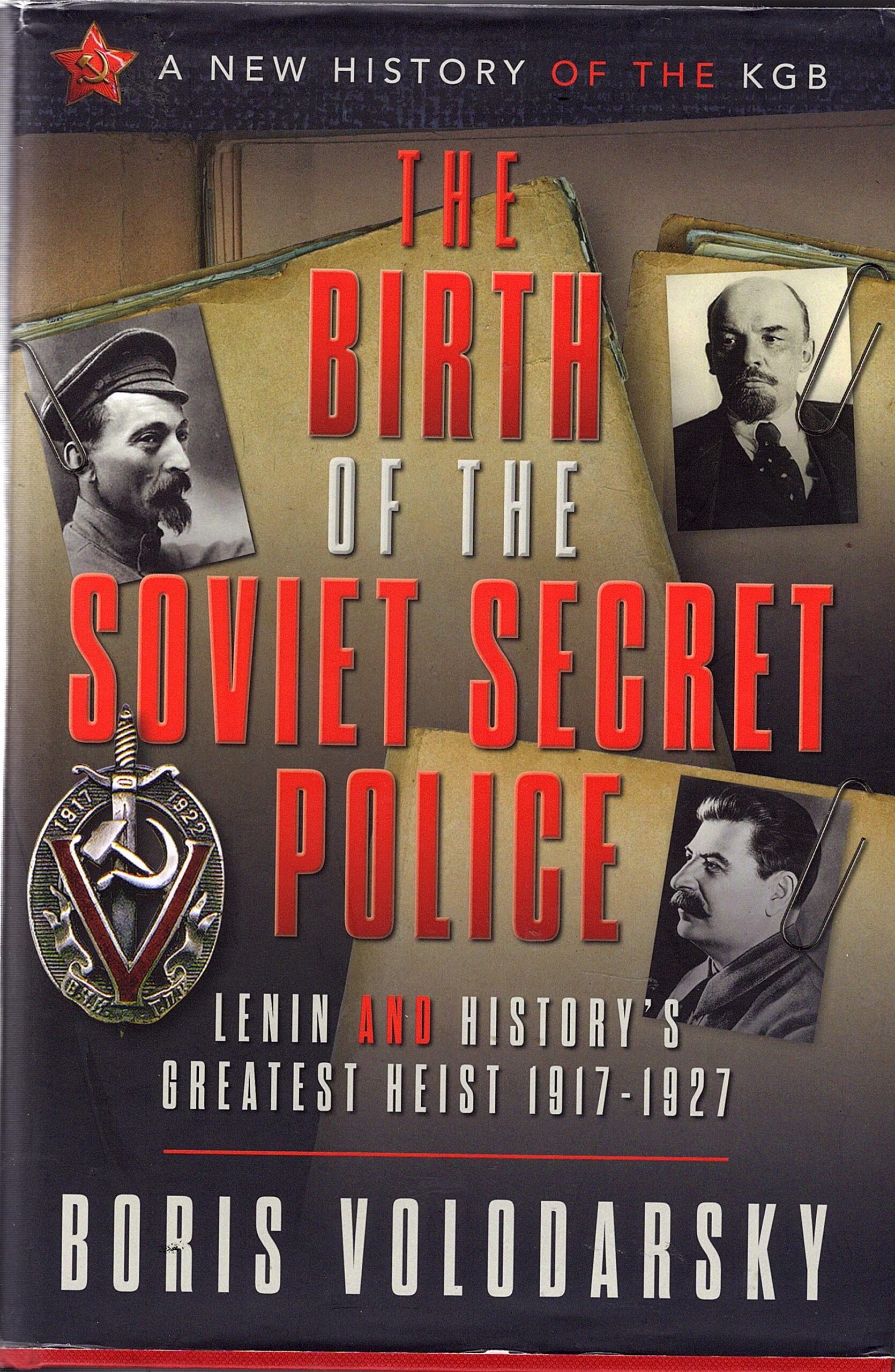
As my primary serious reading during our holiday/vacation in California, I packed Boris Volodarsky’s recent book, The Birth of the Soviet Secret Police: Lenin and History’s Greatest Heist 1917-1927. Like Volodarsky’s other works, I found it both utterly fascinating and extremely annoying. I had submitted several pages of corrections (mainly typographical) to Volodarsky when his Stalin’s Agent appeared in 2014 – a submission that he eventually thanked me for about two years later. His latest book is very similar, jam-packed with stories of subversion, and profiles of those who carried it out in Europe (mainly), but it desperately needed an editor. Volodarsky has no sense of historical narrative, and owns what I suspect is the inability of someone with a photographic memory to exclude any related facts from his story, which means that he has presented a largely indigestible set of mini-biographies, a compilation of acronyms, aliases, birthplaces, marriages, mistresses, etc. – with the dominant outcome for the participants being a bullet in the head, in the Lubyanka cellars, in 1937 or 1938. Moreover, the text has a woefully large number of typographical and grammatical mistakes, many the mis-spellings of proper names, but also some blunders and direly botched edits that indicate that no one read the final electronic version carefully.
It is not that Volodarsky has the wrong intentions. Halfway through his screed he offers the very sensible guidance: “An absolute sine qua non is that all sources, even primary, must be checked, double-checked and rechecked again. There’s a lot of stuff in the archives that got there by chance, like a forgery accepted as a genuine document, or a report based on a biased interpretation or opinion but nevertheless duly filed. Sometimes a testimony, even of a seemingly credible witness or reliable defector, or a source described as ‘a subject of undoubted loyalty’, may be completely invented and include false claims which later leak into the books and articles. There, as it happens, they are sometimes further misinterpreted or misrepresented.” He uses this method to pass out some harsh words on some of his fellow-historians, such as Helen Fry, whom he chastises for swallowing whole the reputation the SIS representative in Vienna, Thomas Kendrick, had acquired for his provision to his bosses of alleged valuable information, when Volodarsky believed it was totally the invention of money-seeking phoneys. He also has harsh words for dupes like John Costello and Nigel West, being taken in by the wiles of the KGB and its stooge, Oleg Tsarev. Intriguingly, he keeps some of his choicest words of disparagement for Christopher Andrew, whom, while he praises some of the latter’s work (Volodarsky was, after all, a member of Andrew’s intelligence seminar), he criticizes for his naivety in such matters as the Zinoviev Letter, and for his credulity over what Gordievsky fed him.
Yet Volodarsky himself commits similar sins. I was enormously impressed with the author’s encyclopædic grasp of the literature, in books and obscure articles, in multiple European languages, which allowed him to integrate an enormous amount of information. Yet a process of verification must allow not only the primary author to ‘check, double-check and re-check again’ his or her sources: third-party researchers must also have the opportunity to inspect them. Volodarsky frequently refers to (O)GPU (i.e. emergent KGB) files without identifying them. His Endnotes contain acronyms presumably defining Russian archives (e.g. GASPI, GA RF) that are never explained. He cites such sources as the State Military Historical Archives of Bulgaria (an institution probably beyond the reach of most enthusiasts) without explaining why they can be trusted. He refers to documents that exist only in his personal archive, and ‘secret’ files of MI5. (If they have been declassified, they are not ‘secret’). It is as if the rules do not strictly apply to him.
As an example of his style, I quote two passages concerning a subject and period that I have been focussing on recently: “A quick recap: in February 1934 Deutsch went to London and Reif joined him there in April. They worked together until June when Reif left for Copenhagen again. By that time, they already had under Soviet control a considerably large network of sources; agents (in today’s terms – intelligence agents, facilities agents and agents of influence) as well as talent-spotters, confidential contacts, couriers, and so on. In August or September Glading (GOT) introduced Deutsch to an important source whom Deutsch immediately named ATTILA. He usually gave codename to his assets by association . . .” Elsewhere he writes: “Nevertheless, there are reasons to believe that Arthur Willert had evolved from a major source of information inside the Foreign Office in the early 1920s into a fully-fledged Soviet agent named ATTILA while his son was recruited as agent NACHFOLER [sic], translated from German as successor, follower, or replacement. All three definitions pass perfectly. This unsophisticated but quite appropriate code name was given by Dr Arnold Deutsch, the recruiter of Philby and two dozen other Soviet agents in London in the 1930s.”
Apart from the typical misprint (‘NACHFOLER’ should be ‘NACHFOLGER’), I find these assertions about a ‘considerably large network’, developed in such a short time (February-June 1934), utterly preposterous. Philby was interviewed (if his account can be trusted) only in June, and he was not formally recruited until months later. Volodarsky claims that Deutsch recruited two dozen other agents in the 1930s: nowhere does he explain how he is sure of this fact. Nor is the significance of ‘London’, as opposed to Oxford and Cambridge, made explicit. (Moreover, it is not clear why a volume that is supposed to take us up to 1927 dabbles in these events, in any case.) The agent ATTILA, whom Volodarsky in one section confidently identifies as Sir Arthur Willert, is much more tentatively described as unknown in another passage. I find it highly unlikely that Percy Glading, an open member of the CPGB who worked as an engineer at the Royal Arsenal, would move in the same circles as Sir Arthur Willert, or that, if the latter had been a potential agent, he would risk being seen in the company of such a character. Volodarsky suggests that Willert was named ATTILA because he reminded Deutsch of an Austrian actor he knew: it sounds to me as if it were just a simple contraction of ArThurwILLERt’s name.
Amidst all the complexities and muddle one can find many useful insights. Volodarsky performs a solid demolition of the accounts of the Zinoviev Letter. He brings the overhyped Sidney Reilly (‘Ace of Spies’) down to size. He makes an intriguing and provocative identification of PFEIL (‘ARROW’ or ‘STRELA’) as Margarete Moos (who had visited Krivitsky in New York after his story in the New York Post appeared in April 1939). Deutsch wrote, however, that he had recruited STRELA in Vienna, at a time when Moos apparently was in London: more research is needed. Volodarsky offers some very useful notations about the highly suspicious (in my mind) Rex Leeper, who was Willert’s deputy, and later helped Peter Smolka (a story that Volodarsky has not reached yet.) He is rightfully scathing about the propaganda ruse executed against the British in the KGB-controlled Oleg Tsarev collaborations with Costello and West. There are innumerable fascinating leads to be followed up.
Yet he seems so wrong on many points – for instance, in his assessment of Krivitsky, whom he savagely debunks, resurfacing his criticisms from Stalin’s Agent, and in his throwaway claim that GC&CS was able to start decrypting Soviet traffic at the outbreak of war in 1939, a highly controversial assertion for which he offers no evidence. The merciless display of sometimes trivial facts about a host of dubious characters wore this particular reader down. Some day I hope to give the book a more thorough treatment. And incidentally, why the ‘Secret Police’? Policing is a task for internal security forces, not active subversion undertaken in foreign countries. The KGB did both, but the title is inaccurate. A volume for the diehards only.
While I was away, I read five books borrowed from the excellent Los Altos Public Library. Mary Kathryn Barbier’s Spies, Lies, and Citizenship was a weak, unimaginative and poorly-written account of what the Office of Special Investigations did concerning the hunt for Nazi criminals who had been allowed to escape (C+); Scott Miller’s Agent 110, about Allen Dulles’s attempts to go beyond gathering intelligence to forging deals with the Germans in Switzerland was a respectable and restrained integration of several key stories, but revealed little new, and could have benefitted from more rigour in background history (B); Howard Blum’s Night of the Assassins addressed a potentially gripping and important topic, namely the German plot to kill FDR, WSC and Stalin in Teheran in 1943, but Ben Macintyre would have done a better job. Despite an impressive list of primary sources, and a pragmatic approach to truth-telling, Blum provided a long-winded and cliché-ridden concoction – replete with ‘doe-eyed, raven-haired’ mistresses, ‘lantern-jawed, broad-shouldered’ intelligence officers, and too many incidences of ‘Jawohl, Herr Obergruppenführer’ (C+). Sleeper Agent, by Ann Hagerdorn was excellent. The story of how George Koval, born in the USA, went with his parents to their birthplace, the Soviet Union, in 1932, and then was infiltrated back in 1940 to become one of the most important atomic spies for the GRU, was very compelling. He absconded back to the Soviet Union in 1948, just in time to experience Stalin’s renewed persecution of the Jews, but he was not identified by the FBI until decades later, partly because of Solzhenitsyn. A remarkable piece of investigative research by Hagerdorn, free of rhetoric, padding, and cliché, although it is diminished somewhat by the fact that her Acknowledgments list hundreds of persons who helped her (was she a project manager or an author?). The lack of identification of GRU archival material is also a letdown, since she relies too much on Vladimir Lota (A-). Never Remember: Searching for Stalin’s Gulags in Putin’s Russia, an essay by Masha Geesen with photographs by Misha Friedman, is a poignant description of how Putin has undone all the revelatory work that Memorial performed to bring home the horror of the Gulag.
While in Silicon Valley I bought Jason Bell’s Cracking the Nazi Code, a volume that I had ordered some weeks ago from the History Book Club, who informed me, just before we set out for California, that it had no copies left. It’s a misleading title, since it refers to the achievements of Winthrop Bell, the Canadian philosophy professor who was recruited by MI6 at the end of WWI to advise on how to handle a defeated Germany, in interpreting various German political initiatives. It is an extraordinary book in many ways, since the author (no relation) was able to exploit the Bell archive, opened in 2012, to discover how Bell had alerted the British and Canadians to the dangers of nazism well before Hitler’s arrival, in the activities of Ludendorff and the Freikorps in 1919. He echoed these warnings in 1939, when he pointed to the coming mass murders of non-Aryans. I do not believe this story has been told before: I would have given it a higher marking had the author, in the last third of the book, not become so repetitive, or distracted by the story of radar, and not indulged in so many observations about phenomenology. He overall provides decent context, but is a little too consumed with the excellence of his biographical subject (B+).
Coldspur under stress
My friend of many years, Nigel Platts, recently informed me that, while he was on holiday in Cumbria, he was unable to access coldspur, the browsing of which must be a highly desirable diversion in those wild and occasionally bleak parts of the United Kingdom. Sky, his broadband provider, informed him that its ‘shield’ had blocked the site on the grounds that it was associated with ‘hate, gore, and violence’ (or similar wording), which came as a bit of a surprise to us both. Even my invectives against charlatan historians could hardly be described as inflammatory, so I wondered whether my descriptions of Cheka outrages over a century ago could somehow have engaged the censor’s attention. (Of course the exclusion could have been performed by some AI-enhanced mechanism, which would explain a lot).
Yet this was not the first occasion of blocking that I have come across. A long-time correspondent in the Liverpool area used to tell me that he had to deploy some devious tricks to get round a similar prohibition. I recall also that, when I was working at the National Archives in Kew, coldspur was permanently unavailable, which perhaps hints at some more deliberate attempt at security, and at preventing pollution of correct thinking among the country’s elite researchers. Could browsers who have had similar experiences perhaps inform me of them? I shall need to maintain a dossier to provide evidence if and when I take this further.
And then I had to deal with the Chinese. I received a strange email from a businessman in Shanghai, who claimed that one of his clients wanted to use coldspur.cn and coldspur.com.cn for their business. The fellow claimed that he had tried to talk his clients out of it, but they were insistent, and he invited me to register the names myself, so that my ‘business’ could be protected. Of course, I didn’t believe a word of it. He was just trying to collect registration fees from me. According to that logic, I would have to register coldspur with every other national suffix to prevent my hordes of eager browsers from being misdirected.
Oh, the trials of being a website administrator . . .
News from Academia
In the middle of May I received the following message from the University of Oxford American Office:
Dear Tony,June is LGBTQ+ Pride Month in the US, and this month we are celebrating by highlighting the exciting work being done to teach LGBTQ+ history at Oxford and how you as an alumnus can help. There is an enormous appetite for LGBTQ+ History among graduate students, and scholarships associated with the Jonathan Cooper Chair of the History of Sexualities, the UK’s first permanently endowed Professorship in LGBTQ+ History, will allow these students to pursue their interests and become future thought leaders.
The Jonathan Cooper ChairNamed after Jonathan Cooper OBE, an expert in international human rights law and activist for LGBTQ+ rights across the globe, the Cooper Chair, held by Professor Matthew Cook since 2023, explores histories of sexual diversity in all their variations, exploring their intersection with categories such as race, class, generation, occupation, education (dis)ability, nationality and community. Professor Cook is the first postholder of the Cooper Chair, made possible by the generosity of philanthropists. There followed a message from Professor Cook: “This work matters not only to LGBTQ+ individuals and communities but to us all: histories that look from the margins provide fresh perspectives on shifting norms and enhance our understanding of wider social, cultural and political realms. Scholarships are key to this mission: I see so many talented students diverting away from further study because they lack the funds – an issue especially for those who lack family support. Underpinning their further study is an investment in their talent and in histories which play a key part in the drive for social justice.” – Professor Matthew Cook
I was astonished, and a couple of days later, responded as follows:
I thought at first that this message must be a spoof, but I then realized you are utterly serious. How can you pretend to any academic excellence when you ascribe such importance to this non-subject?
Whatever “LGBTQ+” means, it is a ragbag of genetic dispositions and behavioural choices (most of which should probably be kept private), a creature of the media and phony academics kowtowing to fashionable notions of ‘exclusion’, ‘victimisation’ and ‘identity’. What about adulterers, asexuals and foot-fetishists? Why are they excluded? How could anyone claim to be able to study ‘histories of sexual diversity in all their variations’?
‘Exciting work’, ‘enormous appetite’, ‘future thought leaders’, ‘LGBTQ individuals and communities’, ‘drive for social justice’, ‘constructs that disempower historically marginalized groups’ – what a lot of pretentious nonsense. It reads like a parody of an old ‘Peter Simple’ column in the Daily Telegraph. How anything useful or insightful could come out of such ‘research’ is beyond me. But I do know that the University has forfeited all chances of my making any further donation to any of its causes, however worthy.
Sincerely, Tony Percy (Christ Church, 1965)
Then, from the other end of the spectrum, on June 14, I noticed that Christ Church Development had posted an announcement on Facebook. It read:
His Majesty the King has approved the appointment of two new Regius professorships at Christ Church.
We look forward to welcoming Professor Luke Bretherton as Regius Professor of Moral and Pastoral Theology, and the Revd Professor Andrew Dawson as Regius Professor of Divinity in the coming months!
Ye gods! What possible fresh revelations could these two gentlemen come up with? I can understand the study of religion as a topic of interest under Anthropology, perhaps, but Chairs in Gods [and Goddesses? Please verify. Thelma.] and Godliness? I learn, however, that the Regius Professorship of Moral and Pastoral Theology was established by an Act of Parliament in 1840, and the show must therefore go on. But is it not time for a repeal? I also read that Professor Bretherton arrives from Duke University in North Carolina, where he has been Distinguished Professor of Moral and Political Theology. His latest book ‘provides a new, constructive framework for what it means to live a good life amid the difficulties of everyday life and the catastrophes and injustices that afflict so many today’. His role sounds more like a preacher or social worker, to me, rather than an independent and disciplined academic. I hope he will adjust quickly from the difficulties of living in Durham, NC to those of provincial England. I would also suggest Bretherton ought to get together with Professor Cook and work on the ‘social justice’ goals. Dr. Spacely-Trellis, where are you?
But then others will say: a doctorate in Security and Intelligence Studies? Can that really be an academic discipline? Seriously?? Maybe if it took up the ‘social justice’ cause . . .
Similarity and Identity
The primary objective of our spell in Los Altos, California, was to re-engage with our three grand-daughters, whom we hadn’t seen for a couple of years. The twins, Alyssa and Alexis, celebrated their eleventh birthday just before we arrived, and the photo above shows them with the gifts we had given them. I was struck by the resemblance of Alexis (on the right) to (a younger version of) Emma Raducanu, who represents England – by way of Canada – as a tennis-star. Now I note that Ms. Raducanu has a Romanian father and a Chinese mother. Alexis is 50% Vietnamese, 25% English (whatever that means, with Huguenots, Germans and possibly the Perskys from Minsk in the running), 12.5% Irish (probably), and 12.5% ‘Black’ West Indian (more likely African than Black Carib, the descendants of the original islanders who still live on St. Vincent). Is the similarity not a bit uncanny?
Emma Raducanu
I write this just to show how absurd all tribal identities can be. When I fill out government forms, I am always dismayed by the long list of entries under ‘race’, one of which I am required to fill out (although I can actually cross the ‘Decline’ box). I recall checking ‘South Pacific Islander’ on one fanciful and courageous occasion during my recent Tahiti phase, and, some time afterwards, I received a visit from a Census Bureau officer. He confronted me by suggesting that I had offered an untruth on a government form – rather like Hunter Biden denying that he was a drug user when he applied for a firearms license, or von Bolschwing omitting his membership of the Nazi party in his naturalization application, I imagine. I protested that I sincerely believed, with the current focus on ‘identity’, that a citizen was entitled to make any choice that he or she wanted to. If I could choose my own pronouns, why shouldn’t I pick my own ethnicity? After all, I didn’t see why an indigenous Quechua from Peru, whose forbears had been the victims of the Spanish Conquest, should be encouraged to enter the meaningless term ‘Hispanic’ when he or she applied for food stamps, or a passport renewal, or whatever. As proof of my ethnicity (or denial of any), I could now show any such official the photograph of Alexis. “Doesn’t she have the Percy chin, officer?”
I am posting this Special Bulletin to record a recent email exchange between Dr. Robert Owen, the official historian of the 617 Squadron Association, and me. As part of my campaign to elevate awareness of the saga of ‘The Airmen Who Died Twice’, I had tried to contact the Squadron through various means, without success. Then, in the middle of May, I found a different email address, and sent my Synopsis (see https://coldspur.com/the-airmen-who-died-twice-synopsis/ ), as well as the supporting PDFs, to it. At the end of the month I received an email from Dr. Owen, and the following brief correspondence ensued.
Dr. Owen to me, May 29:
“Dear Mr Percy,
Your analysis of the crash of Lancaster PB416 has been passed to me for comment.
There are certainly a lot of unanswered questions in respect of the loss of this aircraft, not least the actual number of bodies found at the crash site and subsequently interred.
In analysing your hypothesis I have also consulted with my counterpart in the IX Sqn Association (an ex RAF Tornado navigator) who has also looked into this incident, hence my rather delayed reply.
My own reading of this work is that it tells two separate stories – Operation Paravane with the loss of PB416 and, if I have understood it correctly, an alleged plot (the explanation of the Soviet/Norwegian element is not easy to follow) for Soviet agents to assassinate Peder Furubotn
The link between these two lines of enquiry is ascribed to the crash of PB416 in Norway, and the continuing mystery surrounding the number of bodies aboard the aircraft and their identities.
The difficulty in reconciling the number of bodies is not disputed. Their identities are confused by the initial reports listing personnel allegedly aboard PB416 who are definitely known not to have been on the flight. This issue of identity can be explained by an administrative error.
The claim that there were more than nine bodies (the official crew/passenger number) cannot be explained with any certainty, but again administrative error, combined with the later exhumation and re-burial might be a contributory factor. Without exhumation of the remains of the “unknown airman” in Nesbyen cemetery (which seems an impossible scenario) and formal identification by forensic methods this mystery seems likely to remain unresolved.
It was suggested for a long time that the additional casualty might have been a member of ground staff – but this can be categorically refuted since all RAF members on Paravane – less those known to have been officially on board PB416 are known to have returned safely – including all of the ground contingent.
The idea that there was a stowaway has also been discounted. The question was discussed amongst a number of Paravane veterans and they were all adamant that It would have been impossible for a stowaway to conceal themselves aboard the Lancaster without the connivance of the crew.
Thus the presence of any addition personnel on board would have to have been with the knowledge of the crew. If this was the case how might this presence be explained? If, as is suggested the additional personnel were Soviet agents who were to be parachuted out over Norway, how could this action be explained to the crew?
The key to keeping anything a secret is limiting the number “in the know” and, ideally that those “in the know” are of sufficient rank/status to be entrusted with such information. If this is the case (and surely any alleged plan for the despatch of Soviet agents into Norway for an assassination would be seen as having the highest security rating) then why was a relatively junior crew selected for the task. Frank Levy was a Flying Officer. Furthermore, why were these Soviet agents placed aboard an aircraft that was carrying not only its normal crew complement of seven, but an additional two passengers – thus increasing the number of personnel who would have knowledge of the operation?
It would have been far more logical for any such agents – assuming that there were such – to have been carried aboard a senior officer’s aircraft. In this case this would be that of W/Cdr Tait, with his aircraft carrying only his normal crew of seven.
If W/Cdr Tait and his crew were not to be involved, and if these personnel were to be dropped at night over unfamiliar territory, with terrain that by its nature had limited features to assist navigation, then another sensible assumption might be that the aircraft/crew chosen contained an experienced / senior navigator. The most obvious choice in such an instance would have been the crew of S/Ldr Fawke, a more senior captain, whose navigator, F/Lt Bennett was the Squadron Navigation Officer.
So why would Levy, relatively junior, whose aircraft was already carrying two additional passengers, be selected for such a task if indeed the scenario is correct? Who might have selected him? Presumably the Squadron Commander – W/Cdr Tait.
In his later years Tom Bennett, Gerry Fawke’s navigator, became the No. 617 Squadron Association historian – my predecessor. I knew Tom well. As might be expected of a navigator, he was a man of detail, conscientious and diligent. One of his areas of enquiry was the loss of PB416 and the mystery of the identification of its casualties. He pursued many avenues including Air Historical Branch, the British Embassy in Oslo, the Norwegian War Graves Service and local Norwegians. He also discussed the episode with W/Cdr Tait.
As Squadron Navigation Officer, he was responsible to W/Cdr Tait for all matters concerning navigation. He was closely involved with the final navigation preparations for Paravane, to the extent that before the operation he was sent personally to collect the required charts of Scandinavian and Soviet territory from RAF Northolt under conditions of the greatest security.
Likewise, as Navigation Officer he would have been involved in post-operational navigational analysis – including consideration of possible reasons for the loss of PB416.
This being so, it seems inconceivable that Tom would not have gained some knowledge (even if only a hint/suspicion) of any covert circumstances, had there been any, relating to this flight, either at the time, or in later conversation with W/Cdr Tait.
The results of his investigations failed to establish any definitive answer to the mystery of the identification of crew members. They did however, suggest that there had been several layers of compounded administrative error which can be explained by a number of reasonable factors –the fog of war, poor record keeping or lost documentation.
As for as the reason for the aircraft’s loss: The location of PB416’s crash clearly places it off the planned route back to Woodhall Spa. This is sometimes attributed to a navigation error – which might include the “blown off course” explanation quoted.
However, the crash location might also be accounted for if the the aircraft was on an intended route for it to make a landfall in Northern Scotland. There might be several explanations for this:
Airfields in the Moray region were acceptable as diversionary airfields. The aircraft may have been making a diversion to Lossiemouth, as did a number of aircraft returning the following night.
John Sweetman’s “Tirpitz – Hunting the Beast”, p. 116 cites the instance of F/O Watts of 617 Sqn,:
“..Watts in KC-N hit ‘a huge occluded frontal system’ over Sweden, lost his pitot head and ‘all indicated air speed’, then discovered that fog had closed in over Woodhall causing him to divert to Lossiemouth.” A number of other aircraft also diverted to Lossiemouth.
Admittedly, the weather does not appear to have been an issue in the night of 16/17 September.
Levy’s aircraft may have experienced a technical problem which resulted in the crew deciding on a shorter route, with a shorter sea crossing to a diversionary airfield such as Lossiemouth or Kinloss. There are uncorroborated reports that before the crash an aircraft was heard which sounded as if in trouble / with rough running engines.
There is no conclusive proof that this was PB416, but it might suggest that the aircraft was experiencing technical issues. It is known that engine problems were experienced on account of the low grade Russian aviation fuel and that one IX Sqn aircraft was forced to abort its return flight for this reason and return to Yagodnik.
Another consideration is that the aircraft may have been fired upon by flak as they transited across Finland, Sweden or Norway. This again is given credence by Sweetman (p114):
“Iveson’s log book shows that KC-F was fired on over Finland” and on p. 116: “Three 9 (N flown by Harris with a JW bomb load, W & V) and two 617 (E & Z) Squadron Lancasters left on 18 September. Flying in Knilans’ KC-W 17 September, Bell the navigator recalled that ‘our aircraft had a bent frame, was difficult to control, and the starboard outer engine needed a major overhaul’. He failed to mention three extra passengers from a crashed aircraft. Off course near Stockholm, the Lancaster attracted the hostile attention of Swedish anti-aircraft guns. (Hell, I thought these guys were supposed to be neutral’, hollered Knilans.) Like Watts, they found Woodhall fog-bound and diverted to Lossiemouth.”
A Norwegian account attributed to one of the first to reach the crash site states that the wreckage of PB416 showed evidence of battle damage and that the fuel tanks were “torn and empty”.
If this is correct, then the possibility of PB416 receiving battle damage necessitating a diversion should be factored into the debate.
The question of an additional crew member, or members on board remains enigmatic, but here again the waters are muddied by lack of conclusive evidence. If we accept that there were other(s) on board the aircraft, there is still no proof positive to link them to the alleged Soviet assassination plot. It would make as much sense, to suggest that they may have been additional personnel who were being ferried to the UK. If so, then unless their origin/identity/purpose can be determined no conclusion can be drawn.
“The work is a hypothesis lacking firm proofs, but offering enough credible evidence to provide as watertight an argument as can be expected.” Though each separate line of enquiry has been well researched, there is no firm indication of any conclusive link between the Paravane force and a Soviet assassination attempt, or even suggests any such connection. Any hypothesis based on such a claim must be at best conjecture based upon supposition and circumstantial evidence.
Gaps and inconsistencies in documentary evidence, are not unusual. Often it is a case of human/administrative error, or the loss of records with the passage of time. Such omission/inconsistency does not necessarily indicate subterfuge or conspiracy. Absence of evidence is just that… absence of evidence.
Without further evidence to link the two directly the enigma must surely remain?
With all good wishes,
Rob
Dr Robert Owen
Official Historian, 617 Sqn Association”
I immediately sent a message of thanks, as follows:
“Dear Rob,
Many thanks for your patient and comprehensive reply.
What gratifies me most is that I see at last an admission that the crash at Saupeset represents an ‘enigma’ that clearly needs an explanation. In my investigations, I was dismayed by the lack of any recognition that anything untoward had happened, which led me to believe that the authorities wanted to bury the episode.
Over the weekend, I shall study very carefully your message, and respond with appropriate seriousness in a few days’ time. I am by no means a dogmatist, and developed my theory after intense study of much archival and biographical material. As I am sure you will agree, the final word on any historical event is never written, and I look forward to exploring with you the possible circumstances that led to this extraordinary disaster.
With thanks again for the considerable time you must have spent on this,
Best wishes,
Tony.”
On June 2, I sent Dr. Owen my full response:
“Dear Robert,
I am replying to your very thoughtful message, which I very much appreciated.
I have a few general comments, and I shall then attempt to address your more detailed points.
1) Anonymity and Secrecy: I was puzzled by the apparent secrecy behind the investigations of historians before you. You state that ‘it was suggested for a long time . . ’, and ‘the idea that there was a stowaway has also been discounted’. Yet you give no indication as to who made these assessments, or where and when they appeared. It seems astonishing – even shocking to me – that no proper investigation was undertaken soon after the events at the end of the war, when witnesses were available. (Perhaps it was, but the report was suppressed . . . ) What happened to Tom Bennett’s report (if he wrote one)? Were the results of these investigations ever promulgated so that the public or other historians could discuss them? If not, why not? Why is there nothing on the website that refers to the tragedy?
2) Administrative Errors: Likewise, you state that ‘the issue of identity can be explained by administrative error’. Who has made that judgment? And how can such an unfortunate series of circumstances all be laid at the feet of some careless administrator? After all, fifteen Lancasters made it home that night, with a full complement of aircrew and passengers correctly recorded. Thus the error to which you ascribe the identification problem affected the sole aircraft that went off course, resulting in a confusion over who was killed that went on for two years. Surely it was the responsibility of the flight supervisors to be absolutely accurate over the composition of crews of airplanes, so that next of kin could be confidently informed when incidents of this nature occurred? Was the problem characterized as an administrative error at the time, and was remedial action taken?
3) Breadth and Depth of Research: You mention that Tom Bennett ‘pursued many avenues of research, including Air Historical Branch (= what?), the British Embassy in Oslo, the Norwegian War Graves Service and local Norwegians’. But when did this happen? And what was he told? Did he have communications with the Commonwealth War Graves Commission? Or the Air Ministry, or its successor, the Ministry of Defence? Do you believe that Wing Commander Tait had been completely open with him? Do you not agree that the investigations that I have carried out concerning SOE and Operation PICKAXE, the military mission in Moscow, the NKVD, Milorg, the Norwegian Communist Party, the Americans at Poltava, etc. etc. are relevant to a proper analysis of the case?
To address your other points:
· I am surprised that you say that an exhumation of the remains the unknown airman at Nesbyen seems an ‘impossible scenario’. If he is indeed ‘unknown’, no one should be offended, and DNA analysis should reveal vital clues to his identity.
· It is important that the idea of a ‘stowaway’ be discarded. I have never suggested that any agent could have secreted himself on the Lancaster without his presence being detected, even if in British uniform camouflage! The crew must have known that some special operation was under way. It might have been explained to them as another PICKAXE operation, where RAF bombers were used to drop Soviet agents in occupied territories as part of the SOE-NKVD collaborative project. And the fact that PARAVANE veterans discussed this possibility proves that the idea had been considered. But how was the mystery introduced to these veterans? Were they told about the Wyness/Williams debacle? Did they discuss whether agents might have been infiltrated on board with the approval of the authorities?
· I would regard the minor distinction between exposing the secret to nine rather than seven, as a risk, as minimally relevant. After all, was not each of the fifteen Lancasters returning that night carrying extra passengers, because of the damaged craft left behind as not being airworthy?
· I have no insights on the suitability for such a mission of Wing Commander Tait versus Flight Officer Levy, or how Levy was selected. But maybe Tait’s role was to lead the squadron in its loose information, and the chosen plane had to be last in line, so that it could peel off without its deviation being noticed by the crew of any other craft. I agree with you that Tait must have selected Levy for the operation, and again wonder how much he told Bennett. (One could surmise, perhaps cynically, that the least experienced crew was chosen to undertake such a dangerous mission, and that Churchill would not have been too chagrined had it failed.)
· You suggest that it seems ‘inconceivable’ that Tom Bennett would not have picked up any hint of covert operations, had there been any. Yet the issue of ‘stowaways’ had been raised, which truly suggests some clandestine activity had been suspected. And, if he had indeed picked up such suspicions, might he perhaps have been strongly instructed not to disclose them?
· You refer to the ‘fog of war, poor record-keeping, and lost documentation’ as possible causes of the mystery of the identification, and treat them as ‘reasonable’ factors. (Though how ‘lost documentation’ could be a predecessor phenomenon in this incident seems hard to believe.) Yet again, I reinforce the fact of the peculiar circumstances whereby these ‘administrative errors’ affected solely one plane out of sixteen – one that had a large number of enigmatic aspects to its flight crew, its adjusted flightpath, and the troubling circumstances of its demise.
· You again use the passive voice: the location of the crash ‘is sometimes attributed to a navigation error – which might include the “blown off course” explanation offered’. (How could a ‘navigation error’ take place when the aircraft were flying in formation? How easily could a Lancaster be ‘blown off course’ without making a correction, or communicating the problem? And how come no other plane underwent the experience?) Who has submitted these explanations and judgments? Why does no one take responsibility? Moreover, the Flight Loss Card indicates that PB416’s destination was ‘Norway’, and it records the crash site as being near Nesbyen. The plane was reported as having circled the area for some time. Moreover, there was no apparent surprise when the navigator asked Dyce for a QDF reading! Why do you ignore this clearly documented evidence?
· As for making landfall in Northern Scotland, as I understand it, some of the Lancasters were rerouted to land at Lossiemouth, because of fog at Woodhall Spa, and did in fact land there (as Flight Officer Watts recorded). The maps indicate that the safest route was still to fly over Sweden and north of Denmark, and then make progress towards Lincolnshire or Northern Scotland. Taking that sharp turn to the west across occupied Norway offered no advantage whatsoever. You admit that weather does not appear to have been an issue that night – at least not over Sweden.
· Could Levy have decided on a shorter route without informing his controllers, or without the controllers noticing that he had diverted? Why, if the aircraft was experiencing technical issues, would it remove itself from the formation, and pass over hostile territory? Moreover, if you look at the map of the route, once a plane reached the Skagerrak in the North Sea, Lossiemouth is actually closer than Lincolnshire.
· If low-grade Russian fuel was to blame, how come that PB416 was again the sole victim of this misfortune? Presumably all sixteen planes were fuelled from the same source, and fifteen made it back without incident. By the way, you quote Iveson’s log (mentioned by Sweetman) that stated that his crew, ‘like Watts’, found Woodhall fog-bound, and the plane thus diverted to Lossiemouth. Is that Sweetman’s interpretation? Was it really left to the officer to make that determination? If so, how could it have been that Levy, in PB416, knew about the needed diversion when he was over Sweden?
· Where is the Norwegian account of the crash site held? Can it be inspected? I am not surprised that, if PB416 flew into a mountain, the craft ‘showed evidence of battle damage and that the fuel tanks were “torn and empty”’! Did anyone really expect that they would survive the impact intact? Should we really treat this information seriously?
· The evolution of the ‘identified’ members of the crew – and passengers – of PB416 merits special attention, as shown in the following phases:
i) The September Operations Record Book, showing the original seven listed from the departure on September 11 (without Naylor and Shea), and recording the disappearance of the aircraft on September 18, with an assumption that the crew was the same;
ii) the roster (‘nominal roll’) of those that left Yagodnik on PB416, compiled by Squadron Leader Harman (unavailable, but apparently adding only Shea as passenger);
iii) the recognition on the Flight Loss Report made out at Woodhall Spa the day after the accident that Naylor and Shea had both been passengers;
iv) the numeration of bodies on the ground, made by local Norwegians;
v) the listing of names on the crude memorial in August 1945 (including Wyness and Williams),
vi) the initial Graves Registration Report from August 1945 (which omitted McNally, but included Wyness and Williams);
vii) the ‘final’ War Graves Commission report in December 1946 (with McNally restored, and Williams and Wyness removed); and
viii) the ten headstones in Nesbyen Churchyard, including an unknown airman.
· The public deserves to know about this. While I, in my articles, have done my best to describe and interpret the sequence of events that drove the confusion, I see no evidence that the Squadron has performed any rigorous analysis of the debacle. Yet the fact remains: there is an unknown airman lying in rest in the Churchyard, and neither you nor the Ministry of Defence can explain who it might be, as there is no British (or Canadian) officer missing to be accounted for. I agree that I can offer no solid evidence of the conspiracy, but my hypothesis is much more plausible than the vague claims of human and administrative error that you propose. (The ‘fog of war’ is an inadequate explanation.) Professor Titlestad (whose father was Peder Furubotn’s security officer) is one of several who accept my conclusions. It will remain an enigma only so long as you keep it under wraps, and show no resolve to explore it further. I hope that my endeavours will encourage you to open up, publish your findings, and engage in a further debate about the events. Also, that the Squadron and the Ministry will be ready to offer an apology when the eightieth anniversary of the crash comes up this September.
I respectfully await learning what your next steps will be.
Sincerely, Tony.”
Dr. Owen’s reply of June 5 was disappointingly terse:
“Dear Tony
I have spent a considerable amount of time considering your hypothesis, and commented as requested.
I have nothing further to add.
Rob”
This failure to engage was extremely depressing. I am sure that Dr. Owen is a fine man, dedicated to serving the Squadron Association for whom he works, but his behaviour does not display the attributes that a serious historian should regard as essential to his or her craft. It was incurious, unimaginative, obscurantist, selective, insular, and proprietary. It reinforces my belief that history is too important to be delegated to ‘official historians’. To ignore the evidence and resort to identifying causes such as ‘the fog of war’ is simply unprofessional. I therefore issue this posting in the hope that someone else may pick it up and gain the attention of more independent and resourceful analysts.
[I present the final segment in my series ‘The Airmen Who Died Twice’, offering a bold but confident hypothesis concerning Stalin’s objectives for the mission of sending agents to Norway disguised as British RAF officers. I have added a page containing the whole report in PDF format at ‘Airmen Who Died Twice’ (PDF), which may make the experience easier. This process is something of an experiment for me. I hope to improve the presentation soon. Feedback and tips appreciated!]
Chapter 7: Resistance in Norway
The overwhelming questions to be answered regarding the Soviet Union’s ability to stow two agents on a British plane, dressed in RAF uniforms, to parachute into southern Norway in September 1944 are: What possible objective could such a mission have had? And why would the RAF agree to such a foolhardy and potentially embarrassing adventure? The assumption must be that, for the mission to be successful, the agents, probably incapable of speaking fluent and unaccented English, would have been deemed capable of carrying out the impersonation of legitimate British officers, and thus of gaining access to the circle of a communist leader in whom Joseph Stalin had a particular interest. His name was Peder Furubotn, and he had for some time been incurring Stalin’s acute displeasure. Yet, if anything went wrong – or, equally astounding, even if the project were successful – the agents’ costume would immediately have implicated the RAF, with highly embarrassing implications.
In the analysis of these conundrums, it is useful to recapitulate the role of Norway in the war, its occupation by German forces, the collaboration or competition between various sabotage organizations and the nation’s governments at home and in exile, and the tenuous and contradictory relationship it held with the Soviet Union, a nominal ally. Norway was separated from Stalin’s fortress only by a thin section of the Finnish Petsamo region, an area rich in minerals, however, and thus bearing strategic importance.
The country had been ill-equipped to resist the German invasion of April 9, 1940. Hitler had designs on Norway’s natural resources, including its hydro-electric power, but he also needed to control the flow of iron-ore from neutral Sweden across the natural land-route. Great Britain and France had been aware of the threat, and they had prepared to send an Expeditionary Force to gain control of the valuable port of Narvik. This was conceived during the war between Finland and the Soviet Union, which started in September 1939. At that time, Nazi Germany and the Soviet Union were signatories to a joint non-aggression pact, and control of Finland had been granted to Stalin for purposes of national self-defence. Any communist-inspired resistance movements against the Germans were forbidden – until, of course, the Barbarossa invasion of Russia in June 1941 changed all the rules.
Britain in fact had had to beat a hasty retreat, assisting with the escape of the Norwegian royal family to London to create a government-in-exile in June 1940. It had overestimated the power of its own navy and misread the intentions of the Wehrmacht. Thus Norway fell into the category of occupied territory, and a cowed population had to decide what form resistance to the German invaders should take. In fact, the Nazis were overall more indulgent with the Norwegians than they were with other conquered nations: they regarded the Nordic race as Aryan brothers, and hoped to integrate the populace into the New Order when the war was won. That favouritism, however, did not extend to mercy when violence was exacted against their police and military forces, with some harsh reprisals enacted, and this tension played a major role in the following years.
Routes of Arctic Convoys
Soon after Barbarossa, however, Norway took on fresh significance when Churchill and Roosevelt resolved, in August 1941, to assist the Soviet Union by sending supplies through the Arctic convoy system. This required ships to navigate the dangerous Norwegian and Barents seas to reach, primarily, the ports of Murmansk and Archangel, skirting the northern coasts of Norway, and thus becoming potential prey to German craft berthed in Norwegian ports and inlets, such as the battleship Tirpitz. The convoys continued (with some interruptions) until the end of the war. Stalin kept a close eye on Norway, and he evolved his strategy as the war progressed.
The accounts of resistance in Norway present a contradictory picture: some display ignorance, others practice concealment, and others distort (for political reasons). It is consequently often difficult to pin down the details of events – both their motivations and their outcomes. It seems to me that both London (in the guise of the government-in-exile and SOE) and Moscow (the NKGB) believed that they were controlling the strings, when in fact the agencies on the ground often pursued unlikely alliances to further their goals. I here try to concentrate on the less controversial facts, identifying the main motifs in the plotline.
The British Special Operations Executive trained and prepared a vigorous Norwegian section to carry out sabotage within Norway, which became more intense when the British suspected the Nazis of creating ‘heavy water’ as an important part of the project to build an atomic bomb. Yet fierce reprisals in response to SOE raids alarmed the major resistance organization in place, Milorg, and it resolved instead on a more passive approach, and to focus on preparation to assist invading forces for the time when the Nazis began to lose the war. Milorg was led by a lawyer, Jens Hauge, an enigmatic and controversial figure, who had sought a medical discharge from military service in 1939. He joined in early 1942. The tensions between SOE and Milorg were then resolved by the creation of the Anglo-Norwegian Collaboration Committee in the spring of 1942, and SOE’s independent course was officially halted by October of that year. Yet Milorg did not halt its own sabotage activities, and it pursued a course of assassinations of known traitors.
There was, however, another resistance group, Osvald, which evolved out of the pre-war antifascist Wollweber League, and was led by the more aggressive Asbjorn Sunde. He invoked the assistance of the Communist Party (now strictly underground), and established training centres around the country. Sunde was a tougher character, a sailor who had learned sabotage and assassination in the Spanish Civil War fighting with the Communists for the Republican movement against Franco’s Nationalists, and he was a loyal Stalinist. Thus a pattern familiar elsewhere in occupied Europe emerged: certain resistance groups were set on restoring the pre-war political configuration (such as SOE collaborating with the royalist/social democratic government-in-exile), while others were being directed by Moscow in preparation for a post-war communist takeover. Sunde was ordered to minimize sabotage activity, and to concentrate instead on providing intelligence to his NKGB bosses. Yet the relationships appear to have been very complex: the government-in-exile sometimes gave directions to the Stalinist Osvald group on sabotage projects, and it appears that even Milorg collaborated with it, engaging Sunde’s hitmen to carry out its targeted assassinations.
Added to this recipe was the afore-mentioned Peder Furubotn, leader of the Communist Party in Norway. Furubotn’s organizational skills and connections allowed him to sponsor resistance groups in Oslo, Bergen, and Hallingdal. He was also a controversial figure, known for his independence of thought: he was an outlier, a provincial, with his power-base in Bergen away from the capital centre of Oslo. But he was also a dedicated patriot who desired to bring a domestic Communist regime to Norway after the war through democratic processes, not under the thrall of the Soviet Union (rather like an unauthoritarian Tito). He had in fact spent the years 1930-1938 in Moscow, an experience that included the witnessing of the Great Purge and the execution of some of his friends, which assuredly made him deviate from the solid Stalinist line he had taken up in the 1920s.
Professor Titlestad
According to his biographer, Professor Torgrim Titlestad, who has uniquely been able to inspect Russian archives, Furubotn had long been under the threat of execution, since in Moscow he had aligned himself closely with Bukharin, the executed ‘traitor’, and had refused to declare his public support for the outcome of the show-trials in 1938. Before Barbarossa, the Norwegian Communist party had tried to have Furubotn, who had from Bergen independently undertaken resistance in that period, removed from the Party, but the tables were turned when the Soviet Union became an enemy of the Nazi occupiers. At the time most other important Norwegian communists had either been killed, were in the hands of the Germans, or were refugees in Sweden, and Furubotn was elected General Secretary at the end of 1941. This was in defiance of Stalin’s orders of 1938 (when Furubotn was banished back to Norway from Moscow), that he should hold no senior position in the Party.
Furubotn was able to work independently for many years. He was a survivor. In spite of frequent unsuccessful attempts to bring him in line, during the war Moscow lacked local resources or the military reach to change his behaviour, or to remove him from office. At first glance, the need to have him out of the picture should have appeared less urgent as the war progressed, since Norway (apart from the strategic Petsamo region) did not feature strongly in Stalin’s plans for territorial control of Europe. It was not a conventional ‘buffer state’, hardly a threat to his ambitions, and Stalin accepted that it was part of the ‘western’ sphere of influence. The Soviet dictator did not want to waste resources in trying to control it, although he supported British-American desires to prevent valuable troops from being transferred from Norway to the battle zones in Germany, and he did collaborate with the British and Americans in the plan to oust the Nazis from the Finnmark (the North-east Norwegian territory abutting the Soviet Union).
Sunde’s Osvald group – perhaps surprisingly, given Sunde’s Stalinist aims – gained his funds primarily from the government-in-exile in London, supplemented occasionally by Moscow (through the agency of the Soviet legation in Stockholm, as the VENONA transcripts show). Yet Sunde looked to his rival, Furubotn, for funds, too. In September 1942 he agreed to supply guards at Furubotn’s central camp of the Norwegian Communist Party (NKP) in Hemsedal, in exchange for a continuing supply of money and materiel from the NKP leader. Furubotn had tried to make Sunde sabotage-leader for the NKP, but on the condition that he break his ties with Moscow – something Sunde refused to do, which strained the relationship, and led to severe friction by the end of 1943. Sunde established a training centre in Rukkekdalen in the winter of 1942, and recruited a network of saboteurs in the Torpo-Gol and Nesbyen areas, in the Hallingdal valley. This was the same area used by Milorg to establish its ‘Elg’ base in the early summer of 1944.
Reichskommissar Terboven
Yet the decreasing effectiveness of sabotage, and the costs of maintaining the subversive units, prompted a change of plan. By February 1944, Milorg, alongside the Foreign Office, SOE, and the OSS, had openly disparaged the Communist sabotage efforts, and had applied pressure on Osvald to reduce its aid for Furubotn. The feud between Sunde and Furubotn (which had sharpened when Furubotn had threatened to kill Sunde if he followed through on a plan to assassinate the Nazi Commissar Terboven) intensified. A month later, Sunde did indeed withdraw protection for Furubotn and his network, and he turned his attention to Norwegian exile groups in Sweden. The British increased their operations in support of eventually ousting the Germans: Operation FIRECREST was launched by sea in April 1944, a four-man team landing and then starting to give weapons training. In May, Moscow, through Pavel Sudoplatov (of Special Tasks), ordered Sunde to wind up his organization, and refrain from any further sabotage, Stalin explicitly admitting that the British were in charge in southern Norway, and that the theatre was too far away from Moscow for it to exert any influence. In June, however, Sunde’s network, including Furubotn’s group, came under fresh attack from the Gestapo and the Wehrmacht in Operation ALMENRAUSCH.
Furubotn did not respond well to these moves, and he was increasingly isolated: he had enemies in Hauge and Sunde already, but now, with his autonomous subversion efforts, became an irritant to the British to compound the enmity to him maintained by Stalin. That may have been a fresh pretext for Stalin to want to have him eliminated – as a proven ‘Trotskyist’ defying the policy of the vozhd – and a move against him could represent a useful gesture to his allies. Furubotn had incurred Stalin’s anger by defying his order to stay out of the Party organization when he had returned to Norway, by executing subversive campaigns during the period of the Nazi-Soviet pact (which he had openly criticized), by refusing orders to move to Sweden (where he feared he might be killed), by expressing support for the Norwegian government-in-exile in London, for attempting to wean Sunde away from the NKGB, and for openly publishing anti-Stalinist tracts in the summer of 1944. Others had been killed for less, and Furubotn believed that attempts would be made on his life on his home territory. Professor Titlestad has suggested that Moscow may have recommended to Sunde that he remove his security details from Furubuton’s hideout, thus perhaps allowing the Gestapo to infiltrate the NKP, and to take on the task of eliminating Furubotn. Yet Furubotn had escaped the ALMENRAUSCH assault, despite Sunde’s apparent betrayal, and may thereby have come afresh in Stalin’s sights.
The circumstances of the ALMENRAUSCH operation are puzzling. If a sizeable force assembled by the Wehrmacht with the help of the State Police (the Statspolitiet) did in fact conduct a punitive operation against Norwegian resistance forces (including Milorg, and the two factions of the KPN) on June 13, 1944, it is astonishing how little loss of life there was. The Wikipedia entry (the only account in English, I believe) at https://en.wikipedia.org/wiki/Operation_Almenrausch indicates that a force of eight-hundred was deployed, but that the operation was largely unsuccessful, even though it attacked a ‘secret’ hideout. Eight communists were arrested, but only one was executed. That does not sound like a typical Nazi response. Professor Titlestad explains it as a combination of the Nazis not wanting to kill a large number of fellow-Aryans, as well as a degree of nervousness about the chances of survival of the members of this punitive force in a hostile rural region. Yet the Professor also writes that Furubotn had been the Gestapo’s most wanted man, and that it had tortured and killed Norwegians in an attempt to track him down. The decisive outcome for Stalin, however, was that, in July 1944, Furubotn was still alive.
If an agreement solely for the infiltration by air by NKGB agents to Furubotn’s camp, without any explicit goal of assassination, did take place between Stalin and Churchill (which must be the least alarming hypothesis), it occurred at a time when relationships between Great Britain and the Soviet Union were rapidly deteriorating. SOE had grown frustrated with the lack of co-operation in Moscow, and the Foreign Office was infuriated by Stalin’s abuse of its Military Mission there. The Warsaw Uprising, when Stalin refused to allow Allied planes to refuel on Soviet territory, and the Red Army watched what was happening from across the Vistula, contributed to the discord. In addition, the pressure on the War Cabinet to return to the Soviet Union all POWs they had been liberating, and the lack of co-operation from the Russians over the efforts to attack the Tirpitz, conspired largely to an atmosphere of utter distrust. On August 18, Foreign Office Permanent Secretary Orme Sargent even declared that the Soviet Union was the future Enemy Number 1.
What is certain that some intense discussions took place in London towards the end of August, with Milorg’s chief, Hauge, visiting for four weeks, having been authorized to use the ‘bearing ball’ run by Mosquito from Stockholm to Leuchars. One outcome of that visit was that Milorg now became known as ‘Home Forces’. According to one account, sensing that victory was in sight, the ANCC in January had authorized the provision of a large amount of weaponry to Milorg, and in June SHAEF (now having taken charge of SOE projects) approved of attacks on Nazi industries and lines of communication. Professor Færøy, on the other hand, has stated very confidently that these increased shipments did not take place until ‘the autumn’. The scope of military coordination debated then included measures to counter German scorched earth policy, the capture of Gestapo documents, the destruction of the Gestapo HQ in Oslo and (perhaps most provocatively) a list of agreed assassination targets. Hauge’s meetings in Britain to determine these policies were held at senior level with the Norwegian Government in exile, with Special Forces Headquarters, with the Anglo-Norwegian Collaboration Committee, and with Viscount Selborne, the Minister of Economic Warfare in London, as well as with General Thorne in Edinburgh. Thorne was responsible for the deception plan of FORTITUDE NORTH, as well as for the preparation for the liberation of Norway. Yet, because of the sensitivity of the conspiracy, it is hard not to conclude that the meetings in the United Kingdom must have been entirely coincidental to the plot against Furubotn.
More reliable wireless communications were now being established between SOE and Milorg, and, in Operation GOLDEN EAGLE, two more agents were dropped directly in the Hallingdal area on August 28, to help establish the Elg base with improved radio contact, and to enable preparation for further intensive and frequent drops of supplies over the following months. And then, as Britain started to consolidate its hold over subversive operations in southern Norway, in early September 1944 the very sudden and highly momentous intelligence arrived that Stalin had approved the launching of attacks on the Tirpitz from Soviet territory, which caused a sudden flurry of changes to the PARAVANE project.
Whether the planned assassination of Furubotn (which is posited here as the motivation for the infiltration into southern Norway of Stalin’s agents) was related to the permission Stalin gave for British bombers to fly from Soviet airfields is probably unverifiable. The British must have had something important to gain from the arrangement, but any decision taken must have occurred at the highest levels of command. It is possible that Churchill did not know what Stalin’s precise plan for his agents was, but his agreement in allowing them to assume the identities of live RAF officers is extremely incriminating. If any knowledge of the details of the conspiracy did exist, it must surely have been restricted to Churchill and Gubbins, the head of SOE. SOE/MI6 had a direct – but highly insecure – line to Moscow through its representative George Hill, who was on good terms with Stalin, so negotiations could have been carried on through that medium. The relevant archival material shows some intense exchanges between London and Moscow in August and early September of 1944, but nothing obviously attributable to the Furubotn plot.
As for the RAF, it would obviously have known that it was being ordered to mount a highly irregular operation, but the leaders (i.e. Portal, Harris, Cochrane, McMullen, and Bottomley at the Air Ministry) would not have been aware that the objective of the mission was in fact assassination. They were probably informed that the subterfuge was simply part of an extended PICKAXE operation (i.e. one in a series of co-operative ventures between SOE and the NKGB), where Soviet agents had to be infiltrated in disguise in order that they would be welcomed properly by Hauge’s Milorg network. They would not have known that Sunde (probably) would then lead the twosome to Furubotn’s lair.
Stalin and Churchill
On the other hand, it was a low-risk undertaking for Stalin: he did not care about the fate of agents sent abroad on sabotage missions; their lives were expendable, and, since they would be wearing RAF uniforms, it would be difficult to trace anything to him, in any case. But for the British, it was a highly dangerous operation, involving deceit, not just with RAF crewmen, but with the Norwegian government, who, if its members learned of the plot, would not have taken kindly to the phenomenon of murder missions by foreign Communist infiltrators being abetted by their close wartime ally. Even if the mission had been successful, and the perpetrators had in some way been removed without their masquerade being detected, word might have leaked out, because of the packed Lancaster, the airmen who made it back safely, and the knowledge of the impersonated officers returning home. But if it failed – and in such a disastrous and spectacular fashion, as it did – the repercussions could have been tragic and far-reaching. Yet the destruction of the plane, and all inside it, managed to impose an eighty-year silence that has succeeded in exculpating all the perpetrators.
[I thank Professors Titlestad and Færøy for their advice on this chapter. The opinions represented here are of course my own, and I likewise take responsibility for any errors. coldspur]
Chapter 8: Conclusions
No documentation to prove that Churchill and Stalin conspired to launch the operation to Hallingdal has appeared, and it probably never will. Yet such a decision, to have NKGB agents dressed up in the uniforms of living RAF officers, and be equipped with their ID-tags, can have been authorized only at the very top. It was assuredly not an SOE operation (although SOE radios and servicemen were certainly employed); nor was it an idea of Bomber Command, which would have been fiercely resistant to the subterfuges and risks associated with such an enterprise. Churchill’s irrational and misguided desires to placate Stalin must have convinced him that the Generalissimo’s demands were worth acceding to. The opportunity to carry out an attack on the Tirpitz from Soviet territory, with a presumed greater chance of success than flying directly from Scotland, must have been irresistible to him.
Lancaster at Yagodnik
One can imagine the strained atmosphere when Lancaster PB416 prepared for take-off at Yagodnik on September 17, 1944. Because of the damaged and unusable planes left behind, their crews had to be allotted to the remaining flightworthy aircraft, resulting in crowded conditions. The mood would probably have been very positive, however, given the (modest) degree of success of PARAVANE, and the prospect of returning home with no loss of squadron life. And yet two Soviet citizens were foisted on this particular team, and the members must have been informed that the couple, equipped with parachutes, was to be dropped somewhere along the flightpath. They might not have known that the agents were masquerading as British fellow-airmen underneath their jackets, but they were probably disconcerted about this irregular deviation from the plans.
Etnedal
PB416 was never blown off course by inclement weather, as RAF reports later claimed. As the last plane in loose formation, it peeled off from the chain ahead of it off the coast of Sweden, and made a course for southern Norway. We know it was expected, because the navigator radioed his co-ordinates over Oystogo in Etnedal when the plane arrived there soon after one o’clock in the morning of September 17. These measures were recorded without alarm, even though the location was over three hundred miles to the north-west of the path on which the rest of the sixteen Lancasters were cruising home.
What went wrong? One can perhaps imagine that the NKGB agents had second thoughts – not that they probably had any first thoughts of their own volition over the exploit. Threats had probably been made concerning their families. They knew that they must be on a suicide mission: even if they were successful in finding Furubotn, and assassinating him, they would not survive long in their British greatcoats, with their British ID-tags, but probably owning only a smattering of English, if any. Furthermore, they had to survive the parachute drop itself. It is highly unlikely that they had had parachute training, let alone from a British bomber, and the prospect of landing correctly on hard ground uninjured, and then meeting up with a friendly reception committee, must have seemed distant.
One could conjecture that they perhaps tried to convince the pilot that he should abandon the drop, and take his ‘stowaways’ onwards to Scotland. But Squadron-Leader Levy had his orders, and he would not have wanted to present himself at Lossiemouth with two illegal NKGB agents in his complement of passengers, with much explaining to do, and no doubt flak to be received from the high-ups. The agents were probably armed. Perhaps some sort of skirmish took place, and the plane circled while attempts to resolve the issue, with Levy trying to convince the agents of their duty, took place. The dangers of the terrain went unnoticed, and the plane hit a treetop on the mountain in the Saupeset valley above the town of Nesbyen.
RAF at Dyce, Aberdeen, which had been tracking the movements of PB416, must have known of the mission, and soon assumed that the plane was lost without any survivors. Yet the details appear, strangely, to have escaped their notice. If the Milorg reception-party, aided by SOE agents recently arrived (and maybe attended by Sunde), were in wireless contact (which they surely were, to have been able to finalize the arrangements), they would have transmitted the facts about the horrific collision with the mountain, and presumably have added that there could have been no survivors. Local civilians quickly erected a cross to indicate the ten bodies discovered, which they promptly buried. And yet this news never reached Bomber Command, or, if it did, was ignored. After the defeat of the Germans in May 1945 locals remembered the dead airmen with a hand-painted plaque in Norwegian.
The fact was that it was more convenient for the full list of crew members to remain unknown and unknowable. The story about NKGB ‘stowaways’ could thus remain a secret for a while: the facts buried in red tape and obfuscation – the fog of war. Yet that calm was disturbed when the initial Graves Report was issued in July 1945, and then altered the following month, after an on-site inspection of the markers in Nesbyen revealed the names of Wyness and Williams among the casualties. By then, of course, Wyness and Williams were dead, and could tell no tales. Some coughing, and shuffling of papers resulted, and by the end of December 1946 the final report was able to declare that one unknown airman (of undefined nationality, but perhaps that need not be explicitly stated) had perished alongside the nine certain casualties. No one seemed to want to pose the question: how could the RAF not know who had boarded PB416 in Yagodnik?
Even in this decade an incurious listlessness governs the attitudes of the War Graves Commission in England. Its representative acknowledges the paradoxes articulated in the records, but he shows no interest in taking the matter further. One could assume, perhaps, that corporate memory in the RAF (and in other departments of the UK government) endures to the extent that its employees and associates are firmly cautioned not to encourage any members of the public to press too hard on certain matters. One can admire the dedication that such civil servants (and volunteers) apply to maintaining histories and records while at the same time one has to challenge their lack of resolve.
617 Squadron Badge
As another example, in 2021, the painstaking Nigel Austin posed a question to the Official Historian of the 617 Squadron Association about the procedures involved in compiling a Flight Loss Card. (There is no mention of the loss of Lancaster PB416 on the Association’s web-page.) Dr Owen patiently explained the roles of the Air Ministry, Bomber Command, and the International Red Cross, and suggested that lines of communication became tangled during the investigations. He implied that the initial reports were confused because it seemed that items of clothing belonging to Wyness and Williams had presumably been borrowed, but he overlooked the issue of ID-tags. It was as if this were the first time that anyone associated with the Squadron has investigate the enigma, and Owen concluded his response as follows: “The more one looks, more gaps and unanswered/unanswerable questions emerge with regard to this loss”. Is the word ‘unanswerable’ telling – a sign of policy? In any case, no follow-up occurs.
Even today, almost eighty years after the events, it would be politically highly embarrassing for the truth to be conceded. First is the fact of the cover-up itself – a betrayal of openness, a disgraceful lack of admission of responsibility to the relatives of those who died in the crash, and a promotion of lies about its cause. Second is the damage it performs to the reputations of those involved – the institutions themselves, of course, but also those who led them, and in particular Winston Churchill, with his sentimental behaviour towards Stalin, and his unforgivable tendency to relish picaresque adventures, and to become too involved in them. That is an aspect that his biographers have touched on, but – alongside his interventions in the betrayal of SOE ‘F’ circuits in France in the summer of 1943 – it merits much greater attention.
Churchill had conflicting motives: to make a bold enough gesture to appease Stalin, but to keep it so secret that he would not offend the Norwegian government. Sadly, his obsession over Tirpitz was misguided: he did not know how sparse were its fuel supplies; he did not realize how cautious Hitler’s plans were for deploying the battleship, in his anxiety to protect his Nordic fleet; and he was unaware of utterly low the morale of the Tirpitz crew had sunk, frustrated by inactivity and the barrenness of northern Norway. Yet he surely could not have imagined that the destruction of the Lancaster aircraft, and all on board, could have been a possible outcome of his reckless agreement. The plane having reached Oystogo, it could have continued its flight, taking the Soviet agents to Scotland, where they would never have been heard of again, without Stalin being any the wiser. Whether the impersonators were anguished that the mission had been abandoned, or whether they pressured the pilot to cancel the drop, and save them, will almost certainly never be known. Yet the ineluctable fact that nothing about the operation ever seems to have leaked out from Norwegian sources who were involved on the ground is perhaps the most remarkable phenomenon of this tragic event.
As for Stalin, it should come as no surprise that he would pursue such an adventure. He was ruthless, exploited weaknesses in his allies (both Churchill and Roosevelt), and single-mindedly hunted down anyone who challenged his authority. Furubotn would have been just another victim in the line of such as Ignace Reiss, Juliet Poyntz, Walter Krivitsky, Leon Trotsky, and a whole lot more. The opportunity arose, Stalin grabbed it, and he formulated the plot in a way that it could not be easily traced to any of his decisions, whether it succeeded or not. Not that any attribution to his scheming would have worried him: everything would have simply been denied.
Peder Furubotn probably never knew about the exploit, or that he had avoided yet another attempt on his life. Did he really deserve the fate that Stalin had decreed for him? Professor Titlestad has devoted a large part of his career to investigating Furubotn, and he has written a biography of him, unfortunately not yet published. The Professor has created, however, a website dedicated to his researches, at https://furubotnarkivene.no/, and the ‘English’ tab introduces the visitor to a very useful article on his subject. What is startling to this writer is that the Professor sets out to rehabilitate Furubotn, describing him as ‘one of Norway’s most colorful and charismatic political leaders of the 20th century’ and that ‘for five years, he fought a life-and-death battle to avoid being killed by the Gestapo in Norway and became a role model for surviving the illegal struggle against the overwhelmingly powerful German occupation and its Norwegian collaborators in the NS [the Nasjonal Samling, the only legal party in Norway from 1942 to 1945]’. That was not how I had initially interpreted his role, but Furubotn’s daring example was converted into significant success for the Communist Party after the war.
Professor Titlestad present some fascinating insights into Furubotn’s post-war career, when he even returned to Moscow and remained unscathed, describing him as a more constitutionally sensitive Communist, perhaps a ‘Euro-communist’ of the kind that excited leftist politicians in the western democracies in the 1950s. While I am in any case unqualified to comment on such analysis, this article focusses on the war years alone, and it seems that the record of Furubotn’s activities between 1940 and 1945 is very hazy. It is difficult to track at what time the revolutionary Communist morphed into the simpler and rather sentimental left-winger that the post-war record shows. What is clear, however, is that Furubotn defied Stalin too many times, and his enemies within the KPN made sure that accounts of his misconduct got back to the vozhd.
I thus have to express some reservations about Furubotn’s heroism and reputation. Furubotn seems rather a sorry figure to me: a man lacking formal education who learned about Marxism only when he went to Moscow, and who, after the war, drifted into a vague socialism that invoked the Bible as often as it brought in The Communist Manifesto. If Furubotn had been a Communist during the war, whether Stalinist or not, the mission of a communist was class warfare, authoritarian control (‘the dictatorship of the proletariat’, of course, which was a ridiculous slogan). The institution of Communist power always ended in the incarceration or execution of class enemies, and the abandonment of any constitutional safeguards. The senior resistance organization, Milorg, detested the Communist Party, whether it was Sunde’s or Furubotn’s, and Milorg became the official voice of the people representing the government-in-exile. Yet the Communist message still resonated strongly among major sectors of Norway’s population.
I thus maintain a few doubts about the Professor’s assessment of the integrity of Furubotn and his motives. He writes, also, that the Oslo Harbour sabotage operation orchestrated by Furubotn in the autumn of 1944 was an epochal event. “This activity, which carried the death penalty from the German side, greatly contributed to keeping the hope of liberation alive among Norwegians”, he writes. Yet such an attack went entirely against the grain of what Milorg (and, reportedly the Stalinist rump group led by Sunde) was trying to achieve, and the reprisals could have been severe. Most Norwegians must have realized by then that the Nazis were on the run, and that the Allies were moving inexorably into occupied countries, including Norway. Which Norwegians would have been excited about the destruction of the capital’s port by a subversive revolutionary at that stage of the war?
One last aspect of what appears to me to be a controversy lies in the Professor’s account of Furubotn’s time in Moscow before the war. He somewhat mysteriously writes that ‘Stalin reluctantly allowed him to return to Norway in the autumn of 1938 after 8 years in Moscow’, adding that Stalin kept the family of his son, Gilbert, in the Soviet Union as hostages. I was not aware that Stalin undertook any action ‘reluctantly’, which suggests unrealistically that the vozhd would actually listen to advice from his ministers – and that that group would actually proffer advice to him rather than simply await instructions. (The Black Book of Communism states that Furubotn ‘escaped’ from Moscow.) Elsewhere, Professor Titlestad notes that Furubotn was sent back and essentially demoted to serve a minor role in the Party in his hometown of Bergen, and the Professor has explained to me, having inspected KGB archives in Moscow, that Stalin let him go because he believed that the Gestapo would perform the murderous job for him. Yet Stalin’s ability to recall that he had let Furubotn slip through his fingers would give him additional incentive to extinguish the rebel: the PARAVANE episode of September 1944 was not the first attempt to silence Furubotn for good.
Nikolai Bukharin
The other observation that I found incongruous was the categorization of Nikolai Bukharin, whom Furubotn admired, and whom Sunde had apparently invoked alongside Genrikh Yagoda in denouncing Furubotn. Professor Titlestad writes: “Bukharin had long been one of the leading liberal Soviet leaders after the revolution in 1917, and his trial attracted significant international attention.” I believe that this is a serious misconception. Bukharin was innocent of most of the crimes he was accused of (but perhaps not that of threatening Stalin’s power), but he was no ‘liberal’. He was a Bolshevik who had enthusiastically embraced the revolution, and he was until his death a firm champion of the ‘glorious Cheka’ and its barbarous methods. A too facile equivalence of Bukharin and Furubotn glosses over what Furubotn might have become.
* * * * * * * * * * * * *
Postscript
Lastly, a few observations on methodology. My collaborator on this project, Nigel Austin, has been a determined sleuth, tracking down arcane sources, identifying persons who have some connection with the mystery, and refusing to let go. I know, however, that he was continually on the search for proof of exactly what happened on that night in September, the proverbial ‘smoking gun’, and he might have proceeded forever until he found such. I have occasionally been able to track down such items in my attempts to solve intelligence mysteries, such as with the memorandum about Guy Burgess and the Comintern, the Letter from Geneva concerning Len and Ursula Beurton, and the article in the Viennese newspaper that revealed much about MI6 and Kim Philby, but such moments are very rare.
I decided to explain to Nigel that historiography is frequently an exercise of the imagination, a detective investigation, in which one searches for clues, and then tries to construct a pattern of behaviour and events that can explain what is superficially inexplicable. There is not going to be a solid paper-trail in a case as complex as this. And that is how it was with ‘The Airmen Who Died Twice’. To me, the borrowed uniforms and ID-tags suggested stowaways of some kind. Yet in those conditions the stowaways could not have been furtive: they must have had approval. They could not have been British airmen: that group was completely accounted for. They must therefore have been agents, saboteurs, spies, of some kind. They would not have been Norwegian communists in exile: such persons would not have had to disguise themselves that way, impersonating British RAF crew members. They must have been NKGB agents – Russians. And if they were agents, they must have had a mission. And the obvious mission was assassination. A study of Norwegian resistance quickly came up with the name of Peder Furubotn, who had offended Stalin.
Thus was the theory constructed. It all seemed rather tenuous: had Furubotn really annoyed Stalin that much? And why would Stalin choose that time to set his murder-squad off the leash? And then the encounter with Professor Titlestad’s latest research indicated that assassination attempts had already been made against Furubotn. Stalin could no longer rely on the Gestapo or the Sunde organization to get rid of his foe. So he took on the task himself, and invoked the gullible Churchill to assist him. As the cliché goes: ‘The rest is history’. But in this case it has not been so – until now. And it would be commendable if the British Government, through the Ministry of Defence, made some sort of statement and apology to the public and to the relatives of the dead airmen in time for the eightieth anniversary of the crash on September 17, 2024.
(This bulletin contains the third segment of my study of ‘The Airmen Who Died Twice’, which explains why two Soviet agents were carried on board a British Lancaster aircraft in September 1944, a flight that ended in disaster when the plane crashed into a hill in Norway. For the previous two segments, please turn to Part 1 and Part 2.)
The Lofotens
Chapter 5: Intelligence Manœuvres
The implications of co-operation between the RAF and the NKGB in infiltrating Soviet citizens with subversive objectives into a third country occupied by the enemy are highly significant. It is such a sensitive issue that one would have to conclude that one of Britain’s wartime intelligence organizations was involved. Admittedly, southern Norway was beyond the regular range where the Soviets were able to drop agents for intelligence purposes, but they would not have sought British assistance unless it were not a routine operation. It does not appear that they wanted to parachute in a spy or saboteur blind, without some sort of reception committee. Hence they must have been seeking help from British or British-trained contacts on the ground. Such a pattern is not unprecedented, but the utter lack of any reference, in the records of the RAF and the intelligence agencies, to the joint operation over Norway points not just to a highly clandestine operation, but also to a monumental embarrassment when it ended so dismally and tragically.
The two institutions that maintained networks in countries occupied by the Nazis were the Special Operations Executive (SOE) and the Secret Intelligence Service (SIS, sometimes known as MI6). The first was essentially a sabotage organization, a civil unit reporting to the Ministry of Political Warfare, although many of its leaders were military men. It had been created by Winston Churchill in 1940, specifically to cause havoc behind enemy lines. SIS, on the other hand, was an intelligence-gathering service with some history that worked more by stealth. It resented SOE’s very existence, since the business of sabotage tended to draw the attention of the enemy, while the agents of SIS worked as quietly as possible. Moreover, the fact that SOE had agents in the field meant that they were also a provider of intelligence. Claude Dansey, the assistant chief of SIS, made it his mission to undermine SOE whenever he could.
Hugh Dalton
SOE had an occasionally very strained relationship with the governments-in-exile of the countries where they built their networks. Hugh Dalton, the first minister responsible for SOE, was a socialist who viewed the mission of his organization to enhance the possibility of implementing socialist ‘revolutions’ throughout Europe after the Nazi foe had been defeated. Such a strategy was anathema to most governments-in-exile which, composed of members of the pre-war ruling class, hoped to reinstall the previous form of government, and its attendant privileges, after the war. In addition, Dalton was a notorious showman, who misrepresented SOE’s achievements in Norway, and over-promised to Churchill what the section could achieve. In turn, Churchill, ever the romantic, in February 1942 told the Norwegian government-in-exile that Norway would be the first country to be liberated – a foolish claim.
On the ground, however, much of the strongest resistance to the fascists came from underground communist groups, who had suspended their disgust when the Nazi-Soviet pact occurred. After June 1941, when Hitler invaded the Soviet Union, and Stalin’s dictatorship became an ally of the western democracies, these cells renewed their vigorous ambitions for proper (not Daltonian) revolution. A pattern across Europe occurred whereby weapons and supplies dropped by parachute, intended for patriot forces, frequently ended up in units taking orders from Stalin. The perennial problem with SOE was that its strategy was apparently to prepare patriot armies for the coming arrival of British troops, but that event often took years in the making, or never happened at all, which was damaging to morale. Moreover, there was a permanent risk of arms caches being discovered by the Germans, or simply falling into disrepair. SOE’s management of expectations was poor, to say the least.
Frank Foley
This pattern repeated itself in Norway. Before the war, the SIS station in Oslo reported through Stockholm, but after some embarrassing events in Sweden, Frank Foley (who had been posted to Oslo in September 1939) returned to London in early 1940, and was put in charge of the whole of Scandinavia and the Low Countries. The Royal Navy soon made demands on SIS for intelligence on German naval movements along the coast. The arrival of SOE agents complicated matters, however: Norway was too thinly populated for networks to remain isolated, and there were several clashes between the two organizations. Moreover, SOE initially worked independently of both the Norwegian government-in-exile, and of Milorg, the military arm of the Norwegian Home Front, which, despite its name, was more focused on the future liberation of the country than attention-drawing sabotage adventures. SOE kept clear of it, as it regarded its security as lax. Likewise, the small communist groups also stayed apart from Milorg. They criticized it for its passivity, and were less concerned about Nazi brutalities.
The Lofotens Raid
Thus some harsh lessons were learned. The reprisals after the Lofotens raid of December 1941 triggered Norwegian animosity to SOE, which led to the establishment of a Joint Anglo-Norwegian Committee in London in February 1942. In January, a new SOE Norwegian section was split off from the Scandinavian unit, and the very pragmatic John Wilson had been appointed its head. Yet it took time for the Committee to exert any influence. In April 1942, mismanaged landings at the community of Telavåg, involving mis-steps by both MI6 and SOE in which two Gestapo officers were killed, led to fearsome reprisals. SOE accordingly made contact with Milorg in September of that year, in a spirit of collaboration. It took the first major operation undertaken by SOE and Combined Operations forces (commandos), the November 1942 attempt to land gliders in an attack on the Vermork heavy-water plant, to change policy. The assault was a disaster. The participants were executed: severe reprisals on the civilian population followed. Both Milorg and the government in London were horrified, and their disgust led to a more cautious approach to sabotage. The eventual sinking, in February 1944, of the steamer carrying heavy water on Lake Tinnsjo bolstered SOE’s reputation, but twenty-six persons were drowned in the process.
Reprisals after TelavagNorsk Hydro, Vermork
1943 was a transition year. After Milorg had supported, in April, an attack by the communist Sunde’s group on labour offices in Oslo, the government in exile called it to stop collaborating with communist organizations. In May, at a conference in Sweden, Milorg agreed that its future activities would be determined by the Allied Supreme Command, and that its mission would be to prepare for liberation. Norway had a role to play in diversionary exercises away from the main European theatre (Operation TINDALL, as part of the COCKADE deception plan), and some weaponry was parachuted in for the Norwegian resistance. Yet SOE itself suffered a major setback that autumn, when the infiltration of its Dutch and French circuits was discovered by the Chiefs of Staff. SOE survived (thanks to Churchill’s intervention), but was put under military control, the Norwegian Section of SOE coming under Special Forces Headquarters in May 1944. Soon afterwards General Eisenhower sent out a stern message to the Norwegians that, in the wake of the Normandy landings, no national uprising should take place, as the Allies had no immediate plans to invade their country. A predictable lowering of morale ensued, and, in recompense, some steady carefully-targeted sabotage operations were encouraged.
The early months of 1944 had created a new climate, however. In February, the Foreign Office reported that uncontrolled sabotage by the Communists was increasing, sometimes with the aid of arms supplied by SOE. That was not part of the plan. In May, the Germans tried to press-gang Norwegian workers for work in the Reich, and hundreds of youths fled to the mountains, thus creating a kind of Norwegian ‘maquis’. An unuathorized but efficient group known as the ‘Oslo Gang’ reached a peak of sabotage activity in August. On August 17, Milorg executed a very damaging operation in which an oil storage depot at Son, on the Oslofjord, was exploded. More serious plans for guerrilla attacks were forged, and in May 1944, four sites were identified for the congregation of partisans, one of which was at Elg, north-west of Oslo – a few miles from Nesbyen, the site of the crash. Two men parachuted into Elg on August 31, 1944, and over a hundred men assembled there, with weapons and food stockpiled. That same month Jens Hauge, the head of Milorg, had travelled to London for four weeks of consultations with SOE, Army chiefs, the Ministry of Economic Warfare, and the Norwegian government-in-exile, and he crossed back into Norway from Sweden.
Meanwhile, SIS in Sweden had been experiencing its own tribulations. The Admiralty applied pressure on the organization to provide intelligence on Kirkenes, on the Norway/Russia border, which led to a catastrophic joint project with the Soviets, where two SIS agents were flown into an airbase in August 1942. Instead of parachuting them in promptly, however, the Russians held them for two months, and then dropped them, improperly equipped, into Finland rather than Norway. They were captured, handed over to the Germans, and shot. Soon afterwards, the hapless head of station John Martin was replaced by the Russian-speaking Cyril Cheshire, but the lessons from trying to collaborate with the Soviets on clandestine operations appeared not to have been passed on, and properly internalized.
Improbably, the closest cooperation between SOE and SIS occurred within the section of SOE that worked in the Soviet Union. At the end of 1941, an exchange of missions between London and Moscow had been set up, with an old WWI Russia veteran George Hill appointed as leader. He took a small group with him to start negotiating with the NKVD on shared sabotage endeavours, while the obdurate Colonel Chichaev took up a corresponding post in London. The whole project was highly controversial, since the Soviets wanted SOE help in parachuting agents into Western Europe, which was out of reach of their aircraft. The governments-in-exile would have had a fit if they had known that a British intelligence unit was abetting a potential Communist revolution in their home countries. Moreover, the Foreign Office – quite enthusiastic about ‘co-operating’ with Soviet diplomats – was alarmed at the prospect of collaboration with Communists in more murky quarters.
As it turned out, the operation (named PICKAXE) was for many reasons a disaster, and incriminations started to flow both ways. Collaboration was called off in practical terms by early 1944. Yet by then, the SOE mission in Moscow had been badly abused by the NKGB (as the NKVD became). Hill had probably been appointed by Menzies, the head of SIS, and he represented both SIS and SOE in some of his agent management roles. Unfortunately his cipher-clerk, George Graham (who was of Russian aristocratic birth), allowed himself to be suborned by NKGB intrigues, with the result that Soviet intelligence gained access to SIS codes and cyphers. How that helped Stalin in his preparation for Yalta is an untold story.
A further group in the drama was the 30 Mission, a British military unit sent out to Moscow in 1941, charged with exchanging military intelligence as a way of improving Allied combat against the Nazis. This was another troubled enterprise, since the officers who went there mostly returned in disgust after a short spell, frustrated by Soviet obtuseness and secrecy. Its negotiations had to take place via contacts in a department of the NKGB, and its direct exchanges with the Red Army (and even more so, the Air Force, which was subsidiary to the Army and Navy) were few and constrained. With the Arctic Convoys playing a large role in sustaining the Soviet Union’s goodwill, and ability to counter the Wehrmacht, a large body of sailors and other men was required in Murmansk, a presence that alarmed the NKGB, for fear of ideological infection of the local populace. 30 Mission was the hub through which all the problems and challenges had to be routed: General Martel, and his successor, General Burrows, tried vainly to make the Soviets see reason, and concluded that resolution and hard bargaining produced better results than attempts to please their reluctant hosts.
Voskresenskaya-Rybkina
Last but not least was the offensive arm of the NKVD/NKGB. In July 1941, after Barbarossa, Pavel Sudoplatov was appointed director of the Administration of Special Tasks, charged with sabotage and political assassination abroad. (Sudoplatov had been overall responsible for the murder of Leon Trotsky in 1940.) One of his closest associates was a woman called Zoya Voskresenskaya, also known as Rybkina, via marriage, and as a working alias, Madam Yartseva. Rybkina was sent by Sudoplatov to Stockholm, ostensibly as the press attaché to the Ambassador, Alexandra Kollontai, but in fact as the head of the NKVD station, which exercised a firm control over the activities of all the staff. Her husband, who went by Boris Yartsev as a junior diplomatic official in Stockholm, returned to Moscow in 1943, was present at Yalta, and met his death in Czechoslovakia, in 1947, in one of those mysterious car crashes that prematurely took the lives of intelligence officers who fell out of favour.
In his memoirs, Sudoplatov wrote glowingly about his protegée, who had actually been his handler in Helsinki at the beginning of his career. In 1942, Sudoplatov was also put in charge of collecting information about atomic weaponry, and agents working for Rybkina in Sweden gained information from Lisa Meitner, who had discovered fission with her nephew, Otto Frisch. Sudoplatov claimed that the British knew about the NKGB’s networks in Sweden, and that they were collaborating with the Soviets on joint sabotage operations in Europe. Like many agents who worked under Beria, she was purged (but not imprisoned or killed) after Beria’s own execution.
The deHavilland Mosquito
Yet the most remarkable aspect of Rybkina’s possible contribution to this story is the journey she made to the United Kingdom in February 1944. The VENONA transcripts inform us that Vasily Razin, the First Secretary at the Stockholm Legation, informed Lt.-General Pavel Fitin, the head of the Foreign Intelligence Directorate in Moscow, that IRINA (Rybkina) had successfully arrived in England, by air, on February 6. This flight was operated as part of the so-called ‘ball-bearing’ run, almost certainly deploying a modified Mosquito. It was actually run by the Norwegian Air Force, but under civilian registration, with crews wearing BOAC uniforms and carrying British passports. It was a harrowing and dangerous experience: there was room for only one clandestine passenger, in the bomb-bay. Niels Bohr, the atomic scientist, was one beneficiary, and almost died from lack of oxygen.
The Mosquito Bomb-bay
Why permission should be granted to a known Soviet intelligence agent to take advantage of such a facility is mysterious, and can only point to some very high-level and secret negotiations. What is more, soon after Rybkina arrived, Colonel Chichaev had a private meeting with Colin Gubbins of SOE, a record of which may never have been made. Whether these events were related to the sudden movements in August, 1944, when Colonel Burrows of 30 Mission was recalled to London, his opposite number in the NKGB, General Slavin, disappeared abroad on some unspecified business, Jens Hauge, the head of Milorg, also travelled to London to meet with SOE officers, and two SOE agents were parachuted into the mountainous country north-west of Oslo, is still a matter of speculation. The coincidences are remarkable, yet the need for extreme secrecy over the negotiations with Stalin probably indicates that the particulars of the parachute drop were not on the agenda of the meetings.
Chapter 6: Stalin’s Organs
‘Smersh’ by Vadim Birstein
The rationale behind Stalin’s constant re-organization of his security apparatus is sometimes hard to unravel. In 1943, he separated some functions from the NKVD (The People’s Commissariat for Internal Affairs) into a structure that had briefly existed in 1941, the NKGB (The People’s Commissariat for State Security). The latter was supposed to focus on the territories that had been briefly held between 1939 and 1941, and were shortly expected to return under Soviet rule, such as the Baltic States. But it lacked ample security forces. The NKVD had its foreign mission withdrawn, and concentrated on domestic affairs, such as surveillance of the citizenry, and management of the GULAG. At the same time, Stalin created a new body, SMERSH (‘Death to Spies!’), peeling off those cadres in the NKVD responsible for monitoring disaffection and cowardice in the armed forces. According to Pavel Sudoplatov, Stalin made this move to prevent his NKVD chief Lavrenty Beria from interfering with military promotions – and demotions.
SMERSH existed between April 1943 and May 1946. Its head was Viktor Abakumov, who, like many of Stalin’s security and intelligence chiefs, came to a grisly end. Yet, while its initial task was to root out corruption in the military, it soon took over a more aggressive role identifying and eliminating real or imagined opponents of the Soviet regime in newly conquered territories. Moreover, while the initial threat was identified as German infiltration of the armed forces, its innate suspicion of foreigners in general meant that it turned its attention on the presence of Allied forces on Soviet territory. Notably, supervision of the American air bases in Ukraine had become the responsibility of SMERSH, alongside keeping a close eye on the naval mission in Murmansk supporting the convoys, and on the short-lived presence of PARAVANE operational staff at Yagodnik.
Foreigners might not only be spies: they might also exert a pernicious influence on Soviet citizenry, and the records show that the organs assiduously kept a watch on any liaisons between Soviet citizens and members of the visiting armed forces and their support crews, and followed up with dire threats. Yet the war diaries of the PARAVANE operation do indeed show that some officers showed a more than casual interest in Soviet installations of technology, such as communications. The fact that such interest paled into insignificance against the wholesale theft of Western technology and ideas that the GRU (Military Intelligence) and the NKVD/NKGB had been undertaking for years was irrelevant to the earnestness of SMERSH’s hunt to extirpate any such activity.
Mikhail Ryumin
A SMERSH officer submitted a report on the PARAVANE operation on October 6, 1944, casting doubts on the true motives of the RAF members who led it. The report was probably written by a sadistic thug called Mikhail Ryumin, who was head of the Counter-Intelligence White Army Flotilla, reporting directly to Admiral Panteleyev in Archangel and Abakumov in Moscow. Ryumin had moved up the NKVD ranks by being a protégé of Nikolai Yezhov, the short-lived executor of Stalin’s most dreadful purges, but had survived after Yezhov’s execution. He was later a prime mover in the so-called ‘Doctors’ Plot’, a mirage of Jewish conspiracy conceived by Stalin, and he even denounced his boss, Abakumov. Stalin fired him for incompetence, however, and, after the dictator’s death, Beria had Ryumin arrested and executed.
Ryumin’s report shows that he had a hazy understanding of the PARAVANE mission, emphasizing the failure of the attack on the Tirpitz as a cover for the true objective of seeking information about Soviet military installations (“It can be concluded that under the pretext of the shuttle operation, the flight had an exclusively reconnaissance purpose.”). He refers to the loss of one Lancaster over Norwegian territory, but indicates mistakenly that the return flights were undertaking another bombing raid on the battleship. As evidence for his conclusions about ulterior purposes of the mission, he lists misleading data about the weight and explosive capacity of the Tallboy bomb, the pilots’ cancellations of call-signs on the radio, and an understatement of the number of officers and men who would be arriving (which was, in fact, justified).
The fact that he had been kept in the dark about the true circumstances surrounding the change of plan is shown by the fact that he attributes the haphazard landings at various airfields to a deliberate ploy by the RAF to determine the location, size, and condition of those same airfields. Of course, his report may have been crafted to show the appropriate communist diligence in disparaging the RAF’s failure to sink the Tirpitz, the objective of Operation PARAVANE. Its timing, moreover, could be significant: it was submitted to his boss, Abakumov, three days before the start of the so-called ‘Tolstoy’ Conference in Moscow, where Stalin hosted Churchill and Eden, and the notorious agreements about the carve-up of Europe were made without Roosevelt’s presence.
Group Captain McMullen
Yet some inappropriate nosing around was undertaken by some of the RAF contingent (see Chapter 3). Captain Abercrombie, who had joined the (military) 30 Mission in Moscow the previous April, sought permission to take photographs without constraints, and asked questions about the radio and power stations in Archangel. Ryumin also had negative things to say about a Lieutenant-Colonel Happen, who, after a request by Group Captain McMullen to travel via Moscow, Stalingrad and Tehran to Cairo been rejected, apparently made disparaging remarks and spread ‘anti-Soviet sentiments’. The fact was that the RAF members generally had good relations with their opposite numbers in the Soviet Naval Air Force, and probably said too much in unguarded moments. Such conversations were bound to be overheard by or reported to the SMERSH commissars embedded in the units. (An Appendix to the War Diary refers to ‘the sprinkling of N.K.V.D. personnel (male and female) to check that the interests of the Communist Party are not prejudiced’.) The Diary nevertheless expresses great appreciation of the support they received, especially from Colonel Loginov, who was Chief of Staff to the Commander of the Air Forces of the White Sea Flotilla, and McMullen wrote generous letters of thanks. These commendations (which may have been largely political) would have cut no ice with Ryumin.
Pavel Sudoplatov
One significant Soviet officer who was familiar with Ryumin (and had a low opinion of him) was Pavel Sudoplatov, who had been appointed head of the NKVD ‘Special Tasks’ unit in July 1941. Sudoplatov, who had engineered the assassination of Trotsky, was thus responsible for sabotage behind enemy lines, as well as further assassinations. He also took on a major role in handling disinformation exercises to fool the Germans about a potential anti-Soviet movement within the Soviet Union, as well as Operation MONASTERY, which aimed to penetrate the Abwehr’s intelligence network behind Soviet lines. Abakumov was jealous of Sudoplatov’s role, wanting it for himself, and challenged him in 1942 to turn over all radio deception games against the Germans to him. He was partially successful, but Sudoplatov kept the MONASTERY operation, as well as the COURIERS operation, which claimed the existence of an anti-Soviet faction within the Russian Orthodox Church. Thus the rivalries between Sudoplatov and Abakumov may have contributed to some mis-steps in the execution of the mission to Nesbyen.
The relevance of these connections is important in the PARAVANE story because of Sudoplatov’s relationship with the NKVD officer Zoya Voskresenskaya, also known as Rybkina, after her marriage to another NKVD officer. She had worked for Sudoplatov at the beginning of the war, planning sabotage, and training partisans, when she and her husband were suddenly sent to Stockholm, where she was appointed nominally the press attaché to the Ambassador, Alexandra Kollontai, and took up the name Yartseva. Stockholm, the capital of Sweden, a neutral country, was, like Portugal’s Lisbon, a nest of spies and intelligence-gathering, and it controlled through regular communication the Stalinist faction of the Norwegian Communist Party, as well as providing it with funds. Yartseva was actually the most important person in the Embassy, and was also responsible for controlling the receipt and transmission of all the intelligence coming from the Soviet Union’s Rote Kapelle network in Germany. (Ian Fleming’s Rosa Klebb was reputedly based on her.)
Voskresenskaya-Rybkina
Sudoplatov’s relationship with Yartseva went back many years, since she had actually been his controller in Finland in the early 1930s, and they stayed in close touch. Yartseva had more recently been involved with Sudoplatov’s COURIERS operation, controlling members of the clergy in Kalinin. Sudoplatov also claimed that Yartseva was part of his management team on the ENORMOZ (atomic weapons) project, but his version of events has been challenged by Western experts. Yet they did have another important colleague – Colonel Chichaev, the NKVD representative in London charged with liaising with SOE and its Russian section, and maybe even handling some of the NKVD’s nest of spies. Chichaev had spent time at the Stockholm Embassy in 1940, working with Yartseva.
These threads would come together as Stalin’s strategy for Scandinavia took shape. His ambitions were overall modest for neighbouring territories that were not to be occupied by the Red Army. Finland was problematic. It had a long border with the Soviet Union, and after losing a war in 1940 against the Communist regime – in which the Red Army was at first humiliated – the country had dangerously aligned itself with Nazi Germany, in the belief that Hitler would be the victor. While Stalin respected the Finns for their courage, he resolved to exploit them because of their support of the Fascists rather than waste military forces in conquering them. He was anxious to gain strategically useful territories from them, such as islands in the Gulf of Finland, in order to give him protection for the port of Leningrad and the Baltic States, and regain ownership of the Petsamo (Russian: Pechenga) region in the far north, with its valuable nickel mines. Moreover, the Communist Party was strong in Finland, although Stalin had purged many of its leading members in Moscow.
Pechenga
Sweden was not really a consideration: it had remained neutral during the war, and was geographically not so relevant. Norway had been occupied by the Nazis, and harboured a somewhat subdued resistance movement. Despite the lack of contiguity, some of Stalin’s ministers had pressed for Sweden and Norway to come under the Soviet ‘sphere of influence’, with Norway’s Communist Party a potential asset. The Norwegian government-in-exile was fearful that the Red Army would make incursions through the north of the country, and in early 1944 made appeasing overtures through the Soviet ambassador to avert the possibility. While Stalin probably found satisfaction in keeping that threat alive, and gaining concessions from the Norwegians, he in fact did not want to move Red Army divisions to Norway. He would prefer that the British take responsibility for clearing the country of Nazi troops, although he did not want the latter pouring into Northern Russia. (The negotiated restoration of Pechenga would present the Soviet Union with a narrow border with Norway.) Thus, in the summer of 1944, he pressed Churchill and Eden to take a leading role in the liberation of Norway, and gained a concession from them in August that Finland naturally fell in his bailiwick, and that the British had no strategic interests there.
The western Allies wanted to consolidate their assaults into western Europe and Germany before dealing with the Wehrmacht in Norway: to that end the Chiefs-of-Staff had developed an operational feint called RANKIN designed to pin German troops in Norway through the D-Day invasions. On the other hand, the British did not want premature uprisings in Norway, hoping to preserve the partisan forces to hold their fire until the real day of reckoning. They were aware, however, of maverick Communist Party guerrilla units continuing to cause trouble. Yet Stalin, as in France, did not want any Communists to engage in provocative behaviour and risk turning the Americans against him before the Nazis had been beaten. Thus British and Soviet needs in the area began to converge. Stalin wanted to sign a pact with Finland, using it as a proxy. He planned to demand from it the harassment of German divisions in the north of the country, as he wanted to move the few divisions he maintained on the Finnish border to the vital German battlefield, and he sought British assistance in the endeavour.
On September 19, 1944, a few days after the PARAVANE Operation was executed, the Moscow Armistice was signed by representatives of Finland, the Soviet Union and Great Britain. The British War Cabinet had reviewed its protocols as early as September 7. They laid out some strict conditions: for example, the withdrawal of Finnish troops to the frontier as it existed in 1940; Finland to be responsible for disarming German land, air and naval forces in the country; the transfer to the Soviet Union of critical territories, such as Pechenga; the provision of up to three hundred million dollars’ worth of goods as indemnification for Soviet losses; and the handover of airfields in southern Finland for the Soviets to attack German forces in the Baltic States. Whether this last item was part of a quid pro quo with the British for the use of Soviet airfields in the attacks on the Tirpitz is not stated. But the timing is intriguing, and Stalin was accustomed to including ‘secret’ protocols in his political agreements.
The negotiations that led up to this agreement are regrettably opaque. Yet the intrigues in sending Yartseva to London in February 1944, and the subsequent meetings (see Chapter 5) must have had some serious objectives. Stockholm was a notoriously isolated location: it took the Petrovs nine months to reach it from Moscow in 1942. For Yartseva to gain approval from the British and Norwegian governments for a valuable place on the ball-bearing run to Leuchars in Scotland (and presumably a return flight) must have meant that they considered she had both clout and information of great value, and that it was both safe and wise to allow her to have discussions with Chichaev. What political backdrop could have led to such a concession?
(The final part of this story will appear on April 15.)
[Disclaimer: While I was researching last month’s piece on Smolka, I discovered a seminar delivered by Professor Charmian Brinson, of Imperial College, London, on November 9, 2017 – see https://www.imperial.ac.uk/events/99573/nothing-short-of-a-scandal-harry-peter-smolka-and-the-ministry-of-information/. I sent Professor Brinson an email, asking whether a transcript of her address was available. She did not reply. As I reported in my piece, I had found that an Austrian periodical had published such an article, but I had been unable to gain any response when I tried to order it on-line. Then, on February 1, one of my correspondents alerted me to the fact that Brinson had written a book on German-speakers working in British propaganda during the war. I had overlooked it, since it is not listed on her sadly out-of-date Publications page at Imperial College – see https://www.imperial.ac.uk/people/c.brinson/publications.html. I instantly ordered it, but also sent at that time an early draft of the following bulletin (an almost verbatim copy of what can be read below) to Mark Hollingsworth. The book arrived on February 5, and I saw that her Chapter 7 covers some of the same ground that I tread on. Her chapter is very strong on Smolka’s activities during the war, since she uses archival material that I have not seen, but she is otherwise cautious, and does not present any startling insights, in my opinion. Mr. Hollingsworth can attest to the fact that my research was carried out without her help, or access to her publication, in any way.]
‘Working for the War Effort’ (Brinson & Dove)
In the first bulletin of this two-part report (see https://coldspur.com/peter-smolka-background-to-1934/ ), I introduced Peter Smolka, presented a detailed analysis of the literature about him, and gave a brief description of the archival material on him released by Kew a few years back. Using his Personal File as an anchor, I then performed a detailed investigation into what I classified as the first chapter in his association with British Intelligence, namely the years between his arrival in the UK in 1930, and his rather bold declaration of his collaboration with Kim Philby in November 1934. This segment addresses the remaining five chapters in his career.
Chapter 2:1934-1939 – Building Connections
Special Branch and MI5 continued to keep a watch on Smolka, although their quarry spent an increasing amount of time abroad. By the time that the Home Office replied to his request for permission over the London Continental News, on January 3, 1935, he had left for undetermined places. He boarded a boat to Dieppe on December 27, 1934, not returning until May 31, 1935, when he landed at Croydon Airport. No interest is expressed in his point of departure; no questions are asked how the journalist might have sustained himself during his travels. Lotty is not recorded as accompanying him. Nor is there anything on file until a report from the Immigration Officer at Tilbury, dated August 8, states that Smolka was ‘one of the outward-bound passengers on the M.V. ‘Felix Dzerjinsky’, when she left Hay’s Wharf for Leningrad via Dunkirk on 17.8.35.’
Smolka returned on the ‘Jan Rudzutak’ from Leningrad on September 24, but, again, no interest is apparently shown in what the intrepid traveller might have been up to. In fact that is the last entry in the file for 1935. Smolka was a little late to have been able to attend the Seventh World Congress of the Comintern, held in Moscow, but one might imagine that MI6 would have been intensely interested in learning more about how the Popular Front, activated after the Soviet Union’s treaty with France in May, was being received by the citizenry. After all, it had no other sources of intelligence within the country. Yet no evidence has been left behind of any debriefings.
The files do show a rather desultory interest shown by the Foreign Office in Smolka’s relationship with a Margherita Mantica (née Vesci), who had represented the Neue Freie Presse in the United States. An awkwardness can be detected in a concern that Smolka might trace any inquiry to the Foreign Office, but one fascinating new link crops up, in that Mantica is reported to be living in London with her brother-in-law, Lejos Biro, described as ‘a Hungarian, who is a literary supervisor and director of London Film Productions Limited’. As observant readers will recall, this was the company founded by Alexander Korda in 1932, and which was responsible for the Third Man project in 1948 and 1949. Biro was in fact Lajos Bíró, a playwright and screenwriter of some repute, who contributed a long list of titles to the Korda canon. Korda himself appears to have already been ‘recruited’ by Claude Dansey of MI6 by this time: some reports claim that it was Dansey who introduced Korda to Winston Churchill in 1934.
Nothing else is recorded until July 1936, when Smolka was shown to be off to the Soviet Union again, the Immigration Officer recording that he left on M.V. ‘Sibier’ for Leningrad on July 4. Strangely, there appears no record on file of his return. The reason for his voyage was to perform research for a series of articles that appeared in December 1936 in the Times, and was eventually published in book-form as Forty Thousand Against the Arctic, on April 29, 1937. Yet Smolka was very coy about the dates of his itinerary, neither specifying when his invitation to visit was made at the Soviet Embassy in London, nor when he left, nor when he returned. What is not in doubt is that his writings represented an utterly disgraceful show of Soviet propaganda, and the bravado with which Moscow perpetrated this ruse is matched only by the gullibility with which it was encouraged and endorsed by the Times. He had already delivered a paper at a meeting of the Royal Geographical Society on February 15, 1937 (‘The Economic Development of the Soviet Arctic’), in which he presented himself as an ‘unbiased non-Bolshevik’, again praising the initiatives of the Soviet government in opening up the Arctic, as they will prove ‘profitable and valuable to Russia and the world in general in the long run’.
In his Acknowledgments, Smolka first lists two Soviet apparatchiks, and then expresses his gratitude to ‘The Editor of The Times for allowing me to express again some of the thoughts first published in my series of articles in his columns’, next to ‘Sir Harry Brittain for his many acts of encouragement’, and then to ‘Mr. Iverach McDonald of The Times for acting as physician and surgeon to this book in its infancy’. What is extraordinary is the fact that the Editor of the Times during this period was Geofrey Dawson, a noted appeaser and member of the Anglo-German Fellowship. Harry Brittain was a Conservative politician with an unremarkable career. Iverach McDonald was an elusive character, described in the few items available on him as ‘an expert on Russia’, but where he derived his expertise, or whether that competence translated into a sympathy for the Soviet Union, is not clear. He was The Times’s Diplomatic Correspondent, and Dawson sent him to Prague in the autumn of 1938 to cover the Sudetenland crisis. Why all three gentlemen should have been taken in by this monstrous apology for Stalin’s penal colony is utterly perplexing.
I shall not spend time here summarizing the content of Smolka’s book. I leave it to the verdict of Andrew and Gordievsky: “The most ingenious fabrication in Smolka’s book was his portrayal of the hideous brutality of the gulag during the Great Terror as an idealistic experiment in social reform” (KGB, page 325). Yet the response of the two is unimaginative: they merely draw notice to the fact that Smolka’s reputation in the eyes of the Times and the Foreign Office was not damaged by this piece of propaganda was ‘curious’. (Then why not show more curiosity, gentlemen?) As for the author, he wrote in a note to the second edition (from New York, in December 1937): “I was immediately accused of having fallen victim to Soviet Russia’s exuberant and boastful optimism.” In his Appendix, he claims that ordinary people, ‘further away from the capital’ were able to talk to him freely, and that ‘their criticism of existing conditions and Government measures was even astounding to me at first’.
Yet Smolka’s fortunes improved markedly after this shocking event: little interest was shown in him. A routine inquiry from Indian Political Intelligence was made to Guy Liddell at the end of 1936. On July 13, 1937 Smolka thanked Erland Echlin, the London representative of Newsweek (who had been allocated a PF no., and apparently got into some trouble a few years later) for introducing him to his New York friends, and he must have departed soon after for New York. His departure was not noted, while an embarkation card shows him returning at Southampton on December 20. Likewise, no trace of his leaving the UK appears on file, but he is shown sailing in from Rotterdam on March 7, 1938. He had probably visited Austria, because a Special Branch report shows him as a member of the Austrian Self-Aid Committee on May 11.
His next step was naturalization, and Special Branch recorded his application on June 13, requesting a Search from MI5. His referees were the aforementioned Harry Brittain and Iverach McDonald (Diplomatic Correspondent of the Times), both of whom had encouraged and supported the creation of his notorious book, and Philip Burn, an editor at the Exchange Telegraph (who appears not to be related to Michael Burn, Smolka’s communist friend, of whom more below). Amazingly, nothing detrimental later than 1930 was discovered: it was if the Service turned a blind eye to the fact that this Communist had reinforced his admiration of Stalinism in his recent writings, which might indicate that his loyalty to the United Kingdom may have been in doubt. He travelled to Le Bourget from Croydon Airport on June 27 (itself an unusual and possibly proscribed activity while one’s naturalization request is pending), returning via Rotterdam on July 28. Maybe it was to visit his parents, Albert and Vilma, since a visa application on their behalf was submitted at the end of June. Despite some warning flagged in a police report concerning Smolka’s attendance at ‘certain meetings’, MI5 signed off on September 17 that there nothing ‘detrimental to the character of this alien’. Presumably the request was granted (the archive shows no evidence), and Smolka celebrated, on November 8, by announcing in the London Gazette that he was changing his name to Harry Peter Smollett. Two days later, he joined the staff of the Exchange Telegraph’s Foreign Department.
It is perhaps educational to compare the process that Smolka underwent with that of Georg Honigmann. On April 8, 1938, while pressing Smolka’s case, Rex Leeper in the Foreign Office brought to the attention of the Home Office the names of six other journalists whom the Foreign Press Association was recommending for naturalization, including Honigmann. Honigmann was an industrious journalist with artistic credentials, effectively exiled by the Nazis, who had gathered first-class sponsors with conservative leanings for his naturalization request, but, on bewilderingly pitiful evidence, had been twice rejected because his loyalty to his potential adoptive country was questioned. Smolka was an avowed communist, with dubious connections, who, having been installed as a journalist based in London, had swanned around Europe without being questioned about his business, and had engaged in heavy propaganda for a cause that was overtly opposed to the interests of the British Empire. Yet he breezes through his naturalization test. Many other worthy German or Austrian applicants were rejected. It does not make sense.
Next comes the puzzling gap in the record. In last month’s bulletin, I noted how nothing is recorded in sequence between November 1938 and September 1939, but a report at s.n.116k in KV 2/4178 (undated, but probably submitted by MI6 in December 1939) describes Smolka’s activities that attracted the attention of the Swiss military authorities. Having joined the Exchange Telegraph, Smolka built up a news service organization focused on Switzerland, Holland and Belgium. The report continues:
In April 1939 he went to Switzerland with letters of recommendation from Mr. Leeper, and in May he established a new service at Zurich, at the head of which he placed a Hungarian Jew named Leo Singer, who was subsequently expelled from Switzerland by the Swiss police. Smolka replaced him by Mr. Garrett, who represents himself as related to Mr. Chamberlain by marriage, and enjoys prestige on this account.
I shall return to the controversy of Smolka’s heavy-handed approach to trying to monopolize news delivery from Britain (and suspected intelligence leaks arising therefrom) in the next chapter, and simply note here that the apparent lassitude on MI5’s part in tracking Smolka at this period is more likely to be due to a policy of deliberate concealment. Smolka’s exciting adventures in Prague in March 1939 have been conspicuously omitted in the records of the Security Service.
Rex Leeper
As war approached, on August 30 Smolka’s name was submitted on a list of applicants for employment in the Ministry of Information, to which MI5 responded with a proposed ban on his employment. On August 31, Rex Leeper, head of the Political Intelligence Department in the Foreign Office, while claiming that ‘we’ did not suggest his name, defended the candidate, since Smolka ‘has been very well known to the Foreign Office for a considerable time past, and we have no reason to suspect him of any improper activities’. The very next day, a Mr. Strong (C2, Vetting), having spoken to Leeper, and being reassured about Smolka’s credentials, caved in, waiving the objection. The episode is all too pat, too prompt. In such a significant case, Strong would at least have had to confer with more senior officers outside his section. What is also extraordinary about Leeper’s enthusiasm for Smolka is that, in 1935, he had urged the removal of Harry Pollitt, General Secretary of the British Communist Party, from an influential BBC panel, shortly after Pollitt had returned from Moscow. Leeper was now committing a volte-face in favour of Smolka: one has to assume that he was being swayed by other more influential voices.
The final pre-war incident of note is Phiby’s putative recruitment of Smolka as an NKVD agent. The primary source for this event is Philby himself, and his account is typically deceptive and contradictory. According to what Oleg Tsarev discovered in the KGB archives (The Crown Jewels, p 157), in 1980 Philby had made a statement to his bosses that described the initiation. The key sentences run as follows:
Once, on my own initiative, I decided to recruit an agent, a Henri Smolka, an Austrian who was the correspondent of the right-wing Neue Frei Presse. In spite of working for the magazine, Smolka was hundred percent Marxist, although inactive, lazy, and a little cowardly. He had come to England, taken British citizenship, changed his name to Harry Smollett and later headed the Russian department in the Ministry of Information.
West and Tsarev comment that ‘this account coincides with the explanation offered by Philby to Gorsky and Kreshin in 1943, although in his original version he had given a few more details’. (They never state how they knew what Philby said at that time, nor do they provide documentary evidence of it. Kreshin had taken over from Gorsky as handler of the Cambridge Five sometime in 1942: Gorsky was replaced as rezident by Kukin in June of 1943.) I point out that Philby never gives a precise date for his ‘recruitment’ of Smolka: his reference to the Neue Frei Presse would indicate pre-January 1939 (since it ceased publication that month); the adoption of ‘Smollett’ simply indicates post-November 1938; the citation of the Ministry post as a future event defines some time before June 1941.
This claim needs dissecting carefully. Remember, Philby was talking to his KGB handlers, who, he must have presumed, were not entirely clueless about both Smolka’s and his own history. Philby never indicates that he knew Smolka in Vienna (or had even collaborated with him in the sewers), or that Litzy had been a friend of his. That the Presse was ‘right-wing’ is probably correct (elsewhere in Smolka’s file, it is described as an ‘Austrian Catholic Monarchist paper’): that it closed down in January 1939 is not debatable. It is perhaps significant that Philby refers to the defunct Presse and not the Exchange Telegraph, on which he and Smolka collaborated. Philby describes Smolka as a committed Marxist. He describes the latter’s career as the routine progression of an émigré, overlooking his visits to the Soviet Union, and his publication of pro-Soviet propaganda, but he appears to contradict his own assessment of Smolka’s character by pointing out his rapid rise in an important British Ministry. Lastly, the year should be noted: Smolka died in 1980, so Philby may have been asked to provide a false legend, now that the subject could say no more. The whole deposition looks like a clumsy ruse to conceal the KGB’s relationship with Smolka.
In The Philby Files (1994) Genrikh Borovik presents a slightly different tale (p 137). The KGB had agreed to let the playwright interview Philby in depth. Borovik relates what Philby told him:
In London there was a correspondent of the Austrian newspaper Neue Freie Presse, a man named Hans Smolka. I had met him back in Vienna. Whether he was a Communist or not, I do not know. He seemed to be, judging by his theoretical views – we had chatted more than once. But from the point of view of his own lifestyle, his love of comfort, I would not consider him a Communist.
This is another disingenuous item of testimony, bringing in Philby’s ‘acquaintance’ with Smolka, and introducing the notorious Vienna connection without describing the close connection through Litzy and Lotty. At the same time Philby underplays his knowledge of Smolka’s political affiliations, which must have been obvious to anyone exposed to the agent’s propaganda. The flow of Borovik’s narrative suggests that the recruitment occurred in the autumn of 1939, but Philby adds that he and Smolka ‘used to run into each other at receptions and cocktail parties’, indicating an extended pattern of social acquaintance before the ‘recruitment’ occurred. Yet Philby did not return to England from Spain until late July, met Gorsky for the first time in early September, and left for France as a reporter for the Times in early October, not returning permanently until June 1940. Gorsky was out of the country for most of 1940, but he reported meeting Philby again on December 24 of that year.
The absurdity of the saga is further intensified by commentary that West and Tsarev then make:
Philby’s recollection in 1980 of the ABO episode, which he considered mildly amusing, had caused pandemonium in the rezidentura and the Centre. Who was Smollett? Was he a counter-intelligence plant? What was the extent of his knowledge about the Cambridge ring? (The ABO episode concerns an infamous message from Moscow to London, dated June 14, 1943, in which the Centre assessed that the unreliability of the Philby/Burgess group had been confirmed by the unauthorized recruitment of Smolka, aka ABO.) Maybe this is simply an unfortunate choice of syntax by the authors, but the sentence declares that it was Philby’s ‘recollection in 1980’, not the ABO episode itself, that had wreaked such havoc in the rezidentura and Centre. That must surely be unintended. The suggestion is that the KGB in 1940-41 had no idea who Smolka was, and that Philby’s reckless move of introducing Smolka to Burgess and Blunt had caused irreparable damage to the security of the ring.
Yet, even if Gorsky and Kreshin in London, and Ovakimyan in Moscow, had indeed lost track of the status of some of their agents owing to the execution of so many in the purges (recall that when Ozolin-Haskin, shortly to be killed himself, reported from Paris to Sudoplatov about SÖHNCHEN’s [Philby’s] arrival in June 1939, Moscow did not know who SÖHNCHEN was), it beggars belief to imply that the London residency (Gorsky included) did not know who Smolka was. After all, he had publicized himself in his Times articles, his book, and had enjoyed a sponsored tour of the Soviet Union’s gulags. This farce is put into sharper focus by Gorsky’s report dated August 1, 1939, where he discusses the next step for deploying Philby productively:
In accordance with your instructions we recommended that he try to get a posting in Rome or Berlin. As for the proposal of ‘Smolka’ for ‘S’ [SÖHNCHEN] to become the nominal director of the Exchange Telegraph Agency, we write about it below, in a different section. ‘S’ is not inclined to accept that at the moment.
This must be a genuine article, provided to Borovik by the KGB. (And if it is a fake, an item of misinformation, it clumsily contradicts other plants.) It proves that Smolka was in regular contact with Gorsky and the residency before the war, and Gorsky’s openness in describing his activities indicates that he must have been a familiar figure to Moscow Centre. What is slightly surprising is the fact that Smolka is not identified here by his cryptonym, but the ‘Smolka’ in quotation marks may simply be the result of a transcription process. Moreover, the fact that Smolka had at one time been given the name of ABO (Абориген? = aboriginal?) would also show that he had been approved and recruited by the NKVD. Philby would not have had the authority to allocate cryptonyms, and the whole episode reinforces the notion that it was a clumsy attempt at planting a ‘spravka’ in the file by the KGB.
Indeed, the Mitrokhin Archive is the culprit here. On page 84 of The Sword and the Shield (by Andrew and Vasili Mitrokhin) appears the statement that Kim and Litzi [sic, i.e. both] recruited Smolka in 1939, and that he was given the cryptonym, ABO. The story is attributed to Volume 7, Chapter 10, Item 4 of the Archive. As I have shown in the chronology above, such timing of the ‘recruitment’ was impossible: the entry is an item of disinformation. In KGB Andrew and Gordievsky were right, and Smolka had been recruited well before then. The whole account of Philby’s recruitment of Smolka is an absurd fiction.
Chapter 3:1939-1945 – Propagandist in War
As soon as Smolka was recruited by the Ministry of Information, he started throwing his weight around and antagonizing people, yet continued to be defended by his chief mentor, the inscrutable Rex Leeper. One of the ongoing projects he took under his wing was the husbanding of a press agency called Defence and Economic Service, which sent ‘six articles a week on military and economic subjects in English and German to 568 newspapers on the continent’. Before the war, this had been an independent commercial enterprise, but by December 1939, Smolka had gained a subsidy from the Ministry to encourage wider dissemination on the Continent. Its editor was, rather astonishingly, an Austrian who had apparently passed the Aliens’ Tribunal, and was thus considered safe – one Dr. Paul Wenger. On December 2, Smolka felt emboldened enough to introduce him to the Press Officer at the War Office, a Mr. McCulloch, asking for information.
If the distribution in German, by an Austrian, of material gathered and synthesized from open sources widely around Europe was not considered controversial, the inclusion of possibly restricted information from the War Office should have raised eyebrows. Whether Defence and Economic Service was an alibi for the Exchange Telegraph is not clear, but Smolka soon resorted to threats when he expanded his service to Switzerland. A note on file reads: “Smolka has threatened to get the head of the Agence Suisse (Keller) deprived of his British visa, if he refused to take his news service”. It adds that Reuters and Havas have refused to take Smolka’s service, with the result that Smolka ‘had a virtual monopoly of British news in Switzerland, Holland and Belgium’.
Major-General Frederick Beaumont-Nesbitt
Indeed, on January 12, 1940, Major-General Frederick Beaumont-Nesbitt, Director of Military Intelligence, was moved to complain in writing to the head of MI5, Sir Vernon Kell, drawing attention to leakage of confidential information, pointing the finger at Smolka, and, after noting that he knew that Smolka had been hired despite the objections of MI5, observed, in manuscript, that ‘Smollett’s employment in his present position seems to me nothing short of a scandal!’. His deputy, Brigadier Penney, approached MI5 simultaneously at a lower level (Major Lennox), and the complaints came to Dick White’s attention.
White’s response was meek. He instructed Mr. Maude of ‘S.L’ (in actuality Section B19, ‘Rumours’) to help him formulate a reply. A letter of January 19 merely temporized, indicating that ‘Smolka is not an easy problem’. But not much happened. War Office people sniffed around; B7 in MI5 (a section that must have been soon closed down, since no reference to it appears in Andrew, Curry or West) interviewed Wenger, confirming that his salary was being paid by the Ministry, and concluding that he was genuine. A Mr Bret, London representative of the French Commissariat á L’Information, reportedly echoed the rumour of leakage. Special Branch noticed wireless equipment at Smolka’s house at 16 Fitzjohns Avenue, N.W. 16.
A long report on Smolka was submitted by Maude on February 4, 1940. At first glance it seems extraordinary that such an important undertaking should be delegated to such an irrelevant section. Nigel West, in MI5, reports as follows:
At one point before being posted to Washington [elsewhere he states that Maude became a Regional Security Liaison Officer], John Maude was in charge of a ‘B’ Division section, B19, which ‘investigated the source of rumours’. He soon discovered that the unit, which consisted of about a dozen solicitors, was doing very little useful work and these legal brains spent much of their time answering letters that had arrived denouncing various individuals as enemy agents. Maude wrote a firm memo to Richard Butler and the greater part of B19 were transferred to more productive duties.
It seems irresponsible: the DMI had made a significant inquiry into a possible case of information leakage, yet the task was given to a solicitor investigating rumours. It is more likely that White personally trusted Maude (who would later become a K.C.) to perform a more thorough job than anyone else, or else wanted to keep the investigation out of the mainstream. If White orchestrated a response to Beaumont-Nesbitt, it has not survived.
After providing a recapitulation of Smolka’s career (which in its details reflects precisely what is on file, suggesting perhaps that it had been weeded already), Maude makes a number of points. He suggests that Mr Christopher Chancellor of Reuters may have been casting aspersions on Smolka’s character. He introduces the name of Sir Robert Vansittart as a Smolka champion, alongside Charles Peak. He had interviewed M. Brett [sic], and discounted what he said as evidence that Smolka had contributed to the leaks. He concedes that Smolka was unpopular, and offers the following opinion: “I must say that to me it passes all understanding that the Ministry of Information should employ a German [Dr. Paul Wegner, actually Austrian] to write articles on English military matters.” He notes that Smolka had put forward a proposal that all reports from British Press Attachés should pass through his hands and be edited by him before being issued, (which appears to me a preposterous suggestion) and concludes that ‘the power and influence of Mr. Smollett has [sic] been increasing and ought to be halted’. At least, the Ministry of Information should have been closely surveilling all material that the Exchange Telegraph sent out of the country.
Valentine Vivian of SIS then puts in his oar. On April 8, Vivian writes to Major Marshall of MI5, referring to the latter’s minute of March 29 on MI6’s ‘Vetting’ Form dated February 13. The Minute Sheet lists the arrival of the Form from SIS on February 16 as item 122x, but the entry has curiously been pasted over another item. Indeed, the original trace request is present, directed at Captain Butler, and it expresses a desire to ascertain the reliability of ‘Smollett, possibly Smolka’, who ‘was formerly with one of the news agencies in Switzerland’. Marshall responds with the conventional bio of Smolka, describes him as ‘very able’, states that he is second-in command to Professor E. H. Carr, the Director in the Publicity Department of the Ministry of Information, but does add that Smolka acted in a very high-handed manner in Switzerland in April 1939.
What is going on here? How could anyone in SIS with the authority to submit a Vetting Form be so ignorant about this prominent character? And why would he be interested in the circumstances of a domestic ministerial role, which was MI5’s responsibility in the first place? Was it a test to determine how much the grunts in MI5 knew? Whether SIS was grateful for the information it received is not recorded, but all that Vivian has to say is:
It may just interest you to know that out information is to the effect that Mr. Smollett is in no sense second in command to Professor E. H. Carr, but occupies a much more subordinate position as Foreign Relations Press Advisor in the Ministry of Information.
Well thank you, Vee-Vee, for that shrewd contribution. Those kinds of insight are what led you to having a corner office, I suppose. It is all quite absurd. Moreover, the archive declares elsewhere that Carr was subordinate to Smolka, who exerted a strong influence over him.
On May 17, 1940, the Minister of Information, Duff Cooper, cancelled Smolka’s Daily Press Review as a waste of paper and time. An announcement about it in the Evening Standard was noticed by Indian Political Intelligence, who reminded B4b of MI5 of the suspicions previously harboured over Smolka, and inquired whether MI5 was now satisfied with him. Dick White responded on June 8, attributing the suspicions to the fact that Smolka had ‘a most unattractive personality’: he was otherwise politically reliable. Meanwhile, Smolka was pushing ahead, trying to get his father a place in the Ministry. Leeper then tried to gain him (the son) a post on Intelligence Duties in the War Office, which prompted Colonel Jervois to seek MI5’s advice. On July 26, B19 (a John Phipps?) replied, judging that Smolka could not be trusted absolutely, and thus recommended that he not be hired for such a role. Yet this was absurd: if the Director of Military Intelligence had protest strongly about Smolka six months beforehand (a complaint not formally responded to, according to the records), why on earth would the War Office be considering him for intelligence duties?
The rest of the year proceeded in similar fashion, with occasional questions raised about Smolka’s reliability, while the man himself increased his influence. His secretary, Stella Hood-Barrs, was investigated for passing on possibly encrypted information to German emigrants in Holland, a charge that Vivian dispelled. Albert Smolka, his father, was released from internment in August. The Air Ministry showed interest in Smolka fils in October: Squadron-Leader Pettit (of D3 in MI5) cleared him again, but reminded Wing Commander Plant that he should not be employed on Intelligence duties.
In that way the archive peters out for 1940, with no further entry until March 1941. It was a puzzling year, since any searching questions about Smolka’s reliability appeared to have been quashed without any documentary evidence. What was Beaumont-Nesbitt told, and what was his response, for instance? That dashing officer was forced from his post on December 16, 1940, having made a mess of signalling an invasion alarm in September (see https://coldspur.com/the-mystery-of-the-undetected-radios-part-vii/), but there had been plenty of time for him to follow up on his vigorous inquiry. Perhaps someone had had a quiet word in his ear. Maude’s judgment from April 1 would seem a fitting analysis of the situation: “My own view is that Mr. SMOLLETT has now entrenched himself behind a sort of super Siegfried Line erected by the Foreign Office and it is quite impossible to dig him out at this stage of the war.”
Smolka was heading the Central European Division of the Ministry of Information at the start of 1941. His progress was marked in August, soon after Barbarossa, when the Soviet Union became an ally, by his being appointed head of the Anglo-Soviet Liaison Section at the Ministry. Andrew and Gordievsky, in KGB: The Inside Story (pp 326-328), using Ministry of Information and Foreign Office archives, give an excellent account of Smolka’s labours for Soviet propaganda during the war, and I shall thus not repeat the whole story here. Last month I recommended W. J. West’s The Truth About Hollis as an extremely valuable contribution, and I can now suggest that readers turn to Chapter 7 of Charmian Brinson’s Working for the War Effort for a comprehensive account of all that Smolka did to promote the Soviet cause in the UK – as well as enabling the Russians to understand a lot more about Britain’s culture and its war effort. Meanwhile, Smolka and his cronies were still being watched carefully. A furtive telephone call with Andrew Revai is listened to in May: Revai was a journalist, a Hungarian exile who had been recruited by Guy Burgess, and had been given the cryptonym TAFFY (not that that was known by the Ministry of Information at the time). Smolka tried to get him into the Ministry (or the BBC), but experienced resistance. Using an inside source, B8c reported, in August, that ‘Smolka is a Communist and has good connections with the C.P.G.B’.
Thus 1941 wound down with further desultory efforts to track what Smolka was up to, some dubious broadcasts by the Hungarian section of the BBC taking up most of the bandwidth, and MI5 following lazily some of Smolka’s ‘Peace’ initiatives. His wife, Lotty, was cleared to work as a Research Assistant at the Political Warfare Executive. [Note: Her employer is not recorded here, but appears in a later bio from 1951, proving that several routine items have been weeded.] Likewise, little happened in the first half of 1942, until an important entry is made on June 30. Mr Wolfgang Foges writes to the Ministry of Information about a book titled Russia Fighting 1812-1942 that he has written in collaboration with Smolka, and to which Ivan Maisky, the Soviet Ambassador has consented to write a forward. In his letter, Foges notes that Smolka ‘has known me since childhood’: we thus have an important confirmation of the relationship described in his son’s memoir (see coldspur of last month). (Note: Foges was the founder of the firm Adprint, which introduced the technique of commissioning material and having it published externally. With some assistance from the Ministry of Information, in 1941 it launched the excellent series Britain in Pictures, of which I own several dozen volumes.)
Soon after, Kim Philby enters the picture. Roger Fulford, now Assistant-Director of F Division, had beforehand been responsible for tracking Peace Movements and related activities in F4. On September 10, he writes to Dick Brooman-White (B1g), enclosing an anonymous report (that probably came from elsewhere in F Division) that sets out the following statement concerning Smolka: “In November 1934 with a certain H. R. Philby he formed a small press agency called London Continental News Limited”. The couching of Philby in those terms is presumably not ironic, and it shows how well encapsulated the officers in MI6 were from even some members of its sister service. Yet Fulford knows more: he tells Brooman-White that the man referred to ‘is almost certainly our mutual friend in Section V’, and he requests of his colleague (who, being responsible for Spanish espionage, would have been the liaison with Philby at the time) that he contact Philby to learn what information on Smolka he can give them.
Philby might have been a little alarmed at this connection having been unearthed, but tried to play it off with a mixture of lies and dissimulation. Having spoken to Philby, Brooman-White responds to Fulford, two days later, as follows:
The press agency in question never actually functioned but Philby knew Smollett quite well at the time. He says he is an Austrian Jew who came to this country about 1920 [!!], did well in journalism and is extremely clever. Commercially he is rather a pusher but has nevertheless a rather timid character and a feeling of inferiority largely due to his somewhat repulsive appearance. He is a physical coward and was petrified when the air-raids began. Philby considers his politics to be mildly left-wing but had no knowledge of the C.P. link-up. His personal opinion is that SMOLLETT is clever and harmless. He adds that in any case the man would be far too scared to become involved in anything really sinister.
A shrewd but still clumsy item of denial. Yet it appeared to settle things.
Moura Budberg (some years earlier)
1943 is a barren year for the Smolka archive, with only one insignificant entry in January. The cupboard for 1944 is similarly bare. The only event is the appearance of Baroness Budberg, the mistress of H. G. Wells, and another Soviet agent. A Special Branch report dated April 27, 1944 reveals that Budberg ‘was instrumental in getting . . . . SMOLKA . . . his job as chief of the Soviet Relations Branch of the Ministry of Information, displacing a non-Communist’. No source or explanation of this snippet is provided. Suddenly, the war is over, and the archive jumps to December 8, 1945, where a report from E5l (‘Germans and Austrians’) reveals the following important information:
Hans WINTERBERG, Hilde SCHOLZ, Dr. George KNEPPLER and Dr. Walter HOLLITSCHER are reported to be leaving for Austria in the course of the next few days, most probably for Prague. W. HOLLITSCHER has made an arrangement with Peter SMOLLETT, correspondent of the ‘Daily Express’, to live in his house in Vienna. SMOLLETT and his wife, Lotty, are back in London after having visited Austria, Hungary, Jugoslavia, and Roumania, but intends to go back to Vienna. Though not party members, they are regarded as sympathisers, and, as well as Walter HOLLITSCHER, they are on friendly terms with Lizzy FEABRE, nee Kallman (see report of 9.9.45) and Fred GREISENAU [?] @ HRJESMENOU (see report of 3.9.41).
A hand-written note enters ‘PHILBY’ over ‘FEAVRE’.
Smolka is now apparently so well-established that no questions are asked about the purpose of this highly provocative travel. Moreover, an extraordinary visit to Moscow in 1944 (never an easy journey) has been omitted completely from the record. A correction is entered, however, four days later. While Lotty is recorded as remaining in London, Peter is now in Prague, and is supposed to be going to Vienna shortly. Will our gallant security personnel be able to keep tabs on him?
Chapter 4: 1946-1948 – The 1948 Show
It is in fact Kim Philby who kicks off the 1946 Smolka season. On February 26, 1946, he writes a brief letter to Major Marshall, reminding him of the February 1940 vetting form, and inquiring whether MI5 has any information about Smolka’s activities since then. Had MI6 lost track of him, perhaps? John Marriott of F2c responds on March 12. He describes Smolka’s role at the Ministry of Information, remarking that he visited the U.S.S.R. in February 1944, on official duties, but left the Ministry in June 1945, or near then. He goes on to list a number of associations that Smolka had with known Communists between 1941 and 1945, including Betty Wallace alias Shields-Collins, Agnes Hagen, and Eva Kolmer, as well as the afore-mentioned Hollitscher and Hrjesmenou. At the end of June 1945 Smolka went to Czechoslovakia as Central European Correspondent accredited to the Daily Express.
Since Marriott also asked Philby for any further information he had, a reply came back on March 29 (not necessarily from Philby: it is unsigned), declaring that MI6’s representative in Vienna has said that Smolka is now representing the Daily Express there, and adds the somewhat disturbing news: “There are indications that he has been asking questions about Austrian Barracks Unit, and about our representative in VIENNA. Also that he is cultivating Ernst FISCHER, former Minister of Education and his wife, and is in contact with TITO Yugoslav circles in Vienna.” This was, however, not the Ernst Fischer residing in the UK, a communist who worked for the BBC during the war, and whose PF number is annotated as 45068 (unavailable at Kew) on the letter, but another Austrian Communist, a future Minister of Education, who had spent the war in Moscow.
A follow-up revealed that Smolka must have returned to the UK to pick up his family, as a Special Branch report of April 24, 1946, indicates that they all left from Croydon Airport for Prague that day. MI6 had not been doing a stellar job of tracking his movements. Another report suggests that Smolka remained in Britain while his wife and daughter flew to Austria, but on May 2 M. B. Towndrow of F2a informed Philby of the departure of the four, and he follows up by stating that the renowned Communist Hollitscher is still staying at Smolka’s flat in Vienna. (One might expect the MI6 station in Vienna to be responsible for collecting such information, rather than MI5, but no matter.)
B2B starts to get excited about Smolka again, and it compiles another dossier. A source called ‘VICTORIA’, who had accompanied Smolka to the Czech-Austria frontier in 1938, has submitted a note that endorses Smolka’s communist sympathies. But the wheels continue to grind slowly. In November 1946, MI6 developed a report on Political Journalists in Austria, in which Smolka featured, and it shows an increasing trend. An extract reads:
He [Smolka]came to Vienna as a representative of various English newspapers. His articles are regarded by Austrian Government circles as anti-Austrian, particularly those in ‘Reynolds News’. His fortnightly ‘tea’ soirées at his villa in Hietzing, VIENNA XIII, are a meeting place for leading Russian and Austrian Communists. He has been having difficulties with his British employers and is now trying to gain a firm footing in the Vienna Press. Ernst FISCHER has engaged him as Foreign Editor for ‘Neues Österreich’ and it was he who reported on Dr Gruber’s recent activities in Paris at the Conference.
In these circumstances it might seem odd that Smolka would return to Britain. But maybe MI6 facilitated his return, as it had business to discuss. A report dated February 10, 1947, indicates that Smolka is once more leaving the country, destined for Austria, that he is still employed by the Daily Express, and that he has ‘O.B.E.’ proudly attached to his name on his passport, issued in July 1945. By July, Milicent Bagot is being warned of Smolka’s alarming behaviour. A letter from MI6, based on intelligence from the Vienna station, says that Smolka ‘attends Mr. Helm’s confidential background talks to British newspapermen concerning H.M.G.’s policy, etc.’. It was presumably hard to turn away an accredited journalist for the Daily Express who had been awarded the O.B.E., but suspicions about Smolka’s true allegiances must have been growing. MI6 believes that it has ‘adverse information of a security nature’ against Smolka, and Helm wants to know what it is. Its representative (Philby is no longer around, having been removed from his post as head of Soviet counter-intelligence in December 1946, and been posted to Istanbul) writes to Miss Bagot:
To assist us in concocting this prophylactic, we should be very grateful if you would please send us a summary of your more recent adverse information about Smollett.
That is an odd choice of words. ‘Concocting’ and ‘prophylactic’ suggest that the process is merely a charade, a going-through the motions, and that, moreover, Bagot is in on the game. She was probably not the right person to jockey with on these matters, however. G. R. Mitchell, of B1a, then takes charge, but merely informs his MI6 contact that MI5 has nothing to add to the summary that was sent over on March 12, 1946. And then a new appointment occurs. On February 9, 1948, B1a reports that Smolka has just been appointed as Times correspondent in Vienna, replacing a Mr. Burns [actually ‘Burn’], who was also a Communist (and who incidentally had a PF, numbered 69202, created for him, again not available at the National Archives). Smolka had apparently switched from the Daily Express to Reynolds News as he did not like the paper’s politics, yet that newspaper can hardly have changed its political stance in the period that Smolka worked for it. MI6 confirmed this news to J. L. Irvine on March 2, reinforcing the fact that MI6 was a bit slow on the uptake.
Antony Terry‘Sarah Gainham’ (Rachel Terry)
Yet before this, Smolka had become friendly with two fresh visitors from Britain, Antony Terry and his wife Rachel. Terry, with a distinguished war record, had been recruited by MI6 through Ian Fleming, and had cover as a correspondent for the Sunday Times. In fact, MI6 had insisted that he, a divorcé, marry one of his girl-friends before being posted to Vienna, as they required their officers to have the profile of a stable married man. Terry and Rachel Nixon (also divorced) had consequently undergone a wedding ceremony in April 1947. In June, Rachel, a rather dewy-eyed ingénue as far as the realities of Communism were concerned, met Smolka for the first time – presumably in the company of her MI6 husband. As newsmen, the pair would have inevitably come across each other. (Prompted by an article by Philip de Mowbray of MI6 about Soviet spies, Rachel, writing under her nom de plume of Sarah Gainham, recalled the events in a letter to Encounter magazine in December 1984.)
‘Encounter’, December 1984
Rachel became especially friendly with Smolka’s wife, Lotty, but Peter apparently also opened up to her. What is significant for the story is the fact that Smolka unabashedly declared his sympathies for the Soviet system immediately. He described his work in Moscow during the war as editor of a news-sheet called British Ally (and we thus learn what his mission there was about), while avowing to Rachel his admiration for the Soviet form of government, which was ‘more democratic’ than the British way. Rachel then explains that Smolka was uniquely served by the Soviet administration in south-east Vienna, in that his family factory in Schwechat, unlike all other such properties, was not appropriated by the Russian authorities. A sensational anecdote then appears (which text I recorded last month):
In November Picture Post wanted an article on a foreign correspondent’s life in an Occupied city, and Peter proposed this to my husband as something in his gift. Smolka had the permits necessary to go to such places as Klosterneuburg, impossible to get from the Russians except on an official level. He also invited us and the photographer, the wife of the editor of Picture Post, to dine at the British Officers’ Club with a woman Russian colonel, whose picture duly appeared with us all in the magazine. [The magazine identifies her as Major Emma Woolf: the photograph was taken at Kinsky Palace on January 10, 1948.] This was something so unheard-of that even I could see something odd in it. It could only have occurred with official Soviet approval, and to get permission for foreign publicity of that kind proved intimate and high-level contacts.
Terry keeping Woolf fascinated at the Kinsky Palace
One could well imagine that Antony Terry, who had assumed responsibility for some of Kennedy Young’s agents, would have been initially impressed, but secondly shocked, by these events, and reported them to his boss. The timing is very poignant, for we are now in the middle of the period of the ‘Third Man’ extravaganza, about which Smolka’s files are ostentatiously silent. One might imagine that after the growing concerns about Philby after the Volkov incident (September 1945), the Honigmann business in the summer of 1946 (including the weird divorce), and the decision by Menzies to move him out of the critical counter-intelligence role, MI6 might have started to investigate some of Philby’s cronies. And Smolka would have been an obvious candidate. After all, if the Secret Service believed that Smolka had been some kind of asset of theirs, with the plan of his being able to help in post-war counter-intelligence work against Moscow and its satellites, and had protected and fostered him during the war, it would be of utmost concern if he drifted away, did not inform them of his movements, and increased his involvement with dedicated Communist cadres. This now appeared to be what was happening.
In last month’s bulletin, I laid out the discrepancies and contradictions in the accounts of Graham Greene’s meetings with Smolka in Vienna in early 1948. The dominant evidence is that Greene was asked to go to Vienna to sound out Smolka in as discrete a way as possible, with a plausible reason for being there, with his presence, as a known close colleague of Philby’s, representing no threat to Smolka, unlike what any approach by the local MI6 station would have constituted. I believe it is impossible to determine, from the sources now available, exactly what happened in the planning and execution of Graham Greene’s visit to Vienna and Prague. Every participant had a valid reason for obfuscating the truth. Yet the evidence of Drazin and Fromenthal (see coldspur last month) suggests that in November 1947 MI6 made a decision to send Greene and Montagu on the mission, and the arrangements were facilitated by the close relationship that Korda enjoyed with the Secret Service.
Whether the projected research into the ‘Third Man’ plot was a lucky coincidence, or whether Greene’s findings in Vienna actually drove the decision to stage the film there is a fascinating question. The plan had hitherto been to have the action take place in London: Korda’s claim that he needed to use the Austrian capital since he had pre-war assets there cannot be relied upon. He was notoriously bad with money, and it is not clear what form those assets took, or whether they were in fact liquid. Moreover, all the later explanations of Smolka’s contribution to the plot, with their apparently convincing details about his literary agents, may have been an elaborate fiction, designed to turn attention away from the real reason that Greene needed to spend time with him.
Smolka was in a precarious situation. As a Soviet agent and a British subject, he could have stayed in the United Kingdom relatively safely, unless he started making anti-Soviet noises, when Sudoplatov’s Special Tasks forces would have been sent out to assassinate him. But he was of little use to the NKGB in London, having lost his job when the Ministry closed down, the war propaganda cause complete, and his lack of access to vital secrets negating any value he may have had as a spy. Smolka would have been needed back in Austria or Czechoslovakia to help build Socialism. And that is where his MI6 sponsors, having nurtured and protected him for so long, wanted him, too, to deliver on his side of the bargain, and inform them about the communist cadres. Hence the cover of a journalist, which, after all, was his trade.
Yet it would have been difficult to masquerade as a bemedalled British toff at the same time as exercising a role as a servant of Stalin. The Austrian Communist Party would be looking for his full, energetic support, and that would not involve high-living it with his English colleagues at the Press Club. Furthermore, there would be many communists in Prague and Vienna who did not know that he had been recruited by Stalin’s organs fifteen years earlier, and they would have harboured great suspicions about this rather obvious plant. When Smolka travelled to Czechoslovakia on his way to Austria, the customs and immigration authorities in Prague would have noticed his British passport (although the O.B.E appendix would not have been present in June 1945). Indeed, that later got him into trouble at the Slánský trial in November 1952, when he was publicly denounced as an ‘imperialist agent’.
Thus Smolka had a decision to make, and soon decided that he had to boost his Communist credentials, and slough off the British Intelligence skin. That is presumably why he started praising Soviet democracy to his English colleagues, vaunted his connections with Soviet Military Intelligence, and did not conceal the help he received in restoring his father’s business to health. In addition, he started squealing early in 1948. Sarah Gainham wrote: “It became clear that we were in disfavour, and a Czech interpreter ‘blabbed’ to my husband that he and another correspondent had been denounced by Smolka as spies.” She continued: “It indicated a wish to please the new Czech government, and therefore the Russians who were the direct manipulators of the takeover”, and she concluded that Smolka’s concern to please the Russians was of much greater importance to him than his position with the British.
Smolka would have been more likely to confide in the state of the game directly with his sympathetic old acquaintance Graham Greene, and to give him the depressing news (for MI6, no doubt, since Greene would surely have found the whole business utterly entertaining) that the game was over – or that, in fact, the game had never even begun, since he had been working for the NKVD since 1933. And that illumination must have sent shock-waves and curses throughout MI6. Readers will recall the episode where George Kennedy Young reported that one of his assets had gone over to the other side, as well as the coldspur bulletin I submitted in November 2019 (https://coldspur.com/a-thanksgiving-round-up/ ) where I wrote of my frustrations dealing with the BBC in a report on a letter written by Eric Roberts: “The matter in question concerns an intelligence officer, Eric Roberts, who was informed in 1947 by Guy Liddell of suspicions about a senior MI6 officer’s being a Soviet mole, but was then apparently strongly discouraged from saying anything further in 1949, when he (Roberts) returned from an assignment in Vienna.” The disclosure of this artefact caused Christopher Andrew to react as follows: “It’s the most extraordinary intelligence document I’ve ever seen. It’s 14 pages long – it will keep conspiracy theorists going for another 14 years.” Yet Andrew refused to say any more, claiming loss of memory.
The 1947 suspicions were clearly about Philby (Smolka may have been a loose MI6 asset, but he was never a ‘senior officer’), but the follow-up strongly suggests that the ‘confession’ by Smolka led MI6 to review the connections between Smolka and Philby, having probably learned through Greene of the collaboration in the sewers of Vienna in 1934, and taken a fresh look at the evidence of their joint venture, The London Continental News. Guy Liddell must have known what was going on, and he had had access to all the documents that did not find their way into the Smolka PF. It is no surprise that Roberts was strongly discouraged from saying anything when he returned from his very fruitless stint in Vienna in 1949.
Czechoslovakia obviously plays a big part in this drama, but I do not yet interpret Greene’s unpremeditated move to Prague after his time in Vienna as necessarily linked to Smolka. MI6 received rumours of a coming Revolution in the capital, and it needed boots on the ground. Of course Greene would not want to boast of his work for MI6 in his memoir, but his sharp eye and his contacts would have made him a useful asset, and other commentators have fleshed out the story. Apart from the return by Greene to Vienna in June, where he met Smolka again, reportedly to discuss copyright arrangements, but probably to buy his silence, and square him off, there is little else from 1948 to add about the spy – except for one revealing last anecdote . . .
A letter to Irvine (now B1a) from MI6, dated July 5, 1948, informs him of a difference of opinion between the Czech Foreign Office and the Czech Ministry of Information as to whether Smolka should be granted a visa for Czechoslovakia. Klinger, head of the Foreign Office Press Department ‘is strongly opposed to it on the grounds that SMOLLETT is working for the American and other foreign intelligence sources’. It took an intervention by the Austrian Communist Party to have the visa granted. This follow-up includes the priceless explanation:
The grant of a visa was originally opposed by the Czech Foreign Office because SMOLLETT let it be known during his last visit that he was on a secret mission for the KPÖ. This story was checked by the Czechs and found to be without foundation. It was therefore assumed that SMOLLETT was using the story as cover for an intelligence mission for the Western Powers.
Smolka was clearly out of his depth, and he needed help. I recall the irony of Philby’s comment that Smolka would be ‘far too scared to become involved in anything really sinister’. But, for MI6, the 1948 Show was over.
Chapter 5:1949-1951 – Evidence of Espionage
So what should the response of the Intelligence Services have been? After all, there was nothing illicit in an émigré’s applying for naturalization, pursuing a career in a British Ministry, providing propaganda for a wartime ally while not disguising his or her political sympathies, with the overall contribution being recognized via a medal. And the holder of a British passport would be entitled to travel wherever he or she wanted (indeed Smolka would not have been allowed to go to Prague and Vienna without one) in an accredited role as a newspaper correspondent. Yet anyone’s intensification of associations with communist organizations when the Cold War was hardening, and the apparent demonstration of a lack of commitment to returning to his or her adopted country, would naturally provoke questions. One of the statements that Smolka had to make in his naturalization request was to express an intention ‘to reside permanently within His Majesty’s dominions’. The Metropolitan Police report on him records: “He states that in the event of a certificate of naturalisation being granted to him he will make no effort to retain his Austrian citizenship”, and: “He wishes to become a naturalised British subject because he is not in sympathy with the present regime in Austria and desires to accept the responsibilities of a British subject.”
Those involved can be divided into two groups: those senior officers in MI5 and MI6 who had devised the plan to recruit Smolka as an asset for MI6, or to whom the plan had been confided, and those junior officers who had been left uninformed, and regarded the events more routinely. This latter group would have considered Smolka’s behaviour as an example of how not all those aliens who had come to the United Kingdom before the war, and had taken advantage of its hospitality, even becoming naturalized, were loyal admirers of its political system. The strange case of Georg Honigmann and Litzy Feabre would have been fresh in their minds. The former group would prefer that the whole matter be hushed up, since, even if Smolka had done something illegal (such as passing on confidential information), the last thing they wanted was for the whole messy business to come out in the open, and thus reveal their colossal misjudgments. (How could they have imagined that Smolka, with that résumé, would have been able to carry out a productive role as a spy on the communists in Vienna or Prague, for example?) As for the second group, they would have been professionally earnest in going over the evidence to detect whether the procedures had been followed, whether any oversights had been made, whether there were any clues to Smolka’s future behaviour that had been overlooked, and whether he had had any accomplices that they should investigate.
But Smolka was not going away. He kept both groups busy in the next few years.
MI6 kept Irvine of MI5 informed of Smolka’s recent moves. On 5 February, 1949, the anonymous officer wrote, based on information from the Vienna station, that Smolka was anxious to get a permanent visa for Czechoslovakia, ‘as he claims to have property there’, and Smolka hoped to be successful as he had good connections with Toman of the Ministry of Interior. Someone has written on the letter that Toman had been imprisoned by then, so maybe Smolka’s hopes were dashed. (A later annotation on file states that Smolka was put on the Czech blacklist on January 11.) Yet it sounds as if the Vienna station has another spy in the camp, since the letter next states:
Our representative has learnt from the same source that SMOLLETT’s connections with the Communist Party were not ‘overt’, because it was agreed that he was more useful in his capacity as ‘Times’ correspondent and preferred to remain incognito for that reason. At the same time it has been agreed in the Party that he should be given facilities equal to those of a Party member.
One would expect the Times not to be happy to receive this intelligence. Yet over a year passes before the next entry on file, when, on May 17, 1950, MI6 writes (this time to W. Oughton of B1a) that the French Sûreté has let them know that Smolka, described still as ‘correspondent of the Times newspaper in Vienna’, is said to be in touch with Soviet and Communist circles in Vienna. Not news, at all (as the writer admits), except that it shows the planned move to Czechoslovakia had not been successful. The writer shows his disdain, however. “But we have heard nothing of this creature since our letter to you of 5.2.49.”, he adds, and inquires whether Smolka is still the Times correspondent, and whether Oughton is still interested in him. It takes a while for the facts to emerge, but Norman Hinsworth (B4c) informs Morton Evans (B1a) that Smolka ceased working for the Times at the end of May 1949. So it appears the information was passed on.
It should be remembered that George Orwell had sent his list of ‘Crypto-Communists and Fellow Travellers’ to the Foreign Office’s Information Research Department on May 2, 1949, and Smolka was on this list. Orwell (correctly) believed that it was Smolka who had tried to prevent Animal Farm from being published. Orwell wrote to Celia Kirwan that same day: “. . . it isn’t a bad idea to have the people who are probably unreliable listed. If it had been done earlier it would have stopped people like Peter Smolka worming their way into important propaganda jobs where they were probably able to do us a lot of harm.” The Foreign Office and MI6 were probably not comfortable when they received this news. And fifty years later, Peter Davison (who compiled The Lost Orwell, in which Orwell’s denouncements appear), was ordered to apologize by influential members of the German Press, as well as by members of Smolka’s family, for repeating assertions made by Michael Shelden that Smolka was a traitor. Very sensibly, Davison refused.
By then, however, MI6’s view of Smolka was becoming less charitable. A letter to Oughton dated 20 June provides an update on Smolka’s activities in Vienna, primarily concerned with running his father’s button factory while staying in close contact with various Austrian communists and fellow-travellers. It goes on: “Subject still lives at Vienna XIII, Jagdschlossgasse 27, and suffers from severe diabetes. We wish DR. BANTING had not discovered insulin”, a sentiment that implicitly expresses a hope that a Soviet-style assassination squad would take care of this troublesome person. At this time, the British and US occupation forces were still in bitter conflict with the Soviet Union over the running of the country, and the management of the economy. The Marshall Plan was starting to take effect, Austria being the major beneficiary of that project. Smolka’s preferential treatment by the authorities in the Soviet zone, and his unique ability to run his own business, must have raised the hackles of those who had regarded him as an ally.
And then Smolka came to notice again because of the Peet affair. A few months ago (see https://coldspur.com/the-tales-of-honigmann/) I wrote about John Peet, and the way that Georg Honigmann had deputized for him in the Berlin press shortly before Peet defected to the Communists in 1950. Peet had been the Reuters correspondent in Vienna until 1946, when he transferred to a position with the agency in Berlin, and fled to the Eastern Zone in June 1950. British Military Intelligence in Austria became involved, and Sjt. J. W. Wardlaw-Simons reported that Peet’s predecessor in Vienna, a Mr. H. D. Harrison, had told him that Peet had always held extreme left-wing views, and had been ‘on intimate terms of friendship with the British Journalists SMOLLET and BURNS [sic]’, and asked whether he should approach ‘the subject’ directly.
The ‘subject’ was Mrs Christl Peet, née Guderus, who, shortly before her husband’s defection, had apparently returned to Vienna because of altercations with him. That Peet had foolishly fallen for Soviet propaganda is evident from an extract of a letter to her, where he wrote that he was now ‘on the side of the Peace-loving peoples of the World’. Wardlaw-Simons’ interview revealed little more about his relationship with Smolka and Burn. MI5 received the report in July, and then was sent a confidential memorandum on the Peet defection on October 18, when W. R. Hutton, assistant director of B.I.S. in Chicago, offered a long analysis.
What was B.I.S.? I had assumed it was ‘Berlin Intelligence Services’, but I was puzzled why that organization had an office in Chicago. And then Phil Tomaselli pointed me to the ‘British Intelligence Service’, which (as Wikipedia informs us) was a white-propaganda department of the Foreign Office established in 1941, and re-energized when the Ministry of Information was closed down at the end of the war. Hutton, who stated in his report that he had been in Chicago for about a year, had clearly been working in Vienna during the period in question, since he was intimately familiar with the players. Yet it occurred to me: had Smolka himself perhaps been transferred to BIS when the Ministry shut its doors, under cover as a journalist for the Daily Express?
Hutton described his role in Vienna as ‘information officer for the British element of the Allied Commission headquarters’. He expressed some surprise that both Reuters (in the person of Alfred Geiringer) and the British political adviser in Germany (Peter Tennant) had expressed unawareness of Peet’s political sympathies, since Peet’s fellow-journalists there in 1946 had no doubt that Peet was ‘a close “fellow-traveller”’, or even worse. Hutton identified an ‘unholy triumvirate of Peter Smollett (then DAILY EXPRESS), Michael Burn (LONDON TIMES) and John Peet (REUTERS)’. Hutton then added further incriminating details, including this remarkable passage:
When Michael Burn was moved to Hungary to await receipt of his Moscow visa (which never came – a great disappointment to him), he recommended Smolka for the London TIMES vacancy in Vienna, and despite the protests to the paper’s headquarters in London by legation and by independent British newspaper men, Smolka was appointed and continued as the TIMES correspondent until mid-1949. Though in ill health (Smolka suffers from glandular trouble), he combined this job, firstly, with that of assistant to Dr. Ernst Fischer when the latter was Communist foreign editor of the NEUES-OESTERREICH, triparty ‘independent’ paper. When Fischer, the only real brains of the K.P.O. was ousted, he went to work, it is believed, as the shadow foreign editor of the official Communist party paper. The pro-Communist news agency, TELE-PRESS, was apparently started by Smollett, and he is still a shareholder. On his ‘resignation’ from the LONDON TIMES (as a result of heavy pressure rather than the ‘illness’ which was announced), Smolka assumed managership of a button factory in the Soviet section of Vienna, formerly owned by his father-in-law [actually, ‘father’], and which, remarkably enough, he had managed to get released from Soviet control. He still maintains his interest with the Communist news agency, TELE-PRESS, and is allegedly writing books.
I take several lessons from this testimony. Smolka’s true allegiances seem to have been far more obvious to his journalist colleagues than they were to MI6, even back in 1946. The infamous Michael Burn (incidentally a one-time lover of Guy Burgess), who abetted Smolka’s career at the Times, had in fact been one of Smolka’s referees in his naturalization request, and MI5/MI6 had obviously been lax in not tracking this triad properly. Burn was a provocative character, but also a brave one, since he was captured during the St. Nazaire raid of March 1942. He published a biography in 2003, Turned Towards the Sun, that is predictably equivocal about his ideological sympathies. (He died in 2010, aged 97.) An intimate friend of Guy Burgess, he suggests that he was almost recruited by his lover to the Comintern cause, and he later got into some trouble for delivering Marxist lectures when in German prisoner-of-war camps. He claimed that he was never a communist, never a fellow-traveller, but admitted to having Communist Party ‘mentors’ in London after the war. At one point he writes that he wanted to get to Budapest early in 1948 simply to witness the trial of Cardinal Mindszenty, yet elsewhere describes his great disappointment in not gaining a visa to move to Moscow (as Hutton confirmed). He was in fact tipped off about the Mindszenty trial by Guy Burgess. In his book he makes only one brief mention of Smolka, when the latter attended a dinner in London at which the Austrian Ernst Fischer and his wife were present, which is disingenuous, to say the least.
‘Turned Towards the Sun’
Smolka was engaged in manifestly underhand and subversive work that could have been considered traitorous, and that could have called for his British citizenship to be revoked. His illness (of which much was made in successive years) may well have been a deceit: although apparently confined to a wheelchair soon afterwards, he survived until 1980. It all points to an unhealthy degree of toleration by MI6 for Smolka and his clique. Interestingly, a further provocative statement is made by Hutton on Antony Terry, whom he accuses of staying too close to Peet and Smolka, and of being influenced by them. Terry, who was ‘vehement in his declarations that he was not a Communist’, soon after received a firm defence from the Intelligence Organization of the Allied Commission. In his role handling agents under the aegis of the Vienna station, a certain amount of dissimulation on his part may however have been necessary.
Next came the highly charged and very critical year in British Intelligence history – 1951. In March, the analysts of the VENONA decryptions were closing in on Donald Maclean as the figure behind HOMER, the betrayer of secrets in Washington, and his identity was almost certain by the end of the month. Oliver Franks, the British Ambassador in Washington, informed Guy Burgess that he was seeking Foreign Office approval for his recall to London. Burgess returned at the end of March, and he and Maclean would abscond to Moscow on May 25. At some time during March, Smolka made a visit to the United Kingdom – but his arrival and departure were not noticed by the Immigration authorities.
The sole indication that is recorded is a series of intercepted telephone conversations between Smolka and someone identified as ANDREW, some of them undertaken in Russian. Who initiated the surveillance, and why, are not recorded, but D. Mumford of B1g receives a transcript of them, and wonders whether the Peter Smolka may be identical with the Smolka with whom MI5 is familiar with, and he makes a request that someone should check up whether the person was in the country on March 1. The outcome of that inquiry is not recorded, but on May 30, an investigation from British Military Intelligence in Austria is launched concerning a letter sent from a S. A. Barnett to Smolka, including information on biological warfare in China, and intercepted on February 1. James Robertson of MI5 asks his colleague in MI6 whether the service has any fresh news on Smolka, but receives the answer that there is nothing new in his file since June 20, 1950. Evelyn McBarnet of B2b agrees with her MI6 counterpart that ‘there is little doubt that he is a Communist’ – an assessment that would appear to be somewhat tentative and dilatory given the man’s track-record. On July 9, B1g is able to inform Military Intelligence in Vienna that Barnett is a biologist, a member of the Marylebone branch of the Communist Party, and a security risk.
It is evident that MI5 is trying to determine whether there were any links between Burgess and Smolka. MI6 in Vienna can find nothing. And then the bomb drops. The Minute Sheet to KV 2/4169 shows that Smolka, as early as August 21, 1951, had come to MI5’s notice in connection with the investigations by B1 & B2 into the Maclean/Burgess case. In November 1951, a trawl through correspondence found on Burgess’s abandoned premises reveals a sheaf of documents that were believed to have generated by Smolka. In an extraordinary pageant, seventy pages of these documents can be seen in Smolka’s third file, KV 2/4169: they have been copied from Burges’s unreleased file PF 604529. They merit a complete transcription, as they cover all manner of highly confidential topics, from notes made from Cabinet meetings, discussions of British strategy towards the Soviet Union, success of bombing raids, to details on armaments. They constitute an astonishing proof that Smolka was not merely an influential propagandist, but also acted as a genuine spy.
The introduction to the documents merits being reproduced in its entirety.
The enclosed documents, all of which were found in Guy BURGESS’s correspondence, are believed to have emanated from Peter SMOLKA @ SMOLLETT. They consist of: –
Notes relating to R.A.F. bombing raids in SMOLLETT’s handwriting.
Document describing conversations with various people. This document as typed on a machine with a faulty lower case “m” and has been annotated in SMOLLETT’s handwriting.
A number of documents describing conversations with various people. All these documents typed on a machine with a faulty lower case “m”.
Two documents similar in material and manner to III but typed on a different typewriter.
Sample of SMOLLETT’s handwriting obtained from Ministry of Information File F.P. 8052/4.
This evidence is far stronger than the corollary claims on the typewriter technology made about Alger Hiss by Whittaker Chambers a couple of years earlier, after which Hiss was jailed for perjury. And the whole scenario shows how reluctant Smolka was to pass such documents to the new ambassador, Gusev, his predecessor and close friend Ivan Maisky having been recalled in August 1943. Smolka thus had to implicate the unreliable and undisciplined Burgess in his crimes, and rely on him to forward the information to their masters.
The first reaction by MI5 was to try to acquire a complete statement of Smolka’s immigration records. The request expresses the belief that Smolka may have visited the UK in March 1951, and follows with: “Discreetly obtain U.K. address and particulars of foreign visa and documents of interest and telephone arrival or departure to M.I.5.” The result was that Smolka was seen to have benefitted from a constant renewal of his passport: the original in 1938; a fresh one issued in Moscow on June 17, 1944; an exit permit to allow him to travel to Prague dated June 27, 1945; an application made that same day for a new passport tissued on July 5; a granting of a new passport by the Vienna consulate on July 30, 1947; and a further issuance on July 21, 1951. This last event is the most extraordinary of all, Smolka by then having reneged on his naturalization promises, and shown his utter opposition to British democracy, as well as a clear intent to reside permanently in Austria. What thought-processes did the authorities go through? After all, as his naturalization papers confirm, Section 23 of the British Nationality and Status of Aliens Act, 1914, provides that:
If any person for any purposes of this Act knowingly makes any false representation or any statement false in a material particular, he shall in the United Kingdom be liable on summary conviction in respect of each offence to imprisonment with or without hard labour for any term not exceeding three months.
Maybe Smolka had reconsidered his ‘intention’ to reside permanently within His Majesty’s dominions, but he had omitted his early 1934 visit to Vienna when listing his various absences from the United Kingdom.
So what action did MI5 take on learning of this treachery? According to the archive, nothing. in October 1951, Martin had suggested that, should Smolka visit the UK again (as appears to be his practice) ‘we might wish to get in touch with him’. Indeed. It appears again that the lower-level officers in MI5 have not been brought fully into the picture. Yet an apparently harmless request may have caused greater soul-searching. On December 11, British Military Intelligence in Austria made a routine inquiry (on behalf of their US colleagues) about the activities of Smolka and another Austrian émigré, George Knepler, who had been staying at the Smolka domicile. It takes a while for MI5 to respond.
Chapter 6:1952-1961 – Survivor and Diehard
On January 22, 1952, Arthur Martin, now B1g, wrote a report (heavily redacted in the archive) for British Military Intelligence in Austria. What remains of it is anodyne and stale. Five days beforehand, Martin’s colleague, R. V. Hodson, had recommended a cover-up of Smolka’s role with the Ministry of Information, as the allegations against him concerning his Communism might damage relations with the Americans. Martin notes that the FBI and the CIA have already started nosing around over Smolka, and that B2b has been in contact with them. The Americans can therefore not be fobbed off completely, and he recommends sending to the Intelligence Organisation Austria a sanitized version of his report to pass on to ‘the local American element’.
On February 5, another report arrives, from Vienna, dated January 25, concerning Alice Honigmann (aka Litzy Philby) and Smolka. It seems that the Austrian police have become interested in the activities of both before 1934. The dossier has its amusing items: both the Vienna constabulary and British Military Intelligence are under the misapprehension that Alice married ‘Harald Adrian Russell, student of philosophy’ in February 1934. It goes on to declare that ‘Russel’ was a ‘British diplomat who was alleged to be a dignitary at the court of Siam’. The information is explicitly traced to the article in Die Illustrierte Kronenzeitung (see last month’s coldspur). Neither MI5 nor MI6 has seen fit to point out to their colleagues in Intelligence the true identity of Litzy’s second husband. Thus the Vienna contingent was not aware that Alice Russel was actually Alice Philby, or that she had since married George Honigmann in East Berlin, which indicates that the civil Intelligence Services had been very selective in the information they passed on to their military brethren.
Wherefrom the local interest derives is not clear, but a connection between the two is suggested by another erroneous ‘fact’ – that Smolka ‘lived with his parents in Vienna until 27.9.35’, at which time he left for England. The Colonel GS who signs his name to this report is under the impression that he is at the research frontier, and that he is passing on hitherto unknown information. Whether and how MI5 responded is not revealed, but by now Arthur Martin had more urgent tasks to attend to. A memorandum of February 11 states: “The documents recovered from BURGESS’s flat and from the Courtauld Institute (as listed on PF.604529/SUPP.B.) have recently been re-examined by B.2.B.” Martin goes on to describe in detail greater than was recorded in November the nature of the documents discovered.
Whether ‘re-examined’ in this case means ‘a second examination by B2b’ or ‘the first by B2b after the November analysis’ is not clear. Yet it seems odd that it has taken three months for B2b to start work on such a dramatic and illuminating find. Moreover, the casual mentioning of the Courtauld Institute suggests that the premises of Anthony Blunt had also been successfully searched – which would constitute a startlingly early pointer to the treachery of the art historian. In any event, a project is initiated to track down the sources of the leaks, such as how Smolka obtained access to an Admiralty telegram and to a letter from Sir Stafford Cripps. (Martin was probably unaware of the close friendship between the fellow-traveller Cripps and Smolka.)
Smolka with Sir Stafford and Lady Cripps
Evelyn McBarnet joins the quest, and lists persons who may be able to help, including the inventor Geoffrey Pyke, and Professor Bernal. Minutes of a critical meeting on March 19, 1942, to discuss the highly secret ‘Snow Vehicle’ are dredged out. (One can imagine in what Northern terrains such a vehicle might be put to use.) A few days later, it comes to light that Combined Operations were aware in March 1942 that Pyke had been in touch with Smolka over the scheme. George Carey-Foster, the Security Officer in the Foreign Office, confirms the contents of a telegram despatched by Admiral Myers on Moscow. Anecdotes about Smolka’s favoured treatment by the Soviets when leaving Russia in 1944 are recorded.
The evidence that Smolka passed on several confidential documents, whose use by the Soviets could have seriously weakened Britain negotiating capabilities, is conclusive. A summons to return to the UK for interrogation and a trial would appear to be in order – except, of course that messy, open trials are not popular items on the MI5 menu, and both services would probably have preferred that Smolka simply fade away, literally so, owing to his severe ailment. Thus it is alarming to discover that the next minuted item, dated May 1, 1952, appears under the signature of J. C. Robertson, as B2:
At DB’s [Dick White’s] request I asked yesterday if he would check up in Vienna on the report received from Carey Foster, to the effect that a certain xxxxx of the British Embassy in Vienna had stated that, in his opinion, SMOLKA might be ready to ‘come over’ if suitably approached.
Irrespective of the uncertain syntax (whom is Robertson asking?), this is an utterly shocking switch in policy. To articulate the term ‘come over’ suggests that Smolka is recognized as a committed Soviet agent, of alien nationality, who has expressed a desire to defect for reasons of weakening belief, fear of punishment, or for some other personal reason. Yet Smolka is still a British citizen who has appeared to have betrayed his naturalization promises, has recently been proved to have passed on confidential papers to the enemy, and should face severe penalties if he returned to the United Kingdom. Moreover, MI6 should have been aware that, if such a figure ‘defected’, he would immediately appear on an assassination list, and would be disposed of ruthlessly. Smolka would know that, too. So what is going on here?
A few trivial items follow: Lotty Smolka was reported a paying a fleeting visit to London in June; Smolka was linked to Guy Burgess’s buddy, Jack Hewett; another Peter Smollett, a young American, was mistakenly identified as Smolka for a while; Smolka informed the Vienna consulate of his new address on August 14. Military Intelligence forwards a report from the Austrian Police on October 30, shedding no new information, but merely reinforcing the fact that Smolka is a ‘fanatical communist’. It contains many errors, which McBarnet points out. Yet Smolka still seems attached enough to his status in England to have compiled an entry for Who’s Who 1953. His continuing British connections, however, may have attracted suspicion not far away.
Rudolf Slansky at his Trial
It is possible that Smolka detected warning signs from Hungary some time in 1952. A report from Special Branch, dated November 18 draws attention to some denunciations of Hungarians made by a Jozsef Menny*** (the page is torn). It was entered into Smolka’s file, presumably because he was subject to similar attacks in Czechoslovakia. On Stalin’s insistence, Rudolf Slánský, the Secretary-General of the Czech Communist Party, had been arrested on November 24, 1951, and, after a year of torture, Slánský had been coached to admit his guilt to a Zionist and imperialist conspiracy at his trial which opened on November 20, 1952. He was hanged alongside several others on December 3. During the trial Smolka was also denounced as an ‘imperialist agent’, an accusation, among all the imaginary charges dreamed up by Stalin and his henchmen, that had a measure of truth in it. I have noted earlier Gordievsky’s observations that a plan was hatched to kidnap Smolka from Austria, but was, oddly, not implemented. Presumably Stalin knew enough about the case to conclude that it would be a great injustice – not that such humanistic concerns troubled him normally. He was initiating a fresh new Jewish Purge, and Smolka could easily have fallen into the maw.
This all leads to a remarkable reprise of the ‘defector’ theme from Robertson, who on January 23, 1953, contacts MI6 with an appeal based on the belief that the attacks on Jews may bring Smolka into British hands, thereby offering MI5 ‘some valuable information about Russian espionage’. What is extraordinary is that a group of five further malefactors are listed on this letter, verifiable by their PF numbers, namely Herzfeld, Klopstech, Beurton (Ursula née Kuczynski), Juergen Kuczynksi, and even Georg Honigmann (who had, so far as can be determined, never engaged in espionage). This is, moreover, a very mixed bag, which, significantly, includes Honigmann, but not his partner, Litzy. Robertson couches his invitation in the following terms:
We recognize that, however alarmed any of these people may be by the uncertainty of their future under Communist regimes, this might be outweighed by fear of legal or other punitive action on the part of the British authorities. With this in mind, our suggestion is that you might instruct the appropriate M.I.6. representatives to do whatever may be possible to let it become known to them, or at least to those of them who are at all accessible, that they need have no fear on this particular score.
Robertson must have had approval for this nonsense. It just shows how amoral and disoriented MI5’s counter-espionage policy was at this time.
I can see several flaws in this madcap initiative. First of all, MI6 personnel approaching anyone on this list would put themselves in danger, as well as increase the risk to the targeted individual. All members of this group were regarded with suspicion by their respective security organs behind the Iron Curtain, because of their extended sojourns in the West. Whoever might be approached might certainly report the contact to the Secret Police immediately, a fact that would be relayed, thus putting everyone else in jeopardy. The targets would perhaps be more fearful of losing their lives after defection than becoming victims of Stalin’s purges. The mechanics of exfiltrating such persons, either serially or at the same time, would pose immense problems. The challenge of deciding whether whole families should be brought over (else those left behind would be punished) appears to have been overlooked – as the Honigmann case suggests. If any of these foes of British constitutionality did defect successfully, there was no guarantee that they would tell anything useful (or accurate, even), and, if the truth came out about the nature of their original entry to, and survival in, the United Kingdom, some very embarrassing questions would have to be handled – including the obvious one: “Why are these people being given amnesty instead of being prosecuted?” All this for a vague opportunity to gain some ‘valuable information about Russian espionage’! MI5 and MI6 had been utterly outplayed by their Soviet antagonists, and this was a desperate and hopeless idea.
MI6 responded positively to MI5’s suggestions, and indicated it might be able to set up a rendezvous with Smolka through a third party. McBarnet of B2b gets quite excited at the prospect. Fortunately for everybody involved, Stalin died on March 5, 1953, and the scare of the ‘Jewish Plot’ was over. A report comes in dated May 2. The MI6 representative in Vienna (BLAIR) had made an approach to Smolka on Christmas Eve, but the gesture had not been returned. He concludes that Smolka must, after all, be a ‘dyed in the wool communist, for whom there is no hope’. He notes also that there has been a change in policy on the Communist attitude to Semites. McBarnet attempts to climb down, claiming that she ‘never had any high hopes of SMOLLETT’s defection.’
At the Smolkas in Vienna
And there matters peter out for a few years. In 1957, the Attorney-General refers to the embarrassment of holding a trial should Guy Burgess return to the country, and Smolka’s case is mentioned in passing. On October 29 of that year, prominent mole-hunter Courtenay Young of D1 writes to MI6, asking if they have any news on ‘our old friend’ Smolka, and he has to jog their memory on December 3, having received no response. Another month passes, and he has to make a telephone call to try to prod the Viennese Police into action. At last, a report on March 3, 1958, informs David Whyte that Smolka has moved house, is totally crippled in both legs, and was ‘released’ [actually, ‘ausgeschlossen’, better ‘expelled’] from the Communist Party in the autumn of 1952. Expulsion was a serious action. MI5 feels safe arranging for the watch for Smolka at Britain’s ports to be cancelled.
Out of the blue, Smolka turns up in London. On September 27, 1961, Evelyn McBarnet notes that the Information Resource Department of the Foreign Office had contacted F1a of MI5 to inquire about him, since a Thomas Barman, Political Correspondent of the B.B.C., had been invited to a dinner for Smolka at the Savoy Hotel. She writes to him at the Savoy the next day, and she discovers that his British passport was re-issued in Vienna on June 22, 1960 – an extraordinary revelation, indicating deep confusion and lack of communication. Ms. McBarnet applies for a telephone warrant: G. R. Mitchell reinforces the need to know as much as possible about his present activities and contacts. The outcome was that Smolka agreed to an interrogation by Arthur Martin on October 2, but at the Savoy Hotel, because of his mobility problems.
The transcript of the meeting takes twenty pages: it is the most abject example of an interrogator’s work one could ever imagine reading. Martin has not been briefed properly; he is unsure of what he is trying to achieve; he interrupts frequently; Smolka runs rings around him. It is as if Martin had been instructed to bungle it – but then why did MI5 pursue the interrogation at all? On the major issue of the Burgess documents, Smolka explains it away by stating that Burgess told him that he worked for MI5, and asked Smolka to write down ‘his impressions’ for him. Smolka is allowed to make all manner of outrageous statements – about Burgess, Philby and Litzy, about his communist past. He concludes by telling Martin that he suffers from ‘creeping paralysis’, which is incurable, and that he has been warned that he has little longer to live. He left England on October 4, and died in 1980.
MI6 expressed their interest in reading Martin’s report. No doubt they were delighted that Smolka had escaped without revealing anything embarrassing. Yet a last vital entry hints at far more. Extracts from interviews with KAGO (items 322t through 322z), dated November 29, 1961, are listed in the Minute Sheet, but have been redacted from the file. KAGO was the defector Anatoliy Golitsyn, who did not actually move across from the KGB, in Helsinki, until December 15, so it is clear that he had been briefing MI6 and CIA officers for a while already. Golitsyn is recognized as supplying the final proof about Philby, but I do not believe that his providing information on Smolka has been revealed anywhere else.
Summary & Conclusions:
The career of Peter Smolka is shocking in that he easily escaped all justified challenges to his advancement as a Soviet agent, and to the disclosure of that role. He arrives in the UK with a police record, and is noticed attending subversive rallies. He is recognized as having Communist sympathies. He travels abroad frequently, and is watched, but a critical visit to Vienna to join Kim Philby, who marries the best friend of his wife, is ignored, or its existence concealed. He arranges a journey to the Soviet Union, and writes a highly-biased book about Stalin’s Gulag, which is serialized in the Times. He applies for British naturalization, makes false declarations on his papers, but is endorsed by a team that includes two of the persons who championed his book, and a colleague from the Exchange Telegraph. Despite strong objections from MI5, his application is accepted, largely because of support from the Foreign Office.
As his professional career moves on, further objections arrive, including a strong one from Military Intelligence. Yet, when war breaks out, Smolka seems to have enough champions to be recruited by the Ministry of Information, where he soon exerts considerable power as head of the Soviet desk, promoting vigorous propaganda on behalf of the Soviet Union. In 1944 he receives the O.B.E. for his efforts. When the Ministry is closed down, he moves to Vienna as a newspaper correspondent, eventually replacing Michael Burn of the Times. There he fosters contacts with Communists, and, despite his British citizenship, criticizes his adopted country.
When suspicions about his friend and colleague Kim Philby grow in 1947, MI5 and MI6 start to investigate Smolka. So as not to draw attention, or make the approach too obvious, in 1948 MI6 sends out its former officer, the writer Graham Greene, to meet Smolka, and try to determine where his true allegiances lie, and what he knows about Philby. Smolka probably tells Greene all, but the accounts of the discussion are a smokescreen, with Smolka being attributed with anecdotes for The Third Man. Smolka continues with his communist activities, but he is able to renew his British passport regularly, and even makes an unannounced and unnoticed visit to Britain in March 1951, just as the Burgess-Maclean affair is heating up.
In August 1951, a few months after Burgess and Maclean have absconded, MI5 discovers papers containing confidential information in Burgess’s flat that have unmistakable traces of having been created by Smolka. The Security Service fails to act, but when Smolka becomes a near victim of Stalin’s purge against Jews, culminating in the trial and execution of Rudolf Slánský in Prague in November 1952, MI5 recommends reaching out to Smolka, and offering him amnesty, in the hope that he might ‘defect’, and give the intelligence services vital information on Soviet espionage techniques. Stalin’s death in March 1953 pre-empts this initiative.
Smolka is thereafter watched in a desultory fashion. He eventually returns unobserved to London in October 1961, where his presence is accidentally noticed, and MI5 is informed. He agrees to an interrogation, held at the Savoy Hotel, since he has been rendered immobile, dependent upon a wheel-chair, because of ‘creeping paralysis’. Arthur Martin conducts a half-hearted and utterly incompetent interrogation, where Smolka runs rings around the hapless officer. He tells Martin that he has not long to live. The spy returns to Vienna, and he dies in 1980.
* * * * * * * * * * * * *
My theory is that MI6 developed a plan to try to use Smolka for Soviet counter-intelligence purposes. The idea was surely Dansey’s, as it anticipates a pattern of naïve ‘recruitment’ of Soviet agents who, according to Colonel Z, could be manipulated. In 1940, Dansey enabled Ursula Kuczynski’s marriage to Len Beurton in Switzerland, thereby allowing her to gain a British passport. Her passage to Britain via Lisbon was then facilitated, whereupon she took up her committed role of Soviet agent and courier. In a similar fashion did Dansey identify Smolka as a target with potential, and recruit him as some kind of ‘asset’, probably in 1933.
Dansey’s thinking must have been that, given the chance to work for the world’s premier intelligence service (as he no doubt would classify MI6), and being exposed to the obvious attractions of a democratic, pluralist society like the United Kingdom, agents with communist persuasions who must have known about the persecution of the same by Stalin would gratefully redirect their allegiances. (Admittedly, 1933 was early for Stalin’s purge of NKVD operatives called home for execution, or assassinated abroad, but the Terror was clear.) Yet Dansey completely misunderstood the dedication of the communist mind, or the fear that the system implanted in its agents. Moreover, Kim Philby claimed that it was the attraction of working for an elite force that convinced him to turn traitor.
Exactly how Dansey planned to exploit Smolka is a mystery. To encourage him to take up a virulently pro-Communist stand would probably have deceived his Soviet masters about the plot, but it was so excessive (at a time when the Soviet Union was regarded as equally dangerous as Hitler’s German) that it could – and should – have reduced Smolka’s career prospects in the corridors of power. If Moscow in truth recruited Smolka at about the same time, it would have looked for a more stealthy and subtle approach, akin to Philby’s joining the Anglo-German Friendship Society. Maybe Smolka told his NKVD bosses about the Dansey ruse immediately, and they simply played along with it.
Yet it required a high degree of collusion – from the Home Office, MI5, and the Foreign Office (in the person of the oily bureaucrat Rex Leeper), even the Times, to maintain the pretence. That high-level officials did turn a blind eye to Smolka’s misdemeanours and obvious subversive instincts is evident from all the missteps, unpursued complaints, and clumsy derelictions of duty displayed in the Smolka archive. And all for what? To establish a powerful propagandist for the Soviet cause in the Ministry of Information, while he secretly passed on highly confidential intelligence to the Russians via Guy Burgess. Then, finally, he was packaged and polished to be sent abroad under cover of a press representative to infiltrate the Communist cadres in Vienna, and presumably pass back valuable information.
Why MI6 believed that this scheme would work is beyond explanation. It shows a frightening naivety about the nature of the communist machine, how suspicious it would be about cosmopolitans returning from the West, and how ruthless it would be with possible traitors. Smolka was not a particularly brave man. When he returned to consort with his communist friends in Vienna, he knew there was no going back, no matter how much he had grown to enjoy the life in London (as did Georg Honigmann and his partner Litzy). He had far more to fear from the NKGB than he did from the intelligence and police officers in his country of naturalization, since he knew they could never publicly reveal anything about his extraordinary compact. Maybe he did a deal with Graham Greene, and promised to keep his mouth shut for a sum of money – especially about his friend and colleague Kim Philby.
The exact relationship been MI6, Smolka and Phiby in 1934 is inevitably very murky. The fact that Philby declared that he knew Smolka in Vienna is, to me, incontrovertible proof that they collaborated there, since it was otherwise an unnecessary and incriminating admission. It would appear that MI6 secretly sent Smolka to Vienna to join Philby, which would suggest that the Secret Intelligence Service likewise considered Philby as some kind of asset at this time, and the clumsy attempt by the Vienna station to portray him as a prosperous right-winger would reinforce that view. Yet now is the time to pause for breath, and wait to see how the analysts, experts, and insiders respond to the hypotheses presented here.
The status and allegiance of the influential Austrian Peter Smolka (who changed his name to ‘Smollett’ when he was naturalized in 1938: I shall refer to him throughout my postings as ‘Smolka’ – except when quoting other works directly – as that is the name he reverted to after he returned to Austria) are a matter of some controversy. An apparently tireless worker for the Soviet cause, his role as a Soviet agent has been denied by his son, yet Soviet archives clearly identify him as an NKVD operative with the cryptonym ‘ABO’. In this bulletin, I present the first results of a research project involving the inspection of source material (with special attention to a detailed analysis of the extensive files released by the National Archives in 2015) in an attempt to verify the period for which Smolka might have been active on the NKVD’s behalf, and to discover the interactions he had with British Intelligence. In this first report I survey and summarize the generic literature on Smolka, and present my analysis of his career up to the end of 1934, after a momentous year experienced by Smolka and his colleague Kim Philby, one not without controversy.
Peter Smolka (fourth from left, back row) in Vienna, 1926
I divide Smolka’s career into six main chapters : i) his arrival in the UK in 1930, up to his visits to Vienna in 1934, and the months thereafter: ii) the years spent before the war, up to his supposed ‘recruitment’ to the NKVD by Philby in 1939 (or soon after); iii) his career during the war, highlighted by his prominence in the Ministry of Information; iv) his post-war activity in Vienna up to 1948, including his involvement with Graham Greene over the screenplay for the movie TheThird Man, and what that relationship reveals about his early career; v) the renewed interest shown in him between 1949 and 1951, when, after the escape of Burgess and Maclean, documents incriminating Smolka were found in Burgess’s flat; and vi) the desultory investigation that followed, interleaved with one or two dramatic flourishes, culminating in Arthur Martin’s ‘interrogation’ of Smolka in October 1961. I organize this introduction by first describing the literature published before the release of the Kew material in 2015, next by analyzing what has been since issued that exploits those same files, and lastly by inspecting the considerable literature on Graham Greene and Smolka, which merits a category in its own right. I shall then use the Smolka Personal Files as a backdrop for interpreting what the highly contradictory third-party accounts report. In a bulletin to appear next month, I shall cover the last five chapters, including Smolka’s assimilation into, and acceptance by, leading establishment offices, his service as a Soviet propagandist during the war, followed by his return to Vienna as a correspondent for The Times, when he gained the attention of MI6 after it was reported that he had joined the Communist Party. Now that I have performed my preliminary investigation, I believe that the results are very dramatic, and that they will help clear up some earlier mysteries.
A reminder about my approach to archival documents: I do not take them at face value. I ask myself the following questions:
Who is the author of the document?
What did he or she know at the time?
What was he or she trying to achieve in writing this item?
What does the framework and incidental data of the document (modes of address, redacted information, unredacted information, references, handwritten annotations, missing information, etc. etc.) tell me about its context?
Why was this particular document inserted into the archive?
How does the information therein compare with other sources (e.g. memoirs)?
Similar questions have to be addressed to memoirs themselves.
Sources: Smolka in the UK
While long-standing government files occasionally refer to Smolka’s involvement with the Ministry of Information and with the BBC, the primary source material consists of the four files KV 2/4167-4170 representing Smolka’s MI5 Personal File 39680, which were released by the National Archives at Kew in 2015. They cover the period from when he arrived in the UK as an eighteen-year-old in 1930 up until early 1962, shortly after he left the UK for the last time, having undergone a very feeble interrogation by Arthur Martin. These files are thus the prime source for Smolka’s overall career: writers on intelligence matters who discussed Smolka before 2015 had to rely on snippets in general files, informal recollections and anecdotes, or (in one case) bootlegged extracts from official archives that were made available furtively. I point out that a supplemental ‘Y’ file – a highly secure Annex to his Personal File – was maintained by MI5, the contents of which are of course unavailable.
Smolka had started to come to the attention of authors in the 1980s, when documents relating to the wartime Ministry of Information were released. In Their Trade is Treachery (1981), Chapman Pincher made a brief reference to Smolka’s questionable role at the Ministry, and he pointed out that the debriefings of Anthony Blunt (a secret that must have been divulged to him) had confirmed that Smolka had been a Soviet agent. Anthony Glees, while also lacking access to such archival material, picked up the story and made a strong case about Smolka’s pernicious role in his 1987 book, Secrets of the Service. He made the confident assertion that ‘there is now overwhelming evidence to suggest that one of Bracken’s most trusted advisers, Peter Smolka-Smollett, was a Communist mole’. Yet, apart from the familiar tale of Smolka as a cagey propagandist for Stalin in the Ministry of Information, Glees did not provide any evidence that Smolka had actually been recruited by the NKVD at that time. He referred to the regular meetings that Smolka had at the Soviet Embassy, but those arrangements were in no way out of order, given Smolka’s position.
I suspect, however, that Glees was the first to publish Smolka’s detailed strategy for projecting the Soviet Union’s influence on British policy, although it is sometimes hard to follow Glees’s narrative and use of sources. He made much of the fact that Smolka was a close friend of Brendan Bracken (without explaining how that friendship occurred), and that he thereby conspired with him to oust Hugh Dalton as the head of the SOE. I find much questionable about this theory, however. Glees wrote a lot about ‘moles and agents’ within SOE, but few are identified, and it is not clear how they affected propaganda at a time when SOE was focussed primarily on sabotage and secondarily on intelligence-gathering. The overall conclusion, in the context of the timing of the Soviet Union’s entry into the war, of Smolka’s promotion, of the maturity into action of SOE, and of Dalton’s dismissal, does not make sense to me.
Another controversial contribution was W. J. West’s The Truth About Hollis (1989). While professing to have had no access to secret sources – or even knowingly to have spoken to any MI5 officer – West (no relation to Nigel West) had clearly been shown portions of Smolka’s Personal File, no doubt according to some manner of controlled leakage. For West was an overt member of the ‘Hollis is guilty’ school. West’s contribution is nevertheless very useful. Exploiting Foreign Office and BBC archives, he gives a very sensible analysis of Smolka’s ‘adoption’ by Rex Leeper, his collaboration with Guy Burgess, and his extensive propaganda work at the Ministry of Information. He even includes a two-page circular issued by Smolka in February 1943, titled Arguments to Counter the Ideological Fear of ‘Bolshevism’, which he sources to his own earlier 1985 work Orwell: The War Commentaries. It is an astonishingly mendacious piece, and should have raised a storm.
Further anecdotes surfaced in the next two decades, some from unreliable memoirs, others from Russian sources. Discoveries made by Oleg Gordievsky from Soviet archives were revealed in KGB: The Inside Story (1990) by Christopher Andrew and Gordievsky: they stated firmly that Smolka had been a Soviet agent, suggesting that he had been recruited some time before 1939 (the year in which Philby claimed to have engaged him). Through that assertion, without mentioning Philby, since they would not have been aware then of Philby’s claims, they reinforced the notion of Smolka’s longevity as an agent. They also recorded that, during the Slánský trial in Prague, in November 1952, Smolka was publicly denounced as an ‘imperialist agent’, characterizing this charge, perhaps a little naively, as ‘absurd’. A plan to kidnap Smolka from Austria, and to bring him to Moscow to answer allegations that ‘during the war he had recruited another Jew, Ivan Maisky, then Soviet Ambassador in London, to the British SIS’ was abandoned. Andrew and Gordievsky attribute these events to Stalin’s generic purge of Jews from the upper echelons, but Smolka’s escape from his Czech persecutors suggests that some intervention may have taken place.
It was in fact in Genrikh Borovik’s Philby Files (1994), where some dubious but henceforth much quoted reminiscences from Philby about his recruiting Smolka first surfaced, while Yuri Modin’s My Five Cambridge Friends (also 1994) offered one or two important insights. Modin provocatively asserted that Philby had met Smolka in Vienna in 1934 (without explaining anything about the circumstances), and he added that Smolka was an NKVD agent when he worked with Guy Burgess at the BBC in 1941 (but said nothing about the manner and timing of his recruitment). The Crown Jewels (1998), by Nigel West and Oleg Tsarev, exploited documents sent by the London-based spies to Moscow, and eventually inspected in the KGB vaults, in which Smolka occasionally appears. Yet the authors appeared to take at face value what Philby wrote in his reports, and how he later explained them, and they also displayed an inappropriately high degree of trust in what Moscow Centre declared about its relationship with Smolka.
In 2012, Gordon Corera offered up The Art of Betrayal, subtitled The Secret History of MI6, a rather hectic, journalistic approach that includes some valuable source material, but does not regard the dating of events as important. He introduced Smolka in the context of the Third Man saga, and described him, almost casually, as having passed information to the Soviet Union ‘from at least the start of the Second World War’. It is exclusively here that we learn that Philby returned to Vienna for a brief visit after the war, sourced to a tape-recording by Bruce Lockhart that the Imperial War Museum has withdrawn (Chapter 1, Note 19). Yet Corera danced around the circumstances of the friendship between Philby and Smolka, merely noting that the latter was ‘a friend of Litzi’s who had come to London’, the event undated. The author did not acknowledge any contribution by Smolka to the rescue work performed by Kim and Litzi in 1934. Thus Corera neither revealed nor corroborated relevant ‘secrets’ about Smolka and MI6 that had in fact been aired before, although he did re-present the startling insight first voiced by Andrew and Gordievsky concerning the KGB charges against Smolka during the Prague trials. He wrote that Anatoly Golitsyn, before he defected to the British, discovered in late 1954 in his predecessor’s file at the KGB Residency in Vienna an old letter from the head of the KGB British Department requesting ‘the kidnapping of Peter Smollett to answer charges that he had been working for MI6’.
The problem is that so many works show a cavalier approach to what has been written before. They either overlook previous assertions or disclosures, or accept them unquestioningly, but almost always fail to inspect them properly, to attempt to verify them, or to analyze in any depth the contradictions of multiple narratives that are crying out for resolution. For example, as late as 2015 Boris Volodarsky, in Stalin’s Agent (a book purportedly about Nikolai Orlov, but one rambling across many spheres) offered a wild summary on Smolka, with some vague and unattributed claims (‘Some say that Smolka got his job at the Ministry of Information through Brendan Bracken’), and several incorrect dates. Many of these works are similarly not accurately sourced, and, in general, one has to be very careful in determining who is echoing whom, and where the stories started. Anything that the habitual liar Kim Philby wrote should be treated very cautiously. As always, a close examination of chronology and geography is required to test many of the ‘facts’ that are presented by these authors.
For instance, the book by Andrew and Gordievsky, bolstered by the authority that the latter enjoyed by virtue of his inspection of KGB files, claimed that Smolka and his wife were trapped in Prague when Hitler visited it (after occupation, on March 19) in 1939, and that they thus had to seek refuge in the British Embassy. An endnote indicates that this fact derived from W. J. West’s volume. West had in fact dug out a memorandum, dated November 1938, from Smolka to Rex Leeper, laying out his plans to visit Prague, Warsaw, Budapest, Bucharest and Berne. Indeed the assertion about his escape from Prague does appear in West’s text, and he claimed that Smolka got away alongside one Otto Strassner ‘and other anti-Nazi leaders’, after which he and his wife returned immediately to London – which would suggest that the visits to other capitals were abandoned. Yet West provided no source for his story. The chronology in the Smolka files (which were not officially available in 1989, when West’s book was published) leaves a puzzling gap between November 1938 and September 1939, although serial no. 116a in KV 2/4168 states that, in April 1939, Smolka went to Switzerland with letters of recommendation from Rex Leeper (his sponsor at the Ministry of Information). No embarkation or disembarkation records for either of these purported journeys have been made available. Moreover, the Smolkas’ second son, Timothy, was born on October 12, 1938, so it seems to me unlikely that Lotty, even if it had made political sense for her to accompany her husband to Prague, would have abandoned her sons at that critical time. In addition, Smolka was a UK subject by then, so should have been in no danger.
Yet confirmations of Smolka’s presence in Prague are offered by Purvis and Hulbert. In the BBC archives, they uncovered a memorandum from George Barnes, the Assistant-Director of Talks, to Guy Burgess, notifying him that Smolka had been pencilled in for a talk on March 14, 1941, since he had been in Prague when the Germans entered the Czech capital on March 14, 1939. The duo even discovered a sound recording of the programme, and heard Smolka vividly describe what happened, when reporting for the Exchange Telegraph news agency – which must be one of the most genuine artifacts in this messy tale. They add that the Foreign Office indeed had helped to get Smolka out of Prague. Lotty is not mentioned in this scenario, but Smolka presumably quickly returned from the UK to mainland Europe, but for an abbreviated tour solely to Switzerland. But why was the Berne expedition, but none of the Prague incident, recorded in his Personal File?
Somewhere, behind all this, a truth might be found. It would appear that West was working from a different source, since he appears not to be familiar with those particular BBC exchanges. Maybe a reappraisal of the sound recording, or some delving into the activities of Otto Strassner, might reveal more, but the whole sequence of events is typical of the muddle that surrounds these archival remnants.
Sources:Smolka’s Personal File
The contents of the files at Kew are very rich in many ways, and merit close attention, since they display many anomalies that have not been picked up by any commentators, so far as I can judge. There exists also a Home Office file on Smolka’s naturalization request (HO 405/47416) – superficially not very significant, apart from the fact that two pages of extracts (405/47416/1) are closed, and not to be opened until January 1, 2034. The journalist Mark Hollingsworth (whose book I reviewed in October), had submitted a Freedom of Information request to have this item released immediately. His first appeal was rejected, quite absurdly, on the grounds that an MI5 officer was therein identified. Hollingsworth therefore took the process up to a higher level, but his request was again rejected. The logic for withholding details of a naturalization request from eight-five years ago by someone now accepted as having been a Soviet agent is indefensible: the decision represents sheer bureaucratic obtuseness, and merely draws attention to an area of embarrassment. Of course, there must be something to hide, and matters of institutional pride and shame are at stake. The fact that January 1934 happens to be the centenary of Philby’s presence in Vienna, when he was, according to some accounts, in the company of Smolka, might suggest what matters the closed papers address.
My analysis of the files, in which I integrate the intelligence found there with the surrounding memoirs and histories, will be prominent in the sections that follow. I here summarize recent publications by those who have, to some degree, studied them. As far as independent scrutiny in the recent, post-2015 literature is concerned, I believe the only serious analysis of the KV material has been undertaken by Stewart Purvis and Jeff Hulbert, in their 2016 book on Guy Burgess The Spy Who Knew Everyone. The authors have also brought fresh light on Smolka by their discovery of records in the BBC Archives (many of which were actually first revealed by W. J. West), although these items are remarkable more for their curiosity value than for anything they shed on Smolka’s allegiances, and his ability to outwit his hosts. Purvis and Hulbert also refer to some vital memoirs and histories that help flesh out the story, although, probably because their emphasis is on showing how Smolka contributed to Burgess’s traitorousness, they neglect to discuss some of the anomalies in the record, and avoid any inspection of the Graham Greene connection that helps illuminate the details of Smolka’s career and time-line.
Richard Davenport-Hines, in Enemies Within (2016), also gives a respectable but superficial summary of the Smolka files. He has appeared only to skim them: on the other hand, his analysis is enhanced by his bringing to the discussion some worldly and enlightening insights from contemporary political events. He offers some trenchant (and contentious) judgments, but his canvas is so broad that many of the paradoxes and subtleties of Smolka’s career have eluded him. At least he provides detailed references, and he does provide an original perspective on the Graham Greene connection. Helen Fry misses an opportunity to shed light on Smolka in a very confusing and muddled paragraph in her 2021 book, Spymaster, her profile of the MI6 head-of-station in 1934 in Vienna, Thomas Kendrick.
Mark Hollingsworth’s Agents of Influence (2023) would seem to be the first book that attempts to integrate the available archival material from Kew with the rich seam of narratives on the Third Man extravaganzas (see below). The author offers a useful and colourful synopsis of Smolka’s career. Unfortunately, Hollingsworth undermines his story by presenting Smolka as a prime example of an ‘agent of influence’, rather than a confirmed spy. While it is true that he exerted influence as a propagandist, such a classification understates his more serious role. Hollingsworth cites Corera and Gordievsky in support of his thesis, yet Corera himself reported that Smolka handed over information to the Soviets, and Gordievsky confidently declared that Smolka was a spy. That knowledge is now clear from the reports of information provably originating from Smolka being found in Guy Burgess’s effects after the latter disappeared, a fact that Hollingsworth acknowledges. And if Smolka passed on confidential information to Burgess, he certainly would have done the same to Maisky, the Soviet ambassador. In addition, Hollingsworth, while echoing the dramatic story that Smolka worked alongside Kim and Litzy in the sewers in 1934 (which surely demands closer inspection), nevertheless presents Smolka as being largely influenced by Philby, contrary to the evidence. Hollingsworth also trusts Philby’s account that it was he who recruited Smolka to the NKVD, thus implicitly suggesting that Smolka’s activities were all very innocent up until then.
Sources: ‘The Third Man’ Movie
The fourth chapter primarily concerns Graham Greene, and his visit to Vienna in 1948 to perform research for his screenplay for the film to be directed by Carol Reed, The Third Man. There Greene met Smolka (who had returned to Vienna after the war as a correspondent for the ‘Times’, and did not relinquish that position until May 1949), and the overall evidence points to the fact that Smolka contributed in some way to the screenplay, thereby betraying some of his activities from the 1930s, and probably intimating darker arrangements. The literature in this domain is quite rich. As always, however, the accounts are not consistent, but they are frequently very provocative.
Graham Greene’s ‘Ways of Escape’
Graham Greene: Greene’s account of the adventure in his memoir Ways of Escape (1980) is full of deceit, as would be revealed years after when the archives of the London Films Production were inspected, and Elizabeth Montagu in 1997 started to disclose to researchers sections of her unpublished memoir, which eventually saw the light of day in 2003. Greene makes no mention of his stint at the Ministry of Information in the summer of 1940, where he might have encountered Smolka. He does not disclose how Alexander Korda (the producer of the movie, and an MI6 asset) arranged his itinerary in 1948, and he offers specious arguments for his spending a week in Prague after leaving Vienna, when he was supposed to be in Rome. He never mentions Montagu (who worked for Korda, and apparently arranged his meetings in Vienna): nor does he record his contacts with Smolka, or the controversies that surrounded the latter’s contract with Korda’s film company. He describes an unlikely evening with Elizabeth Bowen, which is nevertheless verifiable from other sources (including Bowen herself), and thus not simply a mask for an outing with Elizabeth Montagu. The overall account is, however, a typical Greenian charade, and serves only to demonstrate that he wished to conceal the nature of the events.
Michael Shelden’s ‘Graham Greene: The Enemy Within’
Michael Shelden: Shelden was the first (unauthorized) biographer of Greene, his 1994 book being published in the UK with the suffix The Man Within and in the USA as The Enemy Within. While much private material was therefore withheld from him, Shelden struggled mightily with the mass of anecdotes he was able to collect, and strained to impart a coherent explanation of what was happening. Significantly, he interviewed Lotty Smolka and her sons, as well as Elizabeth Montagu, who must have shown him some of her then unpublished memoir. In that way, a probably more accurate account of Greene’s activity in Vienna comes out, with his being introduced to Smolka by Montagu, who arranged Greene’s meetings with journalists and businessmen. Thus Shelden attributes to Smolka a role as the source of the anecdotes about the diluted penicillin, the sewers, and the bizarre sharing of facilities by the Four Occupying Powers, since Smolka had apparently written some short stories on these phenomena, which he passed over to Greene. This leads into a startling direct reference to Smolka’s subversive activity in Vienna in 1934, something that Lotty Smolka confirmed to him, yet Shelden sees nothing noteworthy in this extraordinary revelation. He also refers to a contract that Smolka signed with Korda that expressly proscribed him from seeking any other monies or publicity over ‘The Third Man’, and relays Elizabeth Montagu’s disgust and puzzlement over this rather clandestine and suspicious agreement.
While Shelden also explains that Korda was working part-time for MI6 (for such services he had in fact been knighted in 1942 on Churchill’s recommendation), he cannot contrive any coherent explanation for what schemes might have been going on at the time. He does indeed claim that the 1948 trip was cover for MI6 investigations in what was going on (‘keeping an eye on the volatile political situations in both countries’), but MI6 had very capable representatives at the time, especially in Austria, where the distinguished George Kennedy Young was head of station. It sounds like a very lame explanation. He very oddly suggests that Greene was possibly working under private instructions from Philby himself, who was ‘still the blue-eyed boy of the service’ (hardly an accurate representation at this time). He judges it a coincidence that Montagu would lead Greene straight to Smolka, although ‘he was the one man in Vienna who could discuss Philby’s past in detail and who could do it in English’. There is a lot of hidden menace in that suggestion of the Smolka-Philby intimacy, but it remains unexplored: why Smolka would volunteer information about his fellow-agent (a suspected spy) to a former MI6 officer is left unexplained. Shelden is clearly out of his depth.
Norman Sherry’s ‘Life of Graham Greene: Volume 2’
Norman Sherry: Graham Greene selected Sherry as his authorized biographer, and his massive and rather self-indulgent study, The Life of Graham Greene, appeared in three parts, with Volume 2 (1939-1955) – which is the critical item for my analysis – being published in 1994. Sherry had eventually fallen into disfavour with both Greene (who died in 1991) and his family, since he inevitably presented some less illustrious aspects of Greene’s career and personality. Sherry does reflect many incidents of Greene’s employment with MI6, but his preference is for literary analysis, and he is not tuned to the multilayered character of intelligence and counter-intelligence manœuvres. He thus struggles to interpret conflicting information, and leaves several paradoxes unanswered.
For example, his chronology for Greene’s sojourn in Vienna is simply careless. He has Greene ‘reluctantly’ going to Vienna in February 1948: Greene wanted to get his preliminary research for the plot of his screenplay over with quickly, so that he could soon rendezvous with his lover, Catherine Walston, in Rome. Sherry makes an incongruous observation: “He thought of leaving Vienna by train because it would have been easier to reach Italy that way, but for the sake of adventure, he decided to fly.” My research indeed shows that there were no commercial flights between Vienna and Rome at that time: voyagers had to travel by train, but neither were there flights between Prague and Rome. Greene therefore took a plane to Prague, since he apparently did not want to miss an exciting story in the Czech capital. Revolution was breaking out. So much for urgently wanting to be re-united with Catherine: he delayed his assignation unduly.
Sherry does report that Greene spent six or more hours with Smolka on the night of February 17 (which would suggest some very intense discussions), and he next mentions the Elizabeth Bowen cocktail party on February 21. Greene had written to Catherine on February 18, reminding her that he had seen her only a week beforehand (which, if true, would place his departure from England on about February 12), and Greene then stated that he left Vienna on February 23 for Prague, where he stayed for a week. On February 27, a paragraph about him appeared in the News Chronicle. Lastly, Sherry informs us that Greene then met Catherine in Rome in late February, where he started writing his screenplay. Yet, according to the chronology, Greene could not have left Prague until early March. Someone is obviously lying, and Sherry is not shrewd enough to suspect that Greene may have had more official business in Prague.
Greene’s return to Vienna in June, accompanied by Carol Reed, is also covered. Sherry states that the pair went to the Soviet zone, that Greene spent time in the sewers with Elizabeth Montagu and the sewer police, and that on his penultimate day there, the famous Beauclerk told him the story about the penicillin racket. Only now does Sherry concede that Smolka may have been the source of such anecdotes, adding that Greene also visited the Soviet zone with Smolka, and that they spent several nights (evenings?) together. Perhaps uncertain where he stands, Sherry cites Montagu as the authority for the stories of penicillin, and credits Smolka’s short stories as a more likely source than Beauclerk. Whether such tales were ever written must remain a mystery.
W. J. West’s ‘Quest for Graham Greene’
W.J. West: W. J. West returned to the fray in his 1997 book The Quest for Graham Greene. For some reason he is very dismissive of Shelden’s work, and largely ignores Sherry’s, especially when it comes to Smolka. Preferring to believe Greene’s own account, as revealed in the author’s papers at Boston College, he recognizes the contract that Smolka signed, but describes it as a possible ‘cover for some other less avowable reason for payment’. (That is a tantalizing observation, however, that may have a lot of merit.) Yet West seems rather naïve about the context: he describes Smolka simply as a ‘freelance journalist’. He suggests that the papers at Boston College indicate that a priest had apparently written to Greene in 1950, inquiring about the source of the penicillin story, and Greene had replied that he acquired it from the ‘chief of police’ (actually the MI6 officer), Beauclerk. West accepts this at face value, ignoring the evidence that Montagu had provided. He does suggest that Greene already knew about Philby’s adventures in the sewers, without explaining where he gained this insight. It is another very uneven compilation that could have benefitted from some stricter discipline.
Charles Drazin’s ‘In Search of the Third Man’
Charles Drazin: Another author who interviewed Montagu was Charles Drazin, a London-based author and film-historian, who presented a timeline that conflicted with hers in his 1999 book In Search of the Third Man. Here he has Montagu being charged with her mission from Korda in December 1947 (as opposed to her claim of ‘early February’), without any overt explanation as to whether her presence was coincidental, or part of a deeper plot to set the stage. Yet Drazin also dug out a letter of January 5, 1948 from Korda to Greene, instructing him to go to Vienna for three weeks and then to Rome for five weeks for purposes of research work. The proximity of the two events suggests that they occurred in tandem.
Drazin was able to exploit the archives of London Films Productions, and thus presents some original documents. He largely follows the Montagu line about her introduction of Smolka to Greene, and the source of the anecdotes, indicating that Montagu learned about Smolka’s stories before Greene arrived. He adds the fascinating detail that Smolka asked Greene’s literary agents, Pearn, Pollinger & Higham, to handle negotiations of the contract for him, and that he seemed happy with the whole process. Drazin uncovered a signed contract returned by Smolka on September 21, 1948. It all suggests a harmonious and amicable relationship between the couple. He also records that Montagu told him that she suspected duplicity in what Greene was up to –maybe a disingenuous observation on her part.
Elizabeth Montagu’s ‘Honourable Rebel’
Elizabeth Montagu: The part-time OSS and MI6 asset Elizabeth Montagu clearly played a significant role in the affairs in Vienna, but her own evidence is riddled with controversy and contradictions. Montagu, the daughter of Lord John Montagu of Beaulieu, was a member of the Mechanised Transport Corps in France in 1940, and she became stranded when she declined an opportunity to sail back to the UK. Hunted by the Gestapo, she managed to escape to Switzerland, and eventually worked for Alan Dulles of the OSS. After the war she was employed by Sir Alexander Korda, who sent her on a mission to Eastern Europe early in 1948. She had been interviewed by Shelden (and others) in 1993, revealing to him portions of her then unpublished memoir, which revealed much about the bizarre encounters between Greene and Smolka in Vienna in February 1948, and her disdain for the contract that Smolka eventually signed. Yet, when the memoir Honourable Rebel appeared in 2003, a year after her death, the text was much more cautious and restrained. While she described introducing Greene to Smolka, and the fact that Smolka handed over to Greene a manuscript, hoping to get his stories published, she even suggested that Greene might have acquired the penicillin story from other sources in Vienna at the time.
Yet far more serious questions have to be asked about the accuracy of her account. The chronology does not make sense: it is physically impossible. First, she recalls that Korda summoned her to his office to outline her mission in Eastern Europe ‘early in February’. She then describes making an emergency exit from Prague, via a US army plane, to Vienna, just after the February revolution, and then spending a few days in Vienna before receiving a telegram from Korda that Graham Greene would soon be on his way, and that he would need her help. Yet Greene arrived in Vienna, verifiably, on February 12, and left – for Prague, of all places, when he was supposed to be going to Rome! – on February 23. And the revolution in Prague took place on February 21, when Gottwald, on Stalin’s orders, seized power. Montagu’s interviews in Prague must either have been a fantasy, or have occurred after her time in Vienna. It seems to me that she must have been complicit in the whole escapade, was encouraged by MI6 to conceal her tracks after her oral revelations, and then left a deceptive paper-trail in the published memoir, not to be released until after her death. I shall explore this remarkable distortion of the truth in next month’s segment, after I have tried to cross-check dates and sources more deeply, but I suspect that the accounts may be irreconcilable.
Peter Foges: An astonishing contribution to the saga appeared in 2016, in the relatively obscure Lapham’s Quarterly – and then only in an on-line segment, visible at https://www.laphamsquarterly.org/roundtable/my-spy . (I have all fifteen years of Lapham’s Quarterly, a fascinating thematic collection of writings and art, in a pile in my library extension.) It was written by one Peter Foges, a film and television producer, who had been in the enigmatic situation of having Smolka, atheist and Jew, as a godparent. A photograph of this remarkable ceremony, held at Liverpool Cathedral in 1944, appears in the article (see below). Peter Foges’s father had known Smolka in Vienna, and Foges fils informs us that Smolka met Kim Philby through Litzy, who was a good friend of his. Moreover, he states that the three of them worked in the sewers together in 1934, and then Smolka followed them to London. I believe that, while hints have been made about Smolka’s presence in Vienna at this time, this is the first occurrence of any claim that Smolka and Philby had been communist collaborators, and the assertion has monumental implications, into which I shall delve later in this bulletin.
The Baptism of Peter Foges (Smolka in centre); Liverpool Cathedral, 1944
The rest of Foges’s account is error-strewn and woolly. He makes unattributed claims about Smolka’s recruitment by the Soviets (Maly?), and he seems to be unaware of Smolka’s previous time in the UK. He gets dates wrong, and echoes the relationship with Bracken (‘Bracken took a shine to Smolka and fell for his flattery’) without providing a source. He also makes the astonishing claim that Bracken himself ‘dragooned’ Smolka into helping write the script for The Third Man, and that Smolka was even flown in specially for a meeting with Korda and Bracken to plan that the movie take place in Vienna, so that Korda’s wealth locked up there could be exploited. Thus the overall tone of the piece is a bit shrill and questionable, while the first-hand exposure to Smolka that Foges père experienced in Vienna has the ring of truth.
Jean Fromenthal’s ‘Prague Coup’
Jean-Luc Fromenthal: An unlikely contribution to the debate crops up with The Prague Coup, a graphic novel written by Jean-Luc Fromenthal, and illustrated (sometimes very salaciously) by Miles Hyman, which appeared in 2018. The nuggets to be derived do not originate in the story itself, but in the Afterwords. Fromenthal echoes the assertion that Korda wanted to set the film in Vienna since he owned blocked funds in an Austrian subsidiary, Wien-Film, but he also suggests that Greene was actually on a mission to uncover evidence that there was a dangerous mole within MI6 – namely Kim Philby – and that Greene was dispatched to uncover Philby’s tracks. In this context, Smolka’s previous acquaintance with Philby is very poignant, and Fromenthal makes the provocative claim that the pair had met in London, in 1933, i.e. before Philby ventured to Vienna, and that it was Smolka who introduced Kim to Litzy (although the author is incorrect on his dating of Philby’s journey). He boldly declares that Smolka had been an agent of the NKVD, already known as ABO, as far back as 1933. Sadly, Fromenthal does not link any of his assertions to the fascinating Bibliography he offers at the end of the book, so it is impossible to trace these references.
What could also be vital evidence in support of Greene’s mission on behalf of MI6 is the role of one Colonel John Codrington. Fromenthal describes him as ‘a former agent of Claud [sic] Dansey’ (the vice-director of MI6), and he presents his role at the heart of Korda’s organization ‘to facilitate the movement of London Films personnel abroad, during an era in which the British government enforced heavy restrictions in that respect’. Codrington was thus able to make all the arrangements for Greene’s trip to Vienna – and to Prague, the latter excursion being described by Fromenthal as ‘an unforeseen (and to this day unexplained) extension to the journey’. Fromenthal distrusts what Greene said about Beauclerk, and attributes to Smolka the contributions on the penicillin and sewer material.
Thomas Riegeler: Lastly, a prominent article about this whole exercise was written by Dr. Thomas Riegeler in 2020, in the Journal of Austrian-American Studies. Titled The Spy Story behind The Third Man, it trawls widely, and occasionally in depth, through the literature concerning the movie. I learned about several items that had escaped my attention, including the Austrian periodical, The Journal for Intelligence, Propaganda and Security Studies, which devoted a special issue (Volume 12, no.2, [2018]) to ‘The Third Man’, as well as the works by Elizabeth Montagu, and Jean-Luc Fromenthal and Miles Hyman, described above in this report. Riegeler also enjoyed conversations with Smolka’s widow, and their children. (I applied via the Journal’s website to purchase a copy of that important issue, but I have received no reply from the institution.)
Riegeler sets himself an ambitious agenda, describing the role of his article as follows: “By drawing upon archival material as well as secondary literature, this article explores this other history of The Third Man and puts the film in the context of postwar Austria, and highlights how real-life events and personalities inspired its story”. Yet Riegeler unfortunately appears to practice no identifiable methodology, and is very ingenuous. He treats all evidence and testimony as of equal value, and fails to investigate where and why conflicting accounts of the events surface. This defect is especially apparent when he reproduces the statements of Smolka’s son Timothy. These claims fly in the face of what others assert about his father’s activities and loyalties, and Riegeler does not question how objective or insightful Timothy might have been when talking to him.
For example, he weakly characterizes Smolka as ‘a possible Soviet spy’, appearing to trust what Timothy, who downplayed his father’s involvement, told him. Timothy claimed that Smolka père had never been a member of the Communist Party, and never a Soviet agent. Riegeler reports that Timothy stated that his brother Peter had discovered documents in Moscow that Smolka had been judged unsuitable as a spy, as he was ‘far too attached to his family’ – all quite absurd, and flying in the face of what Riegeler himself writes elsewhere, when he cites Andrew and Mitrokhin. Likewise, the other son, Peter, minimized his father’s role in supplying anecdotes about the penicillin scam, ‘as his father never spoke about it’. Elsewhere, Riegeler is haphazard and wrong about dates (for instance when discussing the ‘divorce’, and Litzy’s departure for Berlin, as well as Montagu’s activities in Switzerland). He bizarrely describes the first sacrifice that Philby made was ‘to divorce Litzy’. While Hollingsworth states that the Third Man’s Harry Lime was based partly on Smolka, Riegeler asserts that the inspiration for him was Philby himself.
Additional Material: As a coda, I present two important contributions from MI6 sources. The first is a valuable observation on George Kennedy Young, who was head of the MI6 station in Vienna when Greene arrived. He was a Cold War hawk who constantly criticized Western passivity in the face of Communist aggression. In 1984, he published Subversion and the British Riposte, which described his frustrations. He ran agents, defectors persuaded to stay in place for a while, no doubt, and wrote (p 10) that ‘by the autumn of 1947 the Soviet intention to bring Jugoslavia and Czechoslovakia to heel had become known through defectors’. In a 2020 tribute to Young (see https://engelsbergideas.com/portraits/george-kennedy-young-banker-writer-soldier-spy/) , Rory Cormac wrote that in the autumn of 1947 Young ‘had warned London of the threat of a communist takeover in Prague’. The decision to send Greene to Prague must be viewed in the context of this advice.
The second comes from the writer Jeremy Duns, who has made his writing on intelligence matters available at www.jeremy-duns.com . After the war, the journalist Antony Terry (who had performed very creditably during the war in various roles, but had been incarcerated by the Germans) was recruited by Ian Fleming’s ‘Mercury’ network, and posted to Vienna to work for MI6, while also being employed as a correspondent for the Sunday Times. Duns relies on the reminiscences of Terry’s wife, Rachel, for some of his accounts of Smolka, whom they encountered there. Terry took over some of Kennedy Young’s agents, and Duns writes: “Also reporting from Vienna at this time was a Daily Express correspondent, Peter Smollett, who was not all he seemed.” He continues:
After the war, Smolka returned to Vienna as a correspondent, carrying out much the same job for Soviet intelligence as Terry was for M.I.6. Smolka was a familiar face in the British press pack, but Rachel Terry soon began to distrust him. “In November (1947) Picture Post wanted an article on a foreign correspondent’s life in an Occupied city, and Peter Smolka proposed this to my husband as something in his gift. Smolka had the permits necessary to go to such places as Klosterneuburg, impossible to get from the Russians except on an official level. He also invited us and the photographer, the wife of the editor of Picture Post, to dine at the British Officers’ Club in Palais Kinsky with a woman Russian colonel, whose picture duly appeared with us all in the magazine. This was something so unheard-of that even I could see something odd in it. It could only have occurred with official Soviet approval, and to get permission for foreign publicity of that kind proved intimate and high-level contacts.”
Rachel Terry wrote this in 1984, and even then was being a little coy: the ‘woman Russian colonel’ was in fact Emma Woolf, a senior Soviet intelligence officer.
Duns assumes that this information would have been passed back to Young, but he notes that the British did nothing at that time, despite Smolka’s obvious links to Soviet intelligence. His article cannot be relied on absolutely: his chronology is erratic, and, like many, he has been taken in by KGB files concerning Smolka’s recruitment by Philby – a subject that I shall take up next month. Yet he revealed a very useful source.
I discovered the published source for these anecdotes. In the December 1984 issue of Encounter magazine, the thriller writer Sarah Gainham (the pseudonym of Rachel Terry, then Ames, née Stainer) submitted a long letter titled ‘Smolka “the Spy”’, which, while casting doubt on the reliability of the claim that Smolka had been a Soviet agent, did describe some aspects of his very unusual behaviour when she became acquainted with him in Vienna after the war. I have acquired a copy of the Encounter issue in question, and I shall report fully in next month’s coldspur.
Research Questions
While the overriding questions: ‘When was Smolka recruited as a Soviet agent?’; and ‘What was his relationship with British Intelligence?’ have driven my research, as I made my first pass through all the material described above, I compiled a list of subsidiary questions, as follows:
Why was Smolka so rapidly approved for naturalization (in contrast to such as Honigmann)?
Why did the authorities ignore the implications of his visits to the Soviet Union and his propagandist book?
Why did MI5 and MI6 show so little interest in Smolka’s travel in 1933, and misrepresent the facts later?
Did Smolka truly assist Philby in the sewers of Vienna in 1934?
Why was Smolka’s presence in Vienna not noticed or recorded by MI6?
Why did Smolka declare that he did not meet Philby until late in 1934?
If he did indeed meet Philby only then, why did they so quickly agree to set up a news agency together?
Why was news of Philby’s open collaboration with Smolka not received with alarm by MI5?
Why did Smolka rise so quickly in government circles, leading to his recruitment by the Foreign Office, and eventually the O.B.E.?
In what manner did Brendan Bracken become convinced of Smolka’s value?
Why were the objections of the MI5 ignored, and why was Smolka’s case deemed ‘difficult’?
Why were the suspicious of leakage from the MoI in 1940, described by Beaumont-Nesbit, ignored?
Why did Rex Leeper, abetted by Vansittart and Peak, support him so actively, ignoring the fact that he surrounded himself with Germans and Austrians at his news agency?
Was it really Moura Budberg who enabled Smolka to be recruited by the MoI?
Why did Vivian of MI6 minimize his importance and influence?
Why did Brooman-White of MI5 trust Philby’s opinion of Smolka in 1942?
Who actually first made contact with Smolka in Vienna in 1948?
Why did Smolka accept such a one-sided contract?
Why did Arthur Martin give him such an inept interrogation in 1961?
Why were the contradictions in his account not picked up?
How did Smolka avoid the Czech show-trials?
How, when he was apparently at death’s door, did Smolka manage to survive another twenty years?
Why were suggestions made that Smolka’s visit to Czechoslovakia in 1948 might have been made on secret intelligence business?
Why did MI5 think it might be able to persuade Smolka to ‘defect’ to the British?
Why are so many of Smolka’s activities omitted from his PFs?
When did MI6/MI5 become convinced that Smolka was a Soviet agent?
Why do critics believe Philby’s claim that he recruited Smolka as an NKVD agent in 1939 as ABO?
Why did Graham Greene and Elizabeth Montagu lie about the details of their itinerary in February 1948?
Why did Greene travel to Prague after Vienna, when he was supposed to be in Rome?
What was the role of George Kennedy Young (head of MI6 station in Vienna) at the time of the Greene-Smolka meetings?
(The relevance of several of these may not yet be apparent to the reader, as they derive from a close study of Smolka’s Personal File.)
I thus turn to a detailed analysis of the story of Smolka’s adventure with the United Kingdom, starting in 1930.
Chapter 1:1930-1934– Finding his Feet
Smolka’s Authorization by ‘Der Tag’
A significant fact about Smolka’s arrival at Dover on September 29, 1930 is that he was only twelve days beyond his eighteenth birthday. This was an early age for anyone to start engaging in nefarious activities. Yet his presence was quickly noted by MI5, who received a report in November that Smolka had arrived in Marseilles from Barcelona on August 18, that he had immediately been expelled by the French authorities, on August 20, for taking photographs at the port of Marseilles, and that he was suspected of being an Italian spy. Where he spent the intervening weeks is not clear, but he also came to the notice of the Metropolitan Police when his presence at a meeting of the ‘Friends of India’ society in Trafalgar Square was noticed on November 15. (An MI5 report states that that society ‘is described by I.P.I. as a Socialistic society composed mainly of Quaker cranks and Ghandi [sic, should be ‘Gandhi’] worshippers’.)
Smolka was actually interrogated after this event, and Scotland Yard informed B1b in MI5 of the outcome. Moreover, Smolka misleadingly admitted that he had been detained by the French police after attending a meeting. When the French authorities were consulted, they provided the true story, and added that Smolka had given his occupation as a journalist working for Die Zeitschrift der Neuen Jugend. Smolka produced evidence for the Metropolitan Police that he was attending a course at the London School of Economics, ‘taking a general course as a scholarship student of the Austrian government’. Whether the officials in Vienna knew or approved of their student’s wayward travel and offenses is not stated, but no indication is given that MI5 followed up with the Austrian Embassy to verify Smolka’s claims.
Nevertheless, MI5 increased its surveillance of Smolka, watching his movements, and also applying for a warrant to have his mail opened. They thus learned that he was keen on taking photographs of people in straitened circumstances, that he showed communist sympathies, and that his future bride, Lotty, wrote to him congratulating him on learning Russian. He was successful in getting some of his reports accepted by Austrian periodicals. MI5 also started keeping tabs on some of his friends and associates. His permit required him to leave the country within six months, so he departed from Dover for Ostend on March 25, 1931. MI5 knew from his recent correspondence that his destination was Vienna.
Smolka was away for a couple of years, arriving in Folkestone from Boulogne on May 6, 1933. He was accompanied by his wife, and stated that he was now a journalist for the Neue Freie Presse of Vienna. If Smolka had been recruited by the NKVD, early 1933 would have been the obvious time, as the organization was intensifying its infiltration of the Western democracies. Arnold Deutsch had received his training in Moscow in January. The Orlovs had returned to Vienna in March, and, after a short spell in prison, left for Prague and Berlin, and arrived in Geneva in September. In March, Rudolf Katz was sent by Moscow to join Willi Műnzenberg in Paris. He arrived in the UK soon afterwards. In April, Robert Kuczynski fled to Czechoslovakia, then to Geneva, and arrived in the UK at the end of the month. Edith Suschitzky was arrested in Vienna in May, and married Tudor-Hart in August, thereby gaining her British passport. That same month, Deutsch, back in Vienna, recruited the couple as STRELA. In July, Klaus Fuchs was dispatched from Germany to Paris. John Cairncross spent the summer in Vienna. Ignaty Reif was sent to Britain in August.
And it is now that the record starts to take a strange turn. On August 24, Smolka sent a letter to the Under-Secretary of State at the Home office, in which he referred to a recent conversation he had with a Mr. Hoare of that department. He requested that he and his wife be allowed to stay in the country further, given his new role as special correspondent for the Neue Frei Presse to the Worlds [sic] Economic Conference, indicating that they were economically self-sufficient. On September 6, a Mr E. N. Cooper replied to say that the Secretary of State would ‘raise no objection’ to the prolongment of the couple’s stay in the United Kingdom.
Was something being fixed behind the scenes? The statement that no objection would be raised strongly suggests that others might do so. And who was the Mr Hoare with whom Smolka had spoken? Could it be the future Home Secretary Samuel Hoare, who took up that office in 1937? Hoare clearly did not work for the Home Office at that time, since he was Secretary of State for India, but he spoke Russian, and had been a liaison officer inside MI6 to Russian Intelligence during World War I. John Gilmour, a Scottish Unionist, was the Home Secretary between 1932 and 1935, but does not appear to have achieved much of distinction: maybe he did not know exactly what was going on. Hoare himself was deeply involved with the Round Table conferences discussing India’s constitution that summer (a topic of great interest to Smolka, incidentally), and would not naturally have had reason to be distracted by the appeal of an Austrian émigré. Yet, given his questionable status, how Smolka arranged to have any personal discussion with any Hoare of influence, whether working in the Home Office or not, is something of a surprise.
MI5 appeared not to be disarmed by this recognition. On October 6, they requested the GPO to pass on all of Smolka’s correspondence for a fortnight (‘the usual list of letters’). There were only five letters during this period, but four came from Vienna (their contents were not filed). And immediately this fortnight was over, Smolka started to exploit his new status by some provocative travel. He left Folkestone for Boulogne on November 25, returning to Newhaven on December 12. A further batch of over twenty letters had been intercepted during this period, again mostly from Vienna – not all from the NeueFreie Presse. Thereafter the record turns eerily silent, with the next item constituting Smolka’s departure for Boulogne on August 1, and onward to Vienna, at which time the mail interception process resumes.
What do we know from other sources about Smolka’s movements during this time? Modin wrote that Philby met Smolka in Austria in 1934. Foges stated that Smolka worked with Litzy and Kim in the sewers. Drazin indicated that Smolka had met Philby in London in 1933, and that he returned to Vienna a year later. (That could refer to the August trip.) Drazin also claimed with confidence that Smolka presented Litzy to Philby. That could also not be precisely true: Philby arrived in Vienna in late summer, and he met Litzy soon afterwards. But Smolka, who returned to Britain a month before Philby was directed to go to work in Vienna as a courier, could have given Kim an introduction orally before the latter left. Shelden claimed (probably based on what Lotty Smolka told him) that Litzy introduced her future husband to Smolka, thus placing the encounter between mid-January and mid-February. Yet that sounds like a deception: since Litzy was Lotty’s best friend from their schooldays, it seems more probable that Smolka would have recommended that Philby stay with the Kollmanns when he advised him in the summer of 1933. The various testimonies to Smolka’s contribution to subterranean lore would nevertheless seem to show that he had indeed been active in the sewers.
One of two explanations seem possible to me: a) the accounts of Smolka’s work for the Viennese communists that spring of 1934 are pure fantasy; or b) the British authorities covered up the records of the travel of the Smolkas. The evidence in support of the former is flimsy, of ‘dog in the night-time’ character. No one outside the Smolka family appears to have recorded his presence and activity. Why did no one employed by MI6 (either officially or unofficially) notice Smolka’s presence in Vienna, especially since he was close to Litzy and Kim? Would he have attended the wedding? E. H. Cookridge, who was political editor of an unnamed morning newspaper, does not mention him. G. E. R. Gedye apparently did not notice him. The head of MI6 Station Thomas Kendrick apparently sent no report on him, and there were various English-men and -women floating around Vienna, for example Stephen Spender, Hugh and Dora Gaitskell, John Lehmann, Naomi Mitchison, Emma Cadbury, as well as the American Muriel Gardiner, none of whom appeared to detect or remark on his presence.
Yet, if the testimony of Montagu can be relied upon, Smolka drew upon his experiences to write some insightful short stories. And why would his wife and Foges draw attention to such escapades, except perhaps to elevate Smolka’s heroism? (The photographs of him suggest a fastidious character perhaps rather diffident about soiling himself in the sewers.) Yet several questions need answering. Why would the Neue Freie Presse, having just installed a new head in its London bureau, very soon after call him back to Vienna for several months? – unless it had been compliant in the whole endeavour, which is not out of the question. The major piece in the puzzle lies in the behaviour of the British authorities.
Peter Smolka in London (not dressed for the sewers)
Whether or not Smolka did spend some time in Vienna in the spring of 1934, his Personal File, with its utter lack of entries between December 1933 and August 1934 represents incriminating evidence either way. If Smolka (and his wife) did leave the country – and return to it – during that time, the port officials should have recorded the fact, and informed MI5. If they did so, the information was suppressed. And if the couple never left, one would expect conventional monitoring of them to have continued. But there is nothing. Why would MI5, having been surveilling Smolka closely, suddenly be so casual and uninterested in the activities of a known Communist who made frequent trips to the Continent? Moreover, when Smolka gave an account, in his naturalization request of 1938, of all his movements abroad, he omitted any reference to travel between December 1933 and August 1934, which would have constituted a signed perjurious statement if he had indeed visited Vienna.
Was Kendrick, in Vienna, told to turn a blind eye? He has been accused of negligence. In her biography of him, Spymaster, Helen Fry wrote that he overlooked ‘the majority of the prominent, potentially dangerous, communists in Vienna’, which group may have included Smolka. Her focus shifted, however, as she shifted to make the following controversial statement:
It is, however, possible – though not yet definitely proven – that Philby went to Vienna in 1933 to penetrate the communist network for SIS and was, in fact, working for Kendrick.
I discussed these assertions a few months ago, in https://coldspur.com/kim-philby-always-working-for-sis/, and explained why I thought that hypothesis unlikely. Yet I pointed out that the earlier 2014 version of the book contained an even more shocking claim, made to Fry by a source who wished to remain anonymous, that Philby had ‘always been working for us [i.e. MI6]’. The person told her that it would ‘destroy the book if you say so openly’. Fry did as much, however, by quoting him, and then decided to remove this provocative assertion from the sanitized edition. My conclusion was that she had indeed been nobbled.
Of course her informant may have been a relic who had had ‘intelligence’ passed on to him from the ‘robber barons’ of MI6 who believed that Philby was innocent, and claimed that he had been manipulated by MI6 to pass on misinformation to the Russians. Yet it was a bit ridiculous to assert, as late as 2014, decades after Philby’s escape, confessional memoir, and death, that he had always been a loyal servant of MI6. After all, what did the informant know of 1933? What did ‘always’ mean? Thus the warning may simply have been a traditional smokescreen by current MI6 officers to cause as much confusion as possible. After all, if there was anyone who ‘had always been working’ for the KGB or any of its predecessor structures, it was Kim Philby.
Moreover, there are important issues of tradecraft to be considered. If Philby, as E. H. Cookridge reported, told him that he had close contacts with the Soviet Consul, Ivan Vorobyev, and Vladimir Alexeievich Antonov-Ovseyenko, later to be revealed as an OGPU officer, it was remarkably stupid of the Englishman. It caused a breach between him, on the one hand, and Cookridge and his anti-communist friends on the other: Philby must have misjudged his colleague’s probable reaction. Thus, if MI6 had in reality tried to exploit Philby’s presence in subversive circles to infiltrate the Communist organization in Vienna, Hendrick must have firmly believed a) that Philby was naturally loyal to the British democratic cause, and to MI6; and b) that the Communists could not possibly have any inkling that Philby was working secretly for British Intelligence. If, as seems clear, Philby did spill the beans, he had been remarkably poorly briefed. Indeed, Cookridge assumed that Philby had been compromised by the summer of 1934, and had to leave Vienna in a hurry [in fact in April]. It was more likely that MI6, if it had put out feelers to Philby, suspected that their game may have been rumbled. If the OGPU had smelled a rat, Philby would have been permanently discarded – unless he had been able to convince his contacts at the Consulate that he was in fact loyal to them, and that he was cleverly manipulating Britain’s Secret Intelligence Service. That would suggest, of course, that he had already been recruited by the Soviets.
All this makes the release of information on the Philby wedding to the Austrian Press even more poignant and dramatic. The item (see below) was published in the Illustrierte Kronen Zeitung on May 25, 1934. I extract, highlight, and translate or paraphrase the more significant portions of it. (Readers should recall that Philby had been married to Litzy on February 24, 1934, and the pair had left Vienna on April 28.) The headline reads: ‘A Viennese woman marries into the court of Ibn Saud’, which must have come as a rather startling revelation to those who knew the young leftist firebrand. Litzy was already an agent of the OGPU, was under strict police surveillance, and had probably been set up as part of a honeytrap to capture the young Briton, which makes the following story even more absurd.
Report on Philby Marriage: ‘Illustrierte Kronen Zeitung’, May 26, 1934
The column, having introduced Litzy Kollman [sic] as a student, mentions her marriage to ‘Mr H. K. Philby’, who is identified solely by virtue of his father, a two-decade-long advisor to the King of Hejaz, who had enjoyed such great influence with the King that he was frequently dubbed ‘the secret Chancellor of Ibn Saud’. This was not strictly true. Ibn Saud was the King of Saudi Arabia, and he had annexed the kingdom of Hejaz a couple of years beforehand. No matter. The writer then attempts to set up Litzy as a dedicated scholar with ambitions of becoming a legal expert with the practice of Dr. Joseph Zitter. According to the report, she then encountered Philby in her circle of student-colleagues, ‘a young, elegant Englishman, who, after Eton and Cambridge, and after the obligatory world tour, had come to Vienna to attend the world-famous College of Diplomacy’. Who provided the writer with this nonsense is not clear.
Naturally, the couple fell in love, and the young Viennese treasure is reported to be no longer in her home city. “She is already installed in the lordly mansion of the Philbys, where her husband prepares himself for entry to Great Britain’s diplomatic service”. The writer continues: “Inspired, and still amazed by her fresh good fortune, Lizzy Philby writes to her friends in Vienna of the fairy-tale luxury that surrounds her [no flea-bitten pad in Hampstead, then, under the eye of a sternly disapproving mother-in-law], and also of the long journey that awaits her: H. K. Philby, her husband, is shortly to be transferred ‘with special disposition’ to the court of Ibn Saud.” The column then switches to a long explanation of the history of the region, and of Philby Senior’s role since the end of World War I.
Harry St. J. Philby is described as being ‘a good son of Great Britain and a good friend of Ibn Saud’, but in reality Philby worked mostly against British interests. He opposed the Balfour Declaration, and he worked behind Britain’s back in seeking out agreements on oil concessions with the USA, and even with Spain and Nazi Germany. There are veiled references to Nazi affinities: Philby père is quoted as writing that he considered Ibn Saud ‘the outstanding Arab “Fűhrer” and ‘founder of the incipient Arab “Reich”’ – all very deliberate and weighty words. Readers of the column are advised to watch developments in this sphere closely. “They should expect to hear a lot more about the Arab conqueror Ibn Saud, and, according to past events Philby will surely loom in the background, but not to one side.”
And how does this scenario affect our young, happy couple? The conclusion is muddled, and sentimental. “The petite Viennese Lizzy Kollmann, now Mrs. Philby, will soon reside at the court of the Arab ruler. Whatever the British Foreign Office may demand, and however Arab interests may interfere with Lizzy Philby’s private life – some time during the next year she will return to Vienna: H. St. J. Philby [sic: should be ‘H.K.’] has promised that to his mother-in-law, Mrs Kollmann. And H. St. Philby, the secret Chancellor of Hejaz, has confirmed it.”
How the British Embassy thought it could get away with this charade is unbelievable. After all, there were several Britons still around in Vienna who knew enough about the real life of Litzy and Kim – including the fact that she was not a Kollman at the time of her marriage, and that the innocent young student had already married and divorced one Karl Friedmann. In Treason in the Blood, Anthony Cave Brown wrote of the marriage: “All who were interested heard about it and gossiped about it, and the British community in Vienna was astonished.” It seems that Kendrick must have been under pressure to show that the British authorities had no knowledge of any subversive activities on the part of Kim, and that he needed to present him as a true cion of his right-wing father. It was trying to send a subtle message to the Soviet Consulate. Yet the column is an extraordinarily clumsy creation. Why did they think the Soviets would be taken in? And why was everyone silent over this disinformation? The visitors from the UK surely must have read it. For example, it is not clear how long Cookridge stayed in Vienna (he was later incarcerated in Dachau and Buchenwald by the Gestapo), but he made no mention of it in The Third Man.
All this sub-plot about the Philby wedding leads back to Smolka, if indeed he were still around. If so, he must surely have read the piece, and he would have enjoyed discussing it with his handlers at the Soviet Consulate. Maybe he even had a hand in composing it, with his journalistic skills, and love of intrigue. For one has to start asking the very searching question that this pattern of activity provokes. Did MI6 believe that they had a similar influence over Smolka at this time as they did over Philby? Had they made overtures to him, back in England in 1933, with the idea that he might become an informer for them in the Communist camp? And did they then start to dangle his pal Philby in a similar manner when they discovered what he was up to with Litzy? And had that part of the plot even been dreamed up in London?
I shall return to that controversial conjecture next month, and here tidy up the loose ends of 1934. In any case, Arnold Deutsch left Vienna for London in May, quickly on the heels of the newlyweds (some write that he left before them). If we are to believe Philby’s account of the events that followed, the spy was recruited after some furtive meetings with Deutsch, arranged through the intermediary Edith Tudor-Hart. Yet that schemery was not necessary: it is much more likely that Deutsch was dispatched to verify the determination and loyalty of the OGPU’s new recruit after the rumours in Vienna. Moreover, Philby’s timetable is impossible: if he left Vienna on April 28, and travelled via Prague and Paris by motorcycle (as Cookridge recorded), he would not have been able to attend the May Day parade in Camden (as Philby later claimed).
An alternative scenario, as described briefly in the later chapters of memoir by Philby (published in The Private Life of Kim Philby) suggests that he and Litzy travelled by train, via Berlin and Paris.
Meanwhile, what were the Smolkas doing during the summer, how did they survive, and when did they return to the UK? No record appears to exist. Maybe he was being maintained safely by his Soviet protectors until they gained verification that his comrade from the sewers was reliable, and that it was safe for him to return to the United Kingdom. The owners of the Neue Frei Presse were presumably still complaisant. And then Smolka returned to Vienna in early August, 1934. Perhaps his task was to inform his bosses, in person, that the ring was safe, to confirm that Philby was reliable, and had been formally recruited by Deutsch. For the Comintern wheels were in motion again.
The very same day that he returned, on September 4, Litzy left England for France, and then Spain. Orlov left Vienna for Paris, then London, in mid-September, and his family joined him soon afterwards. Guy Burgess (who had written to Isaiah Berlin in May, informing him that Philby had just returned from ‘fighting in Vienna’) wrote to Berlin early in September to let him know that Philby was staying with him. The PEACH files even inform us that Litzy returned to Vienna, for one month, on September 21 – a dangerous exploit had she not been protected by her British passport. In October, Edith Tudor-Hart recruited Arthur Wynn at Oxford, and Philby was instructed to introduce Donald Maclean to Ignaty Reif. On November 7, the MASK traffic reported that MARY (Litzy) had arrived back safely in London.
MI5 did not appear unduly surprised or excited about Smolka’s re-appearance, as if it were completely routine for a communist under surveillance to have taken another trip to a highly volatile city. One might expect urgent confabulations with MI6 to have taken place: if they did, nothing has survived in MI5 files. A week after Smolka’s return, ‘Tar’ Robertson requested of the G.P.O. a ‘return’ of all correspondence addressed to him, such intervention to last for a fortnight. This is an unusual formulation: a warrant for inspection of a suspect’s mail conventionally ran as follows: “I hereby authorize and request you to detain, open and produce for my inspection all postal packets and telegrams addressed to . . .”. Similar requests had been made in October and November 1933: it seems that a list of all correspondence, with senders identified only if they appeared on the envelope, was the result. Vienna again features strongly, and there is an intriguing letter arriving on September 17 from Guetan in Spain, against which someone has scribbled a half-obscured note mentioning ‘Lizy’. In any case, Robertson was interested enough to request the Home Office file (638153) on Smolka, which contained his Alien record, and the correspondence with the Home Office from November 1933.
Jasper Harker then picked up the baton, writing to Sir Arthur Willert at the Foreign Office for a list of all accredited representatives of the Neue Frei Presse. Willert was under the impression that Smolka, the chief representative of the publication, had been chief for some years, and had just announced that he had hired an assistant, Dr. Robert Ehrenzweig. In a handwritten note, Willert added that Smolka is ‘rather a bore, but decent’, and had an office at the Times premises on Printing House Square. No obvious action results from this inquiry.
As all this busy re-energizing of networks was taking place, and MI5 rather laboriously started paying attention to Smolka again, he then took what might have appeared to be an unnecessarily bold step. Writing as London Editor of the Neue Freie Presse, on notepaper listing its address as Printing House Square, on November 15 he alerted the Undersecretary of State at the Home Office to his intention to form the London Continental News Ltd., along with his British colleague Mr. H. A. R. Philby. He hopes that the Home Office will not raise any objections, and adds in a handwritten addendum: “I have at the same time informed the Press Department of the Foreign Office on this matter.”
While it may seem a little premature for Smolka to have informed the Foreign Office before he had gained permission from the Home Office, this seems a remarkably flamboyant way of drawing attention to his association with Philby. Was it really necessary? The formal response is not included in the file, but extracts from the Home Office papers indicate that a letter was sent to him on January 3, 1935, stating that the Office had no objections, and Harker concurred with that decision.
As so often occurs with these sagas concerning British Intelligence and Communist agents and spies (Ursula Kuczynski, Tudor-Hart, Litzy and Kim Philby, Smolka), one has to pose the challenging questions: Why was the OGPU/NKVD/KGB so brazen in the gestures it threw out? And why were MI5 and MI6 so sluggish and inattentive in their response? It was surely unnecessary for Smolka to draw the attention of the British authorities to his close association with someone who had been watched contributing to leftist subversion in Vienna. One can only assume that he did it as an act of bravado, to prove to himself (and maybe his bosses) that he and Philby were both considered harmless.
As for MI5, who clearly maintained an active file on Philby, the passivity over this letter from Smolka, however superficially uncontroversial, is astounding. The letter was not weeded out at the time. Either someone who had no idea who Philby was (despite the recognition that he had been allocated a PF) added it to the file in innocence, and no senior officer checked what was happening. Alternatively, someone in authority decided that this was all above board, and gave no cause for concern. And why did the document not ring alarm-bells when it was discovered in the late 1940s (as it surely must have been), when Philby began to fall under suspicion? Yet, even in 2015, no one deemed that the publication of the letter was damaging, and that the lack of activity thereafter might prompt some awkward questions.
I offer another explanation for the remarkable number of hints about Philby’s misdemeanours to be found in the archive. MI5 officers were dismayed by the conduct of their ex-chief, Dick White, when he was transferred to lead the rival organization, MI6, and later shown to have been taken in by Anthony Blunt during the war. White then compounded his guilt by allowing Philby to flee unpunished, and then by initiating a damaging search within MI5 for the fictitious ‘agent ELLI’, bringing Hollis, Mitchell, McBarnet and others under suspicion. A generous sprinkling of notes incriminating Philby, and thus embarrassing MI6, was made across various files, awaiting someone in posterity to integrate them into a coherent story, and thereby clear MI5 of any further betrayal.
The last observation I make at this juncture is that another familiar pattern shows itself – the fact that senior officers in MI5 (and probably MI6) made decisions of highly strategic import that they did not confide to their underlings. Thus we encounter the familiar phenomenon of organizational dissonance: a story of eager young officers asking searching questions, but being discouraged when their managers try to diminish the significance of their inquiries, and attribute the suspicious signals to misunderstanding or some kind of prejudice.
Conclusion
This investigation has perhaps been the most challenging that I have ever set myself. The source material is cluttered with lies, deceptions, omissions and evasions. Yet behind it all there must be a narrative that makes sense. There always is. All the actors must have believed that each step that they undertook was either furthering their career (or perhaps preventing it from coming to a grisly end), contributing to the success of the agency for which they worked, or even helping the cause of the nation or movement to which they were ultimately committed. Their priorities were normally in that order. Yet I do not believe that any documents are suddenly going to come to light that will undeniably and permanently clear matters up.
Those readers who have been following my posts over the past few years will probably be able to guess where this line of research is leading. Next month I shall present my analysis of the final five chapters of the Smolka story. In the meantime, however, I appeal to you to get in touch with me – on errors of fact, on mistakes of logic or interpretation, on overlooked source material, on misunderstood procedures. I need all the help that I can get.
This Special Bulletin consists of the first two chapters of a report ‘The Airmen Who Died Twice’, the culmination of a project to investigate a mysterious airplane crash in Norway in September 1944. The events were first described in June 2022 on this website at https://coldspur.com/special-bulletin-the-airmen-who-died-twice/. The complete article contains eight chapters: I shall publish two more in each of the following three months. In that way, the full account shall be available for the British authorities to respond to in time for the solemn eightieth anniversary of the crash of PB416 at Saupeset in Norway on September 17, 2024. I believe the relatives of those crew members killed in the accident deserve a proper apology for the deception and attempt at a cover-up that quickly followed the incident.
I want to give full credit to the role that my collaborator, Nigel Austin, played in this research project. The original idea was his. He discovered some traces of the clumsily muddled story, and uniquely identified the contradictions in what little archival material existed. He then doggedly chased down resources and spokespersons for various organizations that were involved. He contacted me for assistance in providing some method and structure to his endeavour, and I was gripped enough by the drama and paradoxes in his outline to want to work with him. Unfortunately, some personal problems prevented Nigel from completing his side of our agreement, and I decided to take over the project before the details escaped from my overtaxed brain. I thus performed some original research on my own, and also turned Nigel’s observations into a narrative that I hope both instructs and explains. I also believed that it was very important that the story be published well before the eightieth anniversary, and, since no commitment from any historical magazine had been secured in time, I decided to use coldspur as the medium.
Readers will notice that the report lacks any Footnotes. I took this approach in order to broaden the appeal of the text. However, I believe that the narrative is adequately sprinkled with references that will convince readers of the scholarly nature of the investigation. Sources can be supplied, and I shall list them separately, later. On the other hand, many of the communications that must have occurred are not traceable, and probably never will be. That is in the nature of highly confidential government undertakings. Thus the work is a hypothesis lacking firm proofs, but offering enough credible evidence to provide as watertight an argument as can be expected. I hope that, through the publication of these eight chapters, readers around the globe may be prompted to discover and present fresh memoirs, letters, or other documents that will flesh out the story. Or, of course, blow it apart. Because historiography is never finished.
Appearing here on February 15: Chapter 3 (‘The RAF in Yagodnik’) and Chapter 4 (‘The Crash at Saupeset’). Enter the date in your calendar now! And, if you have observations or details to add to the story, please send them to me at antonypercy@aol.com.
Chapter 1: Introduction and Historical Background
The saga of ‘The Airmen Who Died Twice’ is a story about a rash deviation from a serious World War II aerial operation that went horribly wrong. It is a tale about hazardous decisions made under pressure, in a climate of tensions across political, geographical, linguistic, cultural and temporal boundaries. It contains aspects of deep secrecy, betrayal, deception and self-delusion, and has ever since remained a mystery to most British government officials who have had to deal with its legacy. And, above all, it is a story of sacrifice, of brave young men who, having committed to risk their lives in genuine opposition to a real enemy, perished in an unnecessary and highly risky enterprise that should never have seen the light of day.
Battleship Tirpitz
The official – and well-documented – engagement was Operation PARAVANE, which was prepared in August 1944, and took place the following month. PARAVANE was a project undertaken by the RAF to bomb the Nazi battleship, Tirpitz, lying in a Norwegian fjord, and ready to attack the British-American convoys that were transporting valuable matériel to Stalin, via the ports of Murmansk and Archangel. After the foray against the Tirpitz was completed, launched from Soviet territory, and a reduced set of aircraft was being prepared to bring the airmen home to the United Kingdom, a decision was made to re-route one of the aircraft over Swedish airspace to a location over southern Norway, where two parachutists were to be dropped to undertake a dangerous mission. Having arrived at its destination, the plane crashed into a mountain, and all aboard lost their lives. This series of articles offers an explanation of what events and negotiations led to the disaster.
At the time that Operation PARAVANE was executed, the war against the Axis forces was considered by most military experts to have been nominally won. The Western Allies had made a successful re-entry to Normandy in June 1944, and were advancing steadily towards the German borders. By the end of August, Paris had been re-occupied. The Soviet Red Army had advanced on a broad front from Bucharest to the River Dvina in Latvia, and General Rokossovsky’s Army was approaching Warsaw. British, Canadian and American troops had begun to cross the Gothic Line in the Apennines of Italy. Inside Germany, opposition to Hitler was mounting. On July 20, the plot to assassinate him had taken place, although the dictator escaped with injuries. The Allies demand for ‘unconditional surrender’ meant, however, that many more months of intense fighting would take place before the Germans capitulated.
Great Britain and the Soviet Union had always enjoyed a fragile relationship in the conflict with Nazi Germany. When the contradictions of the Nazi-Soviet pact were unveiled by Hitler’s attack on Russia in June 1941, Churchill had immediately expressed urgent support for his erstwhile ideological foe, who had helped Germany with valuable matériel in its assault on Britain. Stalin had responded by quickly making unreasonable demands on Britain, and used his network of spies to gain intelligence, and his agents of influence and ‘useful idiots’ to further the Soviet cause with the British citizenry. After making a private foolish and unauthorized commitment to Stalin about launching a ‘second front’ in France way before the Allies were ready, Churchill was continuously nervous about the dictator’s moods. Yet, after the Soviets repelled the German advance at Stalingrad in February 1943, the balance of power shifted markedly.
In this context, Churchill’s desire to destroy the battleship Tirpitz might be viewed as a bit obsessive. The U-Boat threat in the Atlantic had been largely eliminated, but Britain was still committed to delivering matériel to Stalin through the Arctic Convoys, and the presence of Tirpitz at Altenfjord in Northern Norway represented a large menace to their safety. After the disastrous scattering of the convoy to Murmansk, PQ17, in July 1942, the convoys had been suspended for a few months, and again in the summer of 1943, because of preparations for Operation TORCH. On October 1, 1943, however, Churchill, always eager to appease the demanding Stalin, had assured the Soviet leader that they would resume in mid-November. Moreover, the Soviets had been difficult and prickly over the British presence in Murmansk, ordering two communications stations there to close. In April 1944, British aircraft had tried to attack the Tirpitz from Scottish bases with Barracuda bombers, but they had caused little damage. They followed up during the summer with six further futile attempts, at considerable expense of fuel and ammunition, but were foiled by bad weather and the ship’s defences.
Shrewd observers – especially in the War Office – had already recognized that the Soviet Union was going to be an ideological and maybe real adversary after the war, as Stalin’s plans for subjugating the countries of eastern Europe became clear. Despite the Foreign Office’s enduring belief that Stalin and his commissars would behave like English gentlemen if they were approached with a spirit of cooperation, the Soviets remained uncompromising, suspicious, secretive, and very protective of their country’s subjects. Any intrusion from the West was interpreted as espionage, and as an initiative designed to subvert the Communist empire. Attempts to share intelligence between Britain’s services (i.e. SOE and MI6) and the NKVD had collapsed in mutual incriminations, and SOE was ready to withdraw its station in Moscow in the spring of 1944. Thus the opportunity for cooperation over bombing raids on the Tirpitz would have seemed to be unpromising.
Such qualms would be reinforced by the scandalous behaviour of the Soviet Union during the Warsaw Uprising, which had started on August 1. It was on the Poles’ behalf that Britain had declared war on Germany back in September 1939, and a vigorous Polish government-in-exile in London was keen to see it resume a traditional role in a freed Poland after the Germans had been expelled. Churchill (and, to a lesser extent Roosevelt) was anxious to provide all the help he could to the beleaguered Poles in Warsaw, but was restricted in having to launch support flights from bases in the United Kingdom and in Brindisi, Italy. Stalin had other ideas: he had created the so-called Polish Committee for National Liberation on July 22, and planned to install a Communist regime in Warsaw when the Soviets took the city from Germany. He refused to offer any support to the rebels from his troops on the other side of the Vistula, and rejected Churchill’s requests for landing-grounds behind Soviet-held territory. Stalin was now more universally accepted, even by Britain’s Foreign Office, as an untrustworthy partner.
Thus the Cold War could be said to have started, not with the revelations about Soviet atom spies in September 1945, not at the Yalta Conference in February 1945, but on the banks of the Vistula in September 1944. When Churchill later met Stalin at the ‘Tolstoy’ talks in Moscow in early October, a rather cynical carve-up of Europe was arranged. At this convention Stalin also made stringent demands for a new Polish-Russian border, roughly equating to the old Curzon Line, but forcing the important city of Lvov to be on the Russian side. Churchill was required to return to London to take this dismal message to the Poles, having already upset them with his refusal to challenge Stalin on the circumstances of the Katyn massacres of 1940. The political climate for the British gaining a high degree of collaboration from the NKVD and Soviet Air Force on an aerial mission that required the use of Soviet airfields for an assault on the Tirpitz would therefore seem to have been entirely hostile.
Yet some measure of cooperation had taken root in the summer of 1944. A combined military mission to Moscow had been established as long ago as July 1941. At that time the role of the 30 Mission (as it was dubbed) was more of an intelligence-gathering exercise, as the British War Office and Foreign Office believed then that the Soviet Union would collapse in a matter of weeks before the Nazi onslaught. It was led by a rather foppish Major Macfarlane, whose intelligence background irritated his hosts. In April 1944, however, just as NKVD-SOE relationships had broken dramatically apart, a Lieutenant Abercrombie was sent out to try to define some manner of shared objectives. These background negotiations turned out to be pivotal for the ability of Bomber Command to make rapid changes to its plans at the beginning of September 1944. After the success using the Tallboy bomb in raids on French ports, a fresh approach using these new weapons was considered, initially involving bombers stretching their fuel resources by flying again from Lincolnshire and Scotland to the northern fjords of Norway.
It was in this context that the plans for Operation PARAVANE were made.
Chapter 2: Planning for PARAVANE
Tirpitz in Kafjord, inner to Altenfjord
It was only after June 1944, when successful operations using the 12,000 lb. Tallboy bomb were carried out in France, that the Royal Air Force started to consider using the weapon against the German battleship Tirpitz, berthed at Altenfjord in northern Norway. Yet there was a catch: the only aircraft that could carry such a heavy bomb was a modified version of the Avro Lancaster. After detailed analysis RAF Bomber Command concluded in August that an operation to deploy a squadron of Lancasters for a direct raid from Scotland was not feasible because of the aircraft’s fuel capacity. They thus considered using a base in the northern Soviet Union, Vaenga 1, near Murmansk, as an intermediate refuelling station after the raid.
This airfield, Vaenga 1, was already known to the RAF, as it had been used by Coastal Command (151 Wing) back in 1941, shortly after the Soviet Union became an ally. Hampdens and Mosquitoes had been sent there for training Soviet crews. In April 1943, Coastal Command had evaluated Operation HIGHBALL, using the newly formed 618 Squadron with specially modified Mosquito aircraft, and the Barnes Wallis-designed bouncing bomb, to attack the Tirpitz. Vaenga had been considered as a possible destination, or even launching-site for the operation, but concerns were expressed about the security aspects of exposing technological secrets to the Soviets, and for a variety of reasons the project was abandoned.
Hurricanes at Vaenga Airfield
At the instigation of the Americans, who first came up with the idea of using Soviet bases for shuttle bombing, General Ismay, at the Moscow Conference of October-November 1943, had made a request for the provision of such bases on Russian territory. The Joint Chiefs of Staff also made a request for the Russians to exchange codes and procedures for communicating weather information, and instructed the US and GB Missions in Moscow to follow up. In April 1944, the question of bombing the Tirpitz was raised by Admiral Fisher at the first Mission Conference held by General Burrows (who had replaced General Martel in March). In May Burrows started defining procedures for how airmen stranded in Soviet territory should identify themselves, suggesting strongly that some agreement for the RAF to operate over Russia had been worked out. Briefly, negotiations appeared to improve, as the Soviets articulated plans for attacking the Germans in Northern Norway, which the British believed might assist the BODYGUARD deception. While that venture came to nothing, by August 1944 it appears to have been Bomber Command’s understanding that gaining approval for an operation that required landing on Soviet soil would be a formality. A message dated August 28 indicates that permission would nevertheless have to be sought through the Mission in Moscow.
The formal request was made on September 1, for an operation scheduled to take place on September 7 – an alarmingly short period for gaining approval, and then planning and implementing all the support and infrastructure required. While that approval appeared to be very quickly forthcoming, however, a setback occurred. Vaenga was quickly deemed to be unsuitable. The same day, Air Vice-Marshal Walmsley of Bomber Command, working on a survey recently undertaken by a Squadron Leader in the Photographic Reconnaissance Unit, wrote to Air Commodore Bufton in the Air Ministry requesting that alternatives in the Archangel area be investigated. The primary obstacle seemed to be that Vaenga’s proximity to the target meant that it could be exposed to raids from the German Air Force (although it should not have needed photographic research to confirm that). Moreover, the runways were probably of inferior quality.
Yagodnik Airfield
The outcome was that from a shortlist of a few other airfields, Yagodnik, on an island south-west of Archangel, almost 400 miles from Murmansk, rapidly became the favourite. It possessed a solid runway that could be extended to 1500 yards – shorter than that at Vaenga, but adequate, as the minimum length required was 1400 yards. One intriguing fact is found in a report describing the airfield, dated as far back as May 22, 1944. That survey pointed out that Yagodnik had been used by fighters and bombers, specifically the Petlyakov PE-8, a rather clumsy and accident-prone heavy bomber formally known as the TB-7. The fact that British personnel had been given permission to inspect such facilities, without any accusations of spying, suggests that negotiations for possible use by the RAF had been going on for some time. That may explain why Air Marshall Harris could take for granted at this late stage that the Soviets would agree to such an initiative, despite their customarily extreme wariness of foreigners. Any such move would have had to be approved by Stalin, and the role of 30 Mission as an intermediary in Moscow reinforces that assumption.
The willingness of Stalin to cooperate needs to be analyzed in the context of events in the recent past. Chapter 1 of this story described the ill feeling that had been engendered by his lack of support for the air drops of his western allies, who were trying to assist the Warsaw Uprising. Yet a lesser known scheme involving the United States at Poltava (an airbase in the Ukraine, west of Kharkiv) should also be taken into account. This precedent for the use of Soviet airbases had recently occurred as Operation FRANTIC, whereby the Soviets granted rights to the USA Air Force to conduct bombing-raids from Poltava on German territory between June and September 1944. This operation was not without controversy, however: the Americans were abused by the Soviets, especially when, on June 21, Soviet air defences failed to prevent a highly destructive raid on US aircraft by German airplanes, all of which escaped intact. Moreover, by that time, with the Soviet land forces moving close to Germany, the value of the base had sharply diminished. The important manufacturing targets identified by the Soviets were actually closer to Great Britain than Poltava.
Poltava Airfield
What is more, the Soviets had exploited the presence of American aircraft on their soil by stealing technology secrets. In the light of their own very weak capabilities in this domain, they were keenly interested in the American technique of strategic bombing. Stalin issued strict instructions that every detail of American advanced technology be recorded by the Soviet Air Force, and the latter salvaged materials from aircraft that had crash-landed on Russian soil. They also learned all about the procedures of American ground-to-air-to-ground communications. Thus the opportunity to learn from the RAF about the Tallboy bomb and its method of delivery would have been highly valuable for future Soviet military capabilities. Stalin may have been sympathetic to the project to eliminate Tirpitz, but he had more devious goals in cooperating with Bomber Command. While the vozhd was extremely wary of any Soviet citizens’ being exposed to foreign influences, and the NKGB and SMERSH were trained to consider all such persons on their soil as spies, the arrangement of procuring advanced British technology on Russian soil (or swamp) would deliver more important prizes.
In fact, a more detailed examination of the War Diary of 30 Mission indicates that Stalin had become a more encouraging force behind the project for launching air operations over Norway. When General Burrows took over from the rather ineffectual General Martel, he started to introduce more discipline and determination into his dealings with the Soviets, including better treatment for casualties from convoy operations, and a loosening of the absurd rules about the issuance of visas to returning British officers. He pursued more aggressively the return of radio equipment seized by Soviet customs officials. And, as mentioned above, he started seeking procedures for assisting British aircrew members, possibly stranded on Soviet soil, to help identify themselves to the Red Army or the NKGB, a measure that must indicate that he expected British planes to be operating over Soviet territory. The Soviets were habitually unco-operative, but Burrows learned that they responded better to hard bargaining.
In any case, following the positive signal from the Kremlin, more detailed preparations were briskly made. To accompany the squadrons of Lancasters, Liberator aircraft would be required to carry maintenance engineers and spares. Group Captain McMullen was made responsible for the discipline, quartering and messing of all crews, and was scheduled to fly out in a Liberator in advance of the Lancaster squadrons. His role was to establish communications protocols, and rules for the use of beacons, and relay them to the UK, so that the arriving aircraft could safely find their way to Yagodnik. He had to arrange for the provision of fuel and oil to supply the aircraft for their journey home. He was also to be responsible for dispatching the operational air party on its return flight, or should the original operation have been abortive, on a repeat operation. He was to keep in close contact with British Naval authorities in Archangel and the Air Attaché in Moscow. All in all, it was an astonishingly complex and difficult task to be completed in just a few days, with issues of terrain, security, politics, language and electronic communications to be sorted out. Despite all the challenges, on September 7, the Operational Order was issued for all aircraft to be moved to the forward bases at Lossiemouth, Kinloss and Milltown.
Yet a very late revision to the plan occurred. As a further complication, Bomber Command had, after intense calculations and trials, concluded on September 11 that PARAVANE would better be launched from inside Soviet territory (and not simply use such bases for refuelling). The reason offered later was that the weather was primarily responsible, but also because the closeness of the Russian bases to northern Norway was less demanding on fuel requirements. In addition, the location would enable a surprise, and thus potentially more successful, attack from the south-east, since German Radio-Detection Finding apparatus would be less effective in spotting raids from that direction. Thus the new plan required the squadrons to fly directly to the Archangel area, there to rest and refuel, before launching the attack on the Tirpitz, and then returning to Yagodnik.
Operation PARAVANE (revised)
Who actually conceived this new plan is an enigma: the conclusions appeared to have been arrived at without consulting the Soviets. More sympathetic messages had recently been arriving from Stalin, however. At the end of August, he had floated the idea of creating an International Air Corps, to which Churchill responded enthusiastically. And on September 9, Stalin had announced that he would allow Allied planes to be launched from Ukrainian territory to support the Warsaw uprising – a hopelessly late gesture to save the Poles, but an indication that the presence of the RAF in northern Russia would now be treated more positively. This move was all the more significant since the Soviet Foreign Minister Vyshinski had recently forbidden any US planes assisting the Warsaw Uprising from returning to their base at Poltava.
This change of plan also presents some paradoxes. The archive does not state who made the decision: some historians claim it was Harris. At the end of August, Air Vice-Marshal Cochrane had been involved in intense trials with Squadron-Leader Tait that suggest that he had set out to ‘prove’ that the Tirpitz would be out of range, as if he had been commissioned to provide evidence for a decision already made. Despite coming to conclusions, presumably, that a direct flight to Altenfjord for the assault before landing in northern Russia would not be feasible, the existing plan must have been passed up to Harris for him to adjudicate. Why did Cochrane not propose an alternative plan? He either a) wanted the whole operation called off; b) was not aware of the possibility of an alternative approach by launching the attack from Soviet territory; or c) was party to an elaborate ruse, and pretended to play the innocent.
One account suggests that the USAAF had been the Soviets’ preferred choice as a collaborator for the assault on the Tirpitz. While Stalin did not have serious designs on occupying Norway (he was not even considering re-entering his contiguous neighbour Finland, despite the fact that it had been an adversary during the war), he was interested in gaining part of the Finnmark territory to the North, which would give him access to valuable mines, but yield a short frontier with Norway. In this regard, he still considered the Tirpitz a threat. But he disparaged the multiple, expensive, but unsuccessful series of raids on the battleship by the British, and hoped that the Americans might consider a second base in northern Russia. The Americans had been too chastened by the Poltava experience, however, and, with Germany on the run, Roosevelt was not interested in further buccaneering exploits in the European theatre of war. Thus Stalin turned to the British.
The archival material does suggest that a higher authority was involved. Harris’s memorandum announcing the change is directed to the Admiralty, with a copy sent to Bottomley at the Air Ministry. A memorandum from the Air Ministry informing 30 Mission of the change of plan has a time-stamp of three minutes earlier, however, indicating perhaps that both Bomber Command and the Air Ministry had recently been informed of the new directives. The Air Ministry memorandum attributed the change of plan to ‘weather conditions’ in the target area being too variable: Harris does not provide that as a reason. Moreover, Harris does not take responsibility in his own text, writing instead that ‘It has now been decided’ that the bombers will fly directly ‘from English bases’ (i.e. not via Lossiemouth or Unst) to Yagodnik. The implication is that the decision to launch the attack from Yagodnik had already been made, and it was the details on the route that were important. It is clear, from the anomalous and incongruous cables exchanged between Bomber Command, the Air Ministry, the Admiralty, the Naval Station in Murmansk, and 30 Mission in Moscow that an elaborate smokescreen was being created to conceal the secrecy and irregularity of the agreement with Stalin to use Soviet bases. The apparent rapid decision about a direct flight would have alarming and fateful consequences.
A Memorial : The Shooting of Protestors at a Soviet Prison Camp in December 1923
In Memoriam: On December 19, 1923, six prisoners were shot at the Savvatievsky monastery compound, which was located on an island in the White Sea and had been converted by the Cheka into a camp for political prisoners. The four men and two women, from ages 23 to 37, had staged an open protest about living conditions at the camp, and either perished on the spot, or died soon after from their wounds. The remembrance of this event is especially poignant since Memorial, the Russian organization that has striven to keep alive records of the crimes of Lenin and Stalin, such as this, has been shut down by President Putin.
While I wish all coldspur readers the compliments of the season, I warn them that this bulletin does contain some cheerless, even curmudgeonly, observations.
The Personal Files (PFs) maintained by MI5 represent a rich but often enigmatic resource. They are sometimes converted into a new series of identities in the KV/2 class, KV being the Reference for the Security Service (MI5). Thus most descriptors of individual KV/2 units will declare the number of the PF from which its content is assembled. Yet many PFs have not been released: there exists no master list of such files, but some of their identities can be easily detected since they appear as unredacted annotations made on the pages of many released files. Furthermore, the system used for PFs appears to have allocated numbers in sequential order, with the result that the approximate date of the creation of ‘ghost’ PFs can be quite readily determined.
For example, coldspur readers will by now be familiar with the PF number allocated to Litzy Philby, 68261, since handwritten inscriptions made on items in the Tudor-Hart files (and in others) request that a copy of certain items (letters, memoranda, etc.) be placed in her file – which she may well have shared with her husband. Thus a stab could be made at establishing when her file was opened by studying the dates of released files of PFs holding numbers close to hers. In fact I have started to create a spreadsheet in which I record the PF numbers and their corresponding KV/2 identities, and if a PF has not been released, I enter it in sequence with a reference to the KV in which it appears. I thus have codes for a) unreleased, b) released but undigitized, and c) released and digitized entries, and, if possible, a date on which the file was created. (Undigitized files have to be inspected on site, or, since I have not travelled to Kew for several years, to be photographed professionally by my London-based researcher.)
I have found anomalies. For instance, it appears that a bevy of PFs was created after the disappearance of Burgess and Maclean, with numbers allocated, as the investigation gathered steam, to suspected associates as well as the escapees themselves, such as Philby (PEACH), Blunt (masked as BLUNDEN because of his wartime employment by MI5), and Goronwy Rees (who had volunteered vital information soon afterwards). Yet the suggestion that the collection of material was initiated at this time (May-June 1951) is belied by the fact that the released file on Rees (for instance) contains material that derives from the 1930s. A reference to Philby’s file (PF 604502), dated November 1946, can be seen in the file of the Sicherheitsdienst officer Protze (KV 2/1741). That would suggest that pre-existing PFs on some of these characters had been maintained for some years, but that they were suppressed, for reasons of ‘security’, and that the appearance of a completely fresh inquiry was promoted by the creation of ‘new’ files that may have incorporated older material, and may even have been in existence for a while.
Thus a large number of identifiable but unavailable files exist (unless some of them have been destroyed). Why have they not been released? It could be that the authorities are embarrassed – by the unnecessary surveillance of persons who were of no danger whatsoever, or by the ineffective observations of individuals who were clearly guilty of subversive or treasonable activity. Sometimes specious reasons about protecting family members are given. (I have recently started a project to list all the archival material related to Guy Burgess that appears in the National Archives Directory, consisting of two or three hundred discrete items, mostly in the Foreign and Colonial Office records. It is a shocking story – with many items permanently retained, and many closed but due for opening in the next few decades, including some not to be released until January 2073 (!) – that I shall report on fully in a future coldspur bulletin.)
I have a very pragmatic and inquisitive approach to interpreting all this. One of my on-line colleagues (who has a background with British intelligence) claims that he knows how the system works, and that any anomaly he finds in the records is due to mistakes made by officers, or by the custodians of the Registry. You might call his methodology an a priori interpretation. Since I have no preconceived notions of how the system was designed and implemented, I am a little more sceptical. I tend to regard all manifestations as features of the system, supplemented by possible attempts to cover tracks. You could call my approach an a posteriori one.
One of the anomalies is the fact that certain individuals were given separate classifications, under the KV/6 reference instead of KV/2, representing so-called ‘List’ files. An example is Georg Honigmann (KV 6/113 & 114), whose source is given as L169/65. The Kew Catalogue describes this category rather obliquely and circuitously in the following terms: ‘relating to investigations carried out on related individuals or organisations (for example, investigations into SOE personnel forming part of the SOE ‘list’)’. That is not very helpful. In what way, for instance, would Honigmann have been considered part of a ‘list’ when he arrived in the UK in 1931? I am looking out for other persons of interest in the KV/6 series in an attempt to derive a pattern, and have already collected a small but interesting set.
My study has been complemented by the inspection of some archival material concerning the Registry itself, namely KV 4/21: ‘Report on the Operations of the Registry During the War 1939-1945’. DDO (‘R.H.’, namely Reginald Horrocks) started by describing the state of the Registry in June 1940, when ‘the organization of the service had all but broken down’. The Registry had been allowed to lapse ‘into a most lamentable position’. It seemed that inertia had encouraged information to be gathered in ‘subject’ files, which made extraction of intelligence on individuals particularly difficult. He summarized the problem as follows:
The basic system of filing was inefficient and inelastic. While a diminishing number of individual files were made the records of those individuals on which interest centred (Aliens, Right and Left Wingers) were filed on a subject basis (i.e. Communists in Northumberland). [‘Seriously?’ – coldspur] The effect was, that to obtain complete information regarding an individual several files were needed, many of which were required by other Offices for other individuals. So few obtained the files they needed and Officers’ rooms were stacked with unanswered correspondence and with files all awaiting other files which could not be obtained. Personal files were classified in series, this being a quite unnecessary complication in the process of file making.
Happily, this mess was rapidly cleaned up, and new systems were introduced. Unfortunately, a bombing raid in September 1940 destroyed some of the records of the new Central Index, but its reconstruction was completed by June 1941. According to Jack Curry, this extended period of turmoil, which severely affected morale, was brought to an end only when Petrie approved Horrocks’s scheme. The former chaos, however, may help to explain why searches were often unsuccessful when they should have uncovered incriminating material. Whether the ‘subject’ files corresponded in some way to ‘List’ files is not clear however. The Kew rubric on ‘Lists’ refers, for example, to SOE, which was not created until this exercise was under way. The fact that Georg Honigmann remained in a ‘List’ file, and was never granted a Personal File, may indicate that he was of no particular interest. On the other hand, an alarming note in the report states that ‘In 1940 a number of the old files of no current interest were destroyed’. [How did they know the files contained nothing of interest?] Perhaps the survival of Honigmann’s file is a lucky accident.
Lastly (for the time being, anyway) I refer to one critical file revealed by this practice. In a recent post (https://coldspur.com/kim-philby-always-working-for-sis/ ) I expressed my incredulity that, if a file had been opened on John Lehmann when he travelled to Vienna as an obvious left-winger, one would not have been opened on Kim Philby. Lehmann’ s PF number is 41490, and the first entry in it is dated October 1, 1932. In fact, MI5 picked him up after he was mentioned in a letter by Gerald Hamilton, a few months before he went to Austria. The highly dubious Peter Smolka (later to be named Smollett) had a file opened on him when he arrived in the UK in November 1930. Its number is 39680. And when Smolka asked the Home Office to allow him to set up the Intercontinental News Agency with his colleague H. A. R. Philby, in November 1934, a handwritten note on the letter (visible at ser. 62a in KV/2 4167) indicates that the aforementioned Philby has a PF numbered 40408. That would appear to show that a file on Philby was probably started during 1931, when he was up at Cambridge . . . I wonder what happened to it.
Smolka’s Letter of November 15, 1934
2. Was Kim Philby a Bigamist?
There once was a person from Lyme
Who married three wives at a time.
When asked: ‘Why a third?’,
He said: ‘One’s absurd,
And bigamy, sir, is a crime.’
(attributed to William Cosmo Monkhouse)
A brief synopsis of the saga of Kim Philby’s ‘divorce’, as conventionally represented, runs as follows: He failed to divorce Litzi when they drifted apart, even when he started cohabiting with Aileen Furse in 1940, and had children with her. In August 1946, he reputedly woke up to the idea that he should legitimize his relationship with Aileen, and confessed the existence of his marriage with Litzy to his former boss at MI6, Valentine Vivian. He subsequently contacted Litzy (who had left England by then), and gained her agreement to a divorce, which was finalized in Paris (or maybe Vienna) in early September. He married Aileen on September 25. Litzy was then free to marry Georg Honigmann, which, by most accounts – including the memoirs by their daughter-to-be, Barbara – took place later that year, or in early 1947. Yet records maintained by Barbara Honigmann’s extended family on the genealogical website, Geni, indicate that Litzy and Georg were ‘partners’, not ‘spouses’. Litzy’s Wikipedia entry states merely that she lived with Honigmann, with no mention of marriage. In his biography of Stewart Menzies, ‘C’, Anthony Cave-Brown wrote that Kim married Aileen bigamously, without offering evidence either way, or even investigating why, if he was correct, the events were not pursued by the authorities.
One of the most astonishing aspects of this case is the lack of curiosity on the part of those writers who have blandly accepted Philby’s account of the ‘divorce’, without any tangible evidence, and who have ignored the absurdities of the arrangements by which he gained his decree – which would presumably have been an essential piece of evidence for his marriage to Aileen. (Otherwise why did he bother? He had already lied to a colleague in MI6 that Litzy had been his ‘first wife’.) I have thus been drawn into the dark web of Geni, in an attempt to pin down the evidence that Georg and Litzy were only ‘partners’, not husband and wife. Of course, in principle, based on hearsay and memoirs, it is far easier to suggest that the couple were legally married than they were not, especially as the Berlin marriage records will not be released until eighty years after the event, thus in 2026 (or 2027), and the ‘fact’ of Kim’s marriage to Aileen would strongly suggest that he was a single man again at the time. When we can inspect those records, the matter should be settled one way or the other.
Geni is not wholly satisfactory. The data is maintained by a string of semi-anonymous characters, who apparently do not have to show their accreditation when they maintain genealogical information, are not required to identify sources, and all too often rely on Wikipedia for relevant ‘facts’. They offer email addresses, but often fall into desuetude, and do not respond to inquiries. Yet some valuable details can emerge. While I have not been able to get a response from the person responsible for the information concerning Barbara and her parents’ partnership, I have succeeded in exchanging messages with some genealogists and serious amateurs who have given me some important leads. As for Barbara herself, she is reported to dislike any ‘prying’ into her life, which I thought was a bit rich. After all, if you are going to try to draw in the public by writing very personal memoirs (Ein Kapitel aus meinem Leben, about her mother, and Georg, about her father) that contain multiple untruths and contradictions, you can hardly expect the intellectually curious to turn off their inquiries when matters become a little sensitive. It reminds me of Peter Cook, and his pastiche on Greta Garbo (‘Emma Bargo’), who goes around with a megaphone declaring ‘I Vant to be Alone!’. [see https://www.youtube.com/watch?v=qGVcgZkMxWk]
Peter Cook as Emma Bargo
I have discovered some important facts. When I wrote about Georg’s cousins in last month’s posting, I assumed that Andreas and Johannes were the children of Georg’s brother Heinrich. But Heinrich died in World War I, unmarried, before the boys were born (and Barbara understated their ages, for some reason). On reinspecting Barbara’s text, I noticed that she had described Andreas as ‘ein Cousin zweiten Grades’, which can mean either ‘second cousin’, or ‘first cousin once removed’. The latter relationship turns out to be the correct one: Andreas and Johannes were Schuelers, the grand-children of Georg Senior’s (Georg’s father’s) sister Elise. Elise married Baruch Spitz, and their daughter, Hedwig, married Alfred Schueler. They had the two sons. Hedwig was thus Georg Junior’s first cousin. I also learned that Barbara Honigmann has two (unidentified) siblings, by all accounts also the children of Litzy and Georg, although the displayed genealogical information is very confusing. Barbara’s husband (Oppermann) is recorded on Wikipedia as having taken Barbara’s surname as his own, but one of her siblings also married an Oppermann while assuming the Honigmann surname. In contradiction of this intelligence, Barbara declared in her memoir that she was an only child – and she surely was the expert in this matter. I am not sure what is going on here.
When I tried to contact the primary author (Decker) of the posting about the ‘partnership’, however, I was thwarted, and received no response. On the other hand, I did manage to initiate an email exchange with two other members of the extended Honigmann clan, who were able to supply comprehensive details of the family tree (excluding living members, apart from Barbara). From open information, however, I was able to identify a great-nephew of Barbara, one Leon Rieding, who is apparently in agreement with Mr. Decker’s posting. I attempted to get in touch with him through a surrogate to determine whence comes his intelligence, but he was one of those shadowy figures who do not respond to emails.
And then I returned to Barbara’s memoir Ein Kapitel aus meinem Leben (A Chapter from My Life), and discovered some startling disclosures. She writes of her mother: “In marrying my father in Berlin, she evidently completely blocked out her second marriage with Philby, being content to produce the divorce decree from her first marriage. The requirement to produce a certificate of capacity to marry was certainly fulfilled in a formal fashion, but it was bogus.” She also reveals an extraordinary ‘admission’ from her mother, who told her: “It was in 1942, I think, that I divorced Kim, or perhaps in 1944 or 1945, unless it was in 1946. I have forgotten what year it was that we saw each other for the last time.” Barbara is stupefied that her mother cannot recall the date of her divorce: Litzy is clearly trying to cover up in some confusion, but all that she can add is that she cannot even recall the date when she divorced Georg, as if she suffered from amnesia in this department.
Later, Litzy tells her daughter that she left the UK for Paris ‘in the spring of 1946’ – definitely untrue – and made her way to Berlin. Yet she had to take a detour via Prague, where she met up with her schoolfriend Lotte, the wife of Smolka, before taking the train to Dresden. At no stage of this explanation does she make any reference to her divorce from Kim, in contrast to her husband’s very dramatic, though detail-free, narrative. It is quite incredible that she could have failed to recall such life-defining events if she had indeed managed to gain the divorce decree in Paris or Prague, and she tries on the pretense that the legal separation had taken place some time before.
Of course, the obvious place to gain their divorce would have been the city where they married – Vienna. Borovik, in The Philby Files, claimed that Kim saw Litzy in Vienna. And indeed, Kim has been recorded as making a secret visit there ‘after the war’. The infamous Note 19 in Chapter 1 of Gordon Corera’s Art of Betrayal cites the tape by Bruce Lockhart making a reference to Kim’s presence there, an item ‘since . . . withdrawn from the Imperial War Museum’. Yet Litzy made no mention of visiting Vienna, and the records discovered by British Military Intelligence in January 1952 (where they astonishingly refer to Litzy’s marriage to ‘Harold Adrian Russel’ on February 24, 1934) show no recognition of their subsequent divorce, and no knowledge of the couple since they left for England on April 28. If the divorce had been made official there, presumably MI6, as well as Kim and Litzy, would have found it useful to provide evidence.
These claims to Barbara about her divorce and subsequent ‘marriage’ to Georg are thus highly provocative. It would appear that Litzy maintained the fiction that her marriage to Honigmann took place, despite the frauds committed. Otherwise why would Barbara reveal such an unlikely tale? And why (and when) did Litzy confide this truth to her daughter? (I cannot believe that Georg was unaware of the lapse.) Thus we then have to consider the scenarios:
1) The authorities were convinced by the evidence, and approved the marriage, while Litzy and Georg were complicit in a bigamous arrangement, about which no one else knew until Barbara dropped her clumsy hints. Presumably Litzy would have had to show an ID at the ceremony, and her current British passport would have declared her to be a ‘Philby’: the methods of the East Berlin authorities are unknown by me. (How concerned they were about such bourgeois considerations is another matter, I suppose. If MI6 could prevail on a London registry office to connive at a bigamous marriage, I am sure that the KGB could do the same.) In that case, if a marriage was formalized, a ‘divorce’ could have been accepted in 1953, or whenever it was, but the deception would endure through George’s further two marriages.
2) The marriage was not allowed (or even attempted), and Georg and Litzy were indeed just ‘partners’ (as Mr. Decker indicates), but they were not punished for any attempted deception, since the KGB was partly responsible for the predicament they were in. Barbara was consequently misled. Thus, when the affair fell apart, Georg was free to re-marry, but Litzy was not. And that might explain her later very sentimental reflections on Kim, and her resistance to joining in matrimony with any of her several admirers, since she was still Kim’s legal wife.
I favour the second interpretation. The evidence I have assembled (the claims from Cave-Brown, the very improbable logistics, Litzy’s vagueness and selective amnesia over some of the major events in her life and her later nostalgia for Kim, the bold assertions on the Geni family tree, the nervousness in the Home Office and MI5 about Litzy’s possible return to the UK, and the Home Office’s apparent determination to keep the Honigmann file closed) suggests to me that the divorce never took place. And that has monumental implications for the Philby and Honigmann families.
Lastly, I reproduce an astonishing article (tracked down by one of my collaborators through the Geni link) from the Vienna press of May 1934, filled with untruths about the circumstances of Kim’s sojourn in Vienna, and obviously placed by MI6 in an attempt to distance Kim and Litzy from their communist actions, and present them as closely tied to Kim’s father, the fascist, Hitler sympathizer and Arabist Harry St. John Philby, while emphasizing Kim’s ‘aristocratic’ background. This is a story with enormous implications that I shall return to next month.
Report on Philby Marriage: ‘Illustrierte Kronen Zeitung’, May 24, 1934
3. Hannah Coler’s ‘Cambridge 5’
Some coldspur readers may recall my distant and short-lived contact with the prickly and elusive historian Jonathan Haslam, and his subsequent disinclination to respond to my written letter during my investigations into ‘Gibby’s Spy’. I have discovered that he is now the partner of the German historian Karina Urbach, whose book Go-Betweens for Hitler I had enjoyed several years ago. I even exchanged emails with her afterwards (in 2014 and 2017), and have been able to retrieve from my personal computer archives our very positive conversations about the Hohenlohes, and my researches on Churchill, Halifax and Burgess. Urbach is definitely a class act. She and Haslam co-edited a book titled Secret Intelligence in the European States System, 1918-1989 that, I must confess, I have not yet read.
‘Cambridge 5’
Somehow I discovered that Urbach had written a novel, in German, bearing the title Cambridge 5: Zeit fűr Verräter (‘Time for Traitors’), but appearing under the pseudonym ‘Hannah Coler’. The topic was clear: I had to read it. The book arrived, and I retrieved my 1968 German skills to work on it. Only when I was three-quarters of the way through its 400-odd pages did I learn – after inspecting Urbach’s Wikipedia page – that what appeared to be an English translation had been prepared and published! A search on amazon (not on ‘Coler’, but on ‘Urbach’) had come up with the rather mysterious title The Cambridge Five: A Captivating Guide to the Russian Spies in Britain Who Passed on Information to the Soviet Union During World War II, with the author’s name rather bizarrely offered as ‘Captivating History’. (I do not see how the ‘Urbach’ in the Search found its target.)
I am sure, however, that this is not the novel, but simply a potted guide, maybe based on the imaginary thesis on Philby written by Wera, one of the characters in the book. Large chunks of her work are ‘extracted’ in the book’s pages. I am not going to acquire the English book to prove my hypothesis. I am not sure why this enterprise was thought worthwhile: indeed the German texts presented could act as an informative guide to German readers who know no English, and have thus not been exposed to the wealth of books about the Five, but another publication in English about Philby would appear to have little new to offer.
But back to the novel. It really was quite enjoyable, mainly because Ms. Urbach is obviously very familiar with Cambridge, and the English scene in general, and writes with flair, humour, and a wry affection for the personalities and pretensions of those figures who coloured media and academic life in the early 2010s. The plot revolves around three generations of students: the Cambridge 5, their leftist successors, engaging in protests in the 1970s, and three doctoral students in 2014, working on their theses under one of the previous activists, the womanizer Professor Hunt. Hunt becomes involved in a murder mystery, since one of his former colleagues (and the father of one of the trio of doctoral candidates) is found stabbed to death in Hunt’s rooms at New College. Thus echoes of 1930s revolt, attachment to causes, recruitment by the Russians, betrayal and revenge reverberate across the three generations.
The main thread of the book is the idea that Wera, the German student (whose name echoes that of Urbach’s mother: the author also explains in a postscript that her elderly father had worked as an agent for the CIA) has selected as her thesis a detailed analysis of Kim Philby, and occupies the rooms at Trinity College that were once Philby’s. The novel is interspersed with chapters of her findings as they evolve, and as they are presented to her supervisor, Professor Hunt. She exploits the Mitrokhin Archive (with the help of a Russian girl called Polina), and is presented as revealing hitherto unknown ‘facts’ about Philby. This was, for me, the weakest part of the book, although I can imagine that German readers would be fascinated. The texts of the thesis are unannotated, and thus lack sources, and the ability of Wera to comprehend the multiple cultural and social aspects of the 1930s milieu is unexplained.
The sources for Urbach’s findings about Philby and his traitorous colleagues would appear to consist of the writings of Macintyre, Knightley, Modin, and Philby himself, as well as the usual suspects of background literature (e.g. Andrew, Costello, West, and her partner Haslam). She does also list Barbara Honigmann, but there appear no breakthrough insights. She lists nothing from the National Archives in her Sources, which is astonishing. Admittedly, the Flora Solomon file was released too late for the project, but the Honigmann and Tudor-Hart folders should have been inspected by the time Urbach wrote her book, and what little has been released about Philby’s interrogations in 1951 should also have provided a richer context.
Some early observations caught my eye. Hunt, who is initially very disdainful of Wera’s ability to shed any fresh light on the paradoxes of Philby’s career, is impressed by her spunk, ambition, and skills of observation. He gives her some advice on the research process. He is very disparaging about the role of authorized historians who are fed documents to analyze, and are thus manipulated. He encourages her to look for details that other historians might have overlooked, and advises her to learn Russian, so that she will not be reliant on translators who might deceive her.
All this was very close to my principles, as I have repeatedly written on coldspur, and I wondered whether this exchange was a key to the eventual plot, and resolution of the skullduggery to come. As it turned out, it was a red herring. But I was energized enough by what must be Urbach’s beliefs about ‘official’ historiography of intelligence matters to reach out to her by email, and draw attention to my recent articles on Philby, which I thought might throw Wera’s apparent ‘breakthrough’ up into the air. I sent a congratulatory and very amiable message to her. It was not rejected outright (as if her address were no longer valid), but in the six weeks since, I have received no acknowledgment or reply. I know that she now resides in Cambridge, England, ‘with her family’. I hope that Haslam is not influencing her modus operandi, but she now appears to have taken on the persona of a media celebrity who needs to be protected from the public at large. She has her own website (at https://karinaurbach.org.uk/ ), and the ‘Contact’ button directs potential communicants to her agent. My opinion of her has gone down.
4. The Rejuvenation of Dick Ellis
Over the years I have had dozens of exchanges – well over a hundred – with persons around the world who discovered coldspur, and had some observation or question for me. Apart from Henry Hardy (whom I actually approached early on in my researches) I have not met any of these people, but I appreciate you all. I have spoken on the telephone to merely two or three. Some disappear suddenly, and then reappear years later. Others appear to go off the radar, as if they had been trapped by the 21st-century equivalent of Radio Direction Funding – email surveillance. One or two, I have regretfully learned, have died. Many wish to remain anonymous. Each of them has idiosyncratic ways of communicating, and follows different email etiquette. I try to match them, but I find it strange that some ‘correspondents’, having received an encouraging reply from me, decline to acknowledge it. (If I have failed to respond to anyone trying to contact me, or not thanked a contact for a contribution, or have left a query hanging in the air, I apologize.)
After my recent book review of Jesse Fink’s Eagle in the Mirror, I received a series of emails pointing to useful material from someone with an email name of ‘Dr. Jonathon Empson’, who did not introduce himself, or describe his background, or explain why he was sending me the links. He sounded like an academic (rather than a medical practitioner), one who has studied intelligence matters, or even worked in such organizations. He drew attention to two of the well-known photographs of Ellis that appear in Fink’s book, suggesting that the subject had aged considerably between 1923 and 1927, when a photograph of him had been taken by the British Chamber of Commerce in Vienna. Readers can compare the two:
Dick Ellis in 1919 & 1927
The Doctor merely observed that there was a ‘discernible difference’ between the two images, describing the second as follows: ‘a different person – haunted, and may hint to his first undeclared contact with an opposition service’. I do not believe he was suggesting that the photograph was actually of someone else. When Fink presented the second photograph, he simply noted that Ellis ‘had aged rapidly’. Yet it now occurs to me: can it really be the same person? Apart from the filling-out of the face, and the receding hairline, are the ears not markedly different?
And then there is a third photograph, also reproduced by Fink, taken at a wedding in London in 1933, six years later, with Dick Ellis on the right (see below). Has he not regained some of his youthful demeanor, with his face regaining its less fleshy shape? Fink does not comment on it. I sent an email to Fink just after I received the Doctor’s message, without mentioning the photographs, as I incidentally wanted to point out to him the fact that Ellis’s book on the League of Nations may have been written by the Communist Konni Zilliacus (Fink had referred to the article making the claim, but had not mentioned it in detail), and also to alert him to the fact that Jimmy Burns’s very poor new book on the insignificant Walter Bell, The Faithful Spy, contained excerpts of correspondence on Ellis that he would probably be interested in.
Dick Ellis (on right) in 1933
For several weeks I never heard back from Fink, so had not presented this enigma to him. I imagined that he was still upset over my review, as his post on coldspur suggests. And then, on December 14, I did receive a message from him: he had completely overlooked my message in his inbox, so I was able to rewrite this paragraph in time. As for the Doctor (whose name is almost certainly a pseudonym), I do request of my informants that they identify themselves properly, although I of course always respect any desires for secrecy and confidentiality if their position requires it. One primary rule of intelligence gathering is to try to verify the reliability of a source. The Doctor, despite his flattering remarks and apparently astute observations, is an obvious ‘dangle’, and an irritation. At the same time, I somewhat wryly deemed that Fink was perhaps a double agent, who couldn’t work out whether he should be working for the Potboilers or for the Scholars, but professional relations between us have been restored, and we have discussed a quite shameful review of Fink’s book by Nigel West in The Journal of Intelligence and Counter-Intelligence.
But does anyone else have an opinion about the puzzling rejuvenation of Dick Ellis? Recall that, when discussing the testimony of Protze, Kim Philby had stated that the Ellis whom Protze had encountered was shown to be ‘(a) a White Russian and not an Englishman, and (b) a fraud and a forger’. Answers on a postcard, please, or via a posting on coldspur, or an email to antonypercy@aol.com.
5. The Book Review Magazines
I subscribe to four journals dedicated primarily to reviewing books, Literary Review, the Times Literary Supplement, the New York Review of Books, and the London Review of Books. I occasionally write letters to the Editors of each, some of which I have reproduced on coldspur, and the writing of this section has been prompted by the non-publication of a recent letter by me.
The best of the four is undoubtedly Literary Review. It offers reviews of a wide range of books across many subjects, both fiction and non-fiction. The reviewers are almost always very well qualified, and directed to write concise and compact critiques of the volumes selected. They are obviously encouraged to give unfiltered opinions about a book’s merits and flaws, such as the novelty of its research, or its overlooking of important sources. There is no room for them to expand on all they know about the subject, and then briefly mention the writer towards the end, which is a policy some other magazines appear to promote. In addition, there is no apparent log-rolling, although I do find a little hypocritical the semi-apologies for expressed ‘quibbles’ and ‘niggles’ when they list mistakes they have found. Its Letters section is its weakest part, publishing mostly uncontroversial and trivial comments – but it allocates very little space to this intrinsically rewarding exercise. I wish all the magazines under review would provide more space for readers’ letters, and also offer more details about the qualifications of the reviewers it engages.
The Times Literary Supplement comes in second ahead of the two Book Reviews. It maintains a weekly schedule, and offers a fairly broad array of topic headings, with some reviews much shorter than others, although it sometime strains to find capable objective reviewers in all the domains it covers, and is liable to offer weak assessments based on good fellowship or potential mutual admiration. It does not take itself too seriously: it provides a full page for readers’ letters, although what is published tends to be on the dull side, dominated by sometimes pedantic corrections from around the world, and frequently including ripostes from authors who feel that they have been short-changed or misrepresented in earlier reviews. It regularly covers film, television and other media, which to me is supererogatory, and outside its mission. The style of the reviews is overall lively and engaging: the editor since 2020, Martin Ivens (who formerly was editor of the Sunday Times), overall maintains an expert but ironic touch.
I place the fortnightly New York Review of Books above its London cousin because, while they both occasionally (but not frequently enough, in my opinion) publish outstanding critical reviews, and both select too many very obscure and marginal items, the NYRB does not contain as much political polemic as does the LRB. It covers a gratifying number of books pertaining to Europe, which is important, as I regret my interest in USA history and political affairs is not as great as it should be. I always welcome Ferdinand Mount and Geoffrey Wheatcroft, as well as Marina Warner and Miranda Seymour, who are regular though infrequent contributors: in a brief column in the TLS on October 20, on the achievement of the NYRB’s sixtieth anniversary, recognition of the British influence on the magazine was stated. (I was also pleased to see that the editor, Emily Greenhouse, is allergic to the expression ‘the lived experience’.) The Letters section is, however, the weakest of all four, dedicated primarily to long and fairly abstruse debates between authors and critics.
So why do I subscribe to the London Review of Books (also a fortnightly)? It is sadly still in the shadow of the rather dire Mary-Kay Wilmers (her of the Eitingon family), who, having retired from the editorship a year or so go, still endures in an advisory capacity as ‘Consulting Editor’. But her enthusiasm for very long leftist essays (and her taste, presumably, for really dreadful ‘poetry’) remains, with such as Perry Anderson to the fore among several writers, often from Embankment universities, who indulge themselves mostly in Pikettyish criticisms of free enterprise – presented often as the phenomenon of ‘late-stage capitalism’. Deploring Trump has also been a popular hobbyhorse in articles (not book-reviews!), and I have asked the editors why I should be paying for such obsessions when the magazine is supposed to be a London Review of Books?
I have received no answer.
Yet occasionally an issue of the LRB will be so spectacular that it makes the annual subscription worthwhile, such as that of early October this year, which featured a superbly entertaining review by Lorna Finlayson on some books on animal rights and speciesism (by Peter Singer and Martha Nussbaum), as well as an outstanding review of Orwell material by Colin Burrow. Thus I persevere, bypassing some very ordinary submissions, waiting for the next masterpiece. Moreover, one aspect of the LRB amazes me: it employs a simply gigantic staff, which it proudly lists on its title page. It puts the respective display by the TLS to shame (see images below). How on earth a straightforward literary magazine can afford to sustain all these positions is quite remarkable – and these are only the heads of departments. Could they not double up on some of these duties? And what do all these people do in the afternoons? One wonders whether it is all being subsidized by some generous benefactor, such as the Soros foundation. If it were, I am sure the truth would have come out, but it is all very mysterious to me.
The London Review of Books staffThe TLS Staff
This is all as way of introduction to another unpublished letter. In August, the TLS published a review by a Professor Krishnan Kumar titled This Is Britain. I do not need to quote any part of it, as I believe the letter I sent to the Editor adequately reflects the problem. It ran as follows:
I wonder whether I was the only reader to be profoundly disturbed by some of Professor Kumar’s remarks in his review of books on the vexed issue of ‘race’ (‘This is Britain’, August 11). Most alarming was his statement that, in Britain, ‘mixed-race people are now the fastest-growing ethnic group’. The implication behind this assertion is that each partner in a ‘mixed-race’ marriage (or relationship) must be of ‘unmixed’ or ‘pure’ race, which is not only nonsensical, but also deeply insulting, by resuscitating a doctrine that has been clearly discredited. Kumar compounds his error by classifying such pairs as an ‘ethnic group’, which, given the undeniable different backgrounds of the members, makes the integrity of that highly questionable concept even more absurd.
He makes further categorical mistakes, such as reinforcing the notion that it makes sense to collect ‘Asians’ in a group, and make stereotypical observations about them (‘they are less inclined to intermarry’), as if it made sense to consider immigrants from Iran to Japan, and everywhere in between, as a viable entity worth studying, and one that displayed consistent behavioural characteristics.
It is sad to see how the sociological academics and the census bureaucrats, initially in the USA, but now, apparently, in Britain, too, have ousted the anthropologists and evolutionary biologists in occupying the spheres of social influence. Their obsession with racial classification has encouraged millions to believe that their ‘identity’ can be defined primarily by some tribal heritage, when all it does is to encourage stereotypes, and to promote some unscientific thinking.
My letter was not published. Thus is this sub-Marxian claptrap further established. Kumar, the current Professor of Sociology at the University of Virginia, was educated at Cambridge University and took his postgraduate degree at the London School of Economics. He presumably developed his ideas when he was studying for his doctorate, and encountered no resistance. He was then appointed Professor of Social and Political Thought at the University of Kent, and was able to guide the curriculum and modes of thinking. Since 1971, he has published several books, which his academic colleagues probably praised. Having been away from Britain for twenty years, he was invited to submit a review of three books on ‘race’ and ‘race relations’, and the Editor was either unable or unwilling to challenge him on the primitive and undisciplined points he made. When these absurd ideas, with their outrageous definitions, appeared in print, several readers may have been shocked, but I may have been the only subscriber to take the trouble to write. And the editor decided to ignore my letter.
In such a fashion do insidious and dangerously divisive ideas become accepted. The cult of defining everyone by the so-called ethnic groups or classes that they are claimed to have belonged to since birth, inheriting the victim or oppressor status of their predecessors, is rammed home without any subtlety or scientific understanding. And, as I was writing this piece, I came across a relevant passage by Lionel Trilling (whose windy abstractions and vague generalisations I am mostly not a fan of) in The Sense of the Past (1942), published in The Liberal Imagination:
This is the great vice of academicism, that it is concerned with ideas rather than with thinking, and now the errors of academicism do not stay in the academy; they make their way into the world, and what begins as a failure of perception among intellectual specialists finds its fulfillment in policy and action.
Soon after, I read the following, written by John Gay in his new book The New Leviathans, and cited by John Banville in his NYRB review of December 21:
In schools and universities, education inculcates conformity with the ruling progressive ideology. The arts are judged by whether they serve approved political goals. Dissidents from orthodoxies on race, gender and empire find their careers terminated and their public lives erased. This repression is not the work of governments. The ruling catechisms are formulated and enforced by civil society.
If I had not just passed my seventy-seventh birthday, I might get really steamed up about this travesty. Yet it appears I have allies. On the other hand, maybe I would gain greater attention if I wrote on Christ Church notepaper: the first letter published in the December 15 issue of the TLS was written by Richard Swinburne, from Oriel College, and contains the following nonsense:
Of course ‘an extreme improbability is not an impossibility’, as Edward Greenwood writes (Letters, December 8); but the issue is whether it is rational to believe (in the absence of contrary evidence) that an event (such as the universe being so precisely fine-tuned for life) that would be extremely improbable if it had occurred without a cause, did not have a cause. We should only do this if we cannot postulate a simple explanation of it. But in the case of the universe, we can postulate a very simple explanation, that it was caused by a very simple cause (God, one entity with one essential property, omnipotence), which, I have argued, would make its occurrence probable.
Between superstition and pseudo-science lies sense.
6. Research Agenda
At the beginning of the year, I never expected to be spending so much time on Kim Philby and his various associates, and thus several projects that I had planned have been deferred. Yet they remain on my active list, and I make notes occasionally in preparation for tackling such themes seriously when a vacant spot in the docket turns up.
There is still some unfinished business concerning the Philby investigations. I want to explore more thoroughly where Milmo derived his facts about Kim and Litzy in his December 1951 report, and why White failed to disclose them in his report issued just beforehand. I need to unravel the very strange ‘Stevenson’ business in the Tudor-Hart files, and try to ascertain whether the mystery informant was indeed Graham Greene. A major new thrust will be an in-depth examination of the files on Peter Smollett/Smolka. A cursory look – supplemented by research into Graham Greene, and his dealings with Smolka in Vienna in 1948 – has convinced me that several major anomalies exist in the relationship between Philby and Smollett, and these have been glossed over in all the literature. I need to explore exactly what MI5 knew about Guy Burgess before the notorious escape, and analyze closely the post-mortems that occurred. My analysis of the complete Burgess trove at Kew needs to be completed, and the recently released Rothschild files are straining for my attention. I also have a daunting set of Russian books on intelligence lying on a table, waiting to be tackled.
Matters of peripheral interest endure. I want to compare Chapman Pincher’s fanciful accounts of what Roger Hollis was allegedly doing in Soviet counter-espionage after the war with the more mundane accounts that can be found in source records, such as in the diaries of Guy Liddell, who sprinkles his journals with valuable tidbits concerning the actions of Roger (including his frequent periods of leave and sickness). I’d like to engage in a thorough analysis of the phenomenon of ‘double agents’, and to produce examples from a broad set of initiatives beyond the rather hackneyed and mis-represented set of that species, namely the ‘Abwehr’ agents manipulated to deceive the Germans over the Normandy crossings. I want to investigate the controversies and lawsuits that challenged the first appearance of M. R. D. Foot’s SOE in France. [This topic has been partially addressed by Christopher J. Murphy in a recent article in Intelligence and National Security, published on-line on December 22 at https://www.tandfonline.com/doi/full/10.1080/02684527.2023.2291873 , but I believe Murphy has refrained from touching the serious, more long-lasting, issues associated with the debacle.] Now that I have acquired the files of the prominent Sicherheitsdienst officers who were interrogated after the war, I also want to develop a more rigorous schematic of the activities of Dick Ellis, and what he was claimed to get up to, probably by scouring the original German transcripts of the interrogations.
Other projects go some way back. I have always wanted to understand better exactly what codebooks John Tiltman managed to recover from Petsamo, and when, how they were passed on to the Americans, and how they helped the VENONA project. One longstanding exercise is an investigation into the inquiries that Alan Foote made into the Gouzenko affair, and the connections between the Canadian spies and the Rote Drei in Switzerland. I have not yet studied closely the massive set of Petrov files, which I believe may have much to reveal about Soviet techniques, and possible links to agents who have not been properly identified. I want to examine the cables that were sent by MI6 and the Embassy from Kuibyshev and Moscow in 1943-44, as I believe that George Graham had passed over the cipher- and code-books, and the information transmitted in such telegrams may shed a shocking light on how much Stalin knew about Allied tactics. I also want to pick up my story about the ‘heretic’ communists who fought for the Nationalists in the Spanish Civil war, and then apparently switched their allegiance, such as Humphrey Slater.
Lastly, I have a few more administrative projects to accomplish. I plan to finish my topographical guide to the coldspur collection, and publish it early next year. I’d like to spend some more serious effort on the post-war organization of MI5, which has not received the attention it deserves. Over time, I shall flesh out my spreadsheet of missing cross-references of MI5 Personal Files, offer some sort of chronology, and, maybe with the help of recently photographed files concerning the Registry, describe the processes by which it was maintained.
I thus have plenty to occupy me for a while, and I shall be a much older man than I am now when I complete this assignment – if ever! I am always eager to hear from coldspur readers of other topics worth investigating, as I may find them automatically engaging and thus worthy of elevation in priorities (such as Jesse Fink and his study of Dick Ellis), but I may have to decline. Of course, if Calder Walton wants me to contribute something to his much-awaited three-volume Cambridge History of Espionage and Intelligence, of which he is General Editor, he only has to contact me, and I shall name my fee . . .
STOP PRESS: As I was tidying up this piece on December 29, I was alerted to a large new release of files from The National Archives, involving much on the ‘Spycatcher’ case, as well as on Joan Miller’s One Girl’s War, and on Victor Rothschild’s grumblings. From a quick inspection the Joan Miller material looks very disappointing, but it will mean a lot more work – and I haven’t yet studied the already released Rothschild files. Maybe I need to hire a research assistant, but, hang on, that would be contrary to my principles . . . (I note in my Commonplace file this month an incident where a Professor tried to blame an example of plagiarism on sloppy work by his research assistants. Tsk! Tsk!)
7. ‘The Airmen Who Died Twice’
A few correspondents have asked me what happened to this project (see https://coldspur.com/special-bulletin-the-airmen-who-died-twice/ ). My colleague Nigel Austin and I were rattling along quite well, having completed six chapters of a planned ten, when Nigel sadly succumbed to some personal problems, and was consequently unable to fulfill his side of the research and writing. I waited patiently for many months, but my interest (alongside my ability to understand and explain work already done) was starting to flag, so I had to let him know that I would have to complete the project by myself. It is a fascinating and ground-breaking story, and I am very keen to see it published.
One of the major chapters to be written, however, concerns the state of Norwegian Resistance during World War II, the political tensions between the different factions, and how Stalin hoped to exploit them. This is not a topic that I am intimately familiar with, and I have performed very little of my own research. I am thus going to have to dedicate a large amount of time in between my other monthly projects to attempt to gain some kind of expertise over the subject-matter. I do not want to start publishing earlier segments (which are in good shape, I believe) until I am confident that the complete story has coherence and quality, and that it is properly defensible. When I am ready, I plan to publish a couple of chapters at the mid-point of each month, as a contrast to the monthly bulletins, in a way that will allow the narrative to have some momentum. I’ll report again in a month or two.
8. ‘This I Cannot Forget’
‘This I Cannot Forget’
One of the most moving books that I read this year was the memoir by Anna Larina, the widow of Nikolai Bukharin, who was executed after one of Stalin’s show trials in 1938. Larina was twenty-six years younger than Bukharin, but had known him since she was a child, since her step-father was a colleague of Bukharin’s in early Bolshevik days. She and her husband knew that the inevitable would happen as the noose tightened, and previous friends began to denounce Bukharin for bogus plots to re-install capitalism and assassinate Stalin. Before the trial, she was exiled, with her infant son sent to a children’s home, then learned of her husband’s death, was interrogated and incarcerated in prison-camps, and was fortunate not to have been executed herself by the NKVD.
Before he was arrested, Bukharin managed to persuade his wife to learn by heart a testimony protesting his innocence, something she repeated to herself every day, occasionally committing it to paper, but each time destroying it because of its incriminating implications for her. Eventually, after Stain’s death, and Khrushchev’s ‘secret’ 1956 speech denouncing the dictator and his crimes, and the relative Thaw that followed, Larina in 1961 delivered the testimony to the Central Committee of the Communist Party, hoping that it would be published. It did not appear until 1988.
I had conveniently seen Bukharin only as a noble victim, someone who had had the guts to stand up to Stalin, and to attempt to moderate such disasters as the forced collectivization of the peasants, someone who had tried to put a human face on communism. Stalin never forgot a slight, or a challenge, and had planned the murder of those who had ever disagreed with him, or stood in his way, over many years, manipulating them at his will. His victims would appeal to him, stupidly imagining that it was the NKVD that was at fault, when in fact it was merely a creature carrying out his bidding.
And then I read Bukharin’s testament in Larina’s book. An early paragraph runs as follows:
Dzerzhinsky is no more; the wonderful traditions of the Cheka have gradually receded into the past, those traditions by which the revolutionary idea governed all its actions, justified cruelty towards enemies, safeguarded the state against any counter-revolution. For this reason, the organs of the Cheka won a special trust, a special honor, an authority and respect.
Bukharin went on to contrast the nobility of the Cheka with the ‘degenerate and dissolute organs of the NKVD’. Yet these are not the words of a humanist communist: they reflect the opinions of a bloodthirsty and vengeful Bolshevik, ready to approve the extermination of all ‘class enemies’, including the barbarous treatment of the protestors at the Savvatievsky monastery. For that is what the Cheka, with its ‘wonderful traditions’, was under Lenin – an executor of terrorism and persecution for its own sake, with anyone who showed the smallest sign of ‘privilege’, from Boy Scout medals to aristocratic background, as someone worthy of being exterminated. Any sympathy I had had for Bukharin instantly disappeared.
Nikolai Bukharin
I wrote about the horrors of the Red Terror last year, in my review of books by Antony Beevor and Donald Rayfield. And I was recently exposed to a personal account of exposure to it when I read The Unmaking of a Russian, by Nicholas Wreden. (I bought a copy of a 1935 first edition of this work, signed by the author, for $4 in a second-hand bookstore a few years ago, but had never got round to reading it until I catalogued it in ‘LibraryThing’.) Wreden offers a fascinating description of the chaos of Petrograd in 1918, how ‘enemies of the people’ were summarily executed by the Cheka, and his narrow escapes from such a fate. He also has a gripping story to tell about fighting for the Whites in Estonia, before he manages to gain a retreat to Denmark. Ironically, from his eventual seclusion in the United States, he saw the NKVD on the road to reform by the early nineteen-thirties – an opinion directly opposed to that of Bukharin.
Remarkably, only one of the quoted letters from readers reacting to Larina’s publication in Znamya in 1988 displayed the same reaction that I had. Professor Yevgeny Stanislavsky, after suggesting that all those who had facilitated Stalin’s rise to power were themselves guilty, wrote: It occurs to me that if we had not had the most brutal so-called Red Terror immediately after October [1917], when we exterminated the better part of the Russian intelligentsia or forced it to abandon Russia, and simultaneously exterminated or expelled the technical specialists, the progressively minded bourgeoisie, when we destroyed anyone who was ‘not with us’, when we savagely shot the entire family of Romanovs, including the children, if we had not had that, we would not have had Stalinism.
He finished his letter by writing:
But reading the memoirs of victims of Stalin’s repression, I feel my blood ‘run cold’ and involuntarily there come to mind the atrocities of theGerman fascists, whom we properly judged (alive and dead) with the full severity of the law.
Well said, Professor.
9. J. B. Priestley’s ‘English Journey’
This summer I read J. B. Priestley’s English Journey. I had acquired a handsome Folio Society edition some years back, enhanced by some period photographs of the time, and an introduction by Margaret Drabble. Priestley is an author who seemed to go out of favour in the latter half of the twentieth century, although there has been a recent revival. I regret that I have read very few of his other works, although my father must have been an enthusiast in the 1930 and 1940s, as I recall that he had a prominent copy of J. W. Dunne’s Experiment with Time lying around the house, as well as editions of Priestley’s ‘time’ plays that were influenced by it.
J. B. Priestley
A very clear recollection of listening to a radio version of Priestley’s An Inspector Calls stays with me, however. It must have been in about 1960 (I can find no record or cast-list on the Web), and I was enthralled. My younger brother, Michael, my mother, and I listened to it on an evening when my father was out at some committee meeting: I was not only captivated by the plot, but recalled how my mother instructed her two boys not to inform our father that we had listened to it. She did not explicitly say why, but, since the play involved rape, prostitution and alcoholism, it was very clear what the reason was. Those were not subjects that youngsters in 1960 should have been exposed to, and she would have been criticized for allowing us to listen in. Nowadays, I notice, the play is a GCSE set text.
I was astounded to learn that An Inspector Calls was first produced on stage in Moscow in August 1945, purportedly on the grounds that no theatre in England was available for staging it. I find that hard to believe, and it was a very foolish decision by Priestley, about whom suspicions of communist sympathies were immediately expressed. I noticed also that, in his recent sequel to his biography of John le Carré, The Secret Life of John le Carré, Adam Sisman records his subject’s nervousness about the role of his biographer. Le Carré had written to his brother, Tony, that it was odd ‘to have an “Inspector Calls” in one’s life, going round ringing doorbells from one’s past, & not always coming up with very edifying results . . .’
And then, while I was ready to complete the writing of this month’s edition of coldspur, I came across during a book-cataloguing stint a copy of Priestley’s Margin Released, in a black faux leather edition published by Heron Books in 1962. It has a price of £2 inside, so I must have bought it in England, but had never read it. It is subtitled ‘A Writer’s Reminiscences and Reflections’, and I have enjoyed fewer books more this year. Priestley is opinionated, but engaging, unpretentious, and eminently sensible, and writes in flawless English about his experiences in various fields of writing. Occasionally he is pompous and deceptive. He gives no account of his lawsuit for libel against Graham Greene, about which I read in Norman Sherry’s biography of the rival writer. On page 63 he offered the following insight, however: “Managers who were obdurate if the mill girls wanted another shilling a week could be found in distant pubs turning the prettiest and weakest of them into tarts. (Over thirty years later I made some use of these discoveries in a play, An Inspector Calls, set in 1912.)”
To return to my main topic: English Journey is a wonderfully crafted portrait of a country just starting to emerge from the worst of the Depression, published in 1934, and Priestley’s only rarely sinks into sentimentality. As a proud Yorkshireman, he was distressed at the apparent wastage of human capability that was evident from wide scale unemployment, but he admired the resilience of the affected communities that he encountered, with a familiar divide affecting the North and The South (where light industry was starting to take off). His socialism was obvious, but it was never dogmatic, and he was clear that the rigours and cruelties of Communism should never be part of any political response. His love of, and appreciation for, the countryside, as well as his delight in literature and music, are always apparent. Towards the end, he becomes somewhat repetitive, and occasionally maudlin, but I found the book very evocative of a fascinating period in English social history.
1933 had been a critical year for Europe. Hitler had come to power, and banned the Communist Party. Many of its members fled to the Soviet Union: most of them were later shot by Stalin. Stalin himself had become emboldened by his ability to endure unchallenged the horrors of dekulakization and the Ukrainian famine (the Holodomor) to prepare for a fresh series of purges, starting with the assassination of Kirov. Just as Britain started to crawl out of its slump, Kim Philby decided to throw in his lot with the Communist horror. English Journey remains a timely contrasting perspective.
10. The coldspur Archive
I am happy to report that I have signed an agreement with an academic institution that commits me to entrusting to it my library and archive, with the university allocating a separate space for my collection, and providing indexing and electronic gateway access. I look forward to providing more detail about this arrangement early next year.
The good news is that I now have a home for my library without it’s being broken up and its contents dispersed, or even destroyed. I believe the accumulated volumes are so much more valuable as a unit, and that my collection constitutes a unique set of books on twentieth-century history and literature. The bad news is that at some stage in the next few years I shall be deprived of instant access to my non-electronic resources. Thus, with a full agenda of research still to be executed, I may have to re-assess my plans!
Meanwhile, I continue with my project to record every volume (or, at least, all those books that will be of interest for the Special Collection) on LibraryThing for eventual export to the university authorities. I have now started a routine whereby, every Sunday morning, I spend a couple of hours cataloguing another hundred books, and, as of this date, have entered about 2,200 volumes. Several more months of work await me . . .
11. Mental Health
A couple of months ago I underwent my annual medical check-up, and shortly afterwards received an invoice from my doctor. It was not a large one, for an amount not covered my Medicare, but I was startled to read a couple of line items in the statement. The listing describes the treatment, the standard fee that the doctor would charge for someone uninsured (‘Initial Cost’), the adjustment to reflect the fee agreed with Medicare (or other insurance provider, presumably) for the treatment (‘Insurance Adjustment’), the amount actually reimbursed to the doctor (‘Insurance Paid’) and any remaining amount owed by the patient (‘You owe’.)
‘Wellness Visit’
As can be seen my treatment included a ‘Medicare Annual Depression Screen’, estimated to take 5-15 minutes, and a ‘Medicare Annual Alcohol Misuse Screening’, also 5-15 minutes. I recall telling the nurse that I enjoyed one glass of white wine a day (I could have lied, of course), and discussing with the doctor for a couple of minutes what depressing times we live in, what with tribal conflicts around the world, Trump, Putin, Xi, Netanyahu and other monsters, as well as the challenges of dealing with Greta Thunberg and Sam Bankman-Fried. I thus thought that this allocation was a bit excessive. After all, what would anyone do about my ‘depression’? The fact is that everyone seems to be concerned about ‘mental health’ these days, and media icons even self-diagnose, as if they were quite competent in distinguishing between various forms of mental stability or instability. Yet anxiety, grief, even despair, are part and parcel of human existence, and, if one is not allowed to feel depressed occasionally about the reality and prospects of old age, then the world has come to a pretty pass. I thought of Hugh Kingsmill’s parody of A. E. Housman:
What? Still alive at twenty-two?
A fine, upstanding youth like you.
I suppose the authorities at Medicare need to be on the alert lest I convert any dire thoughts into harmful actions against my fellow-citizens, but this whole process appears to me at a piece of bureaucracy run amok. Plus it is deceitful. The doctor was paid for processes that were completed in a minute or two. When I paid my bill, I suggested to him that we drop these ‘screenings’ next year, and divert to those who truly need help the taxpayers’ $40 it will probably cost by then. As for my predicament, as Mona Lott said in the World War 2 wireless series It’s That Man Again: “It’s being so cheerful that keeps me going.”
‘It’s That Man Again’
12. Coffeehouse Talk
Some time earlier this month, I was sitting in one of Wilmington’s more fashionable coffee-houses, when I couldn’t help overhearing a monologue from a woman at the next table. I made a few mental notes on what she was saying to her companion . . . .
“I think that everyone should have access to free child-care staffed by competent professionals who probably don’t have children of their own to care for so that all can undertake safe, well-paid and fulfilling stress-free jobs that allow them to stay out of poverty, and live in a solar-powered home in a crime-free and multi-ethnic neighborhood, close to good schools with excellent teacher quality and teacher-to-student ratios, while not actually depriving anyone else from an underprivileged minority of the employment opportunity, and should be able to enjoy healthy foods, the cultivation of which does not require the exploitation of the labor of any children or disadvantaged persons, as well as enough material goods that also do not derive from any similar exploitation, and certainly did not in their manufacture cause any environmental degradation, or challenge the survival of any threatened species, or damage to a World Heritage site, or harm any local cultural traditions that should nevertheless evolve to be respectful of women’s and minority rights (especially of the LBGTQ community), and be able to enjoy the occasional holiday abroad while maintaining a low carbon footprint, thus without negatively affecting climate change (although I worry about the enormous demands for water that converting airplanes to run on ethanol will cause), as well as having free access to first-rate medical care, including the availability of a cardiologist and endocrinologist within a twenty-minute drive, using suitably qualified immigrants if necessary while not exploiting anybody and not depriving underdeveloped or developing countries of the home-grown skills they need to emerge from poverty (in a way that avoids the perennial social injustices and ills of developed countries), and enjoy the benefits of a well-staffed care-home nearby, subsidised by the government, so that their aged parents can be looked after by dedicated carers, but can be visited regularly at weekends, and that their investments for their own retirement income grow regularly, with the companies they own shares in making satisfactory (but not excessive) profits while pleasing all their ‘stakeholders’ and engaging in sustainable business models without having to behave in a predatory manner by underpaying their workers or indulging in practices that might harm the planet or contribute to global warming, and can use an eco-friendly car to exercise their right to explore the country and visit protected national parks without interfering with the rights of indigenous peoples to indulge in traditional practices (that may in fact be harmful to them, and in poor taste), or worrying whether such areas in other countries where the laws are less restrictive will have to be exploited for the rare earths that have to be mined for the construction of the batteries needed for such vehicles, or that the surveys that have to be carried out for offshore wind farms will not harm the fragile whale populations, and that their implementation will not require excessive use of energy and steel, or result in massive blots on the landscape, or damage populations of any rare bird species, or that the mining of cobalt, graphite and other elements required to manufacture such items will not cause environmental devastation, civic discord, or harm to any tribal heritage (although the whole notion of tribes that have to stay on their reservations and marry within their own community in order to preserve their tribal identity is a deeply troubling one for any progressive and emancipated thinker . . . and were you aware that many of the Cherokee Indians on the protected reservations are not Cherokees at all, but black slaves who were captured ? . . .)”
I had heard enough. I drank up my Reserve Hazelnut Bianco Latte and left.
[This report was updated on July 17, 2023, to include information from reports submitted by Philby to his Soviet controllers in 1945 concerning his visits to Europe, and some brief analysis.The information comes from Genrikh Borovik’s ‘Philby Files’.]
I use this month’s report to address an outstanding question regarding Kim Philby and his actions on taking over Section IX of MI6, namely:
What was Philby up to in Europe in 1945?
During this analysis, I shall be bearing in mind the subsidiary questions:
Which of the dates and locations of Philby’s visits can be verified from other sources?
What authority and what mission did Philby carry at those times?
What was the strategy of MI6 at the time of these visits?
How did the activities of Section IX relate to military strategy at the end of the war?
Contents:
Introduction
Histories
Memoirs and Biographies
A Small Town in Germany
Conclusions
Introduction
Kim Philby’s travels in Europe in 1945, described in his memoir My Silent War, may turn out not to be highly significant, but they are worth inspecting because they occurred at a critical time in the post-war evolution of MI6 (SIS), and because his account of them contains some implausibilities. The details are not easily verifiable, suggesting some possible deception. What fascinates me is the fact that Philby’s undisciplined account has, so far as I know, not been challenged anywhere (although it has been distorted). This suggests to me either a) that no one with any knowledge of the background has paid much attention to the anomalies inherent in his account, or b) that it is more convenient to let Philby’s fantasies endure, since they obscure some more embarrassing secrets that the authorities probably wanted to remain concealed.
Philby had only recently (October 1944) been appointed to head Section IX of MI6, which had been established in March 1943, dedicated to Soviet counter-espionage and counter-intelligence. Philby replaced John Curry, who, having been loaned by MI5 to MI6 to lead and build the unit, returned to MI5 in November 1944. Section IX was an outgrowth of the wartime Section V that targeted the Abwehr and other Nazi intelligence groups, in which Philby had led the Iberian section. Such resources and skills that drove Section V’s success were now required for the task of frustrating the Soviet Union’s designs for communist subversion. Philby had managed to persuade Valentine Vivian to give him the job in place of the natural candidate, the diligent but difficult Felix Cowgill, who had managed very well Section V’s operation of Special Control Units embedded with the British Army. Cowgill had, however, made himself unpopular with MI5 because of his reluctance to share decrypted ULTRA intelligence, and Philby skillfully courted his allies (Liddell and White) within MI5 to secure the position.
Philby gave a grudging appreciation of Cowgill’s skills in a report to his Moscow bosses, crediting him with an enormous capacity for work, aided by a prodigious memory, and combative in standing up for his principles. But he had few social graces, was unable to delegate and failed at any task of diplomatic negotiation. Thus Cowgill’s ambitions were quickly snuffed. He returned from a visit to the USA, and a further journey to Germany, in November 1944, and resigned in a huff when he discovered how he had been stabbed in the back.
It is not my intention here to offer a comprehensive analysis of the evolution of Section IX – a difficult enough challenge anyway, given the paucity of sources. Rather it is my goal to provide an accurate context for Philby’s initiatives after he assumed leadership of the Section, thereby shedding light on his movements in 1945, and maybe revealing more about how he was viewed in MI6. It was a critical and sensitive time. As the war began to wind down, and the fresh threat of Soviet expansion in Europe and Communist subversion of the democracies was recognized, a gradual shift in resources took place. Yet the assumption evident in the expressed plans was that the transition from performing counter-intelligence against one totalitarian state to building an organization to thwart the incursions and threats of the Soviet Union would be relatively smooth. That was an analysis that at first failed to register some significant differences.
The strength of Section V had been the successful exploitation of wireless traffic undertaken by German military and intelligence units. Operating on occupied territory, the enemy forces had been required to use radio instead of more secure land-lines. A massive investment in message capture (by the Radio Security Service) and decryption (by the Government Code and Cypher School at Bletchley Park) of the so-called ULTRA traffic had allowed Section V (in collaboration with MI5) to build up an extensive map of German units, movements, officers, and missions, alongside information about their deployment of agents. This was supplemented by intelligence gained from air reconnaissance, as well as contributions from citizens of these occupied territories who could provide ancillary information to fill out the inventory. A vital storehouse of data was captured and maintained that helped the Allied military effort.
The situation with the Soviet Union was very different. First of all, it was still technically an ally, and there were factions, especially within the American Office of Strategic Services (OSS) and in the Foreign Office, who looked forward to cooperating with the Soviet Union after the war. They would have tried to suffocate any plans for expanding Soviet counter-intelligence. Work on the external communist threat had however been sadly neglected during the war, both in MI5 and MI6. Wireless traffic was still very much a closed book. Even though some Soviet messages may still have been collected, decryption efforts had stopped after Barbarossa in June 1941. Not until 1943, when renewed efforts by the exiled Poles at Boxmoor, and a successful project based at Berkeley Street in London, under Denniston, to decrypt ex-Comintern communications in Eastern Europe, was the process of intelligence-gathering resumed. In addition, the Soviet Union was a heavily-guarded citadel: SIS had no agents at all on its territory, and SIS’s officers in outlying stations were known to the NKVD. For example, when Archie Gibson moved from Turkey to Sofia in September 1944, he was expelled a couple of weeks later. What SIS officers (apart from Philby, of course) were not aware of was that details of their complete organization, personnel, and mission had been regularly handed over to Moscow. It was not a level playing-field.
My Silent War (Kim Philby, 1968)
Philby’s own account of his travels is elliptical. He starts: “At the beginning of 1945, when the section [IX] was adequately staffed and housed, the time came for me to visit some of our field stations”, and, after a paragraph complimenting himself on the way that he had repaired the damage done by Harry Steptoe (according to Philby Number 2 in Section IX under Curry – whom Philby spells as ‘Currie’: any writer who lazily follows Philby’s example should be treated warily), with his station commanders universally approving Philby’s decisive sacking of the man, he offers an assessment of the state of counter-intelligence:
Our real target was invisible and inaudible; as far as we were concerned, the Soviet intelligence service might never have existed. The upshot of our discussions could be little more than a resolution to keep casting flies over Soviet and East European diplomatic personnel and over members of the local Communist parties. During my period of service, there was no single case of a consciously conceived operation against Soviet intelligence bearing fruit. We progressed only by means of windfalls that literally threw the stuff into our laps. With one or two exceptions, to be noted later, these windfalls took the form of defectors from the Soviet service.
One wonders whether he presented such a bleak outlook to his bosses at the time: this would have seemed to be no recipe for success, and he would surely have had to present a more positive and energetic front to justify his expansion plans.
He went on to describe his sorties:
These trips, which covered France, Germany, Italy, and Greece, were to some extent educative, since they gave me insight into various types of SIS organization in the field. But after each journey, I concluded, without emotion, that it would take years to lay an effective basis for work against the Soviet Union.
Indeed. He then regaled his readers with a series of anecdotes from ‘that summer’ including ‘the wine-glass of chilled Flit which I drained in Berlin’, under the impression it was Niersteiner, as well as memories from Rome, Bari, and Larissa (in Greece).
My instant reaction on re-reading this recently was one of disbelief, for several reasons. First, the timing is impossible. The implication given is that Philby visited such stations early in 1945. For Paris and other liberated cities, that would obviously have been practicable, but for Germany it would have been absurd, since the Nazi surrender did not take place until May 7. And we should remember that Philby was back in London in August 1945, just before the Gouzenko and Volkov events took place, jarring interruptions that disrupted his peace of mind. In any case, were the outlying stations in previously occupied Europe reconstituted that quickly? And would it not have been easier for Philby to have briefed the station-leaders in London? The second is to do with responsibilities. Since Philby had been appointed to head Section IX only in October 1944, it would have been premature and inappropriate for him to refer to ‘his’ station commanders, who reported to a different section. Moreover, Philby had been with MI6 for only three years, had been working in what was essentially a desk-job (analysis), and had no experience in recruiting and handling agents (operations). The third is to do with MI6’s strategy and organization at the time. I recalled vaguely that a deep study of MI6’s post-war structure and mission was carried out during 1944, with a report not coming out until the end of the year, and that further studies continued well into 1945. Thus the new structure, job definitions, and personnel assignments, as well as the methods by which the roles of counter-intelligence officers would be carried out, would not have been established until several months had passed.
I had to start digging around in the literature. First, the histories.
Histories
The Secret History of MI6 1909-1949 (Keith Jeffery, 2010)
Even though it is not the first, chronologically, Keith Jeffery’s authorized history of MI6 (SIS) was the obvious place to start. In many ways I find this a frustrating volume: it is crammed with facts, but Jeffery dances around the chronology so erratically, preferring to concentrate on exploits by geography, that he misses the chance to offer real integrative analysis. No account of the activities of Section IX in its short lifetime was to be found – an extraordinary omission. I consequently discovered that I had to compile my own interpretation of what decisions were driving what events.
Jeffery judged that the three-man committee under Nevile Bland, chartered with reporting on the future organization of the S.I.S., did deliver, in October 1944, a document that was ‘crucial in the history of the service’. Since this was the same month in which Philby had been appointed to head Section IX, the timing of his career ascent was not the most auspicious. Apart from the controversial recommendation that the functions of SOE be absorbed into SIS, the report seems largely unsurprising, making (for example) the case that that SIS be kept independent of MI5, its tone poignantly echoing the name of its chairman. It did discuss a more professional approach to recruitment, recommended that SIS improve its communications with its consumers, and took on the thorny problem of how SIS officers abroad should be disguised. It emphasized the growing importance of scientific and technical intelligence, and managed to stave off a push by the Joint Intelligence Committee to make SIS more subservient to military needs.
Yet matters did not move quickly, as if nothing should happen until the war were won. Moreover, Menzies wanted more deliberations. Jeffery wrote: “Menzies, in fact, had begun planning for the postwar Service early in the spring of 1945, evidently as a response to the Bland Report, with the C.S.S. committee on S.I.S. organization” being established. This entity consisted of Maurice Jeffes, who had been Director of Passport Control since 1938, Dick Ellis [yes, him who had the dubious past], Bill Cordeaux and Kim Philby. The Committee did not report until November 13, 1945, long after Philby’s reputed excursions around the European stations, and just after the Gouzenko and Volkov episodes, which one might expect to have coloured both the conclusions of the report as well as the formal reception of it.
What this Committee recommended was a wholesale re-organization of SIS, to be divided into four main branches, namely Requirements, Production, Finance and Administration, and Technical Services (which absorbed much of SOE). The largest section of the Requirements Branch was to be the counter-intelligence section, headed by Philby, and Jeffery oddly notes that this section would absorb ‘its predecessor’, Section V, but fails to offer any acknowledgment of the recent birth and presence of Section IX. (Only in an observation concerning 1948, when R5 was split into two, does Jeffery mention Section IX. But Philby had long been despatched to Istanbul by then.) At the same time, the report prescribed some streamlining of the Production Branch, which essentially consisted of the field stations gathering intelligence, and confounding enemy thrusts to undermine them. This new system of five Regional Controllers did not, however, operate until ‘late 1945’. Remarkably, Jeffery offers no names to fill all these exciting new posts (apart from Philby in Requirements, and Wilfred Dunderdale, heading his mysterious so-called ‘Special Liaison Controllerate’), perhaps responding to SIS’s desire for anonymity of its officers.
The adoption of these new structures took place in 1946, and only here does Jeffery inform his readers that the Requirements Directorate came into being that spring under Claude Dansey. Yet that does not make sense. By all accounts, Dansey had retired by then, and he died in 1947. Jeffery eventually lists those who took over responsibility for Production in January 1947 (Sinclair overall in charge, with Ellis, Cohen and Teague as his Chief Controllers). The infrastructure and achievements between the end of the war and 1947 are thus a sorry blur, and Jeffery records nothing about any sorties by Philby into Europe. In fact, almost immediately after he had settled in, towards the end of 1946, Philby was summoned by Sinclair (according to Philby’s account) and informed that it was time for him to have a tour of duty overseas. (Might Sinclair’s decision to move him out conceivably have been provoked by the alarming news of Philby’s bigamous marriage in September 1946? That is something over which Anthony Cave Brown speculated.) Jeffery is completely silent on this appointment, until he reaches 1948 in his saga, when, in an aside to the description of a disastrous exploit to infiltrate a couple of Georgians (the ‘Climbers’) into the Soviet Union, he mentions that they were welcomed in Istanbul by the head of station, Kim Philby. It is all a very unsatisfactory performance by the authorized historian, but he was severely inhibited by the selection of material shown to him.
The Friends: Britain’s Post-War Secret Intelligence Operations (Nigel West, 1989)
At times, the narrative in Nigel West’s account would appear to be describing a different world. As an introduction to SIS’s transition from war to peace, West (who never mentions Bland) refers to the fact that Findlater Stewart, the former head of the recently disbanded Home Defence Executive, was commissioned by Winston Churchill, before he was ousted by Attlee, to recommend how the British Intelligence Services should be organized to meet changing needs. Stewart delivered his report on November 27, 1945. West imputes this study as applying to both MI5 and MI6, and gives as an example for such initiatives as having SIS incorporate the rump of SOE in its organization, including several key officers, such as Robin Brook and Dickie Franks.
What is bizarre about this analysis is firstly that the Stewart report actually concerned itself with MI5 (as the National Archives reveal to us), including only marginal comments about relationships with MI6. Attlee and Petrie negotiated over its recommendations until as late as April 1946, when Attlee signed off on it. Secondly, Christopher Andrew completely ignored the existence of such a report and subsequent process in his authorized history of MI5. West acknowledged at the time that the Stewart report had never been published: it was an imaginative guess on his part to attribute to it the mandarins’ recommendations for MI6, but he had been wrongly informed. Thereafter, West provides a little more detail on the new SIS organization than was to be provided by Jeffery, two decades later.
First, he disposes of Cowgill, without mentioning Philby’s role, describes the continued structure of the Sections, including both V and IX, and introduces three Deputy Directors to Menzies, representing the three services, Cordeaux, Payne and Beddington. Then he starts to coincide with Jeffery, outlining the members of the committee that Menzies established in the summer of 1945, adding Hastings, Arnold-Forster and Footman to the list, but dropping Ellis. The structure of the eventual recommended organization is identical: West states that Menzies approved much of the report, but offers no date. He does identify the nine ‘R’ (Requirements) sections, with Philby’s Counter-intelligence being R5. And he adds the fact that Kenneth Cohen was appointed Director of Production, and that three European regional controllers, Gallienne (Western Area, namely France, Spain and North Africa), Carr (Northern Area, namely the Soviet Union and Scandinavia) and King (Eastern Area, namely Germany, Switzerland and Austria) served under Cohen. (Andrew King had to resign from MI6 in the 1960s for concealing his Communist past; a fact not admitted here by West.).
West spends a fair amount of space in describing the role of Passport Control Officer that continued to serve as cover for SIS officers abroad, despite the fact that it was an open secret. He reveals a surprising fact: that during the immediate post-war period, Charles de Salis and John Bruce Lockhart were manning the SIS station in Paris, and two MI5 officers were also on the staff, namely Jasper Harker (the old chief who was lampooned by Jane Archer), and Peter Hope. This might be relevant in that Paris was one of the stations Philby claimed to have visited, and (as will be revealed) the one with the most solid evidence of his presence.
Allied Control Commission: Berlin, May 1945
We can find nothing in West’s study about the activities of Section IX before the reorganization took place, but he does provide some useful information about the Allied Control Council, the entity that governed Germany, the members of which were drawn from the separate Allied Control Commissions. He writes:
SIS had offices in the British Control Commission for Germany (BCCG) at Lancaster House on the Fehrbelliner Platz and requisitioned a building adjoining the Olympic Stadium, where SIS opened a station in 1946. Since the BCCG was eventually to employ a total of 22,520 staff, it was easy enough to provide further cover by attaching SIS personnel to the BCCG’s Intelligence Division (ID), a small unit run discreetly by Brigadier J. S. (‘Tubby’) Lethbridge.
The Berlin connection is interesting: but, of course, it post-dates Philby’s assertions about his travel to that city. West also informs us that, in the year following Germany’s surrender, numerous SIS outposts were established in Germany, the most important being located at Bad Salzuflen, between Düsseldorf and Hanover, under the command of Harold Shergold.
West stresses how important the BCCG was as the frontline of the intelligence war: it was for this group that Dick White of MI5 worked for a year or so, and thereby gained experience and a reputation that helped him in his future career. As West puts it: “ . . . dozens of sites throughout the occupied lands sprang up to house intelligence personnel, train forces, provide wireless interception bases, debrief potentially useful sources and interrogate suspects.” He points out that the focus on denazification, complemented by Soviet-appeasing noises from the Foreign Office, meant that anti-Soviet operations received short shrift, and were frustrated in any case by the communist spy Leo Long, who had been given the responsibility of running agents into the East. Another well-placed spy worked in the BCCG’s Press department, but West was unable to name him in 1989, as he was still alive. While admitting that he had been a Communist, this character denied having spied for the Reds.
The author dedicates a whole chapter to Philby (‘Kim Philby and VALUABLE’), providing some additional facts. When Philby took over Section IX, he left his Westminster schoolfriend Tim Milne in charge of Section V, ‘which also happened to employ Philby’s younger sister, Helena’. West gets the date of Section V’s formation wrong, stating that it was in September 1944, indicating that Curry and Harry Steptoe led it, when that was in fact the time that Curry gave up the post, and returned to MI5. He does record that Steptoe had been selected to make a tour of the Mediterranean stations to rebuild SIS’s organization after the invasion of Italy, an event that would tend to undermine the fact that Philby had to perform this task again himself. Steptoe later became Head of Station in Tehran, but West provides no dates. One might interpret from these sparse sentences that Steptoe was sent to Iran before he could carry out his Mediterranean tour. West’s narrative here could be interpreted to assert that SIS’s reorganization (where R5 replaced Sections V and IX) occurred before the end of the war. His chronology is distressingly vague.
After providing a detailed exposition of Philby’s career, West returns to 1945. Unfortunately, he relies almost exclusively on what Philby wrote in My Silent War, adding a flourish of his own:
While in his new post, Philby made several sorties abroad during the summer of 1945. He visited France, Germany, Italy and Greece, partly to reconnoitre the facilities that might be available for extending SOE’s covert war against the Soviet Bloc, and partly to indoctrinate SIS’s field personnel into Menzies’ plan for continuing irregular operations into the peace.
Where does this embellishment come from? It is not clear. What ‘facilities’ had to be inspected? What ideas did the unimaginative Menzies come up with for ‘irregular operations’? And what was a counter-intelligence officer doing promoting and explaining plans for subversive operations? And all this apparently occurred before Menzies’s internal study was completed in November 1945. It does not make sense.
Yet West continues the myth. Thus:
Since it was ex-SOE personnel who were going to be expected to spearhead SIS’s anti-Communist campaign in the Balkans, Philby undertook a length tour of inspection. His journey in the summer of 1945 took him to visit Charles de Salis and John Bruce Lockhart in Paris, Monty Woodhouse in Athens and SOE’s outpost in Bari.
Paris would have been a very critical element in Balkan subversion, of course. And what happened to Germany? Moreover, SOE was not formally closed down, and absorbed by SIS, until January 1946. It would have been highly irregular for Philby to be nosing around in sabotage or subversive plans at this time, and Gubbins would have been in uproar. There were no deployable ‘ex-SOE’ personnel in existence at this time. The whole account is nonsensical. ‘The importance of chronology’ raises its head again.
MI6: Inside the Covert World of Her Majesty’s Secret Intelligence Service (Stephen Dorril, 2000)
Dorril presents a slightly different time-line. He erroneously has Menzies re-constituting the anti-communist Section IX in March 1944, under Curry, with Philby taking charge of Section V in May, while Cowgill was negotiating agreements with the Americans on intelligence exchange – BRUSA. Philby led a team of 250 officers who performed a valuable task of compiling records on members of the German security services. Before long, however, Valentine Vivian gave him his new assignment:
In August 1944, Philby, who had expected to begin work on the illegal organisations of the Nazi Party and, when the war ended, to work in Berlin as chief of counter-intelligence, was informed that Vivian wanted to appoint him the operational chief of MI6’s anti-communist work in place of Curry.
This came as no surprise to Philby, of course, since he had been manœuvering for it ever since his Soviet bosses told him how imperative it was that he win it. Why ‘operational’ is italicized is not clear.
Dorril goes on to describe how SOE’s demise was arranged, quite quickly, by a committee set up in June 1945, composed of Cavendish-Bentinck, Menzies, Gubbins, and representatives of the chiefs of staff and the Treasury. Gubbins was outnumbered, and accepted the inevitable dissolution of his province as early as July 16, 1945. With the war over, Menzies apparently sent Philby to Athens, and then Frankfurt, ‘where he saw the chief of Allied Intelligence in Europe, General Long’. Thus an apparently genuine confirmation of Philby’s travel appears – but no mention of Berlin. Elsewhere, Dorril appears to accept Philby’s description of his visit to Bari in summer 1945, although he very illogically asserts that this event confirms that SOE was still operational. It was, but Philby had nothing to do with it.
On the other hand, some new intriguing links appear. Dorril frequently refers to Tom Bower’s biography of Dick White for this period – and Dick White was working at the time for Montgomery as chief of counter-intelligence at Bad Oeynhausen, a few miles north of Herford in Rhine-Westphalia. Dorril also reports that that highly dubious character Goronwy Rees – up until the time of the Nazi-Soviet pact an enthusiastic supporter of the Comintern – was also installed there as a person of some influence, senior intelligence officer to Sir William Strang, political adviser to Montgomery. Rees, the character whom Guy Burgess had sought permission to assassinate just a few years ago was now ‘responsible for diplomatic relations with the Russians’.
Dorril, also relying on Tom Bower’s The Red Web (1989), describes how Philby enthusiastically picked up what the old MI6 warrior in Scandinavia, Harry Carr, was trying to organize with Alexander McKibbin – anti-Soviet guerrilla activity in satellite nations like Latvia, Belarus and Ukraine.
As Dorril wrote:
War planning soon became an integral part of MI6’s activities and much thought was given to the setting up of anti-Soviet Stay Behind (SB) networks throughout Europe.
Furthermore, Dorril wrote that Philby was helping with the links to the various exile movements, and was even ‘recruiting among the exiles’.
Stephan Bandera
The archival evidence, however, for exactly what contacts Philby had with such rogues as the Ukrainian nationalist Stephan Bandera in the summer of 1945 is sketchy at best. In his history of the CIA, The Old Boys, Burton Hersh wrote (1992):
It had been Philby’s job all through the postwar months as Chief of Section 9, the Soviet intelligence branch of the SIS, to revise British control over anti-Bolshevik malcontents, and he was quickly in touch with Bandera and his Ukrainians along with the Abramtchik schismatics. Before long the cost of subsidizing these émigré encampments was breaking the English. Unloading ‘the Communist-infiltrated Abramtchik organization upon the all-too-eager Wisner’, Loftus writes, would stand as ‘Philby’s biggest coup.’ ‘Philby also threw in the entire NTS network to serve as the foundation for a Pan-Slavic anticommunist bloc in exchange for access to the intelligence produced.’
Yet this seems to me a mangling of chronology. The author he cites, John Loftus, provided in The Belarus Secret (1982) no archival evidence that Philby was in touch with Bandera at this time, and his text suggests – Loftus is likewise irritatingly vague over his dates – that Mikola Abramtchik (president of the Belarusian Democratic Republic in exile) was not recruited until 1947 or 1948. Nevertheless, Philby was no doubt causing mayhem in many ways already. Such connections and rivalries, and the dampening effect of White’s pragmatism, would probably turn out to be a major influence on subsequent events.
With SOE taken care of, Menzies then set up his Reorganisation Committee (although Dorril presents the deliberations as occurring in October and November 1945). Dorril names the usual suspects, adding Alurid Denne, who, rather improbably, is described as having ‘control of the USSR region’. (Some region: some control.) Philby would indicate that Denne was in fact the secretary to the committee, ‘a careful, not to say punctilious, officer who could be relied on for complete impartiality because he had a comfortable niche awaiting him in the Shell Oil Company’. Hardly the man to cause knee-quaking in the Kremlin. (Dorril attributed the details of his coverage of this committee to West’s book analysed above.)
The outcome, according to Dorril, was similar to that described by West:
Philby was still responsible for supervising the worldwide collection of all anti-Soviet and anti-communist material, intelligence which, according to Philby’s reports to the Soviets, was used ‘to discredit individuals in Soviet embassies and communist activities in other countries, to create provocations against them, to force or encourage them to defect to the West’.A great deal of attention was paid to interrogating former Soviet POWs and other displaced Russians. Philby discovered that the mostly low-level defectors did not know very much about the Soviet Union but were ‘very eager to tell whatever they thought British intelligence officers wanted to hear’.
Dorril here uses Noel Annan (Changing Enemies, p 230) and Borovik as his sources. Yet it all sounds very exaggerated in Philby’s words, and was in reality a poor cousin of what the KGB was actually doing at the time. Indeed, Annan’s message sounds to me antithetical to the sentiments expressed here. Annan wrote, from the page Dorril cited:
It was almost impossible to plant agents in Russia or its satellite states when security was so intense that diplomats were not free to travel where they wished. Yet although the nomenklatura were reluctant to learn that the working class were not starving in the West, the steady stream of defectors, some from the KGB itself, showed that truth did penetrate the Soviet defences.
One yearns for more details here. Who carried out these interrogations – solely Military Intelligence? Were some defectors brought to London? Or did Philby travel to the places where the defectors were detained? And how were the Requirements formulated? What did Philby’s Section IX actually create and distribute in the way of intelligence? Again, details on the work of Section IX are very hard to come by, and the historians try to bluff their way through the fog.
The Cambridge Comintern (Robert Cecil, 1984)
In 1984, Christopher Andrew and David Dilks edited an intriguing set of essays published under the title The Missing Dimension: Governments and Intelligence Communities in the Twentieth Century. One of the contributors was Robert Cecil, who had replaced Patrick Reilly as Stewart Menzies’s private secretary in the summer of 1943, and then moved to the Washington Embassy in April 1945. His essay, The Cambridge Comintern, is notable because he was intimately involved with the creation of Section IX.
Cecil makes some background observations: for example, that ‘contrary to what is asserted by Philby in his book, the Foreign Office had no hand in the manœuvre by which he ousted Cowgill’. When it came to delineate the size and scope of the new anti-Communist section, ‘consultation with the Foreign Office was doubly necessary’, owing to budgetary concerns, and the sensitivities of Heads of Mission who might object to MI6 officers working under their wing. As the intermediary to the Foreign Office, Cecil was given the courtesy of seeing, ‘in late February or early March 1945’ a document written by Philby. It was the proposed ‘charter’ of Section IX. Here Cecil discloses that the proposal described how MI6 officers overseas would be reporting directly to the head of Section IX, and it was couched in language that emphasized the challenges of increased surveillance, and thus the requirement for deeper diplomatic cover. Cecil objected, but was not determined enough:
My vision of the future was at once more opaque and more optimistic; I sent the memorandum back to Philby, suggesting that he might scale down his demands. Within hours, Vivian and Philby had descended upon me, upholding their requirements and insisting that these be transmitted to the FO. Aware of the fact that I was in any case due to be transferred in April to Washington, I gave way, but I have since reflected with a certain wry amusement on the hypocrisy of Philby who, supposedly working in the cause of ‘peace’ (as Soviet propaganda always insists), demanded a larger Cold War apparatus, when he could have settled for a smaller one.
This is a strange passage. Did Cecil simply give way, and pass the document on to the Foreign Office? And did that mean that Permanent Under-Secretary Cadogan automatically approved it? In the absence of any countervailing evidence, one presumably has to accept that Philby and Vivian got their way, and might thus have become carried away with the idea of promoting their mission at stations abroad. The notion that an analytical department head would have officers in stations abroad reporting him seems, on the surface, quite absurd, and would surely have received fierce opposition from the operations leaders. And such a move would fly in the face of the more deliberate approach by Menzies to activate a committee during the remainder of the year to make recommendations on MI6 organization. Menzies would surely have had to approve the foreign travel. Etc., etc. The anecdote does, however, reinforce the fact that Vivian was thick with Philby at this stage, and thus would not have been easily discouraged when the business of the Litzi divorce came up the following year.
Triplex (edited by Nigel West and Oleg Tsarev, 2009)
Perhaps the most remarkable contribution to the investigation comes with the collection of secret documents passed on by the Cambridge Five to their Soviet masters, published as Triplex. What is unique about these items is that they have never appeared in their native English form: they are translations back from the Russian of documents passed on to their handlers by the spies, which were then put into Russian by the NKVD/KGB. It was my old friend Geoffrey Elliott who performed the re-translation, along with Dina Goebbel, and the two of them did an extraordinary job of creating material that appears almost totally accurate and plausible.
Philby has a generous allocation of thirty documents, although, for some inexplicable reason, Nigel West does not present them in chronological order. It is possible, nevertheless, to trace a narrative that shows how the fledgling Section IX found its feet (and wings). Valentine Vivian, with the title of DD/SP (Deputy Director, Security) described the problem of ‘Communist activity’ (XK) in a memorandum of September 6, 1944, and, in an adjacent note, pressed for the appointment of Curry’s successor, and for accelerating hiring, bringing his readers’ attention to the ‘heavy load of investigative and collation work needed to enable PCO and SIS officers to handle operational tasks abroad’. The material needing to be analyzed was probably the ISCOT (i.e. Berkeley Street-Comintern) decrypts, since he referred to the fact that ‘in the subsequent fifteen months’ (since Section IX was created), Section IX had become significantly more effective, and had drawn up a picture of how ‘organised Communism is moving at the present time and its ties with the Soviet government’. He continued: “The staffing of Section IX as a whole needs discussing and then resolving, with an eye in particular to the handling of top-secret material within the section and the changes needed to rectify the shortcomings of CR (the Central Registry).” Vivian then laid out an ambitious scheme for staffing up in stations around the world.
What is fascinating is that Vivian then introduced a very comprehensive paper submitted by Harold Steptoe – ‘22850’s very clear report’. Steptoe had just completed a ‘major swing through the Middle East region to train selected representatives in SIS requirements’ (thus clarifying the vague comments that West made), and Vivian highlights Steptoe as being ‘fully trained’ for the purpose. Philby included the report in his dossier handed over to his NKVD controller, and it makes fascinating reading, showing that Steptoe was a very capable officer who indeed had some excellent insights into the state of the game. Thus, if Vivian thought so highly of him, it is somewhat perplexing why Philby boasted of getting him fired so promptly. (After all, Dorrill wrote that he was moved to head of station in Tehran, which was the job that Vivian sought for him. Philby surely never imagined that Steptoe’s report would ever come to light.) Maybe Philby saw him as a threat, since he had been Curry’s leading man, and had had a solid career in Shanghai as consul. Sadly, Steptoe died just a few years later, on March 15, 1949, at the young age of 56. He suffered a heart attack while serving as the minister to El Salvador. I trust his demise was not suspicious, but in the cases of ex-intelligence officers who came too close to the action, one can never be sure.
At the end of the month, Menzies responded by issuing a memorandum that described the mission of Section IX, and outlined an important directive for overseas work.
In the overseas system the work of Section IX should not be confined to Section V personnel stationed abroad. Although the training and techniques of Section V officers make them the best suited for Section IX operations, nevertheless only Section V officers occupying posts appropriate for the task are to be employed for this purpose.
While clumsily worded, this suggested that not all Section V officers were suitable for communist counter-intelligence, and that, despite the considerable size of Section V, suitable staff would have to be drawn from other sections. Menzies hereby announced that Philby would take over Section IX on October 1, and would be ‘ready to assume executive authority’ by November 13, at which point John Curry would return to MI5.
Somewhat surprisingly, Philby’s impulse (in a report of a meeting that he submitted in December) was to argue against the idea that officers of Section V attached to the military staffs in Italy and France should be used for investigating the Communist movement. He wanted a more careful selection of certain Section V officers to be recalled from other military staffs and first trained for this work (something that I actually suggested, in the passage above, would have been sensible). The other attendees at the meeting apparently agreed with him, identified two officers in Rome and Vienna who were suitable, and resolved that ‘all heads of station should in future receive instruction in this field before taking up their posts’. Whether Philby really wanted the cream of the crop, and how he might go about training such persons, are not clear.
In a memorandum from the month before, to Menzies, Philby had made a very noteworthy recommendation, actually proposing a more pro-active approach to intelligence-gathering, echoing ideas that his predecessor, Curry, had made:
However, recent events and especially the position described in Curry’s memorandum have led me to wonder whether we should not in fact be looking at the problem as an integral part of the military situation, intelligence on which might be of real significance for the foreign secretary and the prime minister in determining policy and which should at a minimum provide reliable and useful background even before hostilities cease and far in advance of the peace negotiations.
While this suggestion would appear to contradict one of the key proposals of the Bland Committee’s recommendations, one can perceive how paradoxical Philby’s situation was becoming: in trying to be more effective in his role, he would presumably be aiding the military cause of preparing for conflict with the Soviet Union. One wonders to what degree the Kremlin internalized this message. At the same time, he may have hoped, by working more closely with Military Intelligence, to learn about plans for conflict in a scheme that would benefit his masters. This initiative may have influenced his travel plans for 1945.
The record for the first half of 1945 is bare. Yet evidence of Philby’s pre-occupations is present in a report that he submitted on July 6, when he described how eight meetings of Menzies’s reorganization committee had taken place over the past month (another important chronological pointer). Menzies was nominally chairman of the Committee, but attended only the first meeting, after which he was represented by Arnold-Foster (sic: actually Christopher Arnold-Forster, Chief Staff Officer). The deputy chairman was Maurice Jeffes, and the permanent members were the naval representative, Colonel Cordeaux (whom Philby respected), Dick Ellis, and Philby himself. Gambier-Parry, Hastings, and Footman were ad hoc members, called upon for specific issues. Philby’s observations on the careers and personalities of all these characters are enlightening, and he gives a detailed account of the resolutions and recommendations of the committee.
One of the most vital insights is the fact that Section IX was designed to become a much more aggressive counterintelligence organization rather than a more passive counter-espionage unit. The distinction is important. Since MI6’s charter was to cover non-British territory (and thus not Imperial domains), the role of counter-espionage would necessarily have been restricted – presumably to the movements of agents of Soviet espionage sometimes operating on alien turf, and efforts to infiltrate British embassies abroad. Philby and Vivian had far more grandiose ambitions: Philby’s paper talks openly of ‘targets’ and ‘penetrating the USSR’. “The whole purpose of the operational regionalization is to facilitate penetration of the USSR from the north, south, east and west.” This was of course a futile gesture, but also a monstrous provocation.
Yet what is puzzling about Philby’s early exposition is that he refers to four directorships – for functions identified as Production, Operations, Administration and Technical Services. This scenario would attempt to grant Production (the division designed for Philby himself) a much greater influence in the whole set-up, since the division would be ‘concerned with evaluating, collating and distributing to user departments . . . all material obtained by British intelligence’. As has been shown above, Philby’s vaunted ‘Production’ was reduced to ‘Requirements’, and the ‘Operations’ sector became ‘Production’. Philby must have had his wings clipped during the subsequent negotiations. What is clear, however, is that – contrary to the way some accounts have represented it – the Operations Division would be organized on tight geographical (as opposed to functional) lines ‘since penetration was the cornerstone of the effort’.
An intriguing letter dated two weeks later (July 16) reflects some fascinating light on the fortunes of some of Philby’s colleagues, while enabling the KGB to prepare for the coming assaults. Major Charles de Salis ‘looks after Western Europe’, and is scheduled to be posted to Paris ‘around August 1945’ – an important date, given Philby’s itinerary. On his move to France, he will be replaced by Sir Colville Barclay. (Attentive coldspur readers may recall that Barclay once came under suspicion of being a Soviet spy himself: see https://coldspur.com/two-cambridge-spies-dutch-connections-1/ .) And ‘looking after the Middle East’ is none other than Anthony Milne, the sometime lover of Litzy Philby, who had joined Section IX in May 1944, and was forced to resign for concealing the fact – but not until twenty-five years later! The list has its comic touches: John Ivens, ‘a fruit merchant by profession’, has, as his current job, ‘dealing with the Western Hemisphere’. So comforting to know that these regions of the world were in such capable and experienced hands.
Perhaps the most extraordinary item at this time is a report on Commander Dunderdale’s SLC (Special Liaison Control), since it shows that a parallel intelligence-gathering operation was carrying on, containing an ‘Atlantic’ section, dealing with the USSR, and a ‘non-Atlantic’ one, dealing with everything else. As Philby writes:
The Atlantic section gets intelligence on the USSR from the following sources:
Decrypting of radio telegraph traffic;
Radio telegraph messages en clair;
Radio-telephone intercepts; and
Sundry overt sources such as the Soviet press.
Philby goes on to describe the hush-hush activities of the Poles in this endeavour, with interception stations in Stanmore and in Scotland, and a code-breaking bureau in Boxmoor.
While Philby expresses admiration for the energy executed in his mission by Dunderdale (another character familiar to coldspur readers: see https://coldspur.com/enigma-variations-dennistons-reward/ ), he also points out that Dunderdale ‘claims that the barriers erected around the USSR are so watertight that the old methods, i.e. agents, are virtually impossible to use. Moreover, the strict controls existing inside the country make rapid detection of agents virtually certain’. Such a judgment would obviously diminish Philby’s more expansive plans for penetration. It would be fascinating to know how this dynamic was worked through in successive months. Yet, by highlighting what the SLC did, and emphasizing that SIS would have to rely on techniques deployed by it, as described, Philby gave a clear indication to the Kremlin as to where it needed to tighten up its signals security.
No reports are available on the debates that followed the Committee’s ruminations and recommendations, and the next report is dated March 8, 1946, where Philby describes the new organization, although the final touches are awaiting budgetary approval. The report is rather a muddle: one wonders whether the NKVD officers could make any sense of it, since it displays contradictory information about the gathering of intelligence, and how the management hierarchy works. What is evident is that Philby does not exert as much influence as he imagined he would. John Sinclair has been brought in as deputy director, and reportedly has five directorates reporting to him, which Philby describes as Intelligence (including all stations engaged in counter-intelligence), Information, Finance and Administration, and Development. (He seems to have overlooked ‘Production’ in this list, which is led by Kenneth Cohen, responsible for ‘execution of intelligence operations’. Yet Philby then states that such a function lies with the Intelligence Directorate.)
Moreover, the Intelligence Directorate is headed by Easton, now third in the SIS hierarchy after Menzies and Sinclair, and Philby shares only a deputy role alongside Footman. Philby’s R5 section (‘Counter-Intelligence’) is, however, the largest, and is expected to have a staff of fifteen by the end of the year. And Philby draws attention to a vital new section, the Co-ordination section, which has ‘the very important task of comparing the value of intelligence procured with the price of procuring it, a comparison that it is required to make across very region and every issue’. This section is in the very capable hands of one Squadron Leader John Perkins. Of Dunderdale’s Special Liaison Section nothing is said. Philby’s ally Vivian has been moved out to a staff post as Advisor on Security Policy. Philby adds a short note to the effect that a small group from SOE is being merged into SIS, but it is not clear yet exactly what they are going to do.
All in all, a remarkable collection, a tale of knavery and ambition, but also including a number of pointers (dates, personnel appointments) that help shed light on the puzzling travel arrangements of Philby in 1945.
The Philby Files (Genrikh Borovik – 1994)
An important contribution is made by Borovikh, in that he quotes some of [sic] the reports that Philby wrote for his handler, Yuri Modin, on his ‘inspection tours’ of ‘the European capitals’ in 1945. Because of their immediacy, and the nature of the communication, one might expect these accounts to be of greater reliability than what Philby wrote in his memoir.
The first relevant report is dated March 1945, and describes Philby’s visits to Paris and Rome. He spoke to the MI6 head of counter-intelligence about prospects for anti-Communist work, but the unit was small, and concentrating on ‘German diversionary organisations’. In Rome, the station was more guarded. It had decided ‘to keep Section 9 from any degree of contact with local counter-intelligence service – French, Italian and so on – since they fear that those services could be infiltrated by Soviet agents’.
After reporting (in May) about an OSS project to install a microphone in the building where Togliatti works, the following month Philby recorded a visit to Athens, then Rome, before he flew to Frankfurt (on Menzies’s orders) for a conversation with General Long, chief of Allied military intelligence on the Continent. The objective was to organise ‘gathering of military and political information about the Red Army’. The narrative continues: “S [Söhnchen] reports on his conversation with Long and other members of intelligence in Frankfurt with his material”, indicating that there was further information not disclosed here.
A final relevant report (and I note that these few are probably only a selection) is dated July, and it reflects the deliberations of the committee on how MI6 should be organized best to perform espionage against the USSR. That statement would tend to confirm the suggestion I made earlier that any claims that Philby made about rallying ‘his’ people in the first half of 1945 would have been premature, and that his visits must therefore have been very exploratory. What is significant is the omission of any account of Philby’s and Milne’s expedition to Germany and Austria in July and August. One would expect that the time spent in the hotbed of Allied intelligence would have been of intense interest to Moscow. Philby may have glossed over the whole experience because of the embarrassment of the Niersteiner incident. Alternatively, the KGB might have decided not to release such a report because of its high-level strategic importance. Borovik’s evidence suggests that Philby made only two trips in the first half of 1945: one to Paris, and another to Athens, Rome and Frankfurt. As with many of these records, what is missing is sometimes as critical as what appears. But one can only guess.
* * * * * * * * * * *
In summary, the histories told a confusing story. Much guessing, some inept dating and several unlikely events, a few regular clues, a possible justification for early visits to stations in 1945, as well as some provocative links with Army Intelligence in the British Sector. Perhaps various memoirs and biographies could tell me more?
Memoirs and Biographies
Seale and McConville, Knightley & Macintyre
It is odd how this critical period in Philby’s career is overlooked by many of his biographers. Patrick Seale and Maureen McConville, in Philby: The Long Road to Moscow (1973) took a languid detour around the events of this time. They recognized Philby’s achievement in gaining the headship of Section IX, but laconically dismissed the period as follows: “ . . . from the British point of view the section was not very effective in the immediate post-war period, as its information was largely pre-war and needed extensive updating”. They moved on to the Volkov incident, and then covered the Philby divorce. While they no doubt did not have access to the records now available, they did trust to an excessive degree the surely mendacious account of the events that Vivian vouchsafed to them in letters. After some further rather desperate psychological analysis, and a brief mention of Philby’s contribution on the reorganization Committee (‘in the autumn of 1945’), they recorded Philby’s posting to Istanbul in February 1947.
Phillip Knightley, in The Master Spy (1990), having had the dubious benefit of interviewing Philby in Moscow, had a different spin on this period. He likewise attributed to Philby the achievement of making Section IX a much more aggressive operation, and explained why Cecil was so shocked at Philby’s ambitious goals in wanting to include in his charter the task of gathering intelligence in the Soviet Union. After Cecil backed down, according to Knightley, Philby ‘pushed ahead with the expansion of his section as fast as he could’, with the result that it employed ‘a staff of more than thirty’ within eighteen months – a rather more aggressive build-up than Philby acknowledged to his masters in that summer of 1945.
With no recognition of the reorganization process, or the new structures (had Knightley not even read West’s Friends at this time?), the author went on to write: “In the winter of 1945-6, Philby visited France, Germany, Sweden, Italy and Greece to brief station chiefs on what Section IX planned to do and what it would require”. He had either ignored My Silent War, or decided that he had better correct Philby’s faulty memory (without explaining why), or was simply guessing. Maybe he was using what Philby had told him more recently in Moscow, but it was a very careless treatment. He made, however, an astonishing observation that might point to a strategy that Philby had devised, but one which showed extraordinary naivety:
SIS was not surprised to discover that some of its agents, arrested by the Germans in the general round-up of 1939-40, had been recruited to work in Eastern Europe against the Soviet Union. With a typical display of pragmatism, some of the agents were now rehired by SIS, which argued that their anti-Soviet experience would be invaluable.
I am not sure what is ‘pragmatic’ about a tactic that concludes that a sweep of ‘agents’, who at that time would have had ‘anti-fascist’ and thus harboured possible communist sympathies, had been able to survive the war by working in Eastern Europe against the Soviets, and were now willing to be recruited to do it all over again, working for SIS, would turn out to be a winning gambit. This fragment, however, does perhaps provide a hint as to what Philby may have been up to in Germany in 1945.
Knightley then provides an anecdote about a Latvian, Felikss Rumniceks, who had reportedly been recruited by Philby in Stockholm in May 1945 to infiltrate Soviet Latvia, and had miraculously survived the Gulag to tell, in 1988, the tale of his betrayal. (The Soviets presented him for an interview: Philby died in May of that year.) This factoid must be highly dubious. The timing of this exploit – right at the end of the war, so early in Philby’s tenure, before the project of re-organization, at a time when SOE was still independent, in conflict with how Knightley dates Philby’s travels – would be a stunning disclosure if verifiable. It is true that the Latvian independence movement had been in touch with MI6 officer McKibbin in Stockholm, and radios had even been supplied, but for MI6 to be recruiting and infiltrating agents at this time seems to me highly unlikely. (McKibbin actually worked for Dunderdale’s SLC: he did later lead Operation JUNGLE in the Baltics. Jeffery on page 709 does record such an operation in 1949, but Philby was out of the picture by then. See also https://core.ac.uk/download/pdf/1396086.pdf for more information on this fascinating issue.) In any event, Philby had earlier told Knightley that he was unrepentant over sending agents to their death in such cases, and especially in Albania.
In A Spy Among Friends (2014), Ben Macintyre is both lax and inattentive. He misattributes the setting-up of Section IX to Philby’s idea in March 1944, with Curry initially being placed in charge. While acknowledging that the section’s mission quickly evolved to running intelligence operations, not just counter-espionage, Macintyre then focuses on Philby’s close friend, Nicholas Elliott, before covering the Gouzenko and Volkov incidents, which he places in September 1945 and August 1944 [sic]respectively. He covers the sordid details of Philby’s marriage to Aileen, after ‘an uncontested and amicable divorce’ from Litzi in Paris – with no evidence offered to support his assertion – before moving smoothly on to Menzies’s directive to Philby ‘late in 1946’ that he would be sent to Istanbul as station chief. His replacement as head of Section IX (which in fact no longer existed) would be Douglas Roberts. Of the reorganization, and of Philby’s travels, Macintyre writes nothing.
I next turn to some accounts that contain a little more beef.
The Philby Conspiracy (Bruce Page, David Leitch, and Phillip Knightley, 1968)
The above-mentioned Knightley collaborated with two other journalists on the ground-breaking 1968 publication. I find it impressive in many ways, since it uncovers aspects of the case that could not have been documented at the time, and which many commentators since have ignored. Since their story is based primarily on conversations with other MI6 officers and Foreign Office personnel, it does contain errors, but overall it is insightful and accurate. The authors describe Philby’s moving from Section V in Ryder Street to his new position in Section IX, in Broadway, ‘early in 1944’. They then carry out a sharp analysis of whether the mission of Section IX was counter-espionage or more offensive activities, with one officer informing them that “It was certainly an offensive espionage operation. Philby was supposed to be setting up networks in east European countries for operating against the Russians”. This is not a convincing assertion: the timing must be premature, and Philby had no skills in that domain.
Yet they correctly judge that, because of all the information that Philby passed on, the Soviets must have retained their ‘paranoia’ about the West. They correctly assess that, while the founding of the new section took place before D-Day, its real expansion occurred afterwards. And then they make the very powerful observation about the rivalry between MI5 and MI6 over special intelligence for Eisenhower’s armies, when the responsibility was taken away from SIS, who had expected the role to fall into its lap:
But it did not. Instead, against what one participant described to us as ‘bitter’ opposition from the SIS, a special intelligence organisation was set up called the Cabinet War Room. This was an extremely successful organization, and it was controlled, de facto, by the star of MI5, Dick White. It would have been difficult to think of anything which could have outraged the SIS more. Theoretically, an SIS man was joint head of the War Room: but White was the more formidable figure, and the practical effect. The undeniable fact was that MI5, together with a gaggle of wartime ‘amateurs’, was running perhaps the most exciting foreign-intelligence operation in British history.
While the statement about White is incorrect (White was in Germany with SHAEF at the time: the MI5 officer who supervised the War Room was T. A. Robertson, of the Double-Cross Committee), the claim that the War Room, which was nominally an instrument jointly managed by OSS and MI6, was usurped by MI5, is right. It was set up in June 1944 to service Cowgill’s Special Counter-Intelligence Units (SCIUs) by providing them with the current intelligence on agents, collaborators, location of documents, enemy premises, etc. as the allied armies moved east. MI5 claimed that its greater experience in managing ‘double agents’, and the strength of its Registry, made it a more suitable body to take charge, and Tim Milne of SIS (who had replaced Philby in Section V) was not felt to be a strong enough character to manage it. (Philby famously described his friend, in a report to Moscow, as ‘a very good brain, though inclined towards inertia’.) Menzies bristled, but had to concede.
The War Room is another phenomenon that has not been adequately covered, although Chapter 15 in Hinsley’s and Simkins’s Volume 4 of British Intelligence in the Second World War gives a thorough account (while scrupulously failing to identify any names), and Edward Harrison adds some useful detail in The Secret World. Surprisingly, Andrew makes no mention of it in his history, although Guy Liddell, in his diaries, is expansive about the feuds with MI6 that surrounded it. The authors make an imaginative point that the increased aggressiveness of Section IX was developed out of pique over this slight, and thus should not have been taken seriously. “It is the very presence of Philby as director of the new section which argues that it could hardly have represented the most serious intentions of the British administration”, they wrote, and went on to marvel at SIS’s naivety. “Once again, the question arises of whether the leaders of the SIS simply knew nothing about Philby’s past or whether they knew about it and failed to investigate and take account of it”, they continued, sentiments that approach very closely my theory about the Philby ‘conversion’.
Malcolm Muggeridge
Page, Leitch and Knightley conclude their account by describing Philby’s visit to Paris to see Malcolm Muggeridge (although they do not date it). This is an important subject to which I shall return. They cite Muggeridge’s statement that Philby pointed out to him the flat where he had stayed with Litzi: Muggeridge did not mention the incident to anyone at the time. They also describe how Philby managed to survive the intense vetting process carried out by SIS in 1946. “Numerous officers were re-vetted, and some were asked to leave the Service. Philby was not one of these: he remained an important departmental executive.” Coldspur readers who have come this far will not be surprised by that assessment. Yet the authors trip over their discovery: they (erroneously) declare that Philby was moved to Turkey ‘early in the summer’ of 1946, without evidently considering that the move may have been associated with the purge of the same year.
The Climate of Treason (Andrew Boyle, 1979)
Boyle’s book was the breakthrough volume that led to the outing of Anthony Blunt. He was helped by scores of persons, many of whom he could not name for security reasons, and, of course, in this process he may well have been led astray by some who wanted to obfuscate the issue. Yet his exchanges with such as Malcolm Muggeridge and Felix Cowgill enabled him to shed some fresh light on the events of 1944 and 1945. Boyle was able to benefit from the publication of Muggeridge’s Chronicles of Wasted Time (1973) – which I inspect below – but also learned some valuable information from exclusive conversations with the ex-MI6 officer.
His treatment of J. C. Currie [sic] as the ‘makeshift’ initial head of Section IX is uncharitable and unfair, although he indicates that Cowgill denied Curry access to ‘the pre-war files’. What these files were, or what they contained, Boyle does not say, but Curry would have been intimately familiar with the files maintained in the MI5 Registry. Boyle then follows Philby’s account of his project to usurp Cowgill as the legitimate head of Section IX, with Vivian (‘a weak character who had long smarted under Cowgill’s self-righteous scorn’) easily being enrolled to the Philby cause. Boyle mistakes Robert Cecil for Patrick Reilly as Foreign Office representative, but observes that, when Philby encouraged Menzies to seek the approval of MI5 officers before he accepted the job, director-general Petrie was less than enthusiastic. Boyle writes: “Petrie, in fact, privately disapproved of the underhand scheming which eventually forced Cowgill to swallow his pride and resign from the secret service.” (That insight was provided by Cowgill himself, and Boyle offers a lengthy paragraph on Cowgill’s fruitless ongoing protests and chagrin over his treatment.)
Yet two outlying critics endured in the persons of Graham Greene and Malcolm Muggeridge. Greene rather ostentatiously resigned when Philby was appointed to head Section IX. As for Muggeridge, after his work in Mozambique, and then tours of duty in Algeria and Italy, he had been despatched to liberated Paris in mid-August 1944. He related to Boyle an incident that had occurred some weeks before the Cowgill business had come to a head, when the Personnel Chief of MI6, Kenneth Cohen, sought Muggeridge’s opinion of Philby. Cohen had ventured that ‘anyone so able and energetic as Kim would almost certainly be found a permanent post’. While this is the only indication I have found that Philby’s employment in MI6 was perhaps only temporary, Muggeridge was vehemently opposed to the idea.
“You can’t be serious, Kenneth,” Muggeridge expostulated. “I like the man as well as you do, but I wouldn’t give him house room.”
“Why not?”
“For one good reason. Kim simply can’t be trusted. He happens to be one of nature’s farouches, a wild man capable of turning the place upside down for his own ends.”
Cohen did not act upon Muggeridge’s advice, and Philby advanced. Boyle then recounts the meetings between Muggeridge and Philby ‘during the bleak winter of 1944-45’ in Paris. I shall leave the details of these encounters (when Muggeridge developed solid beliefs about Philby’s treachery) when I cover Muggeridge’s memoir (and may thus be able to date Philby’s visit more precisely). Muggeridge added other anecdotes, however, that did not make it into his memoir. The first was quite remarkable, and involved Rothschild and Philby. At a heated dinner, Rothschild had vehemently criticized the policy of withholding Bletchley Park intercepts from the Soviets, and Philby had joined him in asserting that such cooperation should override any security concerns. The second incident involved an apparent lack of interest on Philby’s part in Soviet infiltration of the French government, and a contemptuous dismissal of information volunteered by a Colonel Arnould, described as ‘the war-time head of the SIS network in France’.
The major episode that provoked Muggeridge took place after an expensive dinner that Muggeridge had reputedly shared with Philby. He tried to discern why it was that Philby had come to Paris to see him. To fire him, perhaps? No. He didn’t work for Philby then. Muggeridge knew that Philby ‘had lately fired Steptoe, a splendid character, straight out of the pages of P. G. Wodehouse, who’d worked for a while with me in Mozambique and then temporarily succeeded Currie [sic] in Section Nine before Philby’s permanent appointment was promulgated’. He fondly imagined that Philby might have wanted to recruit him (Muggeridge), ‘a well-known anti-Communist’, to his empire. For some reason, Philby funked the offer, maybe because he did not want to be rejected in the way Greene had demeaned him. In any case, Muggeridge made a major point to Boyle that he was distanced from Philby, never worked for him, and had spotted signs of his treachery early.
But why was Steptoe so cruelly let go? And what was he doing as a temporary replacement for Curry when Philby had already been anointed? And how had he managed to cause such ‘damage’ during his short tenure? Here is another testimony to Steptoe’s qualities, yet Philby was able to exert some strange power over him, without a whimper from the allies that Steptoe had in MI6. It is very odd. In The Crown Jewels, West and Tsarev write:
He [Philby] was not averse to introducing some humour: at the conclusion of this report he adds ‘Rest in Peace’ to the news that Harry Steptoe, formerly the SIS head of station in prewar Shanghai, has been posted to Algiers. Philby despised Steptoe, an old Far East hand who had been interned by the Japanese and exchanged in Mozambique together with other diplomats after long hardship. Steptoe was later to be appointed deputy head of Section IX, the anti-Communist section that was to prove such an irritant to Philby.
Section IX an ‘irritant’? That does not make sense. In any case, Muggeridge was not having anything of it, however. He told Boyle that, after the events in Paris of that winter, he couldn’t get out of SIS fast enough.
The culmination of that social evening with Philby was the incident that Muggeridge does describe in his memoirs, namely Philby’s rather absurd and flamboyant gestures outside the Soviet Embassy, where he appeared to express his frustration at the impenetrability of that institution, and the whole Soviet intelligence apparat. Muggeridge did not know what to make of it, but considered it was ‘most irregular, if not reprehensible, behaviour on the part of a senior MI6 officer’.
Treason in the Blood (Anthony Cave Brown, 1994) & The Perfect English Spy (Tom Bower, 1995)
I conjoin these two volumes because, despite the slender contribution they make, they are contemporary, and together predictably offer further confusion to the chronology. Bower’s biography of Dick White relies heavily on conversations that the chief of MI5 and MI6 had with Andrew Boyle as well as Bower, and I have shown before what a vain and deceptive raconteur White was. Yet he would not obviously have had reason to lie over some of the events in Paris.
Bower has White arriving in Paris at the end of August to join SHAEF, and sharing coarse living accommodation with ‘about ten British intelligence officers from MI5 and SIS, including Malcom Muggeridge, Desmond Bristow and later Kim Philby’. White at some stage saved Muggeridge from being deported by irate Americans over his attempts to aid the escape of P. G. Wodehouse. Bower then described ‘a contretemps over several [sic] meals with Rothschild and Philby’, also attended by Muggeridge. While Bower seems to analyze the events in some confusion, it appears that White was present at a dinner at which ‘shortly after arriving in Paris [sadly undated] Philby and Rothschild had agreed that the Russians should have been given the Ultra intercepts’. Muggeridge disagreed, but Rothschild grabbed some of those precious messages and pushed them through the letter-box of the Soviet Embassy. White was also able to witness Philby shaking his fist at the Embassy, apparently out of frustration at his inability to penetrate Soviet intelligence. What is extraordinary about this testimony is that White claimed that he was present at two of the scenes described by Muggeridge, yet Muggeridge left White out of his chronicles completely.
And then Bower writes: “As autumn approached, the deteriorating atmosphere in the small mess was aggravated by the cold.” Now this suggests to me that these bizarre goings-on occurred in late September, or possibly early October, unless White and Bower got their chronology hopelessly wrong. The ‘approach of autumn’ is far from Boyle’s ‘bleak mid-winter’, and, since Philby did not take command of Section IX until November 13 (see Triplex above), it sounds as if he was on an exploratory tour, and that Muggeridge may have conflated multiple visits into one. For example, how would Muggeridge have been able to comment, in late September 1944, on the firing of the unfortunate Steptoe?
I turned to Cave Brown. His books are always a mixed blessing. His ‘encyclopedism’ (as Trevor-Roper called it in an infamous review) can be infuriating, and he shows little discrimination in reproducing all the insights that have been entrusted to him over the years. His chronology is perpetually chaotic, and he does not have a nose for following up on ambiguous answers or statements. Yet, in between the overblown narrative, one can expect to find some useful nuggets. So it is with his Treason in the Blood, subtitled H. St. J. Philby, Kim Philby, and the Spy Case of the Century.
Typical is his coverage of Section IX. He introduces it by declaring how Churchill, in September 1944, had instructed Menzies to revive his anti-Soviet service. Yet he next asserts that Menzies responded to that command by re-establishing Section IX in March 1944, and then cites Philby’s memoir, where he explains how Philby’s Moscow bosses urged him to win the prize, and outwit Cowgill. Cave Brown then makes a meal of Graham Greene’s resignation from Section V on June 2, 1944, ostensibly because he was shocked by Philby’s intriguing and lust for power. (Other writers have questioned Philby’s role in ousting Cowgill, indicating that he was on the way out, anyway. Liddell, for example, wrote that Cowgill was fired.) Cave Brown then covers the exchanges with Robert Cecil, implicitly undertaken in March or April 1945.
Next comes a typical item of Cave Brownian flim-flam. “More or less immediately Philby began to recruit men of high quality . . .” I do not know what ‘more than immediately’ might mean, but the impression Cave Brown gives is that a stream of suitable loyal Philbyites ‘began to leave London and to situate themselves at every important outpost on foreign territory; their mission was to keep Philby informed about Soviet, American, British, and French intelligence activity in their areas of operations and to establish working relations with the local foreign counterespionage and security systems where they existed’. I am not sure what these gallant gentlemen did in their afternoons, but it strikes me as odd that such a wholesale surge of busyness could occur at exactly the time that Menzies was initiating his project to consider the new organization of MI6.
Now Cave Brown returns to Muggeridge and Paris.
As each Western European country was liberated, Philby went to its capital to restore the old prewar counterespionage alliance that had formed the basis of the cordon sanitaire against the Soviet Union. The first and the most important of the new liaisons was with General Charles de Gaulle’s Services Spéciaux in Paris. First he sent Malcolm Muggeridge to represent him and then he himself arrived soon afterwards.
Philby was reportedly installed at the Rothschild mansion on the Avenue Marigny – no chilly fleapit for him, then. And then Cave Brown, exploiting Muggeridge’s memoirs, recites the story of the drunken meal with Philby that ended up with the spy gesticulating wildly at the ‘hermetically sealed [Soviet] Embassy’. He also reproduces the spat over the Ultra disclosures carried on by Rothschild and Philby against Muggeridge, but does not source it to Boyle. Instead he refers to pages 186 and 187 of Muggeridge’s memoir, where the incident described did not take place in Paris, but in London, probably in late 1943, and Philby alone was involved, not Rothschild.
The discerning reader will by now have spotted several anomalies. Despite Muggeridge’s protestations that he would have turned down any offer by Philby to work for him, it seems that he was actually on Philby’s team when these events happened. But Cave Brown implies that they happened after the episodes with Cecil, and the roll-out of Philby’s cavalry to points around the world – thus not before April 1945. Given Muggeridge’s period of residence in Paris (see below), that would have been impossible. And Cave Brown’s own timeline is very hazy: if he really meant that Philby’s tours took place ‘as each western European country was liberated’, one might have expected that Paris (liberated August 1944) would have been graced by Philby’s visit a lot earlier. Moreover, the confusion over the place, timing and locale of the Rothschild/Philby protestations about ULTRA is utterly unforgiveable.
Maybe it was time to check what the source (Muggeridge) wrote.
Chronicles of Wasted Time: Number Two – The Infernal Grove (Malcolm Muggeridge, 1973)
Muggeridge is also characteristically vague about chronology. Some events are dated: we learn that he arrived in Paris on August 12, 1944. He soon met up with his MI6 colleague, Trevor-Wilson, and some time after that he was joined by Victor Rothschild, whose arrival enabled Muggeridge to move into the Rothschild mansion in the Avenue Marigny, where Victor Rothschild was de facto head of the family. (His sardonic description of Rothschild could not have endeared him to the ‘Socialist millionaire’.) The business with P. G. Wodehouse took place a few days after his arrival. The memoirist describes the ‘cold fuel-less winter months’ that came along, and confirms that he was representing MI6 in Paris, ‘trying to sort out the position of purported British agents who had been arrested as collaborators by the French police’.
The nearest we get to a specific date appears in the following statement: “When I had been in Paris some months, a directive came from London about a new MI6 department which had been setup specifically with Soviet intelligence activities, including sabotage and subversion. The directive had been drafted by Philby . . .” It is here that Muggeridge makes a brief reference to Steptoe, again suggesting that Philby had managed to oust him from control of Section IX rather than the maybe more deserving Cowgill. A further pointer is offered by a reference to Ambassador Duff Cooper’s anger over the Yalta Conference (which took place between February 4 and 11, 1945). Muggeridge then writes:
It was around this time I received an intimation that Kim Philby was coming over to Paris in connection with his new duties as head of the department concerned with Soviet espionage, and that he wanted to see me. He stayed in the Avenue Marigny house, and we arranged to dine together.
After Muggeridge curries favour with Philby by gratuitously insulting Vivian (whose name he mis-spells) and the unfortunate Steptoe, Philby then takes him for a stroll, and points out a block of flats where he had lived with his first wife. Muggeridge writes:
This was the first time he had ever mentioned a previous wife to me; and it was only afterwards, when his past came to be minutely explored, that I learned that she had been a German Jewess and Communist Party member, whom he had met while covering the Spanish Civil War on the Franco side for the Times, and who was generally assumed to have played an important part in his development into a party activist and Soviet agent.
Several mistakes here, of course. Litzi was not his ‘previous’ wife, but his current one, which suggests that the story of Philby’s ‘divorce’ had been successfully stifled. Litzi was Austrian, not German, and it is not clear where Muggeridge gained his intelligence about how they met. His comment about Litzi’s role in educating Philby (‘generally assumed’) is typically weaselly and evasive. He had obviously not been researching very deeply into the business.
Next Muggeridge presents the oft-quoted passage about Philby shaking his fist at the Soviet Embassy. I emphasize again – Philby alone. There is no mention of Rothschild or White, which prompted me to start thinking about the timing of the claims that incriminated Rothschild in this scandalous behaviour of declaring an unnatural sympathy for the Soviet Union in the business of the decrypts. In 1973, when he wrote his memoir, Muggeridge probably had to be cautious, but he abandoned that concern when he supplied written testimony to Boyle before the publication of The Climate of Treason in 1979. Why did Rothschild, a naturally litigious person, and very sensitive about accusations of his Communist sympathies, not threaten to sue – especially since Muggeridge had vilified him earlier in his memoir?
Perhaps it was because there was a witness who would have supported Muggeridge’s assertions, namely Dick White. Muggeridge and Rothschild both died in 1990, so, when Bower’s biography of White came out, the stage was clear. Moreover, White had apparently also witnessed the melodrama in front of the Soviet Embassy, and was comfortable telling Bower about it at that late stage in the game. Muggeridge had been typically slippery, and had transposed the Ultra incident to an earlier year, and a different location, and to Philby alone in his memoir. Yet he must have felt more aggrieved, or more confident, or less wary of Rothschild, a few years later when he had his intense exchanges with Boyle.
I wondered whether Richard Ingrams’ biography of Muggeridge (simply titled Muggeridge), issued also in 1995, might add some vital evidence to the puzzle. As I recalled when I first read it, it is a rather weak and lazy offering. It says nothing about the Rothschild/White/Philby incidents, includes a paltry list of ‘Books Consulted’ (that does not include The Climate of Treason), but does provide two relevant insights. Ingrams does note that Muggeridge had returned to England by May 18, 1945, which places a bookend to the period in which the shenanigans took place, and he reports that Muggeridge owned a big debt to Dick White, who saved him from being sent back to England when the Americans expressed annoyance with Muggeridge’s tendency to sympathize with those accused of collaboration. This in turn, echoes what Bower recorded about Muggeridge’s indebtedness to White over the Wodehouse business. As a mark of gratitude, Muggeridge may have wanted to spare White from any adverse publicity that may have arisen from tales of his mixing socially with Rothschild and Philby.
Overall, Muggeridge’s writings on the events display a familiar measure of humbuggery and deception. He probably lied about his awareness of the creation of Section XI, and his employment by Philby on it. He contradicted himself in testimony given in his memoirs, and in his communications to Boyle. As with many reminiscences of this kind, his main purpose was to show himself in the best of lights, to display moral superiority, and to settle old scores.
The next place to turn was the memoir of Philby’s old schoolfriend, and deputy in Section V, Ian Milne, known as ‘Tim’. (Tim was the brother of the notorious Anthony, one-time paramour of Litzi Philby, who served with MI6 from 1944 to 1969, and to whom Arthur Martin wrote the infamous 1946 letter requesting information on Litzy Feabre.)
Anthony & Tim Milne
Kim Philby: The Unknown Story of the KGB’s Master Spy (Tim Milne, 2014)
Milne had written his memoir about his experiences with Philby as far back as 1979, and was ready for publication, but had to submit his manuscript to MI6 to gain permission to go ahead. That permission was denied, and it was not until four years after his death, at the age of ninety-seven, that his daughter was able to give permission for the memoir to be published (with some noticeable updates that reflect events since that year). The work does provide a sturdier framework for Philby’s activities in 1945.
Milne took over the headship of Section V in December 1944, when Cowgill resigned. He judged that Philby ‘may have overestimated the difficulties he faced in getting the Section IX job, as Cowgill’s career history, relevant knowledge, and recent contretemps made him a less than ideal candidate’. What is bizarre is the fact that Milne never mentions Steptoe in his account: if Steptoe had been a temporary replacement for Curry, Milne surely should have known about it, which makes the whole imbroglio even odder. Yet he does comment on the War Room, and rejects the argument that its establishment under largely MI5 control was a massive defeat for MI6 and Section V. Only Cowgill bristled over it, and it seems that everyone else was happy with the selection of T. A. Robertson to head it.
The first trip abroad that he made was in March 1945, to Paris (where Muggeridge and Trevor-Wilson were operating), Brussels, and ‘Germany west of the Rhine battle-line’ – a necessary qualification. He does not mention Philby accompanying him on those visits. It was not until after VE-Day (May 8, 1945) that he and Philby came round to thinking that it was time ‘to take a combined look at some of our V and IX people abroad and at SIS stations generally’. Kim’s purpose, Milne wrote: ‘was to examine with the stations the scope for and strategy of future anti-Soviet and anticommunist intelligence work’. Ian also mentioned the possibility of ‘a little relaxation after four very hard years’.
They did not set out until the end of July, going first to Lűbbecke in north-west Germany. Two days later, they drove to Berlin, where a Section V representative, James, was already installed. (The Russians had had exclusive occupation of Berlin until early July, when the first Americans and Britons were allowed in.) James was spending most of his time in drinking-bouts with the Russians, and had acquired, with the help of captured Nazi party members, a comfortable flat for the pair to stay in. Milne points out that he and Philby were in fact reprising the trip to Berlin they had made in 1933, again suggesting there could have been a recreational purpose to the visit.
Lookalikes
FlitNiersteiner
It was on their last day that the cook-housemaid, who had been working for the Russians, produced a ‘fine bottle of hock’ from the refrigerator, whereupon Philby and James quickly gulped down their glasses. Only the ‘hock’ had been pure Flit, an insecticide, and it left Philby violently ill for 36 hours, while he was driven back to Lűbbecke. Who opened the bottle? Had it been resealed? Did the boozers not even sniff the contents first? Could sozzlers like Philby and James not even distinguish the smell of a Niersteiner from that of an insecticide? * Do the liquids look the same? Why would you move Flit from its normal can, and pour it into a wine bottle? Why would you store insecticide in a refrigerator? How did the attendees establish that it was Flit? Was this a murder attempt? Did they think of seeking out antidotes? Would it have been better for Philby to have rested in place rather than being rushed back to Lűbbecke? Milne provides no analysis of, or speculation about, these extraordinary events. It all reminds me of the attempt to kill Jane Stanford (the cofounder of the university), when someone put rat poison in her bedside bottle of Poland Spring water.
[* Readers who have actually sampled both products are encouraged to write to me with their experiences.]
After Philby’s recovery, the couple flew to Klagenfurt, the HQ of the British zone in Austria, a journey arranged by the local head of station in Lűbbecke, whereby the RAF flew them down in an American Mitchell bomber. After arrival, they motored through glorious scenery to Trieste, where there was time to swim and sunbathe and think of peace. Here they heard rumours of the Japanese surrender, which brings us to about August 12. They then set out to drive back to Klagenfurt, and on to Salzburg, where they heard that the war was over (August 14). They arrived back in Lűbbecke via Frankfurt, and then returned to London. Rather disappointingly, Milne does not date the date of their return, but does suggest that Volkov’s request from Istanbul (August 27, although Milne shows ignorance of the exact timing of Volkov’s approach) took place shortly before their arrival. In that case, there is an unexplained and very provocative couple of weeks in Lűbbecke in the itinerary, about which Milne says nothing. In December, Milne took up a new position as Staff Officer to Jack Easton, the new Assistant Chief of MI6.
Despite Milne’s obvious oversights and evasions (e.g. the Soviet hospitality in Berlin, the Flit incident, the precise driving arrangements, the hiatus in Lűbbecke), I believe that some major conclusions may be safely drawn from his account.
The timing of the major trip (to Germany, Austria and Italy), after the Menzies planning meetings in the summer, and after VE-Day, makes much more sense.
Philby’s account of separate trips to four countries would appear to be contradicted by what Milne wrote. [And the Borovik files indicate only two trips.] Philby’s visit to Paris in the spring is well-documented, but outside the scope of the official summer tour.
Philby’s assertion about visiting Greece is apparently unverifiable – apart from the Borovik source, which provides no details. Milne skims over the Austria visit, perhaps because it was largely recreational, and there was no SIS resident there yet.
Philby vastly overstated the scope and achievements of these sorties. His phrase ‘insight into various types of SIS organization in the field’ is simply eyewash.
Milne’s account suggests that the July/August visit was largely for recreational purposes, yet the provision of special travel facilities indicates there was a high seriousness of purpose concerning their exploits.
The involvement of the Soviets in the Berlin activities of Milne and Philby is highly problematic, from the drinking sessions with James, through the recruitment of a housemaid who had been working for the Russians, to the extraordinary episode of the Flit in the refrigerator, at a time when Berlin was under massive stress. Would a head of a Soviet counter-intelligence unit in MI6 not have been expected to exercise some caution in making contact with the enemy intelligence force? Should Goronwy Rees have been involved in organizing such an encounter? (I have not discovered anywhere a suggestion that he was behind the attempted poisoning, and it would be reckless and irresponsible of me to hint at such a conspiracy.)
The silence over the final fortnight in Lűbbecke is similarly very enticing. The beginning of that period happened to coincide with the surrender of Japan, and a meeting was probably arranged for various intelligence bodies after the first successful bomb was dropped on Hiroshima on August 6 may not have been entirely coincidental. There was one last source to investigate at this stage, the memoir of an air intelligence officer posted to Lűbbecke in July 1945.
Strange Intelligence: From Dunkirk to Nuremberg (S. John Peskett, 1981)
‘Strange Intelligence’
In early 1945, Peskett was appointed lecturer at the Control Commission School (Air), training officers for the government of Germany and the takeover of the Luftwaffe. After the German surrender, he was promoted to Wing Commander, and was flown on July 13 from Northolt to the German Air Force station at Detmold. Here he was driven to Lűbbecke, the site of the Control Commission Headquarters, ‘a pleasant little town of no distinction whatever lying to the west of Minden’. After settling in, he drove over to Bad Salzuflen, which was to be his home later on.
A German-speaker, Peskett was much involved in travelling round the country gathering intelligence. That included a visit to Berlin ‘about the middle of August’, which would appear to be roughly coincidental with the return of Milne and Philby to Lűbbecke. He describes the passage as follows: “It was a long and tedious journey with the usual delays where the autobahn had been damaged. We passed the Russian check-point at Helmstedt without difficulty and thereafter had to keep going.” (Milne made no mention of the hardships in their expedition either way, by the same road.) Despite what seemed like an extended stay in Berlin, Peskett managed to be back in Lűbbecke to encounter Milne and Philby.
Shortly after his initial arrival, Peskett was moved to Bad Salzuflen, ‘a little spa town in Lippe’, also taken over largely by the military and the Control Commission. (This was where Dick White was working under Field-Marshal Montgomery.) Here Peskett shared a large house with one or two senior officers, and they kept some of the rooms available for visiting dignitaries from London. Peskett’s chronology, like that of so many of these memoirs, is woefully undisciplined, but he provides his readers with the following insight:
My modest house in Bad Salzuflen was shared first with a senior S.O.E. brigadier and then with a colonel who had been a master at Eton, both stimulating companions to live with. Among our guests from both branches of Intelligence were the late Airey Neave, a man of great charm and ability, to whom I owe my assignment to Nuremberg, the redoubtable Professor Norman, oddly disguised in a wing-commander’s battle-dress, and Kim Philby, who wore no uniform. I found Philby a very pleasant and forceful character, as indeed he must have been to have fooled us all for so long. His speech impediment could be embarrassing but it could have proved an advantage as it gave him at times a good ten seconds to think up an answer. Another guest was Christopher Robin’s cousin [i.e. Milne], which added an odd note to the strange assortment gathered in our exclusive little club.
In other words, a simple confirmation of the presence of Milne and Philby, which must place it at the end of August, but no indication of what the pair were up to at the time.
A Small Town in Germany
British Intelligence Stations in North-Rhine Westphalia
Within this north-east corner of North Rhine-Westphalia, some important allied intelligence units had been set up. The political division of the British Control Commission had been established in Lűbbecke, and Noel Annan had moved there in June 1945. MI6 had set up its main station at Bad Salzuflen, under Harold Shergold (although the date of his arrival is uncertain). SHAEF had moved to Frankfurt in May, and Field-Marshall Montgomery’s Army Group to Bad Oeynhausen, where Dick White was his intelligence officer, and Goronwy Rees was negotiating with the Soviets. What possible concerns might they have shared in August 1945 that demanded an intensive meeting?
In May, the Chiefs of Staff had been instructed to draw up a military plan for opposing the Soviet Union: Project UNTHINKABLE. This supposedly highly-secret project had two aspects – a pre-emptive strike to reclaim Poland in the light of the Soviet Union’s betrayals after Yalta, and a more defensive one, to provide an undercover organization in Germany should Stalin venture further east. The details were refined during July: the successful atom bomb test at Alamogordo on July 16 encouraged the hawks. Churchill imposed restrictions on visits to the Soviet Union. On July 24, Stalin learned about the bomb from Truman at Potsdam, and immediately intensified demands for atomic intelligence, and acceleration of the Soviet Union’s own bomb delivery. After Hiroshima (August 8), Attlee contacted Truman, recommending a joint declaration to exploit atomic power. The project to decrypt Soviet diplomatic traffic was re-initiated mid-month.
With this backdrop, it would not be surprising if such a cluster of intelligence stations did not host a discussion about the threats to security, and their joint ability to handle a number of possibly conflicting challenges. How did the prospect of trying to establish a network of agents within the Soviet sphere of interest co-exist with the requirement to create and maintain a structure in territory that Stalin’s Red Army might be about to overrun? Could supposedly sympathetic German resources be engaged in this task? And how did these demands overlap with the more patient mission of attempting to denazify the country, and have it properly administered by British organs?
The British civilian effort was already under stress: no one wanted to hang around Germany for an extended time. Dick White was one officer who was overwhelmed by the task of attempting to denazify the British zone. As Tom Bower wrote about this precise period:
Bemusement in the face of Soviet distortions was matched by dismay about contradictory policies followed in the American zone. While the US military government hounded Nazis with ferocity, officers in the Counter-Intelligence Corps and OSS were negotiating with German intelligence officers for their services. Emphatically, White refused any relationships with those Germans: ‘I would have objected to the use of a Nazi as an agent, and the prospect never arose.’ Unknown to him, while he was rejecting outright offers by Abwehr officers to co-operate against the Russians, and while British officers were arresting members of the staff of Richard Gehlen, responsible for military intelligence and counter-intelligence against the Red Army, ‘The Americans were negotiating with Gehlen and didn’t tell us. And that was just the start’.
Richard Gehlen, chief of Fremde Heere Ost, had surrendered in May 1945, promising lists of agents to be used in the coming fight against the Communists. Philby had expressed a desire to get closer to military strategists, and Lűbbecke probably gave him that opportunity. The missing fortnight at the end of August might have been occupied by a meeting of the minds to determine to what extent it were possible to develop a network of ‘stay-behind’ agents who would be a source of intelligence in the event of a Soviet invasion after Allied forces had left. I have found no evidence of such a gathering, and it would not surprise me to learn that no record was made or kept – especially in the light of the fact that the British authorities would have had to acknowledge that a Soviet mole played a large part in the debate. (Andrew Lownie, in his biography of Guy Burgess, Stalin’s Englishman (2015), suggests that Burgess passed to his Soviet bosses a May 1945 report by the Chiefs of Staff on UNTHINKABLE, and states that Oleg Tsarev confirmed the authenticity of the document to him in Moscow in May 2003. The document was dated August 11, 1945. The leaker may well have been Philby.)
Yet, when it came to thrashing out tactics for using clandestine forces, one might imagine that Philby’s desire to exploit tainted Nazi expertise in forging fresh Soviet counter-intelligence networks clashed with White’s moral high ground, and maybe more practical sense of the improbability of being able to probe Soviet defences. White had learned some hard lessons about the French leftists who had fought Nazism quickly aligning themselves with Moscow. (For an insightful analysis of this controversial period, I recommend pages 202-220 of Noel Annan’s Changing Places, including a description of Tom Bower’s critical contribution.)
On the other hand, my loyal coldspur contributor David Coppin has made a suggestion that Philby’s presence in Lűbbecke at this time has something to do with nuclear power matters, and he detects a trend of Philby’s being involved with the dissemination of atomic secrets to Moscow. Coppin notes (for example) that other residents at Bad Salzulfen were members of the ALSOS mission. (The ALSOS mission was a combined US/GB effort to retrieve, dismantle and remove German technological developments, especially in the area of atomic warfare, but was winding down by the summer of 1945. See https://en.wikipedia.org/wiki/Alsos_Mission.) Intelligence officers such as James Jesus Angleton made much of the fact that Philby was used to pass on disinformation on such subjects to the Soviets.
I find such theories unlikely. The register of guests at Bad Salzuflen is probably coincidental. It is true that Philby would turn out to be a key informant in the cases of Fuchs, Pontecorvo and Nunn May, but not at a level of his understanding any of the technical issues. The Soviets would have been on their guard if any such material had come their way via Philby. They had enough sources elsewhere, and, if Philby understood he was being blackmailed [when?] to pass on disinformation, he would simply have told his handler that that was what was happening. There may be other clues to follow on this theory, but I do not judge any of the above relevant to espionage on atomic weaponry.
Conclusions
Intelligence memoirs are 25% guesswork, 25% bluff, 25% misinformation, and 25% facts. The problem is knowing which quartile is which. And yet ‘serious’ historical works on intelligence promiscuously quote from such works, displaying no methodology in their selection of ‘relevant’ insights. Philby’s moonshine is as bad as Muggeridge’s humbuggery. The historians cannot admit that they do not know whether certain claims are true or false, that they are unable to verify many assertions, and that they themselves are consequently bluffing much of the time. This exercise has not revealed any special new insights, but I believe it has reinforced the fact that without cross-verification, a precise chronology, a consideration of geography, and even – for want of a better word – an understanding of psychology, these broad-based studies of the byways of British Intelligence, delivered so much with the insider focus (‘What Colonel Vivian told me in a private letter’), or presented as memoir with the goal of burnishing the author’s reputation, are practically worthless.