

Introduction:
At the beginning of this month, we (my wife, our daughter, and I) spent two weeks with our son James and his family in Los Altos, California. Sylvia and I had not seen our three grand-daughters for two years. The highlight of the visit was a party regally hosted by James and his wife, Lien, to celebrate, a little prematurely, our fiftieth wedding anniversary (actually September 24) and my eightieth birthday (December 16). Apart from several of the friends of James and Lien, attendance was boosted by the presence of my brother Michael and his wife Susanna, from London, who had arranged a tour of the San Francico area to coincide with our visit. It was a real bonus to get together with them again. Unfortunately, on my return, I started to experience more severe symptoms of extreme lethargy and shortness of breath that had started before my trip: my doctor summoned X-rays and blood tests, and diagnosed excess fluid in the heart – what is known as pericardial effusion. While the cause has not yet been determined, with medication, I am on the mend. (Within five days, I lost fourteen pounds in weight, primarily fluid from my heart area.) My lack of energy means, however, that I have not been able to dedicate myself to catching up with a backlog of research activities, including responding properly to emails from several on-line correspondents. My apologies.
For my bulletin this month, I present a review of four new books about the Cambridge Five, all published this year, namely Stalin’s Apostles by Antonia Senior, Kim Philby: Ideology, Deception, and the Anatomy of Betrayal by Wayne J. Gombar, Master of Lies by Piers Blofeld, and A Woman Named Edith by Daria Santini. Strictly speaking, the last book is not about the Cambridge Five, but, since Anthony Blunt rather foolishly described Edith Tudor-Hart as ‘the mother of us all’, I believe that Ms. Santini’s biography belongs here. This is a Congenial (‘C’) offering, and should not put too much strain on the casual reader.
As I was putting the finishing touches to this piece, Steve Kippax of the Special Forces Club distributed a link to a Daily Telegraph article published on August 28, which I was able to access thanks to the assistance of my old friend Nigel Platts. The piece promoted a book titled The MI5 Archive: Official Secrets, by Kew archivists Mark Dunton and Stephen Twigge, to be published in September. (Of course, they are not ‘official secrets’ if they have been declassified.) The article strongly suggested that the pair was going to reveal some secrets concerning the Soviet spies (‘fresh details’, ‘previously unpublished files’), and it further claimed that Dunton and Twigge had ‘unparalleled access to the 6,000 files that MI5 has released since 1997’. That was a bit shocking. As employees of the National Archives, they may have found it easier to roam around the shelves, but the latter must have been available to everybody. I recall my critique of Dunton’s rather poor podcast from last summer (see https://coldspur.com/special-bulletin-a-house-of-ill-repute/ ). I did not identify him then, but he is confirmed as being that individual. I did, however, applaud him for his curation of the superb MI5 exhibition that I visited in September, which this book is surely designed to commemorate. Yet Dunton and Twigge are not experts on the subject. For example, Dunton repeats his previous error about Philby’s sending Burgess from Washington to London in early 1951 to warn Maclean. So do not expect much from their book, except for a chance to see some documents ‘published’ for the first time. Forty-five pounds seems a lot to pay for what is essentially a posthumous guidebook-cum-souvenir for last year’s exhibition.
It is certainly timely for a fresh assessment of the Cambridge Five to be written. After all, the last comprehensive inspection of the quintet was undertaken almost a decade ago, by Richard Davenport-Hines, in Enemies Within. His book was vastly entertaining, but did not tread deeply into the murky ways in which their exploits developed, instead concentrating more on the effect that the revelations that the Establishment had spies in its midst had on Britain’s elite. He rightly disparaged the molehunters, but, was, in my opinion, far too indulgent towards, and protective of, the officials and officers in the Foreign Office, MI5 and MI6 who abetted or condoned the deeds of the Five. He also displayed some more dubious notions about gender bias, and suggested that the Cambridge Five were rebelling against the conditions of their schooling, ignoring the fact that a vast number of students in similar conditions resisted the Communist drumbeat.
Moreover, a large number of files has since been released (on the Rothschilds, Flora Solomon, and others, as well as on the Five themselves, Philby – through the PEACH collection – Blunt, Maclean, Burgess and Cairncross) that must provide some fruitful new leads to pursue, and give a more truthful account of how the Five managed to escape the investigations of the Security Service unscathed. There is, of course, the coldspur archive as well, freely available for any historian to inspect, challenge, or reject. Shawnna Morris’s Cambridge Spy Ring, which appeared from the USA last year, cannot be treated as a serious contribution to the canon, as I explained when I gave it a brief review last December, at https://coldspur.com/2025-year-end-round-up/ .
Thus I would expect the eager author of such a work in 2026 to offer some penetrating analysis. He (or she) would no doubt cast a fresh eye on Philby’s ambiguous dealings in Vienna in the spring of 1934, and question the accounts of his return to the UK, which have been echoed so frequently, but have now been shown to be mendacious. He would study closely the following recruitment of Maclean, Burgess, and Blunt – and later Cairncross – and analyze how their activities were monitored by MI5. He might inspect the relationship between Philby and his Austrian bride, Litzy, and consider why, when they informally split up in 1940, they did not get divorced. He would turn a very close eye on the revelations of Krivitsky in 1939, and investigate carefully why MI5 appeared to ignore the defector’s specific warnings about the existence of traitorous individuals who should have been traced to Maclean and Philby, and why the lead and very competent officer who studied Krivitsky’s testimony was rapidly assigned to other duties.
As the war progressed, the author would surely delve into the placement of the five in various positions of influence or access, and perhaps surmise why Blunt, despite his avowed communism, was recruited to an important position within MI5, and then given some other highly sensitive responsibilities. He would no doubt try to offer an explanation as to why Blunt was allowed to remain unchallenged after being discovered passing intelligence gathered by Leo Long in MI14 to Soviet contacts at the Embassy. He would follow the events of 1945 very closely, including the defection of Gouzenko in Canada, and the response of MI6 and MI5 to it, as well as the strained response to the Volkov incident, where Philby managed to stave off disaster by arranging to have the would-be defector returned home for torture and execution. The circumstances of Philby’s very panicky divorce from Litzy in the summer of 1946 (for which no evidence exists), and his overtly bigamous marriage to his long-time companion, Aileen, would come under scrutiny.
For the post-war period, our historian would pay close interest in the evolution of the VENONA project, analyzing why it took so long to identify HOMER, and perhaps reflecting on why Dick White tried to scupper the whole operation. He would attempt to explain why Blunt and Burgess were in 1948 and 1949 very bizarrely involved with Guy Liddell in handling the plans of the bacteriological scientist, Nikolai Borodin, to defect. He would surely ponder over the reasons why both Burgess and Maclean, who should have been fired for their disreputable behaviour, were respectively assigned to a post in the posh embassy in Washington, and head of the American desk in London. He would analyze why White, at the time when the ‘HOMER’ investigation climaxed, would deviously but successfully plant on the CIA a report strongly suggesting Philby’s guilt. He would also immerse himself in the mysteries of the escape of Burgess and Maclean in May 1951, correcting much of the deceptions surrounding the role of a so-called ‘Third Man’ who had tipped off the suspects about the investigation, and providing a more accurate account of how Burgess was perceived at the time. He would indubitably comment on the strange way in which MI5 and the Foreign Office appeared to connive at – or even abet – the eventual flight by the pair, and he would draw attention to the absurd outcomes in which the Security Service’s attempts at surveillance had resulted.
Our intrepid researcher would then surely investigate the bizarre events that took place after the defection, the hugely incompetent interrogation of Philby by White, the bizarre antics of Goronwy Rees, and the provocative evidence that White, holding deep suspicions about Blunt’s loyalty, in late 1951 wanted to offer him an amnesty if he confessed to espionage. He might wonder why Cairncross was allowed to retire from government service without penalty when incriminating evidence was found in Burgess’s flat. He would also study the various official statements about the ‘Missing Diplomats’, and attempt to explain why the defection of the Petrovs in Australia in 1954 caused such a ripple of dismay in Whitehall. He would carefully go through the events that led to Philby’s being challenged in the House of Commons as being the ‘Third Man’, followed by his denial, and his public vindication by the Prime Minister. The transcriptions of the multiple interrogations of Blunt (and others) that took place in the 1950s might lead him to suggest alternative scenarios to those that have appeared in the authorized history of MI5.
He would then go on to inspect closely the timeline following Michael Straight’s disclosure, in June 1963, that Blunt had recruited him to the Soviet cause while at Cambridge. Next, he would track carefully the chronology of succeeding events, such as Cairncross’s fortuitous interrogation by an MI5 officer on US soil, and the highly staged ‘confession’ by Blunt in April 1964, since shown to have occurred at the end of 1963. Our historian would also interest himself in the disclosures of the defector Golitsyn, who named Philby as a Soviet spy in 1962, and wonder why White and Rothschild went to such elaborate lengths to fake the record when they attributed their fresh conclusion that Philby was guilty to the dubious testimony of Flora Solomon. Lastly, he would carefully probe the record to determine why Philby was allowed to get away to the Soviet Union after being accosted by his friend Nicholas Elliott in Beirut in January 1963.
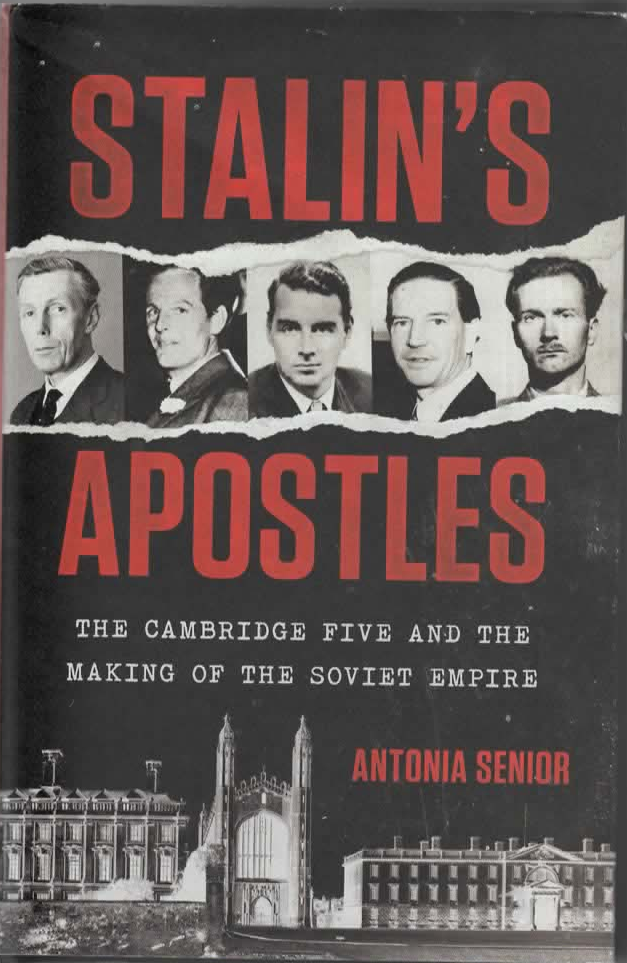
Antonia Senior has written a very engaging book in which she skillfully intertwines the careers of the Cambridge Five, and she gives an absorbing context for their misdemeanours. Yet she covers little of the ground that I have laid out above. Moreover, she has chosen a dreadful title for her composition. The whole point of the Cambridge Five was that they were not ‘apostles’ for Stalin. They engaged in subterfuge to conceal their ideological commitment, and to gain entry to the corridors of power to undermine their employers and their native land. (Yes, Burgess was perhaps an exception, ranting on about the benefits of Communism, and of life in the Soviet Union, but no one really took him seriously. It was part of his cover.) The true apostles were the fellow-travellers, Communist Party members, and apologists for Stalin who were allowed to speak openly in his favour, and to promote the political objectives of the vozhd.
The author has performed an impressive amount of research, and a distinctive and novel aspect of her work is her inspection of archives in Lithuania and Albania. I found these informative and occasionally terrifying, and they add a valuable perspective to the incomplete stories of how MI6 tried, alongside the CIA, to foment rebellion in the (primarily Baltic) states that Stalin had acquired (or ‘reacquired’, in his mind) at the end of the war, as well as questionable outliers like Albania. The main contributor to such hopeless forays was, of course, Philby, but the fact that he was involved with the planning of such exploits is nothing new. Thus Senior’s accounts do not extend our understanding of Philby’s motives and actions. In fact, recent scholarship suggests that the Albanian groups were so infiltrated with Hoxha’s spies that the operations were doomed without Philby’s passing on to Moscow the outlines of the plans.
Yet that is one of Senior’s important themes. In her Introduction she states that “This book is about the fate of the people of eastern and central Europe who were caught between two totalitarian regimes with dark imperialistic visions. It is about Stalin’s uninhibited ruthlessness. Above all, it is the story of how five students from Cambridge University helped Stalin to build a Red Empire”. To a degree, that is correct, and she emphasizes the political decisions that helped Stalin secure the territories and governments he wanted, intelligence that Maclean, especially, was able to pass on, this making Stalin’s negotiations easier. For an intelligent and insightful account of these aspects of the Cold War, Stalin’s Apostles offers you a very readable introduction, but it is hardly news. After all, if the Five were spies for Stalin, what other objectives would they have had in mind? Moreover, of all the thousands of documents that the Five handed over, we do not know (apart from some glimpses through VENONA) how many were translated, how many were trusted, how many were passed to Stalin, and which ones prompted him to make decisions he would not otherwise have considered.
Two of the blurbs on the back cover declare that Stalin’s Apostles is the ‘definitive work’ on the Cambridge Five. Even if such an entity were possible, this work is undeniably not it. Senior claims (in an Endnote on page 446) that her book ‘takes account of all the new material’ on the Five that the National Archives (and MI5) released in January 2025. I know from experience that studying and making sense of all those files, and integrating the resulting conclusions into one’s palette, would constitute a multi-year project. It is a vain and unnecessary boast that Senior makes, and she unwittingly undermines her case. In her Introduction, she writes:
There was a significant release of documents about them [Burgess and Maclean] from the United Kingdom’s National Archives in 2022, and in January 2025 a huge tranche of British intelligence files about the investigations into Blunt, Philby and Cairncross was released. The extent of these files makes clear that reports of establishment sloth in investigating Blunt and his peers have hitherto been greatly exaggerated. Plenty more is locked in the vault.
Apart from the fact that, if more files are locked away (as I have observed beforehand, noting some of the absurd embargoes put on some Burgess files), we must all wait for many years yet for a fuller – even ‘definitive’ – story to be told, the implication that Senior gives is that she had personally analyzed the ‘huge tranche’ in the few months between the release and the copy deadline for her book. Would an account of that fervent activity, countering the ‘sloth’ rumours, not have been a suitable case for treatment? Yet Helenus Milmo’s interrogation of Philby merits only a few paragraphs: there is nothing about White’s wanting to do a deal with Blunt in November 1951, or even about White’s disastrous ‘interrogation’ of Philby in June 1951, which revealed so much about Burgess. White, the epitome of the ‘Establishment’, one would think, merits only four entries in Senior’s Index: Menzies only a few more. Easton, the sceptic over Philby, none at all. It is an expectation raised by the author that she fails to fulfil.
Moreover, she indulges in some clumsy observations that reveal her uncertainty with some basic facts. “The Five inherited all the colonialist assumptions of their fathers,” she states on page 7, but on the next page she writes: “The Five were vehement anti-imperialists, steeped in the language of the Left that blamed society’s ills on an unholy alliance of capitalism and colonialism.” In describing the Parker’s Piece marches of November 11, 1933, her classification of Cambridge students is surely wrong: ‘the broad coalition of leftists, dominated by Marxists’ clashed with the ‘hearties’, whom she describes as the ‘rowers and the rugby boys and the officer-training corps’. Yet, on page 37, she presents Maclean as being asked to join the ‘hearties’, on the occasion when his family expressed a desire that he should join the Foreign Office. Senior illustrates this by quoting a poem that Maclean had written, lambasting the ‘hearties’ – the ‘hard-drinking, prank-playing, careless, right-wing tribe’. If that is who they were (and my guess is that true ‘hearties’ were not that interested in politics), they would certainly not have been candidates for the Foreign Office. It is all rather a mess.
I spotted some careless editing, some evidence of which I present here to help the second edition: ‘idealogues’ in one place, ‘ideologues’ later on. It should be ‘Nigel de Grey’, not ‘de Gray’ (p 167); ‘Kriegsmarine’, not ‘Kreigsmarine’ (p 290); ‘Kiel’ not ‘Keil’ (p 291). Senior is late on the collapse of Liddell’s marriage. She has Maclean informing his masters about the founding of the OPC (the Office of Policy Coordination), within a week, in September 1948, when she has already described Maclean leaving Washington in August. She very improbably has Blunt acting as a go-between for Philby to Yuri Modin in April 1951, when Philby was still in the USA. She describes Philby as an Apostle (of the Cambridge Society) when he was never a member. Like many authors, she writes ‘verbally’ when she means ‘orally’ (e.g. p 362). Yet the major flaw is that Senior has swallowed so many of the distortions and lies that have infected the archives and the memoirs.
In summary, this is still an admirable book, overall beautifully written, in which Senior shows she is mistress of the subject, can keep a solid grip on the overall chronology, and can weave a spell-binding tale by bringing in relevant factual context. She has many anecdotes that shed a sharp light on the antics of the Cambridge Five, and the world in which they operated. In the absence of any other more investigative work, it is an impressive introduction to the phenomenon of the Cambridge Five for a new general reader. Just bear in mind that Senior is too trusting of many of the sources she uses, does not challenge them, and has refrained from digging deeply into the contradictions and paradoxes that I listed at the start of this review.
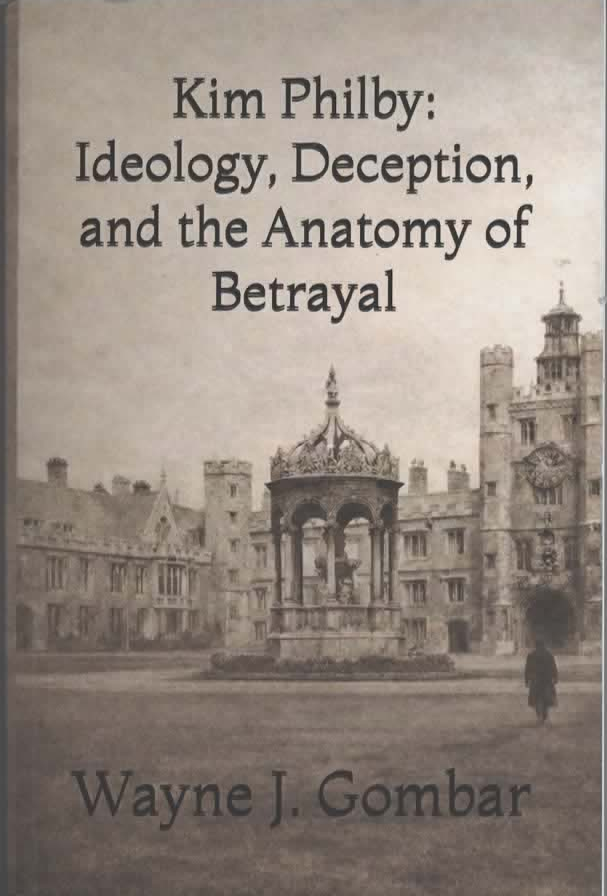
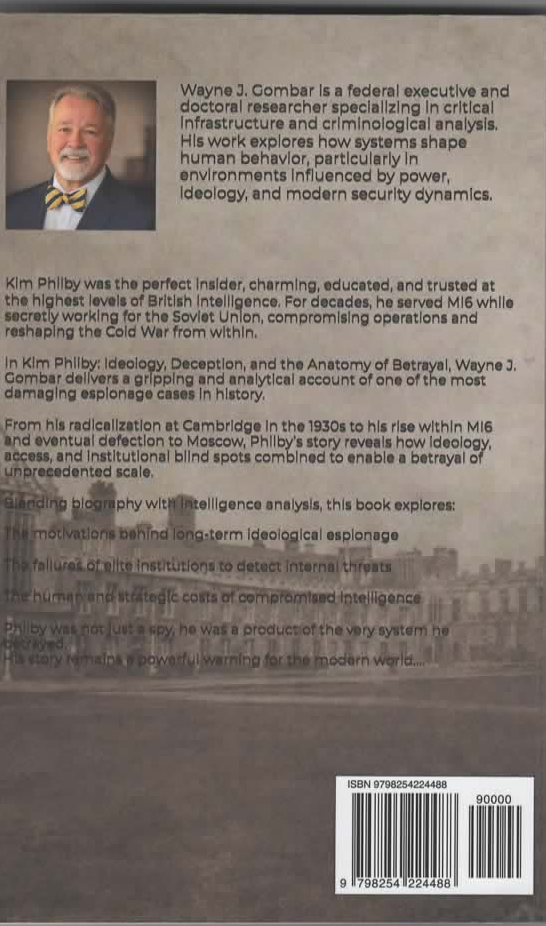
I was alerted to the existence of this volume by a coldspur correspondent, and, having read its blurb on amazon, determined that this was a book that I needed to read. The title suggested that Gombar had some fresh insights to bear on the psychology of Philby, and how he managed to evade suspicions. The author is described as ‘a federal executive and doctoral researcher specializing in critical infrastructure and criminological analysis’. That ‘doctoral researcher’ aspect intrigued me: was this text originally submitted as a doctoral thesis? And, if so, why has it been published already? Was the doctorate ever awarded? It seemed that events were happening in the wrong order.
Indeed, it is a self-published book, and manufactured to order. It is a very poor work, and has hardly enough substance to warrant even a short article. It is vastly repetitive, recycling tedious anecdotes about Philby (he drank, he let down Elliott and Angleton, he was lonely in Moscow and did the Times crossword when he could, etc. etc.) in chapter after chapter. It lacks an index (not that there is much worth indexing); it offers a sparse bibliography with the normal suspects listed (Andrew, Borovik, Cave-Brown, Hanning, Knightley, Seale and McConville, West, etc.), but surprisingly omitting Richard Davenport-Hines’s Enemies Within. He even mentions coldspur a couple of times (without any acknowledgment in the bibliography), but only to reinforce some points about Philby’s activities in Spain. It does not appear as if he has internalized or questioned any of the large amount of research that I have presented on Philby. Yet Gombar claims to have absorbed all the material on Philby that the National Archives released in 2025. I even wondered whether the book had been created by ChatGPT, but judged that no AI engine would hallucinate as badly as Mr. Gombar does.
I am a great sceptic when it comes to psycho-analysis. First of all, I believe that most of it is pure charlatanry, based on questionable ideas that can never be verified scientifically. Second, I always thought that no one practiced in the ‘science’ should apply it retrospectively to dead persons, but restrict it to questioning live subjects under study. Third, the evidence of memoirs, biographies and archival material is so riddled with lies and prevarications that it would be seem to me to be very dangerous to attempt a study of what motivated Philby, why he betrayed, what made him ‘tick’, if ticking is in fact what he did. Sometimes Gombar recognizes this dilemma, but ploughs on anyway, and adds some socio-political commentary that is well-worn, and not very useful.
Moreover, it contains some egregious errors. For example, Philby was not a member of the Apostles. Gombar several times notes that Philby was recruited by Deutsch on the famous park bench in July 1934, but then observes (p 168) that Deutsch had already recruited him in Vienna. He gets the whole ‘Third Man’ episode wrong, and mistakenly claims that Burgess and Maclean were about to be arrested when they fled. Yet the prime blunder concerns Philby’s wives. In Chapter 19 he focusses on Philby’s marriages, naming his three wives (Litzi Friedmann, Eleanor Brewer, and Rufina Pukhova), and describes the way he treated them, and the methods by which they put up with his selfishness, alcoholism, and deviousness. (He does not tackle the bigamy issue.) Yet Aileen, with whom he had the most tortuous relationship, and whose behaviour and suspicions – and eventual demise – are absolutely critical to understanding Philby’s obsessions and heartlessness, is here completely overlooked. In an earlier Chapter on Beirut, however, Gombar had made a glancing reference to the fact that Kim left behind ‘his second wife Aileen and their children in England’. It is an astonishing oversight, not least because Gombar – or anyone who checked his text, if there was such a person – completely overlooked this massive textual faux pas, as well as the significance of Aileen to Kim’s story.
Gombar’s message is not overall new, or a breakthrough – yet it does harbour its own contradictions. He sets out (page 9) to declare that his ‘biography’ (a rather grandiose term for this slender work) ‘treats Philby as a product of his times and institutions rather than an inexplicable moral anomaly’. He presents his analysis as one that ‘illuminates the anatomy of betrayal’. The ‘system’ failed because the assumed mechanisms of trust could be easily subverted, and a strong ideology sustained long-term deception. He echoes the thesis of Ben Macintyre when he writes: “Elite trust, and institutional complacency enabled an ideologically driven insider to inflict damage far beyond what any lone actor could achieve through conventional espionage”. He hammers on this theme through most of the book, but then, in Chapter Twenty, on My Silent War, he switches to another theme, writing:
Subsequent scholarship, bolstered by declassifications and personal testimonies, has steadily dismantled the myth [of Philby’s ability to control the propaganda of his tightly-managed loyalty through his memoir], revealing Philby as neither a romantic anti-hero nor a master spy, but as a product – and ultimately a victim – of systemic trust failures, ideological seduction, and institutional complacency’.
Philby as victim, eh? And never a ‘master spy’? I am not aware of any ‘subsequent scholarship’ that makes those claims. And it all has a rather Marxist ring of individuals being defined by their inheritance and their background. Yet, once a critic starts explaining what factors drove an individual into a role such as treachery, he or she enters a quagmire. “Kim’s early years were shaped by the absence as much as the presence of his father”, writes Gombar (page 23). “The father’s contempt for bureaucratic rigidity and his history of independent action made Kim more open to critiques of the status quo” (page 25). “The systems of empire that produced both father and son – public school, Oxbridge, colonial service – equipped him with the social ease, linguistic facility, and insider knowledge that would later enable his remarkable deception.” (page 26).
Apart from the fact that Philby was never in the colonial service, this is still psychological claptrap. Gombar stirs it up even more by stating that the economic crises of the age caused Phiby’s continued leftward shift ‘from vague socialist sympathies to deeper engagement with Marxist ideas’, as if he had been a shrewd economic analyst. Yet he earned only a third-class degree in economics at Cambridge. Was that because he spouted Marxist propaganda in his exam papers, and found unsympathetic evaluators (not Maurice Dobb, presumably), or was it because he was actually not very smart? In his memoir, Philby never showed any understanding of Marxist economics in his ‘embrace of communism’, only a slavish devotion to Stalinist totalitarianism. It was not ideology that made him betray his country but the satisfaction he gained from joining ‘an elite force’ (something Gombar never mentions).
The other side of the coin is that many of his contemporaries who had experienced a similar background (though perhaps without the maverick father) did not follow the same course. Some may have had communist sympathies for a while, but dropped them as they matured, or when they learned about the realities of the Soviet Union. Others may have maintained communist ‘ideals’, but never would have considered betraying their country to aid a monster like Stalin. Some may have maintained the faith in the ‘anti-fascist’ story until the Molotov-Ribbentrop Pact, at which point they threw up their arms in disgust. Yet the majority may have rejected the whole leftist manifesto outright, seeing clearly that communism was just as evil as fascism, and that an anti-fascist assault by the Reds would lead to a bloodbath with the proportions of the October Revolution. The problem is that there are no controls in experimental ventures like this, and the theories are inadequate.
I suspect there was a simpler explanation. It must have seemed a good idea to Kim at the time, helping the oppressed in Vienna, and it was flattering when Deutsch (either in Vienna, or in London) asked him to join the team, working for ‘Peace’ – what Schiller in Don Carlos called ‘Die Ruhe eines Kirchhofs’. But once you were in, there was no way out, and you did what you were told. Otherwise, if you showed any sign of weakness, you might expect to be discovered in a remote hotel, dead with signs of a ‘heart attack’, a fate that befell so many apostates. And once set on his march, it was a sign of pride for Philby that he never repented or regretted what he had done. He told Nicholas Elliott in Beirut that he would ‘do it all again’. When in Moscow, he found it dreary, he was ignored and considered a spy, he was not given a proper job to do, he found the treatment of WWII veterans appalling, and he sat in his apartment looking at the cricket scores and doing the Times crossword when he could, no doubt enjoying his Chivers Olde English marmalade, and, of course, drinking himself to death. But never did he admit: “I got it wrong”.
Gombar has a line to sum it up: “Philosophically, Philby embodies the ambiguity of consequentialist ethics versus deontological duty.” I think this means that he judged that the end – a purely communist society – justified the means of eliminating anyone who stood in the path to progress, but that that inclination betrayed (as Gombar puts it) ‘the fundamental duties of loyalty, honesty and human solidarity’. Well, that would make Philby an out-and-out Chekist, a Dzerzhinsky, ready to execute purges of any non-proletarian, yet he would have been one of those first in line to be strung up or shot. Gombar comments: “This instrumentalization raises profound ethical questions about whether any ideology can justify the systematic deception and harm Philby inflicted.” In truth, these are not ‘profound ethical questions’ at all, and can be dismissed immediately. Nothing sanctions the slaughter of millions of innocent persons that became a routine by-product of the Communist ‘experiment’.
The final contribution Gombar makes is to draw lessons from the Philby experience to help today’s institutions protect themselves from the same phenomenon – the insider traitor who displays all the signs of fitting the cultural profile of a loyal servant. It is not just the intelligence betrayal that hurts, but the effect that the discovery of the snake in the grass has on trust and relationships. Elliott and Angleton were devastated by Philby’s flight and obvious guilt, and it drove the latter to paranoia about further Philbys everywhere – and infected Peter Wright, too. Gombar brings the challenge up to date. “Digital-age tools – behavioral analytics, continuous evaluation, zero-trust architectures, and AI-driven anomaly detection – have advanced detection capabilities far beyond the analog area,” he writes. That may be true, but Gombar ignores the fact (for example) that the FBI and the CIA ignored for too long obvious signs that Robert Hanssen and Aldrich Ames respectively were engaged in highly suspicious behaviour, and they thus failed to detect the espionage of the pair until tragically late.
What was the analogy in Britain? Were Blunt’s communism, Philby’s exploits with Volkov, or Maclean’s drunken hooliganism in Cairo not enough to raise suspicions, and for the authorities to take action? There were indeed enough signs that MI6 had a wrong-un on their hands well before Phiby escaped to Beirut, and Milmo and MI5 just failed to gain the confession they needed in December 1951. The fact that some diehards in MI6, even after that interrogation, still believed in their man is, of course, another story, one that unveils a conspiracy unthought of in Gombar’s meagre analysis.
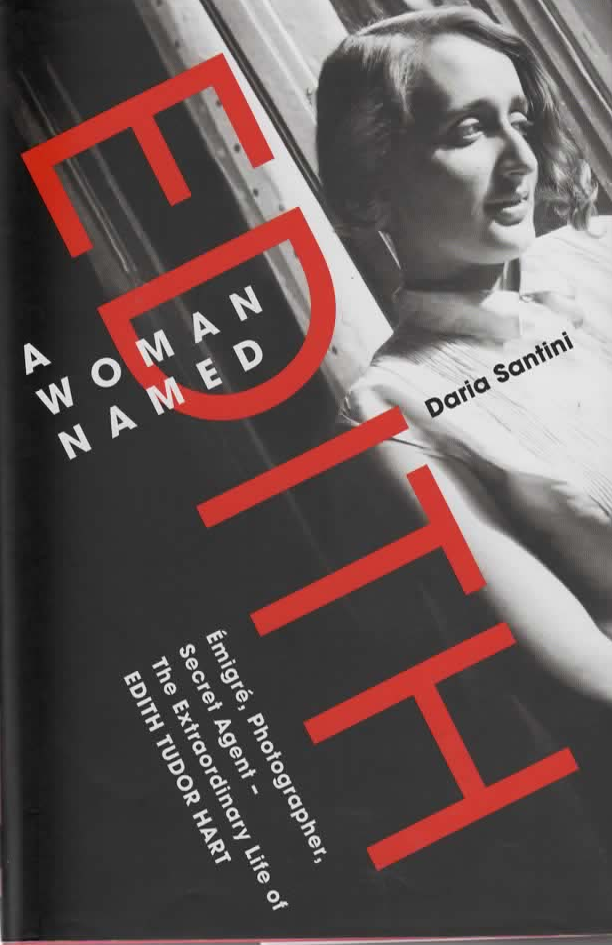
A Woman Named Edith by Daria Santini
Daria Santini has written a very elegant biography of Edith Tudor Hart (née Suschitsky), the courier for Soviet agents in the late 1930s and during the Second World War, and renowned photographer. (For some reason, Ms. Santini has dropped the hyphen from the conventional form of the surname: I shall follow that practice in this review only.) I have been in communication with Ms. Santini, since I wanted to congratulate her on her stylish book, and also to introduce her to my research on Edith, which she had obviously not seen. We have had a very congenial exchange, and Daria pointed me towards the Austrian archive that holds an image of the Philby-Friedmann marriage certificate. We have respectfully agreed to differ on the significance of Edith’s life, and here I am going to explain her viewpoint (as I interpret it from her book), and to lay out why I think Edith’s influence and importance have been overstated. The subtitle of the book is Émigré, Photographer, Secret Agent – The Extraordinary Life of Edith Tudor Hart: if you acknowledge the fact that her role as an agent was hardly secret at all, and that her activities were known by MI5, the rest is not much to work on.
My disagreement thus concerns two main realms: a) Edith’s significance as an agent of the NKVD, and b) her contribution as a photographer. I shall summarize my high-level opinions first before analyzing Ms. Santini’s text. It is worth starting with the blurbs, as usual.
“ . . . Edith Tudor Hart was one of the most significant spies and agent-runners in history.” (Richard Crockett)
“At last Edith Tudor Hart emerges from the shadows to take her rightful place in the history of espionage.” (Stewart Purvis)
“Edith Tudor Hart’s life has been obscured behind her role as the ‘grandmother’ of the Cambridge Five.” (Helen Fry)
Apart from the frightfully poor taste shown in celebrating the recognition of someone who betrayed her adopted country for a destructive cause (Would Purvis, a biographer of Guy Burgess, describe his subject in such glowing terms? Is this fresh applause a side-effect of the feminist movement?), these claims are obvious nonsense. Edith was never a spy: she did not have access to confidential information. She was a courier, but not a very efficient one. She may have been a ‘spotter’ of potential agents for Arnold Deutsch, but, since she was a friend of Litzy Friedmann’s in Vienna, and Deutsch is recorded by some as already having recruited Philby there, the evidence is thin. Anthony Blunt’s much-quoted ‘grandmother’ assertion (in itself rather insulting, since Edith was born the year after Blunt came into this world) should not be taken too seriously: it was probably another of the lies and inventions that Blunt gave his interrogators as a distraction when he was having trouble recalling many basic facts about his dismal career.
The photography angle may be more one of taste. Alongside psychiatry (see above), I judge photography to be one of the most overrated of human pastimes. It seems to me that anyone with a camera may happen to encounter a startling event, and record it for posterity, although the artefact may not have precision or solid structure. Taking photographs professionally, however, requires some artifice, with attention to lighting, and content, and structure, and repeated shots may be required to produce an image that meets what the artist intended. Thus a quantum of distortion and deception may be inherent to the whole process. It is overall a dubious endeavour. As Alfred Stieglitz wrote in 1899: “The placing in the hands of the general public a means of taking pictures with but little labor and requiring less knowledge has of necessity been follows by the production of millions of photographs. It is due to this fatal facility that photography as a picture-making medium has fallen into disrepute.” (What Stieglitz would have thought of cameras on smart-phones is beyond me.)
Thus, when I read on the book’s inside cover: “Throughout her life, Tudor Hart was deeply committed to the ideals of communism, and she used her striking photography to highlight the urban deprivation and inequality she witnessed”, I squirmed. Most of these images were taken from her time in London, but I am never sure whether Edith’s staged portraits are designed to show the innate nobility of children who were exploited by an inhumane system, or whether they reflect the bitterness and preparation for revolution that the photographer presumably desired – and believed was imminent. (“There is something appalling about photographing people. It is certainly some sort of violation; so if sensitivity is lacking, there can be something barbaric about it”, wrote Cartier-Bresson.) And, if she hoped that such touching images might bring observers over to her cause, did she ever wonder what was going on in the Soviet Union at the time? Edith was, of course, not invited to take her camera to the Ukraine, where she could have recorded for her friends in England the horrors of the Kholodomor, with dead bodies in the street, and proof of cannibalism.
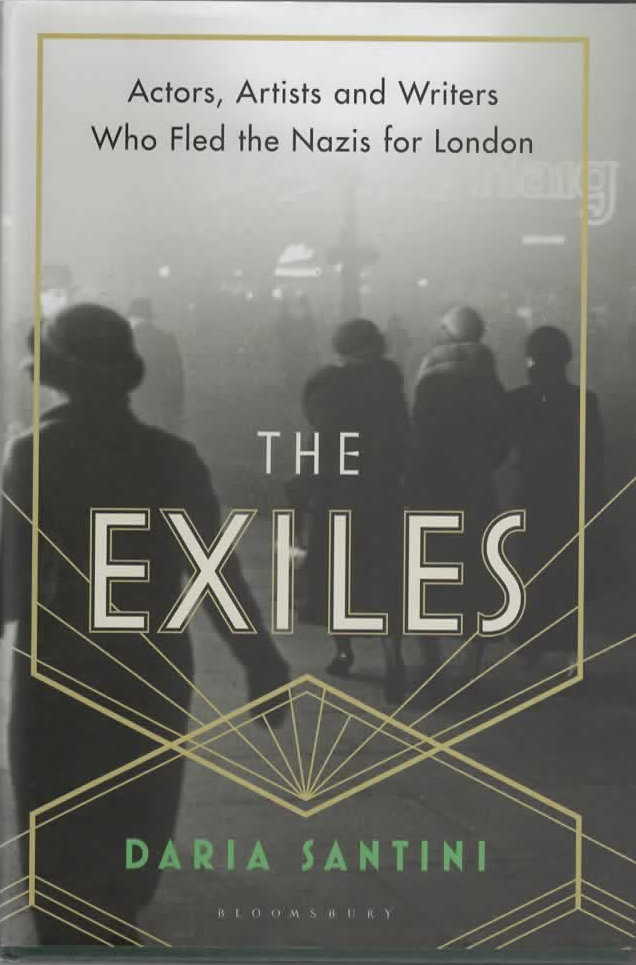
Ms. Santini, the author of The Exiles, a fine 2019 study of actors, authors and artists who fled the Nazis for London, has done her homework. She shows that she is intimately familiar with the various groups that settled in London, the clubs to which they belonged, their affairs and divorces. Thus the reader can expect a thorough and accurate picture of Edith’s early life, and the milieu in which she operated in London. Yet her account is coloured by a far too indulgent attitude towards Edith’s political naivety, as well as by a personal absorption in her photographic art that makes too many assumptions that Santini’s personal, and very sympathetic, reaction will be automatically shared by her readers at large. I know that biographers tend to become too enamoured with their subject, but Ms. Santini sometimes goes over the edge towards unsubstantiated judgments, and even propaganda. I had felt uncomfortable when she introduced Edith in The Exiles in the following terms:
Edith Tudor-Hart’s [sic!] personal story is that of a courageous and independent woman. Seen in the context of the struggle against fascism, first in Vienna and then in England, her tireless political activity and her loyalty to her cause assume an admirable dimension.
Since Britain declared war of Fascist Germany shortly after the Nazi-Soviet Pact was signed, and Edith was then a citizen of the United Kingdom, I see nothing admirable about her commitment to an ignoble cause, and the betrayal of her adopted country.
Moreover, where the facts about Edith’s life are thin, Santini indulges in a lot of speculation. For example, in her Introduction, she writes: “Edith was considered the driving force behind one of the twentieth century’s most successful spy rings, the Cambridge Five, because of the uniquely convincing energy with which she had brought the right people into the Communist fold.” Why the passive voice? Who are these ‘considerers’? It is difficult for me to see this frail and socially awkward young lady as the ‘driving force’ behind anything, let alone an entity as influential as the Cambridge Five. Which people did she bring into the Communist fold? Were they not already committed? And the whole point of setting up a clandestine ring was to keep it away from the Communist Party, and have its members work under subterfuge. Further: “While her photographs still speak loudly, it can be hard for us to recapture that unique mixture of fanaticism and hope that led her to devote her life to the pursuit of an ideal which seemed to promise so much but was ultimately tragically corrupted.” Well, the photographs may speak loudly to Ms. Santini, but they may appear as phony to some of us. And yes, it is hard for the more level-headed of us to imagine that ‘mixture of fanaticism and hope’: what did Edith know of that ideal? Whatever it was, it was corrupted from the start. I dislike that weaselly ‘ultimately’, since murder and state terrorism were built into the Bolshevik regime from the first days of the revolution.
Yet I was soon (partially) disarmed by Ms. Santini’s full and fascinating account of Edith’s life. She provides some rich and engaging background about Edith’s early years: her visit to England as a teenager, her joining the Communist youth organization in Vienna, her (possible) love affair with Arnold Deutsch, her returning to Britain, where she mixed with the Tudor Harts, her communist activism that came to a halt when she was spotted demonstrating in Trafalgar Square on October 26, 1930, and her consequent expulsion, which she reluctantly accepted. Back in Vienna, she takes up her activism, is offered a job as photographer for TASS, and is eventually rejoined with her lover Alexander Tudor Hart. They marry quickly, under persecution, and Edith returns permanently to the UK as a British citizen. The narrative is coloured with much speculation and flimsy argument, however, such as:
“But Villa Seeblick is likely to have had lasting impact on Edith’s character . . .”
“It was almost certainly during this time that Edith, energized by political discussion with her colleagues at Troststrasse, felt drawn to communism, viewing it as a more militant and decisive solution to society’s ills.”
“It has sometimes been said that Edith and Arnold Deutsch were lovers and that he was the man to whom she lost her virginity.”
“She almost certainly joined the Communist Student Fraction . . .”
“Edith’s shadowy handlers probably felt that this keen, clever, well-connected young woman could be more useful there [in Britain] than in her native Vienna.”
“It is likely that, on Deutsch’s suggestion, she made contact with communist circles in Britain through the Tudor Harts.”
“There is no concrete evidence in accessible archives that she was a Comintern agent.”
“Edith’s appointment as TASS correspondent was a way of employing her as one of the Soviets’ secret agents in the West.”
And there is more of the same.
This analysis does not convince me. How Edith was supposed to further the communist cause of inspiring revolution in Britain is beyond me. Ms. Santini writes, apparently without irony: “Edith’s own scepticism about Britain’s sluggishness in the fight against imperialism was clearly reflected in her friends’ joint efforts – vigorously aided by the Comintern – to spread the communist message among British workers.” (Why would the custodians of the British Empire have fought to dismantle it in the 1930s?) But how would Edith have contributed to this mission undetected? Above all, if she had been a ‘secret agent’, she would have been instructed to stay out of trouble. And yet she was arrested after the 1930 demonstration in Trafalgar Square and expelled. MI5 and MI6 kept a watch on her, and, after her marriage to a notorious rabble-rouser in Vienna in the summer of 1933, she returned to the country, having reportedly been recruited by Arnold Deutsch shortly beforehand, and was immediately in the sights of MI5 again. What was ‘secret’ about all this?
And that surveillance pestered her for all her days thereafter, through the clumsy business with the camera invoices in the Percy Glading affair, and the photograph of Kim Philby, to the romantic liaison with Berti Broda (when she acted as a courier for atomic weaponry secrets), and the reports on her from the MI5 agent KASPAR (Joseph Laemmel). Santini tellingly describes KASPAR as ‘treacherous’ (page 221), overlooking the fact that Edith, now a UK subject, was, like Fuchs and Litzy Philby and others, the real treacherous one, betraying her adopted country. So why did MI5 do nothing? Perhaps it was partly a deliberate kind of mild persecution, letting her know that she was being watched, and thus acting as a deterrent for any more serious subversive undertaking. Perhaps it was just another brick in the wall of ‘keeping an eye on’ possibly dangerous elements, as it did with hundreds of the innocent and guilty, in the hope that eventually the subject might lead them to Mr. Big (or Mrs. Big), or to further contacts over whom they could shed their meagre tentacles. Having shown little enterprise in the business of the Glading camera, and having failed to catch Edith in the act of taking papers from Broda, MI5 missed its sole opportunity, and had little to justify arrest and trial.
Finally, there is the cavalcade of photographs that were designed to act as propaganda. “That autumn [1930] in London, she honed her photographic skills in the city in which poverty and social inequality were of a magnitude she had never encountered before”, she writes. Well, maybe. Edith had never been to Russia, of course, but the author adds that Edith wrote to Alexander that the standard of living was higher in London than in Vienna, despite the Depression. She writes that, when photographing scenes from life in the East End of London, Edith portrayed ‘a world full of dignity in the face of capitalist exploitation.’ The poor of the East End may well have been happier to be exploited by the capitalists than by the Bolsheviks – not that they received reliable information about the elimination of the kulaks as a class, of course, being more likely to learn of the nonsense that Sidney and Beatrice Webb were reporting about the ‘New Civilisation’ at that time.
Yet here is an opportunity for the author to insert her own sentimental and maybe not objective opinions of Edith’s photography into her text:
“Striking, however, is the fact that the photographer adds her own distinctive touch to this hopeless universe: something real and warm yet unsentimental at the same time, a human dimension that draws us in and makes us reflect.”
“Edith was convinced that the solution to the endemic misery exemplified by what she saw and recorded lay with the ideals and practices of communist Russia.”
“The photographer’s style is restrained, stark and unadorned. The eye behind the camera is showing us the way things are: there is no didactic drive behind these pictures, yet they grab your attention and we linger over them because they seem to be telling us a story. the political message is coupled with a genuine interest in people, in the small but telling details that make the photographer’s subjects profoundly human . . .”
“Perhaps Edith asked her subject to pose, but whatever she did to emphasise the contrast between deprivation and abundance, between the injustice suffered by starving children and a world of plenty, the photographer’s power is undeniable.”
So were her photographs didactic propaganda, or not? Santini never resolves this tension. And there is much of this type of commentary in the book. These are very personal observations, and Ms. Santini is surely wrong to hijack all her readers’ native reactions in order for her to exaggerate Edith’s significance, and to show her sympathies for Edith’s misguided convictions.
There was more to Edith’s life, and she stayed in Britain after the war. She had been delighted when her son with Alexander, Tommy, was born in 1936, but the child turned out to be severely autistic, and caring for him (or trying to find suitable care) took up a lot of her time, and exhausted her. Alexander was not a good absent father, and Ms. Santini covers Edith’s struggles with compassion and sympathy. Edith engaged in a series of unsatisfactory and unhappy affairs, including a quite inappropriate relationship with her psychiatrist, Donald Winnicott. She was obviously very ‘clingy’. She opened up an antiques shop in Brighton, and died there of cancer in 1973. It was rather a sad life – one with just enough pathos and topical political intrigue to warrant a biography, I suppose. I regret, however, that the fineness of Ms. Santini’s writing, and the originality of much of her research, cannot overcome her misplaced sympathies and misrepresentations. The claims about Edith’s significance are simply unsupportable, in my opinion.
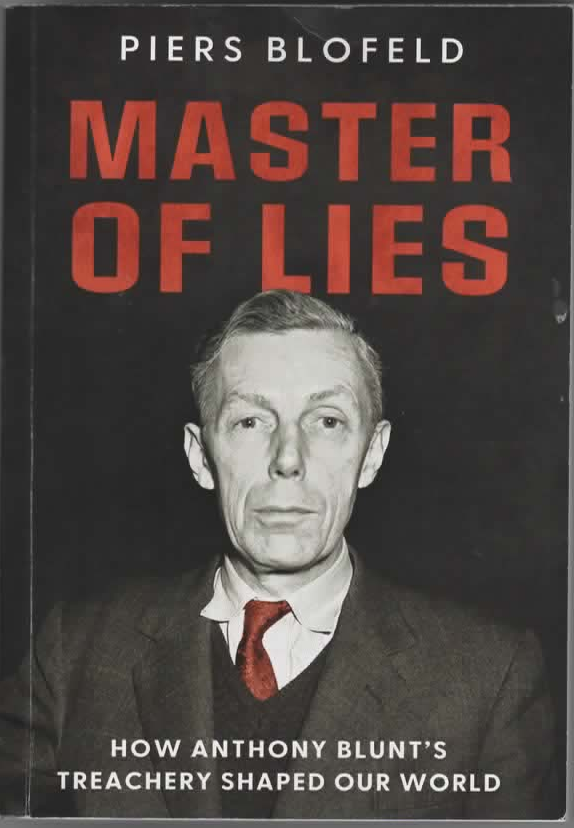
Master of Lies by Piers Blofeld (2026)
Readers may recall my unpleasant experience in dealing with Piers Blofeld, the literary agent for Stephen Verkaik and the latter’s Traitor of Arnhem. Blofeld had sought me out, trying to promote an upcoming book of his about Anthony Blunt, and unwisely tried to flatter me by complimenting me on all that I had written about Blunt and his cronies on coldspur. He then sent me a proof copy of Master of Lies. Within two minutes of picking it up, I realized that Blofeld had not read a word of what I had written, since he neither referenced it, nor did he challenge my conclusions with his new theories. I was seriously annoyed with him for his ingenuous deception, and for wasting my time. After a somewhat heated exchange, we parted reasonably amicably, although I infuriated him a few weeks later, when, having at his request obtained a copy of John Costello’s autopsy after he had failed, I posted it on coldspur. He accused me of ‘stealing his research’, claiming rather absurdly that he should have exclusive use of the document for his own purposes, and he insulted me by calling me some unmentionable names. I continued with my research into JOSEPHINE, and concluded that both he and Verkaik were charlatans. No doubt Blofeld regards his experience with me as equally unpleasant.
I did not think much more about Master of Lies until I saw that Richard Davenport-Hines had reviewed it in the Times Literary Supplement of May 29, alongside Senior’s and Santini’s recent books, in a piece titled The Traitors: Cold War double agents, their lives and motives. (Yes, ‘double agents’ again.) What surprised me at first was that Davenport-Hines spent more column-inches on Blofeld than either of the other two authors, which in my opinion was disproportionate to their imagined worth. Of course, I had not yet read Master of Lies, but I did not have high expectations. Moreover, the critic (author of Enemies Within) was scathing about Blofeld’s methodology (or lack of it), his cheap criticisms and his obvious factual errors. His conclusion? “There is good stuff in Master of Lies, but overall it is a bedlam of hasty imprecision, rash postulates and prosecutorial animosity.”
I was thus not taken aback when, in its edition of June 12, the Supplement published a bitter riposte by Blofeld. He accused Davenport-Hines of getting his facts wrong in his ‘mean-spirited and ad hominem review’, and he offered a few counter-corrections to how Davenport-Hines had interpreted his text. Blofeld continued that the critic’s reading of Blofeld’s explanation of why Blunt became a traitor ‘shows the most unpromising levels of undergraduate reading comprehension’, which was perhaps an unworthy slur against a writer with a formidable record of scholarship behind him. Perhaps Blofeld spoiled his case by concluding his letter with the evidence that the late Queen’s private secretary had contributed a blurb for the book that hailed it as ‘rigorous, unsettling and startlingly readable’, as if the judgment of that civil servant proved that some of Davenport-Hines’s accusations of Blofeld’s vendettas could immediately be negated. This one could run and run, I thought. But Davenport-Hines wisely did not respond. Or, if he did, the Editor of the TLS called it a day.
What the exchange did convince me, however, was that I had to read the book, and it would seem to be an appropriate volume to fill out this quartet of reviews. I thus retrieved it from my shelf, and read it in a couple of evenings. I think Davenport-Hines’s assessment is overall correct, although my take is that he reacted a bit too hyper-sensitively about Blofeld’s attacks on intellectuals and the ‘Establishment’, and that he spent too little time on the extravagant claims made about Blunt’s role as a super-manipulator. The fact is that Blofeld has executed much original research (some of which I wish I had carried out myself, such as studying Fidrmuc’s Personal File and digging out the appearance of Patricia McCallum in a 1999 BBC Timewatch documentary), but it is all selected and massaged with such recklessness that no coherent story arises from it. In fact, I would have thought that Davenport-Hines would have enjoyed some of the obscure connections that Blofeld has brought to the surface, such as the acquaintances and relations of Guy Liddell’s disreputable wife, Calypso.
My copy is an ‘Uncorrected Proof – not for Sale or Quotation’, but I do not imagine that the text has changed much in the official publication. (For the integrity of my library, I might even buy it, but it is not yet available on amazon.usa. My on-line colleague Andrew Malec has informed me that my name does now appear under ‘Acknowledgments’, but I would rather be dissociated completely from this publication.) And there is much to enjoy in it. I was particularly taken by Blofeld’s suggestion that it was Blunt who carefully laid out Burgess’s correspondence to be ‘discovered’ by Arthur Martin & co. at Burgess’s apartment. I had suspected that Burgess was responsible for this himself, as a way of dragging all his contacts into the maelstrom. After all, if he had not cleaned out his flat, he must have known that much incriminating evidence would come to light. And maybe he plotted it all with Blunt: the exercise did provoke MI5 into much fruitless investigation, and distracted attention from Blunt. I thought that Blofeld rightly gave the appalling Victor Rothschild a real drubbing, and there were many fascinating vignettes of other characters who lurked in the Blunt background.
Yet the relentless promotion of Blunt as the arch-schemer who almost single-handedly changed the face of Europe is desperate and ill-begotten. Perhaps out of embarrassment, Blofeld soft-pedals the wily way that Blunt invoked the Luftwaffe to bomb Wormwood Scrubs, and thus destroy the records of Blunt’s communist past (which formed such an absurd role in Verkaik’s Traitor of Arnhem). Yet the incident is still there, undenied. Blofeld spends a lot of ink trying to convince his readers that Blunt was the Abwehr spy JOSEPHINE, who caused such havoc, and was even responsible for the deaths of thousands of GIs in the MARKET GARDEN fiasco. He also sets up his case that Blunt was also ELLI, the mysterious agent named by Gouzenko. He has Blunt as being the manipulator of not only Churchill (by virtue of the fact that he wrote up the monthly MI5 reports for the Prime Minister), but also Hitler and Stalin, for whom he packaged up intelligence reports, and which they (of course) unfailingly read. He was – according to Blofeld – ultimately responsible for Stalin’s rape of eastern Europe. Lastly, shortly before he was unmasked, he managed to secure the deaths of several of his contemporaries, who knew too much, and, despite their unhealthy lives, experienced a premature death.
The problem is that Blofeld has set his mind on showing that Blunt was an underestimated arch-villain, and plucks at any loose straw that might assist in his extravagant exploit. In that way, he ignores many of the facts about the events surrounding the Cambridge Five. Apart from the impossible logistics of the Wormwood Scrubs business (which I dismantled in https://coldspur.com/verkaiks-traitor-of-arnhem-part-1/), he does not appear to have considered the following: If Blunt was JOSEPHINE (a person who did not actually exist, incidentally), how did he pass his messages to the Abwehr? (Krämer referred to JOSEPHINE hundreds of times in his reports to Berlin.) Why does Blofeld think that a simple message about a possible attack in the Arnhem area caused a catastrophe of such proportions, when the message did not even arrive at the OKW desk in time to have any impact? Does he really believe that Montgomery’s plan for MARKET GARDEN was a masterstroke (when it was fatally flawed from the outset), and that it was scuppered only because of Blunt’s opportunistic insertion? Does he not question why the haughty and fastidious Blunt would (almost literally) risk putting his neck in the noose if he were to be discovered passing state secrets to the Germans?
Is he also not aware that the Admiralty and the London Controlling Section were carrying on a disinformation campaign, exploiting the Swedish attaches Oxenstierna and Cervell, in order to mislead the Germans about an attack on Scandinavia? Why has he ignored the fact that MI5 clearly abetted the escape of Burgess and Maclean, using the shady Blunt as an intermediary? And why does he overlook the fact that, just a few months later, Dick White and J. D. Robertson wanted to give Blunt a free pardon if he admitted all his misdemeanours in spying for the Soviets, proving that his skullduggery was well-known to the senior officers of MI5 at the time? Does he really think that the secret of Blunt’s confession would have been confided to such junior officers as Patricia McCallum, and that she would have even have referred to him in her report had she known about it? I could go on, but I believe this list is enough to show that, for all his industriousness and imagination, Blofeld should not be taken as a serious historian.
Another problem is that this nonsense gets lapped up by those who should know better, and then, of course, by the public at large. If you study the entry for Master of Lies on the publisher’s website, at https://www.quercusbooks.co.uk/titles/piers-blofeld/master-of-lies/9781529446609/, you will see a number of extravagant expressions of praise by some less than stellar names, e.g. Rod Liddle (a brilliant journalist who died earlier this month) and Nicky Haslam, as well as an actor, Damian Lewis, for some reason, and by the rather improbable Rt. Honorable Lord Young of Old Windsor (‘intelligence history as it should be written’), who all surely have no understanding of the topic at all. Yet, at the bottom, there appears a contribution from Dr Michael Reynolds, who was an assistant director in MI5 before founding and running the counter-terrorism unit in MI6. “In life, Anthony Blunt was the Cambridge spy who ‘got away with it’. Forty years after his death, this riveting book exposes the extent of his betrayals, of his country and his friends. A gripping narrative and a must read”, is Reynolds’s contribution. If this assessment is typical of the brains running the country’s intelligence services, what hope is there for you all? And why did Blofeld for a moment believe that I might be impressed by his nonsense?
Blunt was obviously a busy man – alongside his various intelligence duties, JOSEPHINE, ELLI, and then Keeper of the Queen’s Pictures and Director of the Courtauld Institute. He may also have been the Scarlet Pimpernel and the Creature from the Black Lagoon, for all I know. Blofeld does not say. But an arch-villain with overwhelming influence? It hardly goes along with his deferential tone to Edith Tudor Hart as ‘the Granny of us all’. And was Andrew ‘Granny’ Gow perhaps the Granddad of the whole rotten shower, mentoring them at Trinity College? Moreover, the multitude of transcripts of the interrogations conducted by MI5 show Blunt as a hesitant and ill-prepared individual, with his selective memory, contradictions in testimony, and feeble explanations. Hardly the brains of an evil enterprise on the lines of . . . whom should I say? But of course! Ernst Stavro Blofeld, the head of SPECTRE.
(Recent Commonplace items can be viewed here.)