This Spring Round-up offers me a timely opportunity to report on four projects at various stages of completion. All were undertaken in collaboration with a remote coldspur correspondent: three of the four (all based in Europe) have requested complete or partial anonymity, which I have of course granted. It is possible that the outcomes of such projects lead to disclosures that make some participants feel uncomfortable, or that professional status imposes a requirement to keep their name out of public eye. In any event, I have enjoyed each of these investigations, and I trust that they shed fresh, and sometimes important light, on the respective intelligence topics. Supplementing these accounts are a few items of extended commentary on other investigations that I have undertaken in recent months.
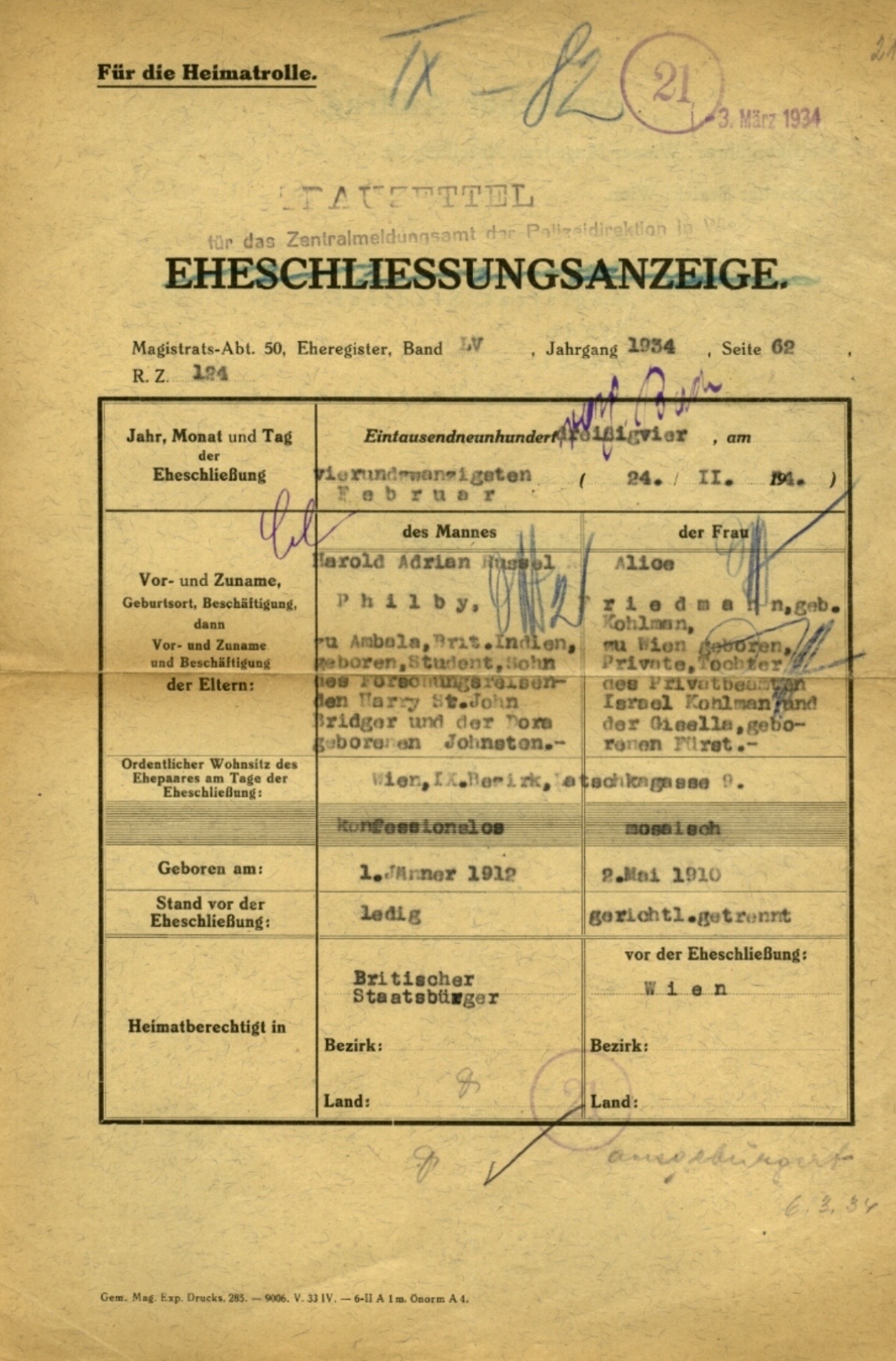
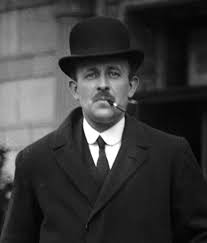
The image reproduced above comes from the Archive of the City of Vienna. I am very grateful to Daria Santini (the author of the recent A Woman Called Edith, a biography of Edith Tudor-Hart), who has been stepping out on research paths similar to those I have been treading, but who has been more enterprising in locating on-line archives. For more on the quest for tracking down Philby marriage and divorce certificates, see the story below. This is a Type ‘C’ report (Congenial): it includes some discussions of spycraft, but it should not be too technical for the average reader.
Contents:
The Burgess-Maclean Anniversary
(a couple of attempts to mark the 75th anniversary of the infamous escape)
The Incident in the Forest
(an update on the investigation into the integrity of John le Carré’s plot construction)
The Zinoviev Letter
(a review of Gill Bennett’s book, and a reminder about the Genuine and the Authentic)
Colonel Spencer
(a profile of a largely-forgotten MI5 officer)
John Cairncross and the Sicherheitsdienst
(an extraordinary anecdote surfaces from the Sicherheitsdienst files)
Philby’s Bigamy
(a carelessly deposited comment in Philby’s file resuscitates the debate on Philby’s marriage to Aileen)
‘Saturday at M.I.9’
(Airey Neave’s poignant book about escape lines in WW2)
Inconclusive History
(follow-up on VENONA, and authorized histories)
Patricia McCallum’s Report
(the fascinating contribution to the JOSEPHINE story from an unrecognized MI5 officer)
Much Hokum in Stockholm
(a potboiling novel about MI6 and SOE in Stockholm)
The Library Project
(an update on the transfer of the coldspur Library to UNCW)
* * * * * * * * * * * *
The Burgess-Maclean Anniversary
Dedicated readers will know that this weekend is the seventy-fifth anniversary of the escape of Guy Burgess and Donald Maclean to Moscow. I wondered how it was going to be recognized in the Press, and I took it upon myself to attempt to give it publicity. History Today seemed a worthy outlet. I had had an article published there almost a decade ago, on Isaiah Berlin, titled The Undercover Egghead, and thus thought that the Editors might be receptive to publishing a piece close to the anniversary. It could be quite a coup for the magazine, I thought. I thus wrote up my story, based on my recent research, paying attention to the style and length that the magazine appears to endorse, and sent it off to the Editors, at the same time introducing them to coldspur. That was in mid-February – plenty of time, I thought, to get it approved and set up by the end of May.
I received a very prompt and enthusiastic response, on February 19. Indeed, the Editor who replied to me recalled my article on Berlin: she had worked on it herself. She promised to get back to me ‘shortly’ after she and her colleagues had read my article. This was all excellent news. So I waited – and waited. It was March 19 when I realised that a month had passed without any communication. What was going on? Perhaps they were trying to find an academic referee who could give my piece professional approval. I thus wrote back, inquiring why there was a delay, and gently pointed out that they might have problems finding anybody who was immersed deeply enough in the case to be able to offer a proper opinion. Another week passed without any reply. I was beginning to get annoyed now. So on March 26, I somewhat tetchily wrote again, asking my contact the editrix whether she would care to respond.
I quickly received the following message: “My apologies for the slow reply. I was hoping to find time to read your article and write proper feedback but this week got away from me. I’m afraid we haven’t found time to read it although we are intending to as soon as possible. I’m sorry it’s taking a while, but I hope to get back to you properly soon.” This was quite absurd. In a period of six weeks, none of them could find the twenty minutes it would take to read my article? Over two months later, I have still heard nothing. The magazine is hopeless, unprofessionally run, and insulting to a former contributor. Even if they have reservations about the story (the previous editor admitted to me that its board is very nervous about articles on recent history, since they tend to be rather ‘controversial’), at least the editors should have the courtesy to inform me. Why is it that I continually have to try to work with these impossibly dysfunctional institutions (the University of Aberystwyth, the Friends of the National Archives, Christ Church Alumni, GCHQ, the Foreign and Colonial Office, et al., and now History Today) and get perennially frustrated? Am I the only one? One could almost imagine that MI5 has been active in blocking my attempts at publication and promotion! How might that be?
On the other hand, I was successful in gaining some recognition through an unusual medium – the Listener crossword in the Times. My contribution, titled ‘Outfielder’, appeared in the edition of May 23. For those of you with Premium access, it may be seen at https://extras.thetimes.com/web/public/pdfs/9f82ef8bae6b574e6d7447de25c9df07.pdf?_gl=1*8vrutw*_ga*NDE4OTE1MzU4LjE3MTc4NzAzNjA.*_ga_X7E6ERDZVV*czE3Nzk1NjE0NjckbzQ3NCRnMSR0MTc3OTU2MTQ3MyRqNTYkbDAkaDA. For everyone else, I present it here. Even though the deadline for entries (June 4) has not passed, I am sure the secret of the theme is safe, especially since the final few clues have been chopped off from the printed version. The Listener diehards will have already submitted their solutions, and, if you have never attempted a Listener puzzle before, you may find the challenge a bit daunting.
This is the ninth Listener puzzle that I have had published. The first was forty-six years ago, when the Listener magazine was still in existence. I suspect that my run might be a record for longevity among active puzzle-setters, but I would have to check out the puzzle website (at https://www.listenercrossword.com/), and go through the Setters’ records, in order to verify. I have already submitted Number Ten, by the way.
The Incident in the Forest
Readers may recall that a new correspondent, Loȉc, posted some comments after my analysis last December of John le Carré’s plot construction in Tinker, Tailor, Soldier, Spy. I realized at the time that my recall of the details may have been shaky, so I thanked him, and committed to re-reading the book carefully. On February 9, I sent him the following message:
Dear Loȉc,
I have at last got round to re-reading TTSS, and trying to work out the exact plot. (I wonder, has anyone understood exactly what was going on? Did Le Carré even work it all out??)
I reproduce your insightful comments, for which I again thank you:
About Prideaux being shot in Czecho in John le Carré’s TTSS, I guess it was OK for Karla if Prideaux was shot dead during his capture. I think Karla already knew everything about Control’s suspicions about Gerald the Mole, through Haydon.
It happened that Prideaux was indeed not killed by the shootings, and Karla could interrogate him, just for Prideaux to confirm Control’s suspicions to Karla. Prideaux was indeed somehow a pain in the a** for Karla, since he had to get him back to the UK to satisfy Haydon, his ex-lover. Karla would have preferred to have Prideaux killed before or after interrogation. Karla did not learn anything particularly interesting from Prideaux’s interrogation. All Prideaux’s networks behind the iron curtain were already blown, but because of Haydon’s treachery.
(In the 1979’s BBC series the action in Czecho near Brno has badly aged, I have to agree.)
You write that Soviet Services (or StB?) “would have spirited Stevcek away”, but remember that the Stevcek defector is a complete bait made up by Karla (even though Stevcek does exist), there is no need to spirit him away… Or maybe I missed your point ?
You also write that Soviet Services (or StB?) “would not have done would be to set up a noisy and attention-drawing shoot-out, the details of which were bound to have escaped after the event”. But this is actually exactly what Moscow Centre (Karla) wants : That the failure of the operation (Testify) and the capture of agent ELLIS (Prideaux) gets _very_ publicized, so that Control’s position becomes unsustainable and he has to resign…
Your thoughts ?
The incident in Czecho has multiple layers, it seems to me now.
First of all, how did Control set it up? I believe that the first time he heard about Stevcek was through his intermediary in Austria, although there is no indication that Stevcek would have known about the mole. Control came to that conclusion because he discovered that Stevcek’s real job was in Moscow Centre’s England section, and he jumps to the conclusion therefore that Stevcek wants to tell him about the identity of the mole. Yet it could have been a false trail: the timing of Stevcek’s initiative is very convenient. What astonishes me, however, is how on earth Control would have been allowed to go to Austria alone to meet what could have been a plant! He could have been kidnapped himself . . . Correct me if I am wrong, but I don’t see any other mention of Stevcek before Prideaux describes him.
Why and when did Control first have suspicions about a mole? It is very unclear. Moreover, I think he kept them to himself. I do not see any evidence that Haydon (or the others) learned about them: they were just ambitious, and wanted Control out. Le Carré writes that ‘Karla and Haydon were receiving signals that Control was smelling a rat’ (Chapter 38): that sounds phoney to me. Karla and Haydon? Separately, or Karla via Haydon?? How would Haydon receive ‘signals’ from anybody, as opposed to picking them up directly? I think Control kept the cards very close to his chest, but I also think that his suspicions (his ‘rotten apple’ theory, which spreads) are very weakly laid out. Why would one symptom of disaffection in the ranks, and a possible traitor, suddenly cause all the other officers to become potential traitors? Quite absurd. Operations going wrong, and thus being betrayed? Sounds more like Peter Wright and ELLI to me. And, if Haydon had found out about it, he would have been ordered to shut down for a while until the coast was clear. Thus I still do not understand how Karla learned of Control’s suspicions about a mole, and decided to set up Stevcek through the emissary in Vienna. That is a big hole in the plot.
So Control set up Prideaux to meet the phantom Stevcek. And the Russians organized the whole thing to make as much fuss as possible. (I admit I recalled this wrong last December.) But what did they want out of Prideaux? More details on the mole theory, and the candidates? Surely they would not have expected Prideaux to know much – more than Haydon, possibly, but not about Control’s inner ruminations and suspicions. And yet Prideaux eventually gave in, and told them the TTSB stuff. Not that it helped them much. But why the exaggerated military operation, with Russian troops hanging around for twenty-four hour, and the powerful assault on Prideaux, and the claims that he single-handedly had been trying to kidnap a Czech general (laughable!), and British troops put on the alert in Germany?? Apparently because it was ‘a mock battle, to raise a wind’, and presumably to embarrass Control (Chapter 32). But how could you stage a mock battle when it was one man against an army, and have anyone take you seriously? So I agree with you that it was a way of getting the exploit publicized, but it was unnecessarily melodramatic.
Thus all that firepower was a sham, and the plan was to take Prideaux alive, and maybe he was shot by mistake. Yet I still do not understand why it was necessary. Why not simply state that a British agent had been captured masquerading as a Czech national on suspicion of handling rebellious networks in the country? That might have embarrassed Control enough to get him sacked (an imitation of the Buster Crabbe incident, and Sinclair of MI6?) without having to engage in an absurd military exploit that would have been laughed out of court. And then why send Prideaux back to the UK, when he could have spilled the beans about the whole interrogation – and eventually did so? As you say, they could have made him disappear. Sentimentality over his possibly being an intimate of Haydon’s does not seem a plausible explanation in such circles.
Enough for now. Just a few initial thoughts. I look forward to your reactions. Lastly, was Haydon a mole or an agent-in-place? If he had been recruited at Oxford, then he was a mole, but he took a long time to get active. If it was Suez that drove him over (politically and psychologically very unlikely), then he was an agent-in-place, but would not have much to betray by then. Traitors who became such out of ideological grounds (as opposed to money, or blackmail) were very rare after WWII, and Haydon’s defection to the Soviet cause that late is simply not credible to me.
Very best wishes, Tony.
* * * * * * * * * * * * *
Unfortunately, I did not hear back from Loȉc for a while, despite posting a short note on coldspur that he should perhaps check his spam folder. And then, in early May, he gratifyingly picked up my message, and provided a very rich response. We share a great interest in John le Carré (JLC): Loȉc is young (I think), enthusiastic and imaginative; I am old (I know), sceptical and cynical. We have thus enjoyed a ‘free and frank exchange of views’ (as they say in diplomatic circles). Our ongoing exchanges should probably be published somewhere, but we have yet to negotiate what form such coverage should take.
I approach spy fiction with the same methods that I apply to real-world conundrums. Yet there is a difference. With the paradoxes of the real world of intelligence, I know that a plausible explanation for what occurred must exist, and my role has been to attempt some hypotheses. (Sometimes my theories have been borne out by the discovery of archival material that confirms them.) With fiction, no such answers need to exist, and it is up to the author to provide them, either through well-placed hints, or by an Agatha Christie/Sherlock Holmes-type dénouement. One can assume certain events or procedures, but, if they are not evident or discernible from the text, they are creations of one’s own fertile mind. Thus I feel entitled to call out what I see as major flaws in plot construction. Moreover, I have always believed that JLC’s novels were written as stand-alone volumes.
Loȉc’s immersion in the plots of several of them has caused me to re-assess. He is intimately familiar with the texts, and brings an invigorating and entertaining perspective to the task of analysing the plots. He has presented me with some useful explanations as to the motivations of the key characters, the means by which they achieved their objectives (an often overlooked aspect of espionage fiction) and the thorny question of who knew what, when, and how they learned about it. Our conversation continues, however, in trying to determine what can be gleaned from hints in the narrative itself, and what is presented as a plausible theory untouched by le Carré. Thus I still struggle to understand the key motivations, and methods used, in Karla’s devilish plot to bring down Control: the risky approaches made by Stevcek using an emissary, the audacious visit to Vienna by Control, the ignoring of the indications about a set-up, the forced selection of Haydon’s ex-lover, Prideaux, for the assignation in Czechoslovakia, the exaggerated assault awaiting Prideaux, the supposed threats made to Karla by Haydon if Prideaux is not returned, Prideaux’s survival and release, and his eventual silence back in the UK until Smiley ferrets him out.
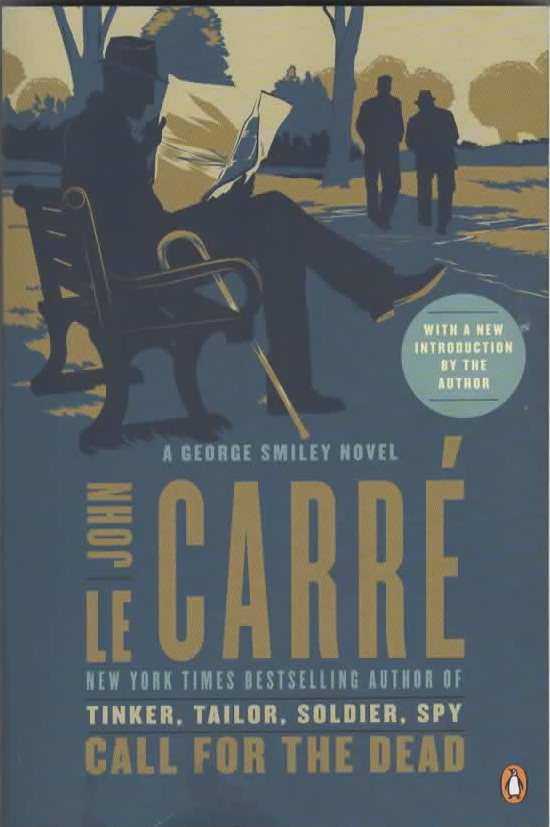
Loȉc drew my attention to Call For The Dead (1961: JLC’s first novel) for insights into one aspect of the plot. I do not believe I have ever read it: I have acquired the book, and am addressing that oversight right now. Yet he also suggested that A Legacy of Spies clears up some of the loose ends of Tinker, Tailor, Soldier, Spy. I shall have to re-read that work. And how much should we rely, in trying to understand the role of the mole, and Smiley’s reactions to his existence, on the predecessor novel that introduced Mundt, The Spy Who Came In From The Cold? (I have now learned that Mundt appears in CFTD, and botches a murder attack on Smiley.) I had noted in an earlier coldspur posting that JLC, when responding to a German reader who had pointed out flaws in the construction of TSWCIFTC, admitted that he and his publisher had not been thorough in working through the details of the plot. It is all very fascinating, and I plan to report more later in the summer.
The Zinoviev Letter
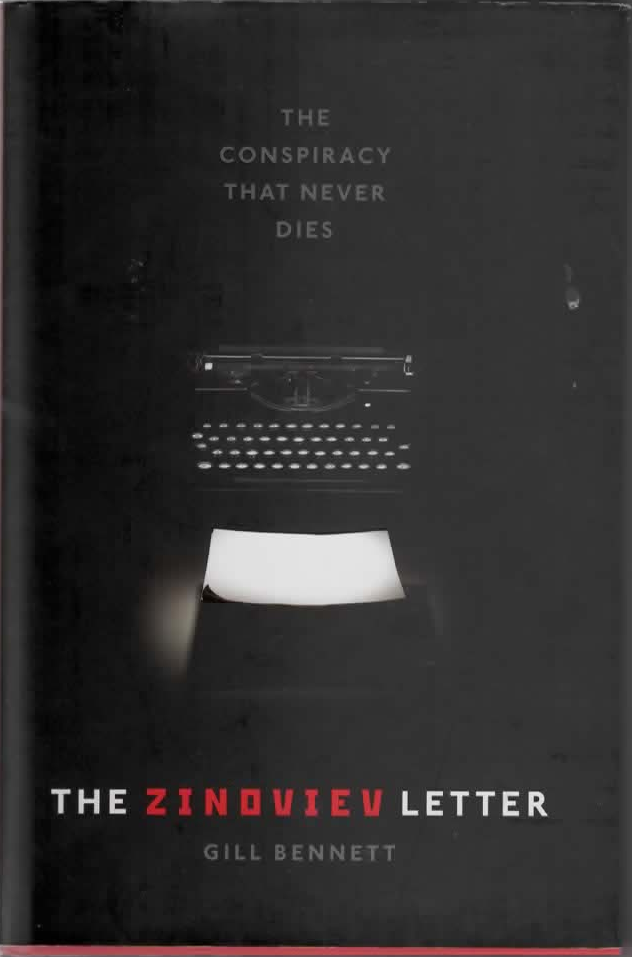
In my recent piece on official history (see https://coldspur.com/the-life-and-death-of-official-history/), I drew attention to Gill Bennett’s book The Zinoviev Letter. I had not read this, but had gained the impression, probably from reading an earlier article by Bennett on the subject, that Joseph Ball, ex-MI5 and Conservative Party grandee had been behind it – not responsible for its authorship, but surely assisting in its promotion and distribution to parties who might use it to help defeat the Labour Party in the elections of October 1924. Indeed, the Daily Mail publicized the letter, which purported to be from the hand of Grigory Zinoviev, head of the Comintern, and encouraged the British working-class to take up the Communist revolutionary cause. In the resulting public scare about Ramsay MacDonald’s appeasement of the newly recognized Soviet Union, the short-lived first Labour administration lost the election.
In the interests of thoroughness, and having been piqued by Bennett’s dismissal of ‘conspiracy theorists’, I thus acquired and read the book. It is subtitled ‘The Conspiracy That Never Dies’, and indeed, Bennett fails to stab the demon through the heart, and has to admit that, despite her intensive researches, and her former role as official destroyer of conspiracy theories, she still cannot identify the author of the letter. She concludes: “I really wish I did know, beyond doubt, who wrote the Zinoviev Letter, and the details of the political conspiracy surrounding it. For the story of the Zinoviev Letter is, above all, the story of a political conspiracy – and, as I know only too well from my career as an official historian, good conspiracies never die.” Thus the ‘gripping historical detective story’, as the book is described in its blurb, turns out to be something of a damp squib.
Yet it is another aspect of the discussion that interests me more. In his contribution to the blurbs, Christopher Andrew submits that the book is ‘a brilliant, gripping dissection of the most famous “fake news” in twentieth-century Britain . . .’. ‘Gripping’ is not a word I would have used here, but the analysis does bring up the important issues of ‘fakery’. Occasionally, on coldspur, I have brought up the important distinction between what is ‘genuine’ and what is ‘authentic’, although I confess that I have not always been consistent in using these terms. I have quoted before the words from page 216 of Robin Winks’ The Historian as Detective (1969), who, in turn cited Barzun and Graff:
Verification is required of the researcher on a multitude of points – from getting an author’s first name correct to proving that a document is both genuine and authentic *. Verification is accordingly conducted on many planes, and its technique is not fixed. It relies on attention to detail, on common-sense reasoning, on a developed ‘feel’ for history and chronology, on familiarity with human behavior, and on ever enlarging stores of information.”
[* Note: ‘The two adjectives may seem synonymous but they are not: that is genuine which is not forged; and that is authentic which truthfully reports on its ostensible subject. Thus an art critic might write an account of an exhibition he had never visited; his manuscript would be genuine but not authentic. Conversely, an authentic report of an event by X might be copied by a forger and passed off as the original. It would be authentic but not genuine.”] (Jacques Barzun & Henry F. Graff, in The Modern Researcher, 1957)
Thus one can start to classify various archival documents according to this scheme: examples of items that are Genuine but Inauthentic could be James Robertson’s memorandum about Borodin, Arthur Martin’s report on Blunt’s Confession, or the Government White Paper on the Escape of the Missing Diplomats, where the authorship is clear and undeniable, but the underlying ‘facts’ revealed are untruths. An Ungenuine (or Fake) example could be the release of ULTRA information to the Soviets, where the underlying facts are true (even though massaged) but the carrier or source is Ungenuine. Not that exclusive lines can be drawn: one might say that Kim Philby’s memoir is Genuine (though influenced by the KGB), while his text contains large chunks of Authenticity, sprinkled with large dollops of Unauthenticity. Alexander Foote’s memoir was ghost-written by Courtenay Young (and thus Ungenuine, even though Foote may have approved of most of it), while the underlying text was almost wholly Authentic (apart from such equivocations as fixing the identity of ‘Lucy’ Roessler). Many archival memoranda and reports look both Genuine and Authentic: the Zimmermann Telegram is a famous example of such. An obvious example of what is Fake and Inauthentic would be the Hitler Diaries that Hugh Trevor-Rope so ignominiously endorsed. Yet the key is for the detective-historian to work out when the author is dissembling, or concealing the truth.
I present a table to illustrate the idea:
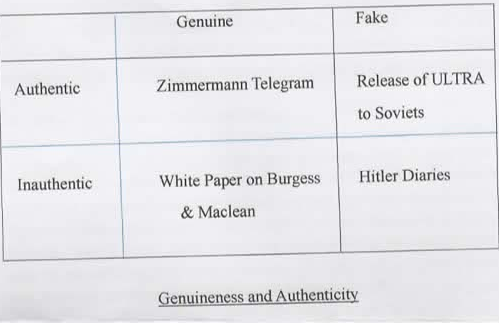
What surprised me about Bennett’s text, however, is the fact that she uses the terms ‘authentic’ and ‘genuine’ interchangeably. For instance, she writes (p 133): “Marlowe’s statement had said little on the matter of the Letter’s authenticity, other than that MacDonald ‘knew’ it to be genuine”, and (p 221): “He [Kozlov] did, however, draw an interesting distinction between different types of forged documents produced at that time: those which showed every sign of being genuine in both form and content, and those that were planted in newspapers as a form of disinformation, with little care given to whether they appeared authentic or not.” Thus, if there were useful observations to be made about the Genuineness of the Letter (did Zinoviev really write it?), and its Authenticity (did the seditious appeals really correspond to Comintern policy at the time?), they became lost in the muddle.
Ironically, some poignant twists did occur. On page 217, Bennett quotes the Russian historian Kozlov again: “While admitting that the content was an accurate reflection of the Comintern’s plans and objectives, he [Kozlov, in 1996] cited internal mistakes of style, terminology, and nomenclature as clear proof of forgery, and concluded firmly that ‘in the form in which the “Letter” was published and attached to the British Foreign Office’s official Note, it simply never existed’.” On page 148, she had cited Zinoviev himself: “After ‘examining the letter closely’, Zinoviev said that ‘he did not remember having actually dictated it, but that it so closely conformed with the general policy of the Third International towards Great Britain that he would certainly have signed it if it had been placed before him, but for the fact that it would obviously have produced difficulties.’” These items would tend to confirm that the format of the Letter had been faked, but that Zinoviev endorsed the opinions that it expressed. Holding those opinions, and promulgating them at such a sensitive time, are two very different matters, however. Zinoviev might not have appreciated such a distinction. Ms. Bennett’s conclusion would appear to be that the Letter was both a fake and inauthentic. I would agree with her. The examples of documents that have been forged but nevertheless reveal authentic statements are rare.
Colonel Spencer
One of the occasional rewards of writing coldspur is the receipt of email messages from persons who have spotted a reference in a bulletin to some relative, and who want to know more about him or her. A few weeks ago, I received a message from a relative of Colonel Edward Spencer DSO, OBE, LOM (USA). The gentleman (who wishes to remain anonymous: I shall refer to him as ‘Duncan’ hereon) had noticed in my report from August 2017 that I had written: “We owe it to West’s and Tsarev’s Crown Jewels (thanks to a leak from Anthony Blunt) to gain the information that Shillito left MI5 in October 1945, and was replaced by an officer named Spencer. Maybe he left in disgust, and did not execute a smooth handover.” I had not thought seriously about Spencer since, but I was about to have a refreshing awakening.
Duncan wrote of his relative: “He was a prominent British counterintelligence officer during the second world war – https://www.tracesofwar.com/persons/90417/Spencer-Edward-Leslie-Joe.htm. After the fall of Nazi Germany he was then recommended to MI5 for whom he worked as military advisor until 1954 having been recruited by Sir Percy Sillitoe (former MI5 DG) to work for the De Beers International Diamond Security Network, set up by Sillitoe to combat the illegal diamond smuggling rings across Africa.” Now that ‘Traces of War’ synopsis looked suspicious to me. There was no way that there could have been a British Intelligence presence in Berlin from February to April 1945, before the war was over. What was going on?
Duncan further regaled me with an article about Spencer’s time in Persia (now Iran), written by the highly respected Professor Adrian O’Sullivan. It has not been published, but it is based on a lecture which O’Sullivan gave to the Royal Society for Asian Affairs on November 15, 2016. It is titled ‘Joe Spencer’s Ratcatchers: British Security Intelligence in Occupied Persia’, and it indeed offers a stimulating account of Spencer, as Defence Security Officer for SIME, in rooting out various agents working against the Allied cause. In this endeavour, he came to work very closely with Alex Kellar of B Branch in MI5. Duncan also informed me that Ben Macintyre, in Agent Sonya, claimed that it was Spencer who interrogated Rudi Hamburger (Sonya’s husband) in Tehran and then subsequently handed him over to the Soviets when he finally admitted that he was a Soviet asset. (How could I have overlooked that?) Indeed, the whole story is laid out, derived from Hamburger’s file at KV 2/1610.
O’Sullivan ended his tribute by writing: “Because of his unique experience dealing one-on-one with the Russians, Joe Spencer went on to become chief of British counterintelligence in occupied Germany, after which he enjoyed eight years as MI5’s military adviser before retiring with an OBE. At the time of Joe’s retirement, one of his Tehran staff, Dick Thistlethwaite, who also went on to become very senior in MI5, wrote in a letter to Sir Reader Bullard, a distinguished member of the Society who served in Tehran as ambassador throughout the war, that the success of British security intelligence in Persia was ‘really due to a splendidly led but extremely small team, which it now seems to me had a remarkable esprit.”
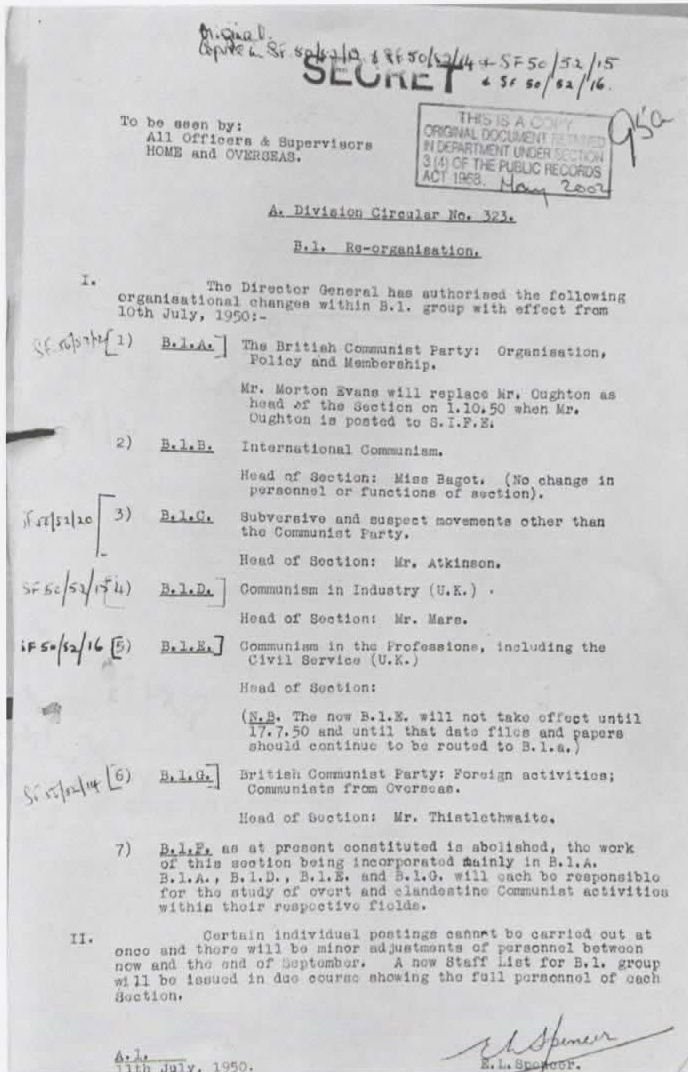
I started digging around. Within a few minutes I was able to locate an important artefact from the MI5 organization file, a memorandum actually signed by Spencer, at KV 4/162, page 35. It is dated July 11, 1950, Spencer is identified as ‘A1’, and the memorandum describes organizational changes within B1 that have recently been approved by the Director-General. Now A Division overall had administrative responsibilities, but also ran the highly important and sensitive surveillance operations. Spencer was not head of A Division, a post held (probably) by Charles Butler at the time. I wrote to Duncan, suggesting that Spencer, if he had replaced Shillito, with his vast experience would surely not have tolerated working for Hollis for long. And then, a few weeks later, I found two valuable references in Liddell’s diaries, in the entries for August 26 1944 and for September 17, 1945.
The first is a long entry that must have fuelled key pieces of O’Sullivan’s paper, and it describes a meeting held between Liddell, Spencer (then with CICI, the Combined Intelligence Centre Iraq), Harry Allen, Roger Hollis, and Alex Kellar, now transferred from SIME into MI5. The second, in the immediate wake of the Gouzenko affair, shows Liddell having a discussion with Spencer, who is indeed described as ‘taking over F.2B and F.2C’. Liddell adds: “He has been informed about the MAY case but John Marriott will continue with it any rate for the present.” It was this role (F2B being Milicent Bagot, working on International Communism, F2C Hugh Shillito, monitoring Soviet espionage) that must have given rise to the family rumour that Spencer was for a short time head of Soviet counter-espionage. In fact, Duncan learned from MI5 that Spencer had been recommended for employment in MI5 when still in the Army (no doubt by Dick White), but was not appointed to the permanent staff in May 1946, after which he worked in the general service branch (i.e. A Division) for most of his time in MI5.
What I found provocative were Spencer’s awards. The DSO was clearly merited. The Legion of Merit citation reads as follows: “For exceptionally meritorious performance of outstanding service as Assistant Chief of Staff, G-2 (Br), HQ Berlin District during the period 19 February 1945 to 28 April 1945, as a Chief, Counter-Intelligence (Br) thereafter to 10 May 1945.” That phrasing erroneously suggests that Spencer was based in Berlin at the time, which is ridiculous, since the war was not over. Spencer must have been working out of (probably) Nenndorf, planning the FAUST operation, which infiltrated German POWs into Berlin. It sounds as if he did his job well, which was to be expected, but it lasted only for three months. Maybe that was all you had to do to earn a LOM, but I find it rather puzzling.
The other interesting award is the OBE granted on June 1st, in the Coronation Honours list of 1953. What had Spencer done in those few years with MI5, when his duties appeared to be mainly administrative? Being a ‘military advisor’ to MI5 hardly cut it. Duncan’s information gained from MI5 declared that Spencer ‘was promoted to senior officer in 1951 and was posted to the protective security branch in 1954’. Yet that latter role took place well after the OBE award, and Spencer resigned that year because he said he had found another position with better pension arrangements. The true story may have to come from Duncan and his family: remember that Duncan informed me that Spencer ‘had worked for the De Beers International Diamond Security Network, set up by Sillitoe to combat the illegal diamond smuggling rings across Africa’.
That was a new one on me: where was the substance? Of course, Wikispooks came up with an answer: “The International Diamond Security Organisation (IDSO) was set up in 1953 by Sir Percy Sillitoe at the behest of De Beers to tackle diamond smuggling, using ambushes, death squads, and torture. Based in South Africa, Sillitoe’s IDSO commissioned a private army to penetrate and topple the ‘million-carat network’ – the world’s most notorious diamond smuggling ring. When IDSO’s operation was complete, the Sunday Times gave the story to Ian Fleming, who had impressed Sillitoe with his first Bond adventure Casino Royale [the Wikispooks entry actually gets the title wrong here]. Fleming was contacted by an IDSO agent, John Collard, whom he met in Morocco. The result of their conversations was a series of newspaper articles about the ‘million carat network’, a book, The Diamond Smugglers, and the James Bond novel Diamonds are Forever (1956).” How much of that is true? I have no idea. But Sillitoe was obviously a dark horse, and Spencer’s OBE may have been awarded for helping with some unpleasant ‘wet jobs’. John Collard was a solicitor who worked for MI5 – no apparent OBE for him. I described some of his activities in my coldspur report of February of this year, when he was an officer in C2 helping with the Fuchs/Peierls inquiries of 1948.
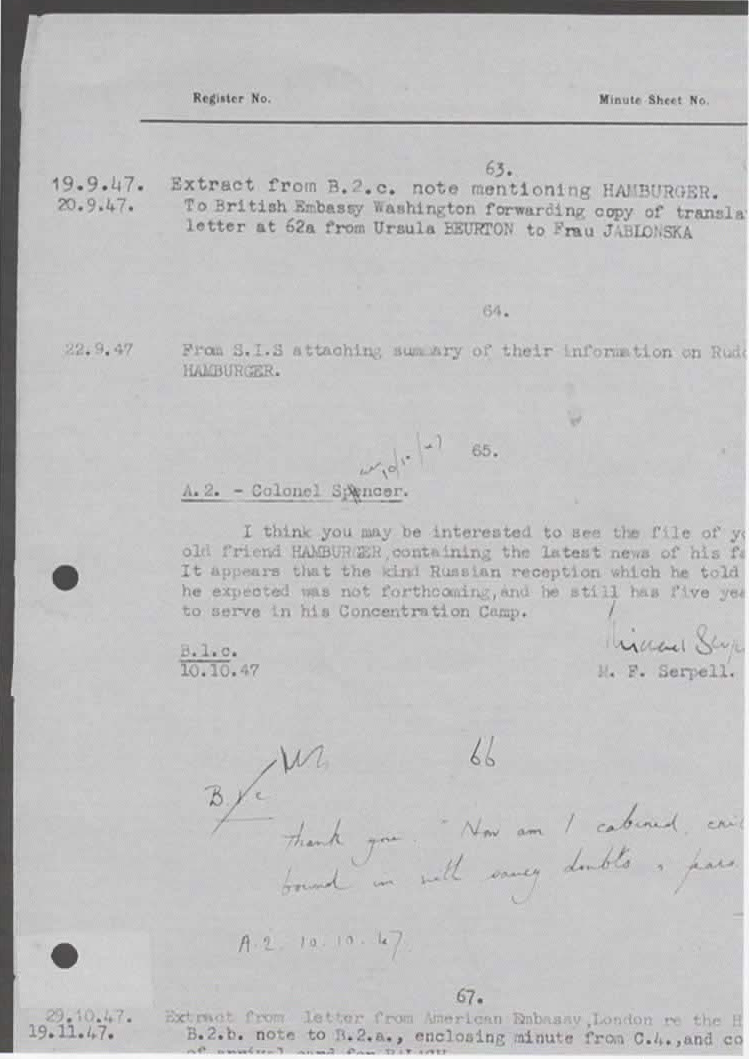
I discovered two last Spencer artefacts. The first was a brief mention, in David Tremain’s recent book on Gouzenko and Nunn May, Fallout, where Spencer (back as C2) in early 1954 was rushed to the Passport Office to discuss Nunn May’s passport application. I found the second in KV 2/1610. Michael Serpell, of B1c, wrote to Colonel Spencer (then A2, a more significant post) on October 10, 1947, saying: “I think you may be interested to see the file of your old friend HAMBURGER containing the latest news of his fate. It appears that the kind Russian reception which he told you he expected was not forthcoming, and he still has five years to serve in his Concentration Camp”. Spencer offered a brief handwritten reply: “Thank you. ‘Now I am cabined, cribbed, confined, bound in with saucy doubts and fears’.” I did not recall this line, but as many readers will know, it is from Macbeth, where Macbeth learns that, while Banquo has been killed, his son, Fleance, has escaped. (It should be ‘bound in to saucy doubts’, by the way.) Is Spencer here lamenting the fact that Hamburger’s first wife, Agent SONIA, is still on the loose? Answers on a postcard, please.
John Cairncross and the Sicherheitsdienst
I was contacted several weeks ago by an enterprising young German with the name of Andreas Franck. He had been researching some family history from the pre-war years in Vienna, and he had stumbled across Kendrick and his network, which in turn led him to some of my research on coldspur. Andreas wanted to draw my attention to a fascinating item that had recently been digitized and posted to the German Foreign Office Archives (‘Politisches Archiv des Auswärtigen Amts’). It specifically referred to one Caincross [sic], and can be seen on digital pages 4-14 at the following url:
https://politisches-archiv.diplo.de/invenio/direktlink/7495f2e8-335b-4589-9833-96545367ae79/. Even though his full name is not given, and his surname is mis-spelled, it is clear from a brief description of his background on page 12 that John Cairncross is the man identified. The note mentions his studies in Cambridge and Paris, his humble family background, as well as his entry into the Foreign Office in 1935.
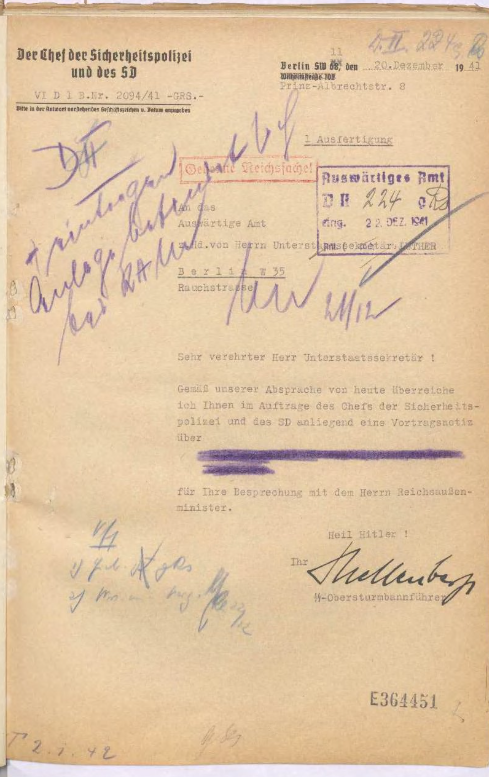
The nub of the story runs as follows. It takes place towards the end of 1941. Through a French intermediary, a friend of Cairncross’s who was reputedly working undercover as a V-Mann (‘Vertrauensmann’ = trusted agent) for the Sicherheitsdienst (SD), Cairncross made a peace overture to the Germans. Cairncross claimed that he was secretary to Samuel Hoare, the British ambassador in Madrid. According to the documents, the informant, named Robert Dubosq, had had several meetings with Cairncross in the preceding months, and was able to report that Hoare was part of a cabal that hoped to bring down Churchill in a vote of confidence motion, and to replace his administration with a group keen to stop the war with Germany. Lord Beaverbrook was also stated to be a member of this circle. Walter Schellenberg, foreign intelligence chief for the Sicherheitsdienst, was interested enough in this approach to want to pursue it, and he eventually brought it to the notice of Hitler. Yet the Führer squashed the whole initiative early in 1942.
What to make of this extraordinary tale, that of a spy for the Soviets sent on a mission to negotiate for peace with the Germans? The German documents look genuine and authentic. Cairncross as Hoare’s secretary appears highly unlikely, however. Even though there are large gaps in the published records of Cairncross’s actions during this period (i.e. from the two biographies of him, and his ghosted autobiography) there is no evidence of his presence in Madrid, or of his undertaking the missions abroad that the German files ascribe to him. Moreover, the description given to Schellenberg of Cairncross’s career indicates that he was detained and incarcerated for a while after Churchill’s accession in May 1940, because of his pro-Nazi beliefs. That embellishment was surely absurd, and it must have been invented to boost the character’s credentials in the eyes of the Germans. The Cairncross files from the National Archive offer nothing for this period: he had come to MI5’s attention because of his actions helping a Belgian communist enter the country, but there was nothing else to work on.
Cairncross had been working for Maurice Hankey, a close friend of Hoare’s, at this time. Andreas very diligently explored the files on Hankey, Paymaster-General in Churchill’s administration, but no longer a member of the Cabinet, who expressed some strong disgruntlement about Churchill in letters to Hoare. He found enough to show that Cairncross had been active in Whitehall at the time in question, sometimes signing letters under his own name, at others drafting correspondence for his boss’s signature. Thus someone else must have been masquerading as John Cairncross in Spain, using the name to give some form of verifiability, while believing that the ruse would not be uncovered by the Germans from London. The only other scenario would be the entry of an entirely different ‘Cairncross’ into the picture – a highly unlikely set of circumstances.
‘Cairncross’ was insisting on strong privacy during any possible encounter. Yet the Germans were beginning to have doubts about his authenticity. A report from Under-State Secretary Luther on January 2, 1942 noted that the British Foreign Office listed him as an embassy secretary, but it added that his name did not appear in the rolls of the British Embassy in Madrid. Nevertheless, Schellenberg forwarded his report to Hitler, who immediately expressed his scepticism about the claims in it, and ordered the operation to be suspended until he was able to consult with Foreign Minister Ribbentrop, who was in Hungary at the time. That move by Schellenberg was untimely, and Hitler’s tentative response is also surprising. For Japan had attacked at Pearl Harbor on December 7, and Germany had declared war on the USA four days later. With the Axis powers now extended, and a new enemy to confront, it was not an auspicious moment to respond to an unofficial peace initiative from Great Britain.
Indeed, a further note from Luther, dated January 19, 1942 reported that the Foreign Ministry had requested of him that no further action be taken on the opportunity. Some desultory follow-up did indeed reveal that ‘James Creicross’ was registered with the police in Madrid, and that, when he arrived in Madrid in 1940, he initially stayed at the Ritz Hotel before finding his own apartment. On February 17, Luther put out a final message requesting that Schellenberg be informed of the fact that the Madrid Embassy had been instructed not to take any further action in the Cairncross business. That suggests that Schellenberg had not been very closely in the loop, in any case. (He wrote nothing about it in his Memoirs.) By this time, however, Churchill had easily survived a vote of confidence in the House of Commons, so the enthusiasm of Hoare and his collaborators must surely have waned.
So who was the diplomat masquerading as Cairncross? I wondered whether a candidate might be Viscount Astor, who had been Hoare’s Private Parliamentary Secretary in 1937-1938. Astor was also a firm appeaser. (He inherited his father’s peerage in 1952.) Could he have joined his former boss in Madrid, and necessarily wanting to conceal his real name, masqueraded as John Cairncross (except in the Embassy itself) when he established himself in Spain in 1940? I showed this piece to my expert friend Richard Davenport-Hines: he knew much about Astor, since he had worked on the Astor papers, and had had contact with some of Astor’s surviving relatives. He thought it highly unlikely that he would engage in such subterfuge. So the search had to continue.
Moreover, we note an eerie parallel in such impostures. During the Venlo incident of September 1939, when the MI6 officers Stevens and Best were pursuing leads from a supposed dissident faction in the Wehrmacht, Schellenberg had himself adopted the persona of a real official, Hauptmann Schaemmel, and he made sure that the latter was dispatched to the East during the operation. Schellenberg successfully organized the abduction of Stevens and Best.
What was going on here? We have several questions to answer:
- From where did Luther gather his information that Cairncross was listed as an Embassy secretary?
- Who was Hoare’s private secretary in Madrid?
- Was it that person who decided to impersonate Cairncross?
- What was the true role of Dubosq?
- Did Hoare truly try to reach out to the Germans for a peace deal?
- Did Hoare and Hankey intrigue over the abuse of Cairncross?
- Why did Hitler need to consult Ribbentrop, and why did he not dismiss the approach immediately?
In recent weeks, Andreas has been very resourceful in trying to track down members of the Embassy in Madrid in World War II. He came up with a list of potential Cairncross impersonators: Michael Cresswell, Anthony Nutting, and a Mr Reed, which offered some promising leads to follow up. Andreas was even planning a visit to the UK, to the National Archives at Kew, and to Churchill College, Cambridge, in order to dig more deeply into the goings-on in the Embassy in Madrid. And then I came across an utterly serendipitous reference. I had recently read Airey Neave’s Saturday at M.I.9, where he writes extensively about ‘Monday’ (actually Michael Cresswell) on the COMET escape route to Madrid, but never identifies him. He is, however, named in Foot’s and Langley’s history of MI9, where the authors state that ‘Henry Hankey, son of the former Secretary of the Cabinet’ assisted Cresswell. Hankey’s own son a member of the Madrid staff! That was exciting.
Given Cresswell’s sensitive involvement with the MI9 escape-line, and the fact that the Foreign Office/MI6 had plans to send him to Mexico (which he thwarted), Andreas and I agreed that Cresswell would have been a very unlikely candidate for breaking his cover to deal with the Abwehr. Andreas again very industriously dug up fresh information on Henry Hankey by returning to Roskill’s biography of his father (which I have read, and made notes on, but do not own). He learned that Henry was attached as a Second Secretary in the Madrid Embassy from the fall of France until the end of the war, and Andreas thus returned to the quest freshly energized. He accomplished his research visit to the UK in the middle of this month, and returned to Germany with a host of valuable photographs of archival material. So far, Andreas has been able to inform me that (according to the Hankey papers in the Churchill Archives) Henry Hankey probably did not arrive in Madrid until November 1942, and thus should be discounted. (But was that entry inauthentic, I wonder, given the gobbet that Franck uncovered earlier?) Otherwise the spotlight turns back on Nutting . . .
I shall provide an update in due course.
Philby’s Bigamy
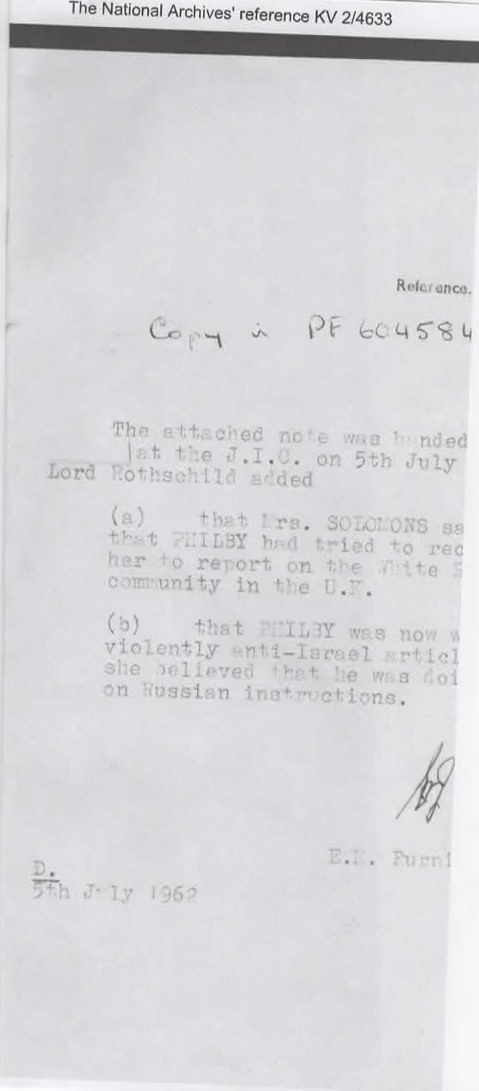
I have previously written extensively as to why I believe that Kim Philby’s marriage to Aileen Philby (as she had by then re-named herself by deed poll), née Furse, in September 1946 was bigamous. See https://coldspur.com/a-wintry-miscellany/ from December 2023. Recently, one sharp-eyed correspondent drew my attention to something relevant that I had overlooked. It appears in the Philby (PEACH) PF at KV2/4736 sn. 707a, and it consists of a note that was passed to MI5’s Director-General Roger Hollis on July 5, 1962. Martin Furnival Jones (‘D’) appended a brief memorandum about the incident, where the source of a tip has been redacted. The wording of Furnival Jones’s text suggests that Lord Rothschild was at the gathering where the transfer occurred, and that a general discussion may have taken place. The tip described in the original memorandum declares that Flora Solomon ‘has now told Victor Rothschild that she knew that Philby was working for the Russians at the time of the Spanish Civil War’. Furnival Jones writes that Rothschild ‘added’ two points concerning Solomon: i) that Philby had tried to recruit her; and ii) that Philby was now writing violently anti-Israel articles, presumably on Russian instructions. The implication (Furnival Jones’s note bears the same date) is that Rothschild orally augmented the account at the meeting.
Was Rothschild the donor? Apparently not, since the text of the note asserts that the author has since ‘discussed the above case with V.R.’, who recommended that he (Rothschild) interview Solomon, as she would not take kindly to a formal interview by an MI5 officer. The author adds that Solomon had already introduced Philby’s case to Rothschild, representing Philby as ‘currently an enemy of the State of Israel’, because of the articles he was ‘now writing’. Now this incident could be interpreted as Rothschild being flushed out, after which he tried to regain control of the situation. Had the mystery informer also been told by Solomon about her evidence on Philby, and was she annoyed that Rothschild had done nothing? That may be a discussion for another day.
I had described this incident in my piece about Flora Solomon three years ago, at https://coldspur.com/the-folly-of-solomon/. Rereading it recently, I must admit that I had forgotten much of what I had written, but I also acknowledge that I severely misrepresented some of the details of the episode. I did, however, draw attention then to Solomon’s monstrous mendaciousness, and the feeble attempts by MI5’s Arthur Martin to take advantage of the wild inconsistencies in her story. Yet I also overlooked at that time an enormous anomaly in the story. Rothschild makes his claim that Solomon has expressed to him her dismay over the articles on July 5. Yet the Observer article photocopied – and in the Philby file, but not the Solomon collection! – is dated July 22, and it appears to be an introduction to a series by Philby, since it celebrates the tenth anniversary of the Egyptian Revolution, which did indeed occur on July 23, 1952. Moreover, in her memoir Baku to Baker Street, Solomon recalls appealing to Rothschild at a chance encounter in Rehovot, Israel in August 1962! Now Solomon might have got the month wrong, but there is no mention of the pair having recently met in Israel when these records were laid down.
It was then that my hunch was reinforced that the whole episode had been manufactured by Dick White and Victor Rothschild, with Solomon’s compliance, to provide an alibi for the ‘proof’ they needed that Philby had been (and may still have been) a Soviet spy. At the end of May, having inspected closely the interrogation reports of the defector Anatoly Golitsyn (known as KAGO), Furnival-Jones and his team were convinced that Philby was the counter-intelligence officer that Golitsyn knew about, but could not name (based on the evidence from the would-be defector Volkov). Thus they set about creating a fiction that would unmask Philby but conceal the source. Yet how did Rothschild know about anti-Israel articles as early as June? (I have checked out Observer articles by Philby in the first half of 1962, and there is nothing overtly anti-Israeli to be found – certainly nothing ‘violently’ so. And it consists of a massive stretch to conclude that, since an article expressed mild support for Nasser, it was therefore violently anti-Israel, and therefore Philby must have been writing on the instructions of Moscow! Solomon’s ‘evidence’ is strongly inauthentic. This confirms the exercise that Palliser of MI5 carried out in 1971, as is shown in the file.)
The most fascinating feature of the note is, however, that, in sketching out who Flora Solomon was, the author has written: “Certainly responsible for introducing Aileen and Kim Philby, and was a witness with Thomas Harris at their alleged marriage.” (This is what my colleague had spotted.) An ‘alleged’ marriage? I had not noticed that before. So who was the sceptic who had enough knowledge to want to insert such a challenging statement? Moreover, on the note itself, someone has inscribed, opposite the ‘alleged marriage’ clause: “This was a genuine marriage in 1946.” Who was the officer who had such confidence in the facts that he or she would choose to correct this vital testimony?
I noticed that, in Furnival-Jones’s note, the details about the circumstances of the episode had been redacted. I thus went back to the original, in Flora Solomon’s file, and discovered an intriguing distinction. The two items appear as sn. 57a in the file, KV 2/463-1, but Furnival Jones’ note has not been so stringently redacted. Here it is quite clear that the meeting was held by the Joint Intelligence Committee, with very little space having been allowed for the identification of the informant (see Figure below). Obviously someone decided that recording the group setting might give dangerous information away, and that person redacted the version destined for Phiby’s file while forgetting about its counterpart chez Solomon.
Now I do not believe that there could have been many persons on the JIC who would have been even vaguely familiar with the details of the Philbys’ marriage ceremony. The heads of the three Intelligence Services were no doubt present, Clive Loehnis (GCHQ), Roger Hollis (MI5), and Dick White (MI6). Hollis is exempt since he was the recipient: Rothschild because the note refers to him specifically (although he may not actually have attended the JIC meeting, but might have been engaged in the discussion immediately afterwards). The brief space for the informant leads me confidently to the fact that the person reacted was “C”, namely White. White, having discovered that Philby had been re-hired by MI6 since he became its head, and spurred by the Golitsyn disclosures, must have thought it was time to flush him out again. It looks as if White and Rothschild conspired to involve Solomon in an intrigue, and then decided to present it to the members of the JIC. Moreover, White did it in dramatic fashion, not simply having a discrete chat with Hollis, but bringing it up at an important meeting, where Rothschild might possibly have played the role of a convenient foil.
How to interpret both those observations? My correspondent and I agreed that the only reason for saying ‘alleged’ was that the writer believed either that no ceremony took place, or that a ceremony that did take place was invalid. We know that the event happened: the marriage between Harold Philby and Aileen Philby is registered as taking place at Chelsea Register Office on September 25, 1946, and Flora Solomon and Thomas Harris are recorded as acting as witnesses. Another item in Solomon’s file, at KV 2/4633, sn. 11z, records an extraction of the marriage certificate, dated June 9, 1951, (as preparation for Dick White’s interrogation of Philby) indicating that Solomon and Harris were ‘present’ at the marriage. Of course (as my correspondent has reminded me), their role as witnesses did not require them to testify to the legality of the arrangements, but simply to witness that the procedure was carried out.
A corresponding entry can be seen in the Philby file. On that same day, June 9, 1951, D. Storrier of B5 compiled a report on the Philbys for Ronnie Reed of B2A (see KV 2/4723 sn. 10a), in which he stated: “A copy of the marriage certificate between Harold A. R. Philby and Aileen A. Philby has been obtained and is attached”, but a handwritten note of January 7, 1970 informs us: ‘marriage cert. which was attached has been transferred to current vol. [?]’. Furthermore, a note further records that, on August 1, 1947, H. Hunter in B42 had written to Roger Hollis (sn. 8B) stating: “We have examined a marriage certificate today at the Chelsea Register Office which shows that H. A. R. Philby and a woman of the same name (changed by deed poll) were married on September 25th 1946.” It adds that the certificate stated that the bridegroom’s former wife was named Alice Philby, formerly Alice Friedmann. (I have one of my best agents in London currently tracking this document down with the goal of securing a copy.) A solitary, unsigned note appears here, too, indicating that the Philby divorce had been made absolute on September 17, but it enigmatically does not indicate in which city or country the action was taken.
These records suggest some further questions. First, what had prompted Hollis on that date to request an inspection of the marriage records? Was it the breakthrough in verifying the details of Philby’s first marriage [see below]? Did he harbour some doubts about the ceremony’s legality? If so, why? And was the interval between the issuance of the divorce decree and the marriage itself unrealistically short, given the requirement to establish the bona fides in advance of the marriage ceremony, and the fact that the divorce had taken place somewhere in central Europe? (In 1953, Evelyn McBarnet of D2B added a note that explained that the original marriage in Vienna had been impossible to trace in 1947, since Philby’s name had been registered with the Viennese authorities as ‘Russell’ – his third Christian name. Thus it must have taken a very resourceful and accommodating public servant, wherever he or she officiated, to solemnize the quickie divorce that Philby claimed had taken place.) Moreover, one might question whether a marriage certificate would contain details about the name and status of the groom’s former wife. Philby must surely have had to offer evidence that his divorce had been finalized, but would that data be reproduced on the certificate? So why was all this evidence removed to another file, away from inquisitive eyes? In conclusion, why would White suddenly suggest that the evidence that Hunter discovered was false? It all suggests that something untoward had been going on.
As for the officer who wanted to correct the record, it must surely have been Graham Mitchell, head of D Section at the time. I am sure there was nothing underhand about his action: there would be no point in his coming to Philby’s defence. He merely adopted a rather naïve view of the proceedings. Nevertheless, since there was plenty of evidence on file that an official ceremony had taken place, one has to wonder why did he not use more imagination in trying to devise what the source meant by ‘alleged’? Did he perhaps approach White about it? It would have been the sensible course of action.
Yet, after my fresh analysis of the archives, I conclude that the whole process is even more bogus than I first thought. While both Victor Rothschild and Arthur Martin interview Solomon, neither of them questions her about the legitimacy of the Philby wedding ceremony. Martin and Solomon discuss it briefly, and Solomon acknowledges that she was a witness, but the delicate matter at hand is simply avoided. Either Rothschild and Martin did not know about the allegation (which makes no sense at all, given Rothschild’s contributions to the White note), or they all knew about it, and had vowed to keep it a secret. Moreover, in the transcript of the Martin interview (which took place on August 1), Solomon frequently refers to her recent approaches to Rothschild (one by telephone). Her visit to Israel took place after that – and that is why the date for Martin’s interview is misleadingly given as September 22 in a couple of places, to suggest that the disclosures did actually take place while she was in Israel. Solomon had been talking to Rothschild in late June. But did she approach Rothschild on her own accord, and, if so, why then? Or did Rothschild actually contact her to inveigle her into the plan he had cooked up with White?
Moreover, the whole process of wanting to give Solomon a pretext for going to Rothschild with her suspicions about Philby seems rather pointless. Whom were White and Rothschild trying to convince concerning Philby’s guilt? The JIC? Hollis? The Director of Public Prosecutions? Since they surely were not thinking about bringing Philby back to the UK to face a trial, I interpret it solely as a gesture toward posterity to conceal what they had learned from Golitsyn. And, indeed, it was successful. Christopher Andrew swallowed the whole story (see p 435 of Defend the Realm), where he describes the ‘chance meeting’ that Rothschild and Solomon had in Israel, and how what she disclosed to him enabled Nicholas Elliott, ‘armed with this information’ to fly out to Beirut to confront Philby. What nonsense! Why would Philby have been shattered by suggestions that his recent articles were anti-Zionist? And why did White & Co. fumble the whole chronology so badly that their clumsy intrigues are revealed in all their absurdity?
My final thought thus lies with White. If he was ready to stick his neck out in 1962 about the doubts surrounding the legitimacy of the Philbys’ wedding, he should have been prepared to be challenged as to where his intelligence derived, and why he had not spoken up before. The situation resembled Solomon’s reluctance to speak up about Philby’s spying earlier, ‘as she did not want to get involved’. Bigamy was a serious offence in Britain in the 1940s: in 1946, White might have backed up the deceit, however, because at that time he had had no suspicions of Philby, and an almighty stink would have resulted if it had it been publicized, with all manner of unpleasant facts coming out of the woodwork. In 1962, with Philby in Beirut, and White holding the position he did, he might have felt that he could impose more authority. For posterity, the ‘proof’ of Philby’s guilt was unconvincingly presented as driving from Solomon’s testimony to Rothschild concerning the ‘anti-Zionist’ articles, since the issues of attempted recruitment of Solomon, working for the Soviets in Spain, and an illegitimate marriage would have let in the sunlight on some murky goings-on in MI5 and MI6.
Thus it would have suited White to support this rather weak argument. Yet might the threat of being exposed as a bigamist have perturbed Philby even more than being branded as a spy? That might have pushed him over the edge, not wanting to return to the UK to face his family in defending such a charge. And perhaps White even nudged Solomon to leak to her Soviet friends what was going on. Yuri Modin was noticed travelling to Beirut that summer, as if he had been given a tip-off. Remember that Lord Strang had also voiced the opinion that the best outcome for the Foreign Office, MI6 and MI5, so far as Philby was concerned, was for him to debunk to Moscow like his predecessor fellow-agents . . .
And the certificates confirming the Kim-Litzi divorce remain obstinately elusive. I offer £100 to the first person who can provide an image of them, with details of date and location.
‘Saturday at M.I.9’
As part of my research into Peter Baker, the enigmatic and irresponsible British intelligence officer from operation Market Garden, I found that a reference to his misdeeds was to be found in a memoir written by his boss, Airey Neave. The book was called Saturday at M.I.9, ‘Saturday’ being the cryptonym for Neave in his role organizing the escape lines for Allied servicemen from (primarily) France, Belgium and the Netherlands in World War II. I accordingly bought it, and read it, so that I might conclude the second part of my research into The Traitor of Arnhem.
I imagine most Britons of my generation are familiar with Airey Neave. While a Member of Parliament, and a leader in Margaret Thatcher’s opposition administration, he was killed by an IRA car-bomb in March 1979. Last year, I belatedly read his memoir They Have Their Exits, which described his attempts to escape from German prison-camps, culminating in a daring success at Colditz Castle. He then had a successful period setting up the lines, which required an astonishing amount of risk and self-sacrifice on the part of the local citizens who were willing to help smuggle the grounded aviators and prisoners-of-war across France and the Pyrenees (mainly) to the safety of Spain, and then Gibraltar.
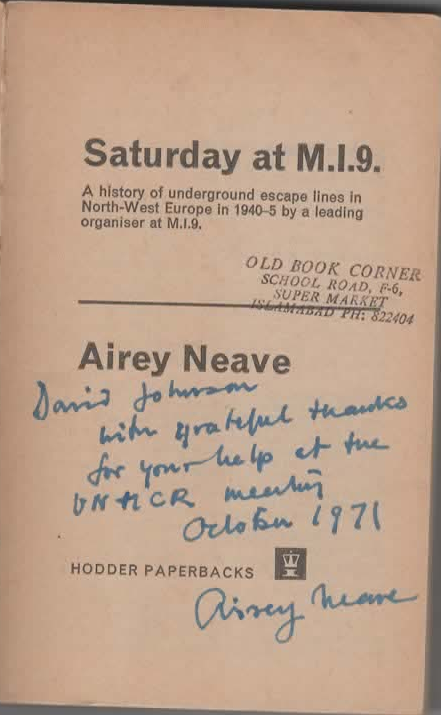
I found a copy on-line from a bookstore in Dallas. I was delighted to find that Neave had written a message, to a David Johnson, and had signed the cover page (see above), which made the item an even more valuable part of my library. Moreover, I was astonished to see that the copy of the book had passed through The Old Book Corner, on School Road in Islamabad. Does that shop still exist? How on earth did the book reach there, and how did it come to the USA? Presumably Mr Johnson had not treasured his gift so much as to want to hang on to it. I cannot see Airey Neave donating a book acquired from such a source, and it is a bit surprising to me that he could not have rummaged around to find a copy of the original Hodder & Stoughton hardback edition published two years before the paperback edition, in 1969. Johnson cannot be the Queen Mary College historian of that name who has contributed to a podcast titled ‘Conservative Lives Cut Short’, since he is far too young. I cannot quickly identify a David Johnson involved with UNHCR in 1971. No matter.
Saturday at M.I.9 is quite a gripping read. As I explained in my last coldspur bulletin, Neave chose to be very cagey in not identifying Baker by name when he described the misdemeanours of his agent codenamed ‘Harrier’ after the Arnhem debacle. “Alerted by the capture of Harrier, the Gestapo had arrived in Tiel and were said to have shot twenty members of the Resistance”, Neave writes. Thay may not have been all. The author had, however, already related some of Baker’s earlier exploits while working for Neave’s I.S.9 (W.E.A.) unit. This was obviously a very sensitive affair, and I wonder whether Baker was awarded his Military Cross to cover up any rumours of betrayal. Another murky business.
One other incident caught my eye. On page 186, Neave describes the almost disastrous events when an escapee, Windsor-Lewis, of the Welsh Guards, was sitting in the back of a car being driven by the heroine Mary Lindell, with a German Kommandant next to her. (You’ll have to read the book to learn how they got there.) Lindell explained that the man behind her was her rather dim-witted mechanic. As she pointed to him, she noticed that the badge of the Welsh Guards was tattooed on his forearm, and was showing. Fortunately the Kommandant did not notice. But was that absurd practice standard? Did no one think that, if war came, and a member of the Guards were captured, and then tried to escape, any attempt to conceal his identity would have been destroyed? Quite extraordinary.
Inconclusive History
I received a few very complementary comments on my recent posting on the VENONA project. One of my correspondents put me slightly on guard at first: he described it as ‘monumental’. Now that may have been akin to a book reviewer’s classifying a work as ‘magisterial’ – not necessarily a compliment, but suggesting perhaps heaviness and pedantry. I wondered whether my reviewer was perhaps thinking of Mount Rushmore, namely something in poor taste, over-the-top, and out of place. I thus tentatively asked him whether that was the monument he had in mind. I was gratified and amused to learn that he understood my allusion in exactly the way I intended it, and he assured me that he was impressed with what I had achieved.

I have not yet received any challenges to anything I wrote. That could be for a number of reasons, of course. But I am very interested in learning where I may have gone wrong in my exposition and conclusions. One prime example might be that I have overlooked some important work, or archival material. Another might be that I have misjudged the sincerity and integrity of some of the players, and I should thus weigh their separate contributions differently. I might well have stumbled over some basic cryptological processes, since I admitted I did not know what ‘classical cryptological techniques’ were. Whatever fresh input arrives in my Inbox, I shall be energized to pick up the threads of any debate.
Yet it overall saddens me that I do not believe we are ever going to get a ‘definitive’ history of VENONA (not that I applaud that term, of course), and the best we can get is an ‘inconclusive’ one – since the possible opposites of ‘definitive’, namely ‘non-definitive’ and ‘indefinitive’ appear to be neologisms. I immodestly believe that my account is more useful than anything else that claims to cover the same territory. At the same time, however, it is surely ‘inconclusive’, since I raise too many questions, and historians are supposed to answer more questions than they pose. The participants (whose testimony cannot be unconditionally trusted, of course) are all dead. It is possible that hidden archival material may be released that would shed light on some of the secrets, but I expect the guardians will want to keep such items under wraps, and, unless the public at large knows of documents that exist – or did exist at one time, like the missing links of MI5 PFs that I regularly pick up and enter in my spreadsheet, no useful Freedom of Information Request is going to be raised.
‘Definitive’ history brings me back to one of my bugbears: the seal of approval that appears to come with the publication of an ‘authorised’ history. I have previously railed at Christopher Andrew’s invocation of such dubious works as Kim Philby’s memoir, and Peter Wright’s Spycatcher, in his history of MI5, since the historian never provided any guidance as to when such works should be trusted, and when not. I wholeheartedly harangued the genre of authorized and official history in my coldspur posting last January: I am sure my tirade did not go down well with the parties involved (if they bothered to read it, or even knew about it), but I would not expect any of my victims to try to defend themselves, and thus draw even more publicity to their undignified utterings.
Yet I encountered a fresh example recently. I had recorded in my January piece the rather sad way that Keith Jeffery’s History of MI6 was constructed. It does contain a truly sad aspect, because Jeffery was very ill as he tried to complete the project. (When I was completing my doctoral thesis, my supervisor contacted Jeffery in the hope that he might act as an examiner, but Jeffery bravely had to decline, telling Professor Glees that he did not have long to live.) Jeffery’s inability to attend to all the detail, however, resulted in a distressing episode. He included in his coverage of MI6 in wartime Scandinavia one version of the highly questionable accounts by Peter Falk of the purloining of documents from under the nose of the Abwehr officer Karl-Heinz Krämer at his Stockholm flat. He had no reader over his shoulder to nudge him about its accuracy, and he had clearly not inspected any of the source material himself (as I explained in my recent piece). One of the main planks in the article about Jeffery was that he was ‘a stickler for accuracy’, but here he fell down lamentably. Now that it appears in the ‘authorized’ history, however, the incident gains the odour of sanctity that comes with such publications. I know from experience: some correspondents have challenged me on my interpretation of events with remarks such as: “But I read it in the authorized history!”, as if the account they were citing must therefore be true.
Patricia McCallum’s Report
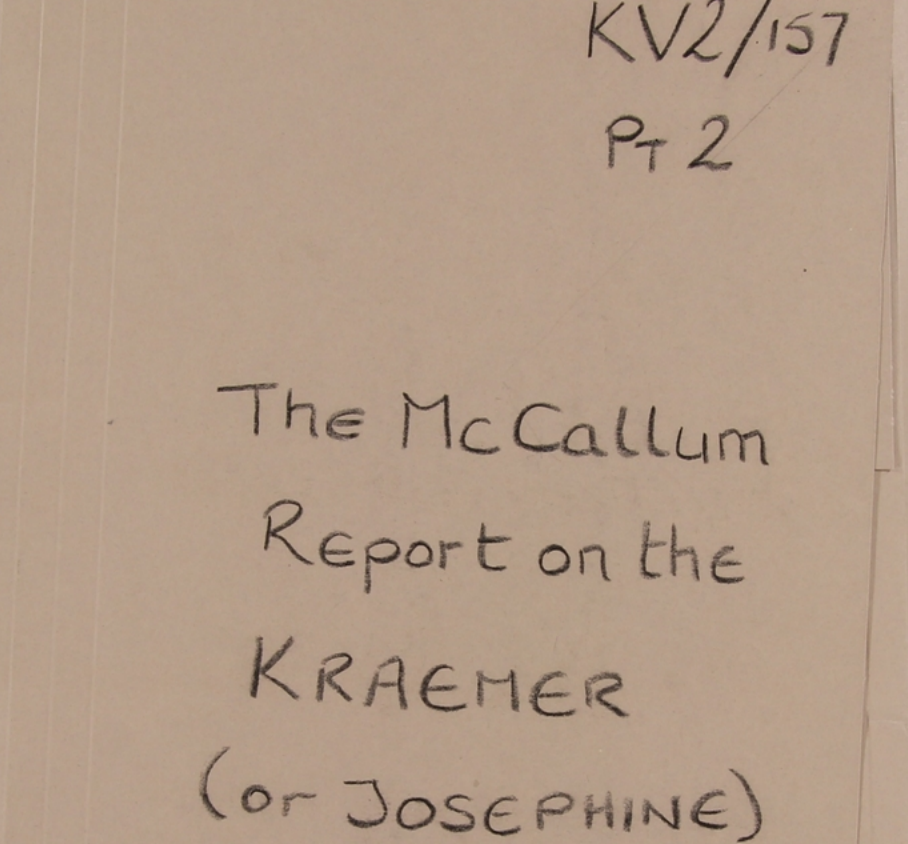
In my analysis of Verkaik’s Traitor of Arnhem, I had drawn attention to the fascinating and perplexing report, written by a Patricia McCallum, that appeared in the Karl-Heinz Kraemer Personal File. Who was she? And why had she been invited to undertake this project? Verkaik declares her to have been an SIS officer ‘who had served in the registry during the war’, and explains her engagement by the fact that MI5, in the 1970s, was so worried about JOSEPHINE that they commissioned the report. Why would the Security Service have been so worried about a possible spy some thirty years after the events? And why would it entrust the job to an unknown figure?
I quickly decided that this Patricia McCallum could not be the photographer of that name who married the actor Michael York, nor was she likely to have been closely related to the current head of MI5, Sir Kenneth McCallum (born 1974). But I did find, in the Staff Registry of MI5 for 1939, a Miss P McCallum, who worked in A3T. That would be a more likely match, and that remarkable resource, Phil Tomaselli, gave me further information from London. He confirmed the A3T membership (with ‘T’ standing for ‘Transport’), and added that she was born in 1904, was unmarried, worked as a VAD in a hospital in 1939, and had private means. Further, he stated that the number of female officers in MI5 has been understated, and many women were advanced through the ranks because of their analytical skills. Thus McCallum might well have been given such an assignment. Yet, if that were so, I would have expected her name to have turned up in some of the Personal Files in the 1950s and 1960s. (I shall have to take a sharper look-out in the future.)
Helen Fry makes no mention of her in her rather pointless book Women in Intelligence (2023), nor does Claire Hubbard-Hall in her similar production Her Secret Service: The Forgotten Women of British Intelligence (2024). Even Phil Tomaselli, in an article he wrote in 2023 for MAGNA, the Friends of the Archives magazine, fails to record her career. Obviously a more serious trawl through the archives is necessary to create anything approaching a ‘definitive’ record of such persons. In the coldspur bulletin of July 5, 2024 (see https://coldspur.com/summer-2024-round-up/ ) , I offered a review of Fry’s book, and suggested a number of names who should be added to the roster. In Patricia McCallum we clearly have another entrant to the lists.
Her report, ‘The McCallum Report on the Kraemer (or Josephine) Case’, can be seen in KV 2/157-03 (pp 45-56) and KV 2/157-04 (pp 1-70). It should be published to sit alongside Jane Archer’s report on Walter Krivitsky. In MI5 Debriefings Gary Kern went ahead and reproduced the text of Archer’s report without any overt permission given from The National Archives, so I do not see why someone else should not do the same with McCallum’s work. Its structure is tantalizing: the main body is headed ‘Karl Heinz Kraemer’, while McCallum refers to three Appendices. Appendix 1 (described first in a footnote on page 56 of the first file) covers Kraemer’s reporting during the run-up to D-Day. Appendix 2 (referred to on page 55, on page 1 of the second file, and elsewhere thereafter) covers the material purportedly sent to Stockholm by Major Cervell. Appendix 3 covers the failure of KRAEMER’s alert to Berlin concerning the imminent Arnhem landings to arrive in a timely manner. Oddly, they appear out of order, but at least they are intact.
The report is not dated. Verkaik sets it in the early 1970s. I think he is correct. The primary reason is that McCallum lists as one of her sources Ladislaw Farago’s Game of the Foxes, which appeared in 1971, while Blunt is openly identified, and must therefore not have been unmasked. (I echo my belief – contrary to Verkaik’s objection – that McCallum would not have been informed of Blunt’s amnesty of 1963-1964.) The citation of Farago is provocative, since it shows that McCallum had been encouraged to consult some external literature, and not focus exclusively on the files on hand. Yet she is sceptical: in her first reference (p 51) she writes: “No doubt this is the usual Farago exaggeration . . .”. Her second (p 1 of the second file) is a somewhat dismissive ‘Typically Farago claims . . .’, while the third (p 23), appears in a footnote that starts ‘Farago, for what it is worth . . .’. One wonders why she bothered.
What is significant, however, is that she has not been steered in the direction of Peter Falk, the MI6 officer in Stockholm who masterminded and monitored the whole message-purloining exercise at the Kraemer residence, and whose variations on the story have been so influential since. Thus McCallum’s sources are almost exclusively the Kraemer files themselves. Occasionally she cites Liddell’s Diaries; she quotes Link files associated with Kraemer, concerning ISTOC and ISOS (ULTRA decryptions); she is familiar with Hesketh’s FORTITUDE Report. In addition, she cites six other PFS, those for ONODERA (60306), GARNIER (601069), AARI (64390), TOGGENBURG (46529), an anonymous one (106550), and the notorious CERVELL file (113128), which is exhaustively exploited in Appendix II. TNA Discovery admits to no knowledge of the AARI, TOGGENBURG and CERVELL files, while I have been able to download those of GARNIER and ONODERA for inspection. As I reported recently, I submitted a request to MI5, inquiring why the CERVELL file had not been released. I have still heard nothing.
McCallum clearly enjoyed this exercise. She shows a sound analytical brain, a love of detail, and a sharp sense of what is bogus. There is so much material here to pore over closely that I am going to reserve a coldspur slot later this summer for recording my analysis of the Report – maybe in the hope that I shall by then have learned more about Cervell, and that the Garnier and Onodera files will reveal some more insights.
Much Hokum in Stockholm
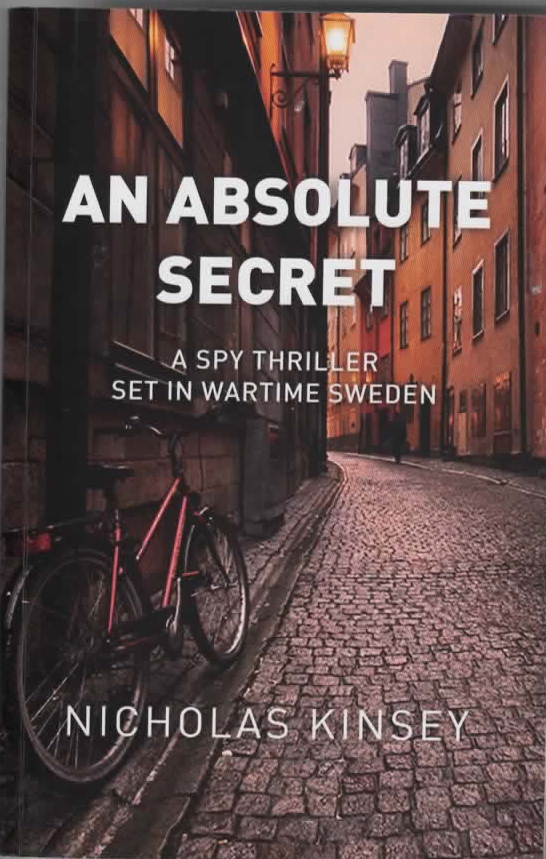
During my researches into the Kraemer business, my attention was drawn somehow to a book titled An Absolute Secret, by Nicholas Kinsey. It was heralded as ‘A Spy Thriller Set in Wartime Sweden’, and the blurb clearly informed me that it revolved around the activities of an Austrian maid sneaking out documents belonging to the Abwehr officer. Thus, despite my antipathy for novels that loosely borrow real characters from the intelligence world, and then construct fanciful plots around them, I felt I should give this one the lookover. I consequently bought it and read it.
Now, if the idea of a novel including the following cast of characters – familiar to coldspur readers – is appealing, An Absolute Secret is one for you. You will encounter Peter Falk (disguised as Peter Faye), Sir Victor Mallet, Anthony Blunt, Jane Archer, Count Bernadotte, Karl-Heinz Kraemer, Walter Schellenberg, Heinrich Müller, Wilhelm Canaris, Heinrich Himmler, Alexandra Kollontai, Vadim and Evdokia Petrov (with the latter as a Rosa Klebb-type figure), Reino Hallamaa, Wikho Tikander, and Makoto Onodera, with persons such as Ursula Kucsynski, Guy Liddell and Roger Hollis (inevitably portrayed as ELLI) operating just off-stage. In fact, the real model for Rosa Klebb, Vera Rybkina (née Voskenskaya), also known as Madame Yartseva, was the highly influential NKVD boss in Stockholm, and is recorded as consorting with Peter Tennant *. (See also https://coldspur.com/special-bulletin-the-airmen-who-died-twice-part-3/.) The author admits that he was inspired by Hugh Thomas’ ‘investigative work’ The Strange Death of Heinrich Himmler, while claiming that ‘solid historical research went into writing the novel’.
(* For those readers who like this sort of gossip, I offer a quotation from Touchlines of War, page 254. Tennant described the Yartsev couple in the following terms: “We made formal contact with our opposite numbers, mine being Madame Jartseva, an ample lady of the dimensions of Hattie Jacques but with straight dark hair parted in the middle with a bun, whose lips occasionally flickered into a smile. Her husband was the Commercial Counsellor, a decorous version of George Formby.”)
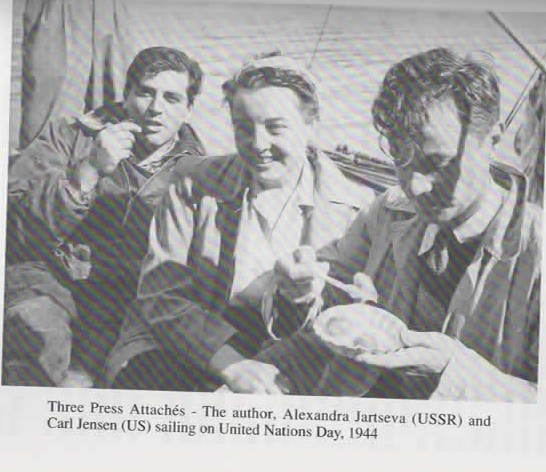
It is pure hokum – reasonably enjoyable hokum, I suppose, if you suspend your disbelief, but still hokum, with SOE and SIS agents getting involved in gunfights with both the Nazis and the Reds, and escaping (mainly) unscathed. I wondered where the plot was leading to, the attempt to merge in Bernadotte’s attempts to rescue Scandinavians from German prison camps was clumsily executed, and the ending is weak. I suppose there is a market for stuff like this, but for anyone who is only vaguely familiar with the activities of MI5, MI6, SOE, the Gestapo and the NKVD during this period, the tale must be less than riveting. The author admits in his ‘Historical Notes’ that ‘to facilitate the telling of the story, I have folded the events between August 1943 and May 1945 into a single year and have given myself some liberty with the dates’. But those were not the only liberties he took.
I imagine part of my distaste is that I find the conflicts, ambitions and betrayals of the real ‘secret world’ far more fascinating than the kidnappings and gunfights imposed on characters borrowed from history, where the novelist feels free to plot however he or she likes without regard to the truth. Of course the historian has to be far more careful when investigating the contradictions and complexities of the world of espionage. Divining motivations and psychology of key actors is a speculative business, and thus one has to dig behind the archives, the memoirs and the reminiscences offered to biographers to postulate what really happened when there is no clear evidence. And yet so many phenomena seem inarguable: the rivalry between Dansey and Vivian, Blunt’s deception of White, White’s betrayal of Hollis, the lack of confiding in lower officers by the MI5 high-ups, Burgess’ desire to have Rees killed, Rees’s lying, Philby’s lying, the scheming to let Burgess and Maclean escape, the probably bigamy of Philby, the games over Blunt’s ‘confession’, etc., etc. I should also include the cover-ups of the PROSPER disaster, the PB416 crash, and the debacle at Arnhem.
The Library Project
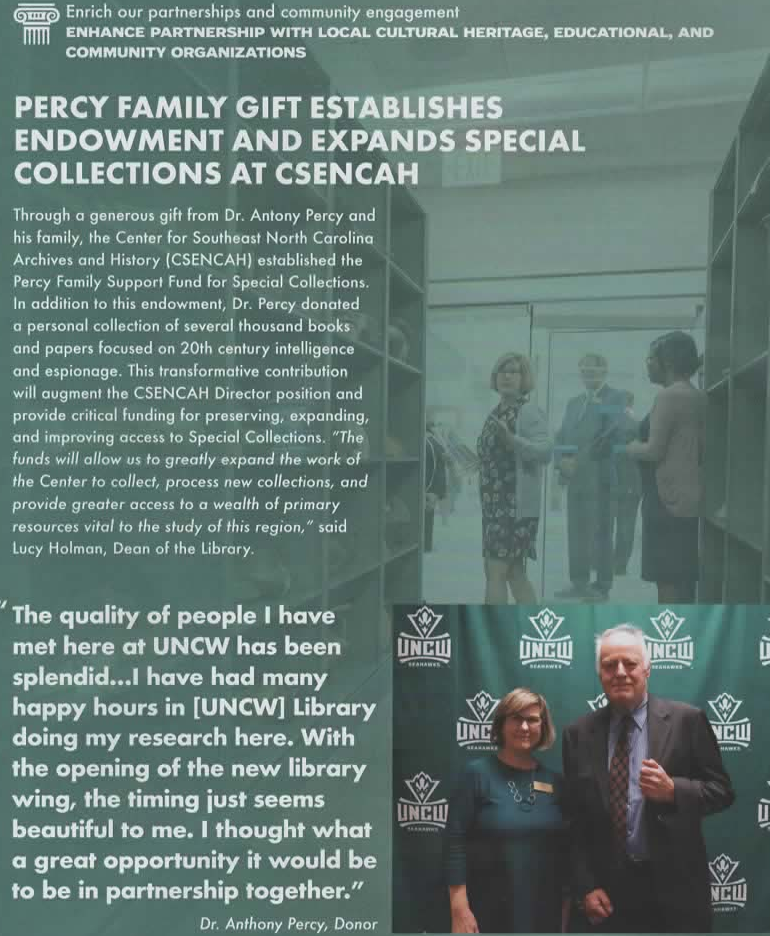
Finally, I have to report on the state of my library, and its transfer to the University of North Carolina in Wilmington. Over 5,000 books have now been transported to the Special Collections, and are being recorded and indexed. I am down to my ‘core’ of books on intelligence and espionage – about 1,200, I reckon – and a residue of various paperbacks (fiction and non-fiction, including many Pelicans), as well as esoterica (humour, games, crosswords, bridge, chess, etc.) in which the Library is not interested. The final removal will take place in September, after which, of course, if I need to perform research on any of my volumes, I shall have to drive the forty-odd miles to Wilmington for a day’s work.
This summer I shall start cataloguing all my archival material (magazines, articles, clippings, letters and memorabilia, etc.), and I shall try to bring some order to all the electronic information on my PC. What all this means, of course, is that a sudden shift in coldspur publication will probably take place towards the end of the year, when my conventional intensive research will have to be replaced by more superficial observations (“What? Do I hear shouts of jubilation in the back row?”), and maybe content of a more biographical nature. I have some projects unfulfilled, but that reality will just have to be accepted. My primary goal was to find a home for my library instead of its being dismantled, and that end is in sight.
This last month, I was suddenly struck by the dilemma that many other kindred spirits of intelligence enthusiasts are facing in deciding how to dispose of their libraries. I am a member of an SOE on-line chat-group, and I read how difficult it was for owners of valuable collections (mainly in the UK) to find a university or other institution to accept their assemblies of valuable books. Charity-shops, or the dump, seemed to be the likely destiny of such paper. I accordingly posted a note to the group that ran as follows:
“I empathize with all those members wondering what is going to happen to their carefully assembled collections of books and archival material.
A few years ago, I decided that I did not want my extensive collection to be fragmented and strewn to the four corners, and that its value consisted in its being maintained as a whole. After some investigation, I set up a Foundation with the University of North Carolina in Wilmington. UNCW had a background in intelligence matters. I realized, however, that it would need a stimulus to house, organize, catalogue, index, and promote my collection of 7000+ books and papers (as well as some significant electronic items). The outcome was excellent (see attached). I believe that my collection of books on intelligence history, comprising volumes in British, American, French, German, and Russian, as well as archival material consisting of magazines, letters, etc., will be the finest in the United States – possibly in the world – and a magnet for researchers from around the globe.
To date, about 5,000 books have been transported to the Centre in Wilmington (about forty miles away from where I live). The residual core of 1,200 or so intelligence and espionage titles will be moved from my library in September. By December I hope that a full catalogue of inventory will be available on-line.
Thus I appeal to any members who are looking for a good home for their treasured items – hang on! Rather than have them dispatched to a charity shop, please consider donating them to the Percy Family Special Collection when you can determine that it is missing an important work that you own. Donations will obviously be very welcome, but I shall also be investigating setting up a Fund to purchase items that would really benefit my collection.
You will be able to find occasional updates on the scheme at my website, http://www.coldspur.com, or you can contact me directly at antonypercy@aol.com.
The books will survive! The electronic versions may not.
Thank you.
Tony.”
I know that this does not completely address the problem, but I am hopeful that the Collection may be able to gain in this way some important items that I never got round to acquiring, and that donors (or sellers) will feel some gratification that they have been able to contribute to a unique institution. I shall follow up with more details about the scheme.
Lastly, as my swansong, I shall be giving a talk on September 1 on behalf of the Osher Life-Long Learning Institute at the University, titled ‘The Secrets Behind the Atom Spies’. This will consist of a packaging of my recent research on VENONA, highlighting the way that the atom spies (primarily the Rosenbergs, Fuchs, and Maclean) were each brought to their individual judicial outcomes (or not) through the decryption of Soviet cables. A story with a nice Anglo-American flavour, and probably a subject whose details may by now have eluded many more senior citizens, and which will probably be utterly fresh to a new generation. Moreover, it will include some cautionary and topical messages about totalitarian regimes trying to steal secrets, as well as some mildly barbed comments about the government owners of information hanging too long on to facts that the public deserves to know.
(Recent Commonplace Entries can be seen here.)